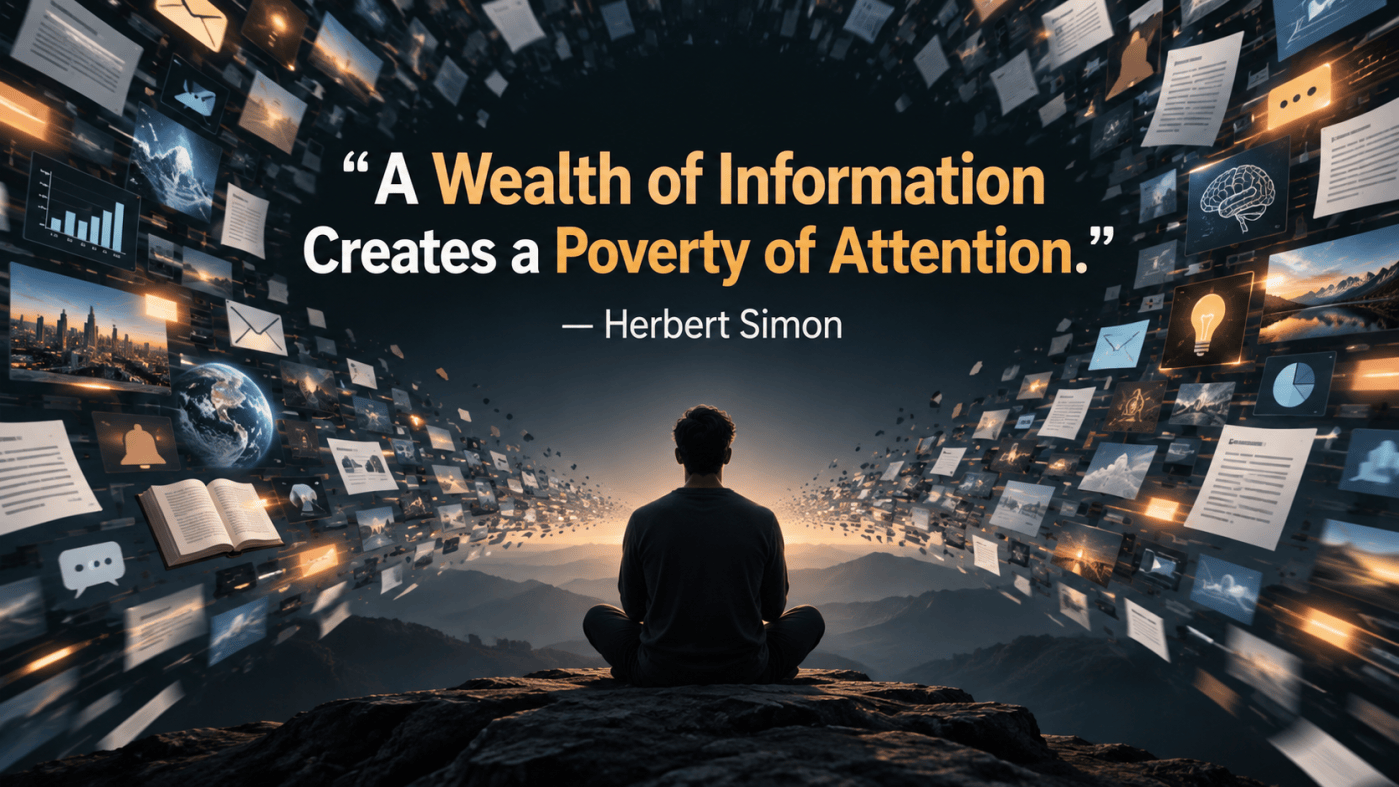
A trusted partner said something to me on LinkedIn today that stopped me cold—not because it was flashy, but because it named a real problem of our moment.
In a time when endless information is free and figuring out what to act on is hard, I believe organizing & operationalizing the truly good stuff is a must. I am on a mission to produce the world’s largest, high-trust, free resource library for commercial and industrial consumers. Energy isn’t getting cheaper and at the moment, it’s not becoming more abundant relative to demand growth. So, half my time now goes to this mission. Half. That’s how I’m doing it.
Daniel Burke, co-founder and CEO of Tactical Energy Group, in a LinkedIn conversation
That phrase—organizing and operationalizing the truly good stuff—brought me back to what I learned years ago from Peter Drucker. The shortage is rarely raw information. The shortage is disciplined attention, trusted judgment and the willingness to convert knowledge into action.
Information is abundant. Judgment is scarce.
Drucker saw the knowledge economy coming long before the rest of us had browser tabs multiplying across three monitors. In 1959, he coined the term “knowledge work.” In The Age of Discontinuity, published in 1968, he anticipated that cheap, fast and universally available information would transform society as profoundly as electricity. The Drucker Institute’s account of his work also emphasizes the habit that made his counsel so bracing: stop merely making plans and start taking action.
That is the bridge between Drucker and Daniel’s mission. A resource library is not valuable because it is large. The internet is already large. It becomes valuable when someone with experience filters the noise, supplies context, organizes what survives scrutiny and helps another person make a better decision.
A trusted network does something an algorithm cannot reliably do on its own: it puts reputation on the line. It says, “I have looked at this. I understand the operating reality. This deserves your limited attention.” Trust is not a decorative layer added after the content is assembled. Trust is the architecture.
Curation is a form of operational leadership
We sometimes talk about curation as though it were collecting—saving another link, filling another folder, building another database. But serious curation is closer to management. It requires choices:
- What is reliable enough to include?
- What is useful to a plant manager, facility leader or operations executive?
- What context turns a technical fact into a practical decision?
- What should be ignored, even if it is popular?
- What must happen next?
Drucker’s distinction between efficiency and effectiveness still matters here: doing things right is not the same as doing the right things. His writing on priorities is equally sharp. If we allow pressure to choose our agenda, the important work gets sacrificed—and the hardest part, converting a decision into action, never happens. The Drucker Institute’s adaptation of Priorities and Posteriorities makes that point plainly.
Organizing the good stuff is therefore not clerical work. Operationalizing it is not an afterthought. Together, they are the work of helping people decide what deserves priority—and then making the next move possible.
“Half” is the sentence that matters
Daniel’s ambition is enormous: the world’s largest high-trust, free resource library for commercial and industrial energy consumers. But the line I keep returning to is shorter: “So, half my time now goes to this mission. Half.”
Most missions fail in the calendar before they fail in the marketplace. We say something matters, then give it whatever time remains after meetings, messages and emergencies consume the day. Daniel has reversed the equation. He has attached a real allocation to the priority.
That matters especially in energy. Commercial and industrial consumers face decisions with long consequences: equipment choices, resilience, power quality, demand, maintenance, capital planning and the cost of getting any of them wrong. Energy is not getting simpler. Demand is not politely waiting for supply to catch up. In that environment, credible guidance that is free, structured and designed for action is not “content.” It is infrastructure.
The new advantage is trusted compression
We do not need more information dumped at our feet. We need trusted compression: the right knowledge, selected by people who understand the field, organized around actual decisions and delivered with enough context to use.
That is what the best networks have always done. They reduce uncertainty without pretending to eliminate it. They connect expertise to need. They help us borrow one another’s eyes.
And perhaps that is the Drucker lesson worth carrying forward: knowledge becomes consequential only through contribution. The useful question is not, “How much information can we gather?” It is, “What can we help someone do better?”
Daniel Burke has answered with a mission—and with half his time. I find both the library and the commitment worth watching. Start with Energy Decision #33 and the conversation that sparked this reflection.
 Bright, Shiny Objects!
What do you think?