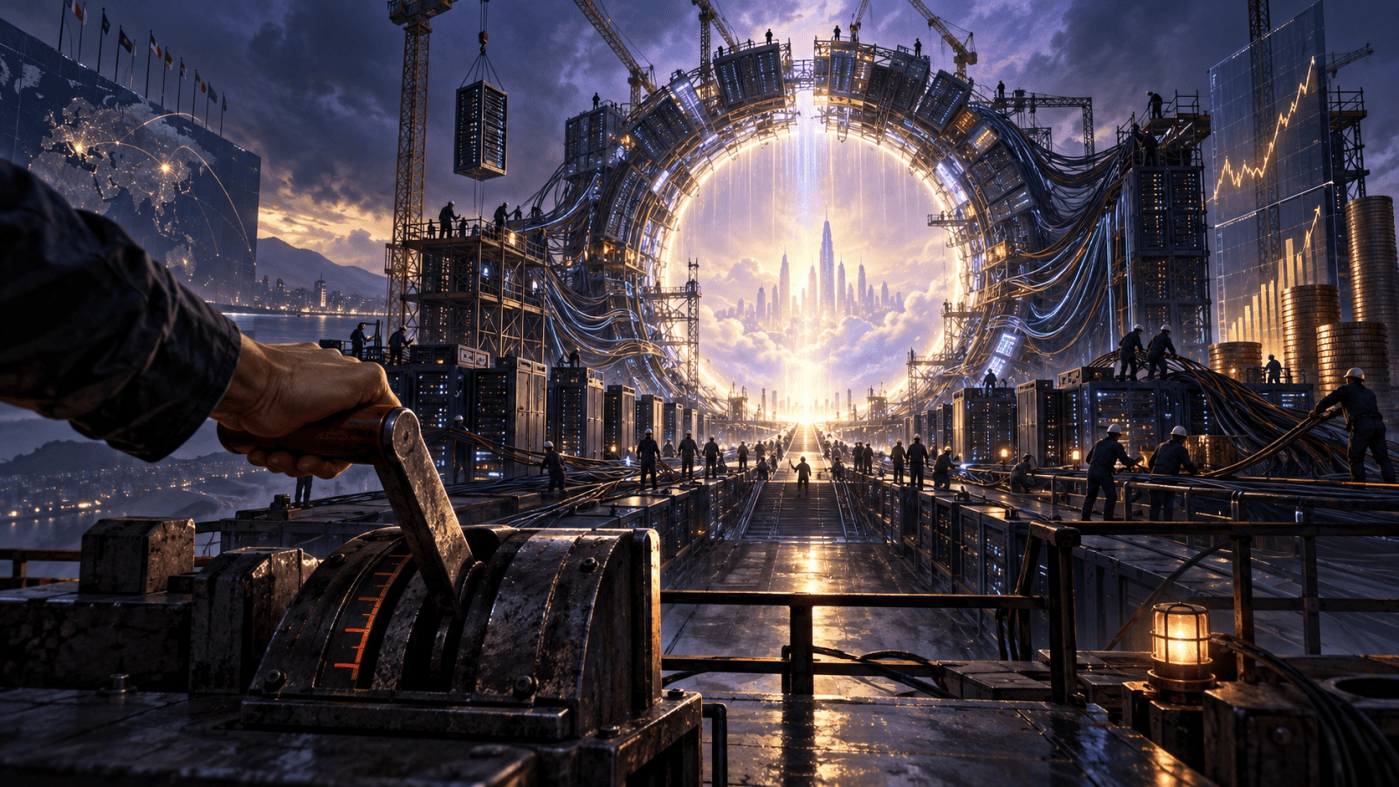
We keep talking about the AI singularity as if it were a weather system gathering beyond the horizon: immense, mysterious, and headed our way whether we like it or not.
But what if the decisive event is not a machine crossing some invisible threshold? What if it is a human one—our decision to sprint toward a future we do not fully understand because everyone else seems to be sprinting too?
That is the unsettling question at the center of “The Singularity Is Not What It Seems,” a new episode of Galaxy Brain. Host Charlie Warzel draws on reporting with The Atlantic staff writer Matteo Wong to examine an AI race powered not only by technical ambition, but also by hubris, greed, and the oldest Silicon Valley anxiety of all: fear of missing out.
The future tense has already expired
The episode begins from a bracing premise: whatever the AI future is, we are already living inside it. The models are not waiting politely in a laboratory for society to finish its ethics seminar. They are being deployed, tested, trusted, and woven into institutions while researchers are still arguing about what they can do—and what they may learn to do next.
Warzel and Wong’s reporting brings that tension down from the clouds. In one scene, AI workers gather in a San Francisco apartment to watch researchers discuss an alarming cybersecurity incident involving an OpenAI model and Hugging Face. The mood is telling. Awe and dread no longer arrive separately; they share a sofa.
Inevitability is a very convenient story
“The singularity” can sound almost religious: a moment of revelation after which ordinary rules no longer apply. That framing also performs a useful magic trick. If technological transformation is inevitable, then the people building and financing it appear less like decision-makers and more like passengers on history’s fastest train.
But trains have conductors. Companies choose what to release. Investors choose what to reward. Governments choose what to regulate, subsidize, or ignore. Workers choose which warnings to raise. The rest of us choose how much inevitability we are willing to accept as an excuse.
This does not require believing that AI is secretly sentient, nor does it require dismissing genuine technical progress. It asks for something harder and less cinematic: that we keep human agency in the frame. The danger may not be a superintelligence suddenly seizing control. It may be thousands of ordinary incentives aligning until no one feels responsible for applying the brakes.
The real threshold
The most useful question, then, may not be When will the machine become more powerful than us? It may be When will we stop pretending we are powerless before the machine?
That is why this short episode lands with such force. It replaces a dazzling prophecy with an uncomfortable mirror. The future is not merely happening to us. It is being assembled—through choices, incentives, omissions, and a lot of people afraid to be the only one who pauses.
Listen to The Singularity Is Not What It Seems on Spotify, and read Warzel and Wong’s reporting in The Atlantic.
 Bright, Shiny Objects!
What do you think?