“Selfish” is one of those words that arrives with its verdict already attached. We hear it and picture greed, entitlement, or someone taking the last slice without so much as a glance around the table.
But what if that reflexive condemnation causes us to confuse self-absorption with something essential: the ability to recognize and honor our own needs?
In “Honoring Thy Self: The Unsung Virtues of Selfishness,” clinical and forensic psychologist Stephen A. Diamond argues that some people do not need to become less selfish. They need to learn how to be selfish in the right way.
Some songs try to convince me that everything will be all right. George Harrison’s “All Things Must Pass” does something wiser: it reminds me that nothing stays the way it is.
Not happiness. Not heartbreak. Not youth, success, disappointment, friendship, love, grief—or even the darkest night.
That may sound melancholy, but the song has never felt depressing to me. I hear it as an act of consolation. George does not deny loss or decorate it with easy optimism. He simply places it inside a larger truth: whatever I am experiencing now will change. The difficult part of life is accepting that this applies to the things I treasure as well as the things I want to escape.
That emotional balance is one reason the song is so great. It mourns and reassures me at the same time.
A trusted partner said something to me on LinkedIn today that stopped me cold—not because it was flashy, but because it named a real problem of our moment.
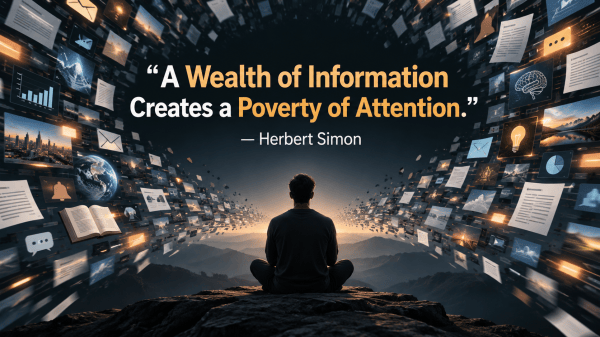
In a time when endless information is free and figuring out what to act on is hard, I believe organizing & operationalizing the truly good stuff is a must. I am on a mission to produce the world’s largest, high-trust, free resource library for commercial and industrial consumers. Energy isn’t getting cheaper and at the moment, it’s not becoming more abundant relative to demand growth. So, half my time now goes to this mission. Half. That’s how I’m doing it.
That phrase—organizing and operationalizing the truly good stuff—brought me back to what I learned years ago from Peter Drucker. The shortage is rarely raw information. The shortage is disciplined attention, trusted judgment and the willingness to convert knowledge into action.
Most of us don’t notice what holds our lives together. We notice the urgent email, the strange noise in the car, the person who disappoints us. We rarely notice the clean water, the functioning lungs, the patient friend, or the colleague who quietly keeps the whole enterprise from wobbling.
That isn’t simply ingratitude. It is also how attention works. Familiar, nonthreatening things fade into the background so we can respond to what is new. Habituation makes daily life possible—and, at the same time, makes it dangerously easy to forget what makes daily life possible.
We are pouring extraordinary amounts of money, electricity, infrastructure, and ambition into making artificial intelligence more capable. But how much are we investing in the people expected to use it wisely?
That imbalance sits at the heart of a provocative new essay in Psychology Today by Cornelia C. Walther. Her concern is not simply that AI is accelerating. It is that the human abilities AI is meant to extend—attention, memory, judgment, imagination, language, and agency—can weaken when assistance quietly becomes substitution.
That distinction matters. A tool can help us reach farther while still leaving us responsible for the reaching. But when the tool routinely remembers, drafts, interprets, and reasons for us, our role can shrink from creating thought to merely approving output.
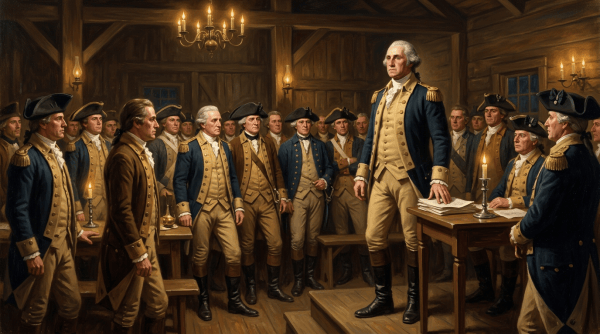
In March 1783, George Washington faced what may have been the most dangerous moment of his public life.
The Revolutionary War was essentially won, but the American experiment was anything but secure. Officers of the Continental Army were furious. Congress had failed to pay them what they were owed. Some were openly discussing whether the army should use its power to force Congress to act.
Washington walked into a meeting of those officers at Newburgh, New York.
He argued against military intervention. Then, near the end of his remarks, he pulled out a letter and struggled to read it. Washington reached into his pocket for a pair of spectacles.
“Gentlemen,” he told them, “you must pardon me, for I have not only grown gray but almost blind in the service of my country.”
Men who had endured years of war with him reportedly wept.
The conspiracy collapsed.
There are few moments that better illustrate George Washington’s conception of leadership. He possessed enormous power at that moment. His officers revered him. The national government was weak. History offered plenty of examples of victorious generals who had converted military glory into political power.
Washington chose restraint.
Nearly two and a half centuries later, Donald Trump offers Americans an extraordinarily different conception of strength.
And whatever one thinks of Trump politically, that contrast is worth examining.
Because this isn’t really a story about whether George Washington was a good man and Donald Trump is a bad one.
It is a story about what Americans believe character has to do with power.
That is a remarkable lifespan for a television idea—and an even more remarkable lifespan for a vision. For six decades, Star Trek has insisted that curiosity is stronger than fear, that cooperation is not naïve, and that humanity can become better than it is now.
I have enjoyed many corners of that universe, but when I think about what Star Trek means to me, I keep coming back to two captains: Jean-Luc Picard and Kathryn Janeway.
They are very different leaders. Picard is the diplomat-philosopher, measured and deliberate. Janeway is the scientist-explorer, warm but formidable, forced to improvise thousands of light-years from home. One commands the Federation flagship with the weight of civilization behind him. The other must preserve that civilization when almost everything familiar has fallen away.
Together, they offer two versions of the same enduring lesson: character matters most when the map runs out.
We keep talking about the AI singularity as if it were a weather system gathering beyond the horizon: immense, mysterious, and headed our way whether we like it or not.
But what if the decisive event is not a machine crossing some invisible threshold? What if it is a human one—our decision to sprint toward a future we do not fully understand because everyone else seems to be sprinting too?
That is the unsettling question at the center of “The Singularity Is Not What It Seems,” a new episode of Galaxy Brain. Host Charlie Warzel draws on reporting with The Atlantic staff writer Matteo Wong to examine an AI race powered not only by technical ambition, but also by hubris, greed, and the oldest Silicon Valley anxiety of all: fear of missing out.
There is a moment in every technological story when the argument shifts from What can it do? to What are we willing to let it do? OpenAI’s GPT-6 Astra may be that moment.
Axios reports that OpenAI president Greg Brockman called Astra a “generational leap” and said he personally believes the company has reached artificial general intelligence. The label will be debated for months. The practical change may arrive sooner: Astra is designed to operate inside software and complete complex professional tasks, not merely explain how a human might complete them.
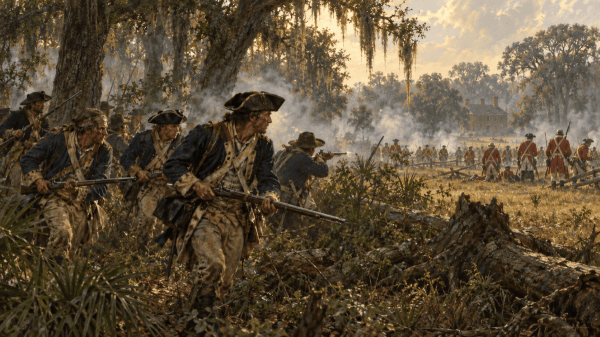
On September 8, 1781, two exhausted armies collided at Eutaw Springs, South Carolina, in one of the fiercest—and most revealing—battles of the American Revolution’s Southern Campaign.
Major General Nathanael Greene marched roughly 2,200 American troops toward a British camp commanded by Lieutenant Colonel Alexander Stewart. Greene had spent months refusing to let battlefield setbacks become strategic defeats. Again and again, he forced the British to spend men and supplies they could not easily replace.
The Americans struck early. Their militia gave way to Continental regulars, who drove much of the British line backward. For a moment, the Patriot attack seemed ready to sweep the field. Then the advance lost momentum. Some American soldiers stopped to plunder the British camp, while determined defenders rallied around a brick house and nearby garden. A British counterattack helped turn the tide.
By day’s end, Greene had withdrawn. The British held the field, so by the usual rules of eighteenth-century warfare they could claim victory. Yet their losses were punishing, and Stewart soon pulled his force closer to Charleston. The British had won the battle while losing more of their ability to control the South Carolina interior.
Many people stay in unhealthy or even abusive relationships because early experiences and lessons from their family teach them what to expect in relationships.
In the article “The Relationship Isn’t Right for You, but Why Do You Stay?” from Psychology Today, the author explores the reasons why individuals may remain in unhealthy or abusive relationships. It delves into how early life experiences and lessons learned from family can shape one’s expectations and perceptions of relationships, making it difficult to recognize when a relationship is detrimental. The insights provided encourage readers to reflect on their own relationship dynamics and the impact of their upbringing on their current situation.
The most important question isn’t whether students use AI. It’s what kinds of thinking schools still require them to do.
Coral PS Hoh argues that educators should divide the work deliberately: let AI extend students’ capacity while holding them accountable for critical, creative, strategic, and ethical judgment. That matters because literacy and math proficiency were already weak before generative AI—and increasingly specialized knowledge makes breakthrough connections harder to see.
A blanket ban may protect familiar assignments. It won’t prepare students for the problems they’ll inherit. Schools should teach students to question AI, justify their choices, expose errors, and use the tool without surrendering the thinking.
Retirement is often sold as a permanent vacation. The reality is richer—and messier.
Leaving full-time work can bring welcome freedom, but it can also unsettle the routines, relationships, identity, and sense of purpose that work quietly supplied.
Psychologist Jasmin Tahmaseb-McConatha offers a more honest frame: retirement is not a finish line but a process of rebuilding meaning. That means making room for both relief and grief, then creating a satisfying new reality one day at a time.
The most useful takeaway is wonderfully ordinary. A walk, coffee with a friend, a creative project, meaningful work, or a story shared across generations can become the architecture of a good day. These are not ways to fill time; they are ways to reclaim connection, contribution, and belonging.
Who am I now—and what still makes me feel useful, connected, and alive?
If retirement is approaching—or already feels less simple than advertised—this thoughtful essay is worth your time.
Gaslighting is a manipulative tactic that causes someone to doubt their perception and reality. The article “10 Signs That Someone Is Trying to Gaslight You” outlines key indicators that may suggest you are a target of such behavior. These signs include persistent denial of facts, emotional manipulation, and efforts to isolate the victim from support networks. Recognizing these behaviors is crucial for self-empowerment and protecting one’s mental health.
New Work Foundation is a registered 501(c)(3) nonprofit dedicated to equipping young workers in America with the tools, information, and skills to navigate an AI-reshaped economy.
The New Work Foundation offers various tools and resources for job seekers, including:
Career Workshops: Interactive sessions focused on building skills and understanding the job market.
Resume and Cover Letter Templates: Ready-to-use templates that help applicants present themselves effectively.
Interview Preparation Resources: Guides and tips to enhance interview skills and confidence.
Online Courses: Educational content on essential skills and industry trends relevant to today’s job market.
Networking Opportunities: Platforms to connect with industry professionals and mentors.
Job Boards: Listings of available positions tailored for young workers entering the job market.
Webinars and Podcasts: Insights from experts on navigating the modern workforce.
Perhaps the most useful tool on the website is a ‘field report‘ which is “an AI job explorer that helps grads understand the best careers for their major. Enter your field of study and explore roles by compensation, job listings, and AI exposure — so they can make smarter decisions about where to focus their energy.These resources aim to empower young workers to successfully secure employment in an AI-driven economy.”
If there’s ever a boring anniversary, I’ll skip it but that day is not this day!
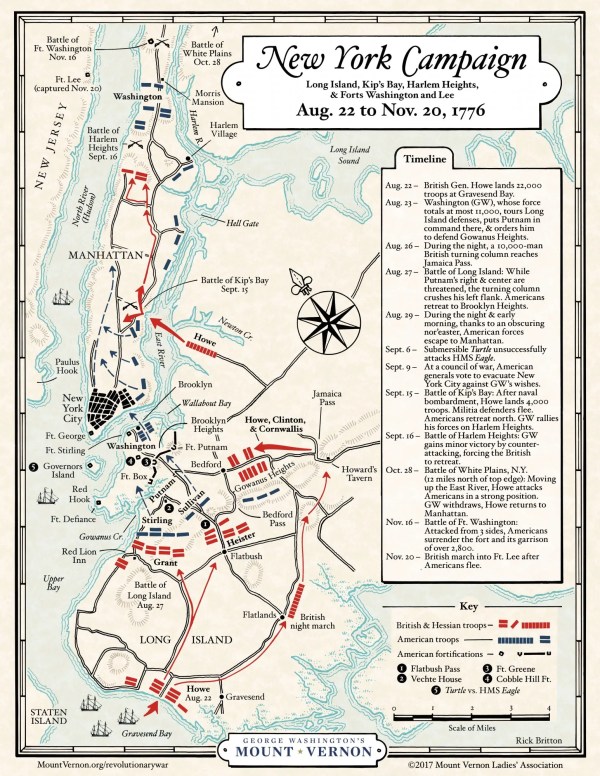
Tonight marks an especially good 250th anniversary. On the night of September 6–7, 1776, Sergeant Ezra Lee climbed into David Bushnell’s tiny hand-powered Turtle and set out into New York Harbor to attack HMS Eagle, Admiral Richard Howe’s flagship. Lee was unable to attach the explosive charge to the ship, but the attempt became the first known use of a submarine in combat. The U.S. Naval History and Heritage Command dates Turtle’s departure to the evening of September 6, and the Smithsonian published a substantial new article on the experiment just three days ago for its 250th anniversary. Naval History and Heritage Command
There’s a neat commemorative connection today, too: Warrenton, Georgia, where Bushnell lived late in life under the name David Bush, is holding a 250th-anniversary Turtle commemoration and wreath-laying today, September 6, 2026. Explore Georgia
Then, September 6, 1781, brought one of the Revolution’s darkest final battles. Benedict Arnold, now fighting for Britain, led roughly 1,600 British troops against his native Connecticut. New London was burned, while across the Thames River British troops stormed Fort Griswold at Groton Heights. After the fort fell, many American defenders were killed after surrendering; their commander, Lt. Col. William Ledyard, was among the dead. The attack came only about six weeks before Cornwallis surrendered at Yorktown. Fort Griswold
And that battle is being remembered today as well: Fort Griswold is holding its 245th-anniversary commemoration this evening, extinguishing candles one by one as the names of the fallen are read. Greater Mystic Chamber of Commerce
So September 6 gives us an extraordinary Revolutionary pairing: 1776 — Americans experiment with the future of warfare beneath New York Harbor. 1781 — Benedict Arnold returns home at the head of a British invasion force.
Conspiracy theories aren’t always immune to evidence—they may simply require the right evidence, delivered clearly and respectfully.
A new study found that an AI chatbot offering personalized, fact-based responses reduced participants’ confidence in conspiracy theories by about 20 percent on average. Remarkably, the change persisted two months later, even among people whose beliefs had initially been strong.
The findings challenge the assumption that reasoning with conspiracy believers is futile. They also suggest that listening closely, addressing someone’s specific claims, and responding without ridicule may be more effective than presenting a generic fact-check.
Cats’ intelligence and sociability are difficult to test, but new findings are increasing our understanding.
Cats are often misunderstood when it comes to their intelligence and sociability. Recent studies have provided new insights that challenge common perceptions, revealing complexities in feline behavior and cognition. These findings highlight the unique ways in which cats interact with their environment and humans, prompting a reevaluation of their capabilities.
To delve deeper into this intriguing subject, we encourage you to read the original article What About Cats?. It’s a fascinating exploration that sheds light on the true nature of our feline companions!
250 years ago today, September 4, 1776, George Washington was trying to rebuild discipline in an army still reeling from the Battle of Brooklyn. With the British poised to strike again, Washington was alarmed that soldiers were wandering away from their units. He ordered commanders to keep their men close, conduct roll calls three times daily, punish unauthorized absences, and stop the plundering of homes, orchards and gardens. In a remarkable letter to Colonel Fisher Gay, Washington warned that “the safety of the Army, & the good of the Cause” depended on vigilance and discipline. (Founders Online)
At the same time, Washington was quietly preparing for the possibility that Manhattan might have to be abandoned. He informed John Hancock that unnecessary military stores were being moved north of King’s Bridge so they would not be lost if the Continental Army had to retreat. Mount Vernon is highlighting this exact episode today as part of its “On This Day 250 Years Ago” series. (Mount Vernon Ladies’ Association)
September 4, 1778 also marked the opening movement of Grey’s Raid. Major General Charles Grey’s British expedition sailed into Buzzards Bay and landed near New Bedford that evening. During the ensuing raid, British troops devastated American shipping, warehouses and supplies—a reminder that the Revolution was also an economic war fought against ports supporting privateers and the Continental cause. (Revolutionary War) A recent New Bedford historical investigation notes that the raid remains surprisingly little commemorated locally, though plans are already developing for its 250th anniversary in 2028. (The New Bedford Light)
The thread connecting today’s events: in September 1776, Washington was learning that preserving his army mattered more than holding ground. Two years later, Britain was increasingly trying to damage the American war effort by striking the communities and commerce that sustained it.
The article “Why the Flock Backlash Has Gotten So Intense” from The Atlantic explores the growing public outcry against the use of surveillance technology, particularly Flock Safety’s automated license plate reader cameras. It delves into the reasons behind the backlash, including concerns over privacy, data security, and the potential for misuse of the technology. As communities grapple with the implications of such surveillance tools, the discussion highlights the balance between safety and civil liberties.
To gain deeper insights into this critical issue and understand the different perspectives involved, I encourage you to read the full article: Why the Flock Backlash Has Gotten So Intense
















 Bright, Shiny Objects!
You must be logged in to post a comment.