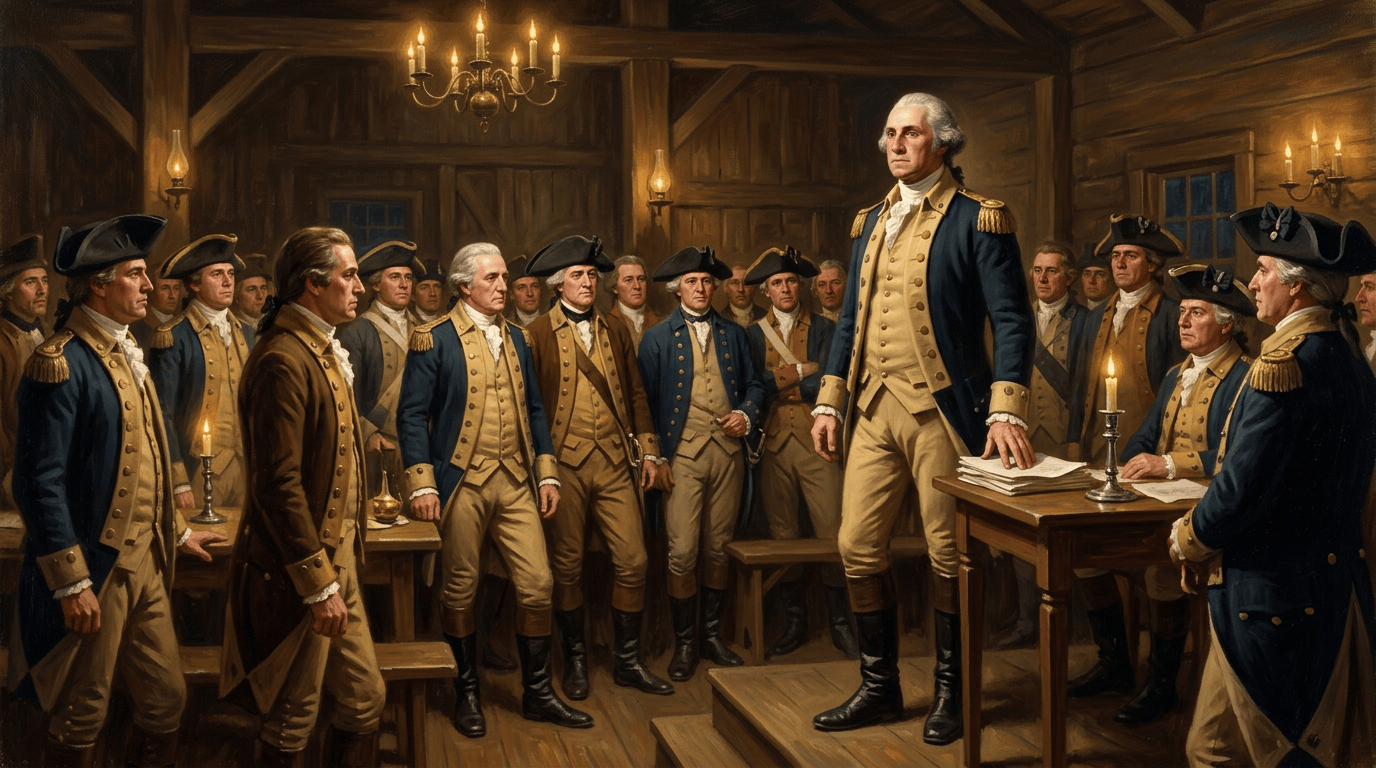
In March 1783, George Washington faced what may have been the most dangerous moment of his public life.
The Revolutionary War was essentially won, but the American experiment was anything but secure. Officers of the Continental Army were furious. Congress had failed to pay them what they were owed. Some were openly discussing whether the army should use its power to force Congress to act.
Washington walked into a meeting of those officers at Newburgh, New York.
He argued against military intervention. Then, near the end of his remarks, he pulled out a letter and struggled to read it. Washington reached into his pocket for a pair of spectacles.
“Gentlemen,” he told them, “you must pardon me, for I have not only grown gray but almost blind in the service of my country.”
Men who had endured years of war with him reportedly wept.
The conspiracy collapsed.
There are few moments that better illustrate George Washington’s conception of leadership. He possessed enormous power at that moment. His officers revered him. The national government was weak. History offered plenty of examples of victorious generals who had converted military glory into political power.
Washington chose restraint.
Nearly two and a half centuries later, Donald Trump offers Americans an extraordinarily different conception of strength.
And whatever one thinks of Trump politically, that contrast is worth examining.
Because this isn’t really a story about whether George Washington was a good man and Donald Trump is a bad one.
It is a story about what Americans believe character has to do with power.
Washington Was Not the Marble Man
We have made George Washington almost impossible to understand by turning him into a monument.
The Washington of statues and dollar bills appears serene, humorless and nearly devoid of ordinary human passions.
The actual Washington was considerably more interesting.
He was ambitious.
He cared deeply about his reputation.
He enjoyed wealth, fine clothes, good horses and the social status of Virginia’s planter elite. As a young officer, he actively sought advancement. He could be remarkably sensitive to criticism.
And Washington had a temper.
People who witnessed it remembered it.
Thomas Jefferson once described Washington becoming so angry during a Cabinet meeting that he erupted in fury over attacks against his administration.
This wasn’t a man who lacked powerful emotions.
What distinguished Washington was his belief that a leader was responsible for mastering them.
That distinction matters.
Washington’s greatness did not come from the absence of ego.
It came, in significant measure, from his repeated willingness to subordinate ego to something larger.
Trump Makes a Different Argument
Donald Trump has built his political identity around almost the opposite proposition.
Trump rarely attempts to conceal his appetites, resentments or ambitions.
He attacks people who attack him.
He gives opponents nicknames.
He boasts about victories.
He complains publicly about perceived betrayals.
He demands loyalty and frequently responds to criticism personally.
Traditional political culture regarded many of these behaviors as weaknesses to be hidden.
Trump transformed them into evidence of authenticity.
That transformation is one of the most important political developments of the modern era.
To millions of supporters, Trump’s refusal to restrain himself is precisely the point.
They don’t necessarily see an undisciplined politician.
They see a politician who refuses to submit.
When Trump violates a political convention, supporters often interpret the violation as proof that the convention itself was illegitimate.
When he attacks institutions, they may see someone finally willing to confront institutions they no longer trust.
When he refuses to apologize, they may see strength rather than stubbornness.
Trump therefore offers a fundamentally different definition of leadership:
Strength is demonstrated by fighting.
Washington’s definition was closer to:
Strength is demonstrated by knowing when not to fight.
Two Men Obsessed With Reputation
And yet the comparison becomes more interesting when we stop looking only at their differences.
Washington and Trump share something important.
Both understood the enormous power of public image.
Washington carefully managed his reputation throughout his life. His clothing, posture, correspondence, public appearances and even his silences contributed to the image he wished to project.
He understood something modern politicians understand instinctively: leadership is partly theater.
Trump understands this perhaps better than any American politician of his generation.
The rallies.
The red hats.
The entrances.
The slogans.
The gold.
The photographs.
The nicknames.
The unmistakable speaking style.
None of it is accidental.
Washington constructed the image of the republican Cincinnatus—the victorious soldier willing to return to his farm.
Trump constructed the image of the billionaire fighter who walks into a corrupt system and refuses to play by its rules.
Both are political characters.
Both contain elements of the actual men.
And both became larger than the men themselves.
The Most Important Thing Washington Ever Did
Washington won battles.
He presided over the Constitutional Convention.
He became the first president.
But arguably the most important thing George Washington ever did was something much simpler.
He went home.
Twice.
In December 1783, after the Treaty of Paris formally ended the Revolutionary War, Washington appeared before Congress in Annapolis and resigned his commission as commander in chief.
Then he returned to Mount Vernon.
King George III reportedly expressed astonishment at the possibility that Washington would surrender power, supposedly remarking that if Washington really did so, he would be “the greatest man in the world.”
Whether the quotation reached us exactly as spoken is less important than why generations repeated it.
People understood how unusual Washington’s act was.
Then he did it again.
After serving two terms as president, Washington could almost certainly have remained in office.
Instead, he left.
Again.
That decision established one of the most powerful traditions in American political culture: holding power temporarily could itself be evidence of greatness.
The voluntary surrender of power became part of the American definition of legitimate leadership.
And This Is Where Trump Becomes Historically Interesting
Donald Trump’s relationship with that tradition is fundamentally different.
Trump’s political career has repeatedly challenged the assumption that restraint validates authority.
His instinct is generally to push.
Push against opponents.
Push against institutions.
Push against unfavorable election results.
Push against prosecutors.
Push against judges.
Push against journalists.
Push against members of his own party.
Sometimes institutions push back.
Sometimes they yield.
But Trump keeps testing the boundary.
And that raises a question much bigger than Donald Trump:
How much of the American political system depends upon leaders voluntarily restraining themselves?
The Constitution contains rules.
But every political system also contains customs.
Presidents traditionally observed countless limitations not because a statute explicitly required them but because previous presidents had established expectations about how the office should behave.
Washington helped create that culture.
Trump has exposed how much of it depends upon voluntary compliance.
That may ultimately be one of his most important historical legacies.
January 6 Makes the Comparison Unavoidable
There is no intellectually serious way to compare Washington and Trump on the subject of political power without confronting January 6, 2021.
Trump maintained that the 2020 election had been stolen and pursued multiple avenues to overturn or prevent certification of the result. Courts repeatedly rejected challenges to the outcome, and state officials certified Joe Biden’s victory.
On January 6, a mob attacked the Capitol while Congress was meeting to count the electoral votes.
Trump’s defenders and critics continue to argue fiercely over responsibility, intent and the meaning of his actions that day.
But for the purposes of comparing presidential character, something broader matters.
George Washington became an American archetype partly because he established that political legitimacy requires accepting limits on personal power.
The peaceful transfer of presidential authority became an extension of that principle.
January 6 demonstrated that Americans no longer universally agree about how that principle should operate—or whom they should trust to determine when it has been violated.
That is a profound change.
Maybe This Isn’t Really About Washington or Trump
And perhaps that’s the most uncomfortable conclusion.
Presidents don’t simply impose their conception of leadership upon the country.
The country chooses them.
Washington’s generation desperately feared monarchy, standing armies and concentrated power. Americans had just fought a revolution against a king.
Their ideal leader was therefore a man powerful enough to govern but virtuous enough to surrender power.
Our political culture is different.
Many Americans today believe institutions themselves have become corrupt, unresponsive or hostile to ordinary citizens.
In that environment, restraint can look less like virtue and more like weakness.
Compromise can look like surrender.
Norms can look like tricks designed by insiders.
And a leader who promises to smash through those restraints can look heroic.
That doesn’t explain every Trump voter.
It doesn’t excuse every Trump action.
But it helps explain why Trump’s conception of strength resonates with millions of Americans.
He did not invent the demand for that kind of leader.
He discovered it.
The Question Washington Still Asks Us
George Washington died in 1799.
Donald Trump’s final historical reputation will not be written for decades.
But placing the two men beside each other reveals something worth considering.
Washington possessed ambition but cultivated restraint.
Trump possesses ambition and celebrates combativeness.
Washington demonstrated power by surrendering it.
Trump frequently demonstrates power by refusing to yield.
Washington worried that his behavior would create precedents.
Trump often asks why precedent should constrain him at all.
Perhaps neither man can be understood apart from the America that elevated him.
And perhaps that’s why comparing them is more useful than simply ranking them.
The question isn’t whether modern America could produce another George Washington.
The more interesting question is whether modern America would want one.
Would we recognize restraint as strength?
Would we admire a politician who declined to exploit every available advantage?
Would we reward someone for walking away from power?
Or have we reached a moment when leadership means never backing down, never admitting defeat and never leaving the battlefield voluntarily?
Washington believed the survival of the republic ultimately depended upon something the Constitution could not guarantee: character.
Not brilliance.
Not popularity.
Not even patriotism alone.
Self-command.
The ability of a person entrusted with enormous power to decide that possessing the power to do something does not necessarily mean it should be done.
More than two centuries later, Donald Trump has forced Americans to reconsider that proposition.
And the answer we give may ultimately tell historians considerably more about us than it does about either man.
 Bright, Shiny Objects!
What do you think?