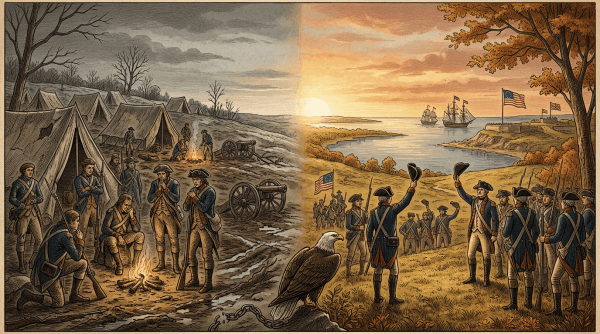
Submarine and Yellow

Today in Revolutionary War History — September 6

If there’s ever a boring anniversary, I’ll skip it but that day is not this day!

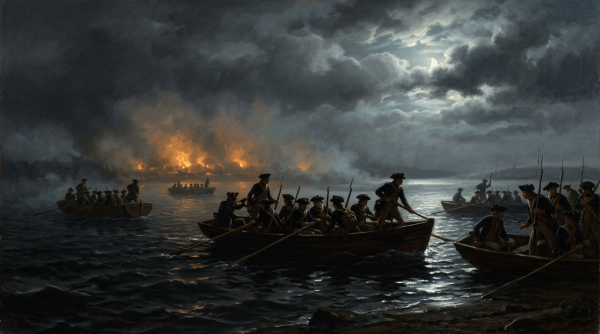
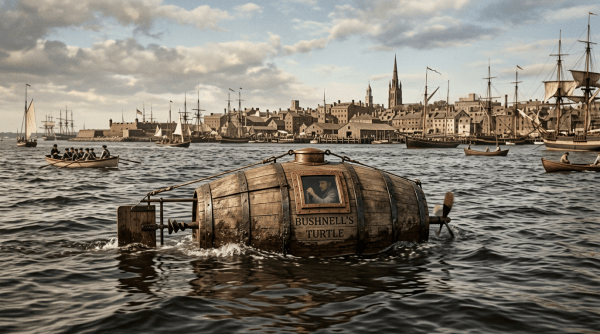
Tonight marks an especially good 250th anniversary. On the night of September 6–7, 1776, Sergeant Ezra Lee climbed into David Bushnell’s tiny hand-powered Turtle and set out into New York Harbor to attack HMS Eagle, Admiral Richard Howe’s flagship. Lee was unable to attach the explosive charge to the ship, but the attempt became the first known use of a submarine in combat. The U.S. Naval History and Heritage Command dates Turtle’s departure to the evening of September 6, and the Smithsonian published a substantial new article on the experiment just three days ago for its 250th anniversary. Naval History and Heritage Command

There’s a neat commemorative connection today, too: Warrenton, Georgia, where Bushnell lived late in life under the name David Bush, is holding a 250th-anniversary Turtle commemoration and wreath-laying today, September 6, 2026. Explore Georgia

Then, September 6, 1781, brought one of the Revolution’s darkest final battles. Benedict Arnold, now fighting for Britain, led roughly 1,600 British troops against his native Connecticut. New London was burned, while across the Thames River British troops stormed Fort Griswold at Groton Heights. After the fort fell, many American defenders were killed after surrendering; their commander, Lt. Col. William Ledyard, was among the dead. The attack came only about six weeks before Cornwallis surrendered at Yorktown. Fort Griswold

And that battle is being remembered today as well: Fort Griswold is holding its 245th-anniversary commemoration this evening, extinguishing candles one by one as the names of the fallen are read. Greater Mystic Chamber of Commerce

So September 6 gives us an extraordinary Revolutionary pairing: 1776 — Americans experiment with the future of warfare beneath New York Harbor. 1781 — Benedict Arnold returns home at the head of a British invasion force.
Living to Fight Another Day

Today in Revolutionary War History — September 4

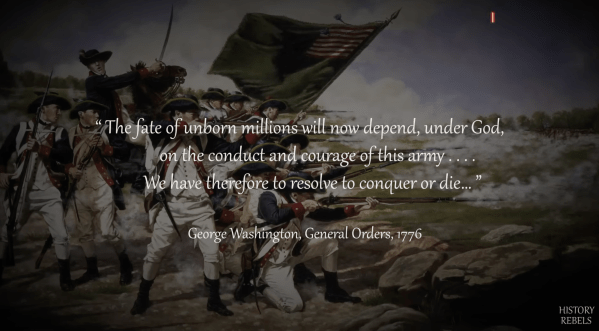
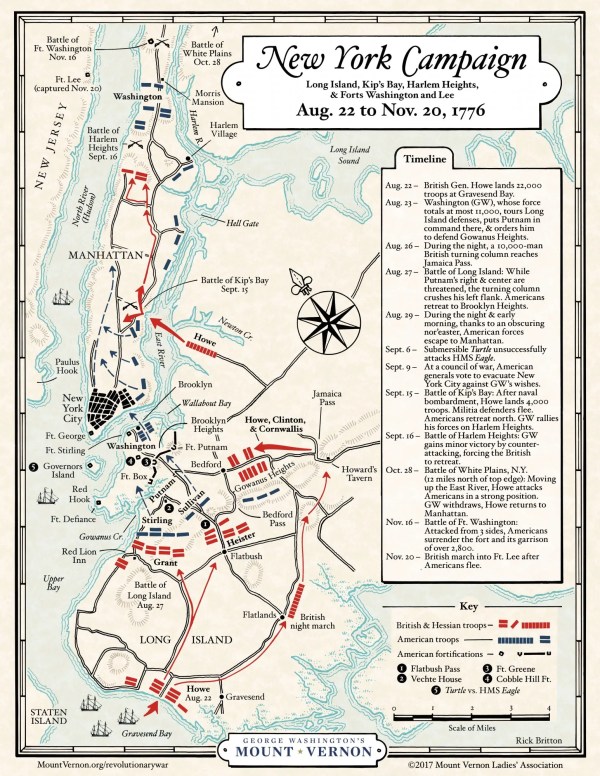
250 years ago today, September 4, 1776, George Washington was trying to rebuild discipline in an army still reeling from the Battle of Brooklyn. With the British poised to strike again, Washington was alarmed that soldiers were wandering away from their units. He ordered commanders to keep their men close, conduct roll calls three times daily, punish unauthorized absences, and stop the plundering of homes, orchards and gardens. In a remarkable letter to Colonel Fisher Gay, Washington warned that “the safety of the Army, & the good of the Cause” depended on vigilance and discipline. (Founders Online)

At the same time, Washington was quietly preparing for the possibility that Manhattan might have to be abandoned. He informed John Hancock that unnecessary military stores were being moved north of King’s Bridge so they would not be lost if the Continental Army had to retreat. Mount Vernon is highlighting this exact episode today as part of its “On This Day 250 Years Ago” series. (Mount Vernon Ladies’ Association)

September 4, 1778 also marked the opening movement of Grey’s Raid. Major General Charles Grey’s British expedition sailed into Buzzards Bay and landed near New Bedford that evening. During the ensuing raid, British troops devastated American shipping, warehouses and supplies—a reminder that the Revolution was also an economic war fought against ports supporting privateers and the Continental cause. (Revolutionary War) A recent New Bedford historical investigation notes that the raid remains surprisingly little commemorated locally, though plans are already developing for its 250th anniversary in 2028. (The New Bedford Light)

The thread connecting today’s events: in September 1776, Washington was learning that preserving his army mattered more than holding ground. Two years later, Britain was increasingly trying to damage the American war effort by striking the communities and commerce that sustained it.

The Difference that 7 Years Makes

Today in Revolutionary War History — September 3

Today gives us two excellent anniversaries—one exactly 250 years ago, and one that ultimately finished the Revolution.

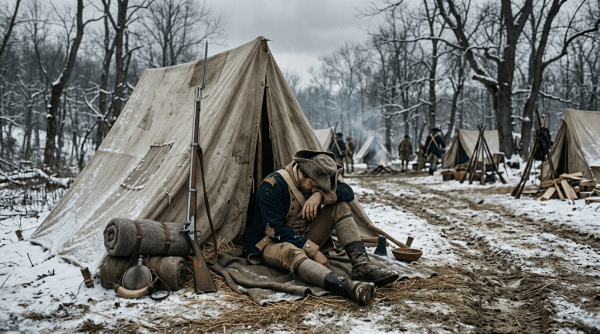
September 3, 1776 — Washington tries to restore his battered army. Just a week after the Battle of Brooklyn, Washington’s army around New York was in rough shape. General William Heath reported that soldiers who had suffered most on Long Island were “much Dispirited” after losing officers, blankets and other possessions. Some lacked money, and sickness was becoming a problem. (founders.archives.gov)

Washington’s general orders that day reveal his concern about something even more dangerous: the army’s discipline was beginning to crack. He condemned recent incidents of cowardice, plundering and rioting and warned that stealing abandoned property could bring about the “ruin of any Army.” (founders.archives.gov)

Meanwhile, engineer Rufus Putnam gave Washington a grim assessment of Manhattan’s defenses: the British had so many possible landing places—and such good intelligence about American movements—that preventing another British landing was essentially impossible. Washington was already strengthening the New Jersey side of the Hudson opposite Fort Washington, ordering work on defenses that would eventually become Fort Lee. (founders.archives.gov)

And Congress answered the extraordinary question Washington had raised the previous day: Should New York City be destroyed rather than surrendered to the British? John Hancock informed Washington on September 3 that Congress had decided “that no Damage should be done to the City of New York.” (founders.archives.gov)

And then, seven years later…

Continue reading “The Difference that 7 Years Makes”

To Burn or Not to Burn

I’m going to just keep going with this #semiquincentennial thing for awhile…

Today in Revolutionary War History — September 2

250 years ago today, September 2, 1776, George Washington was confronting the possibility that New York was lost—and considering an extraordinary response.

Only days after escaping the catastrophe on Long Island, Washington wrote the Continental Congress asking what should happen if his army were forced to abandon New York City. Among the possibilities: should the city be burned rather than allow the British to use it as winter quarters? Congress ultimately rejected the idea. (Smithsonian Magazine)

Continue reading “To Burn or Not to Burn”

Narrative of a Revolutionary Soldier

Joseph Plumb Martin’s Narrative of a Revolutionary Soldier is an extraordinary glimpse into the life of a soldier during one of America’s most pivotal eras. From the very first pages, Martin draws readers into his world with a vivid and engaging writing style that makes the harsh realities of war feel immediate and relatable.

What truly shines through in Martin’s narrative is his unwavering sense of duty and patriotism. His accounts of daily life in the Continental Army are filled with both humor and hardship, illustrating the resilience and camaraderie of the soldiers who fought for their beliefs. Each chapter offers a unique perspective on the American Revolutionary War, complete with personal anecdotes that give the reader a true sense of the trials and tribulations faced by those who served.

Continue reading “Narrative of a Revolutionary Soldier”

Recommended Books after Narrative of a Revolutionary Soldier

Oh, yes. If what grabbed you about Joseph Plumb Martin was that wonderful “ordinary person actually living through the Revolution” quality—the hunger, marching, lousy officers, humor, fear, boredom, and sudden violence—there are some excellent places to go next. Martin is unusually special because enlisted-men’s memoirs from the Revolution are relatively rare. 

Continue reading “Recommended Books after Narrative of a Revolutionary Soldier”

August 31 in Revolutionary War History

Today — August 31 — gives us a particularly good Washington story, especially coming right after the 250th anniversary of the Battle of Brooklyn.

🇺🇸 August 31, 1776 — Washington explains the Great Escape

One day after completing his extraordinary evacuation from Brooklyn Heights, George Washington finally sat down and told Congress what had happened.

He was exhausted.

Washington wrote John Hancock that during the preceding days he had “hardly been off my Horse and never closed my Eyes.” (Founders Online)

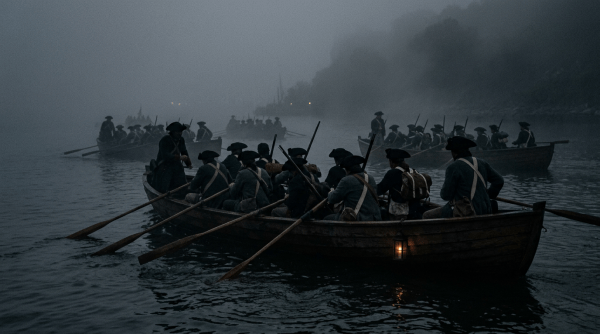
After the disastrous Battle of Brooklyn on August 27, Washington’s army had been trapped against the East River. Rather than risk another battle that could destroy the Continental Army, Washington secretly evacuated roughly 9,000 troops across the river to Manhattan during the night of August 29–30. Silence, darkness and finally a remarkably dense fog concealed the operation. (National Park Service)

On August 31, Washington reported the result to Congress:

“Our Retreat was made without any Loss of Men or Ammunition…”

Continue reading “August 31 in Revolutionary War History”

Washington’s Army Disappears

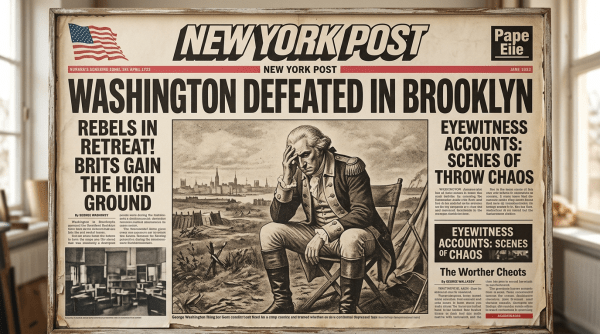
250 years ago today in the predawn hours of August 30, 1776, George Washington completed the extraordinary evacuation of the Continental Army from Brooklyn Heights across the East River to Manhattan.

After the devastating Battle of Brooklyn on August 27, roughly 9,000 Americans had been cornered with the British in front of them and the East River behind them. Washington recognized that another major engagement could mean the destruction of his army. National Park Service

So during the night of August 29–30, Washington pulled off a remarkable escape.

Colonel John Glover’s 14th Massachusetts Regiment—the Marblehead Mariners— used their considerable seamanship to ferry soldiers across the river. Wagons were muffled, campfires were left burning, and the troops were ordered to remain silent so the British wouldn’t realize what was happening. National Park Service

And then Washington caught an extraordinary break.

Fog rolled in.

It concealed the final stages of the evacuation from British observation. By about 7:00 a.m. on August 30, the Continental Army had safely reached Manhattan. The troops on Governors Island were among the last removed. National Park Service

We even have an eyewitness diary entry from Massachusetts soldier Moses Sleeper for today:

“Last night Evacuated Long Island with verry Much Fatigue…”

Sleeper recorded reaching New York at about 1:00 a.m. National Park Service

Why August 30 matters

This wasn’t a victory in the conventional sense. Washington had just lost the largest battle of the Revolution.

But he understood something fundamental that would become central to his strategy:

The British could capture territory. They could not be allowed to capture Washington’s army.

As long as the Continental Army remained intact, the Revolution remained alive.

And there’s something wonderfully cinematic about it: Howe wakes up expecting Washington’s battered army to still be sitting across from him at Brooklyn Heights—and discovers that the Americans have simply vanished.

Washington Decides to Escape Brooklyn

250 years ago today and two days after the disastrous Battle of Brooklyn, Washington’s army was trapped in its fortifications at Brooklyn Heights. The British were close enough that one American soldier recorded on August 29 that they had thrown up a breastwork “within gun shot of our Lines.” National Park Service

Washington now faced the possibility that his army—and perhaps the Revolution itself—could be destroyed.

On August 29, he made the critical decision to evacuate Brooklyn secretly across the East River.

That evening, Colonel John Glover’s Marblehead Mariners, experienced Massachusetts seamen, began ferrying thousands of soldiers, horses, artillery and supplies across to Manhattan. The evacuation continued through the night of August 29–30, aided famously by fog that concealed the operation from the British. National Park Service

It’s hard to overstate this one: Washington didn’t win a battle on August 29, 1776. He saved his army. And by saving the army, he kept the Revolution alive.

Battle of Brooklyn Coverage Around the US

I’ve been tracking the anniversary of the Battle of Brooklyn and pulled together recent news coverage and commentary about how this pivotal moment in the Revolutionary War is being remembered today.

“Today, August 27, 2026, is exactly the 250th anniversary and the Battle of Brooklyn/Long Island got some noteworthy coverage.

Continue reading “Battle of Brooklyn Coverage Around the US”

The Role of Virtue and Education in the American Experiment

Popular government requires virtue, and public opinion must be enlightened.

George Washington

This is one of the central assumptions behind the Founders’ idea of republican government: a republic could not be sustained by a good constitution alone. It required citizens capable of governing themselves—both morally and intellectually. That theme also fits the broader Revolutionary-era framework we’ve been building.

Continue reading “The Role of Virtue and Education in the American Experiment”

Battle of Long Island: 250 Years Ago Today

If most Americans know what happened 250 years ago today, it might be because of this song from the music Hamilton:


Hoewever, celebrating 250 years of America has nothing to do with Hamilton, UFC matches or Indy car races: it has to do with being mindful of the courage of real Americans who put everything on the line for us.

The Battle of Long Island, fought in August 1776, was a significant engagement during the American Revolutionary War. It marked the largest battle of the conflict in terms of troop strength, as British forces sought to seize control of New York City from the Continental Army. The battle showcased the tactical superiority of the British army and resulted in a decisive victory for them, forcing the Continental Army to retreat. This encounter set the stage for subsequent struggles throughout the war, highlighting both the challenges faced by the American forces and their resilience in the face of adversity.


For a more in-depth look at the strategies, key figures, and aftermath of this pivotal battle, be sure to read the full article on Wikipedia — I think you’ll be amazed! This is what it means to celebrate America; to pause and reflect on moments like this…

Bonus

Media, Technology, and Stress At America’s 250th

“The United States is in a strange position. Even as we prepare to celebrate our 250th anniversary we are dissatisfied with how things stand. A recent Pew Poll indicated that 69% of Americans don’t like the way things are going right now but that may have always been true in this country; historians believe that only 30-40% of American Colonists actively supported the Revolutionary War, with 20% remaining loyal to the crown, and the remainder being neutral or disengaged.”

Go to the source and read the whole article if you’re interested: Media, Technology, and Stress At America’s 250th

Lexington and Concord at 250: Can We Still Hear the ‘Shot Heard Round the World’?

Big Revolutionary War anniversaries lie ahead—and bring reminders of our messy, surprising history…

April 19, 2025, marked the 250th anniversary of the American Revolutionary War’s inception, highlighting significant historical reflections and events tied to this milestone. The article delves into the implications of such anniversaries, suggesting they serve as a reminder of the complex and often surprising nature of history. Additionally, it questions whether the essence of the conflict, encapsulated in the phrase “the shot heard round the world,” still resonates in today’s society. Through this lens, the article encourages contemplation on the ongoing relevance of the Revolutionary War and its legacy in contemporary America.

Source: Lexington and Concord at 250: Can We Still Hear the ‘Shot Heard Round the World’?

Why are the Battles of Saratoga significant to American History?

The Battles of Saratoga were pivotal in the American Revolutionary War for several reasons:

  1. Turning Point of the War: These battles marked a significant turning point in the war, as they were the first major victories for the Continental Army against the British.
  2. Foreign Support: The American victory at Saratoga convinced France to openly support the American cause, providing crucial military and financial aid. This French alliance was a game-changer for the Patriots, giving them the resources and legitimacy they needed to continue fighting.
  3. Boost to Morale: The victories at Saratoga boosted the morale of the American troops and civilians, who had been struggling against the powerful British forces. It demonstrated that the Continental Army was capable of defeating the British and inspired hope for independence.
  4. Diplomatic Significance: The American victory also had significant diplomatic implications. It showed other European nations that the American Revolution was a viable cause, encouraging them to consider supporting the Patriots.

In essence, the Battles of Saratoga were a crucial turning point in the American Revolutionary War, leading to French support, a boost in morale, and increased international recognition of the American cause.

If you’d like to know more, I suggest this book or you can watch the series on AppleTV+:

Continue reading “Why are the Battles of Saratoga significant to American History?”

George Washington

Happy birthday, your Excellency!

“Celebrated biographer Ron Chernow provides a richly nuanced portrait of the father of our nation and the first president of the United States. With a breadth and depth matched by no other one volume biography of George Washington, this crisply paced narrative carries the reader through his adventurous early years, his heroic exploits with the Continental Army during the Revolutionary War, his presiding over the Constitutional Convention, and his magnificent performance as America’s first president. In this groundbreaking work, based on massive research, Chernow shatters forever the stereotype of George Washington as a stolid, unemotional figure and brings to vivid life a dashing, passionate man of fiery opinions and many moods.”

The Exceptional 18th Century: A Turning Point in Human History

The 18th century stands out as a remarkable period in human history for numerous reasons. Often referred to as the “Age of Enlightenment” or the “Century of Reason,” it witnessed extraordinary advancements in various fields that would forever shape the trajectory of humanity. From scientific discoveries to political revolutions, let us delve into why the 18th century was truly exceptional.

Continue reading “The Exceptional 18th Century: A Turning Point in Human History”

Could Putin actually fall?

What history teaches us about how autocrats lose power — and how Putin might hang on. Source: Could Putin actually fall?

The odds are not in his favor

Here’s something else to consider. Historically, in asymmetric warfare the underdog has a better chance of winning. Consider the American Revolutionary War and the War of 1812. See…

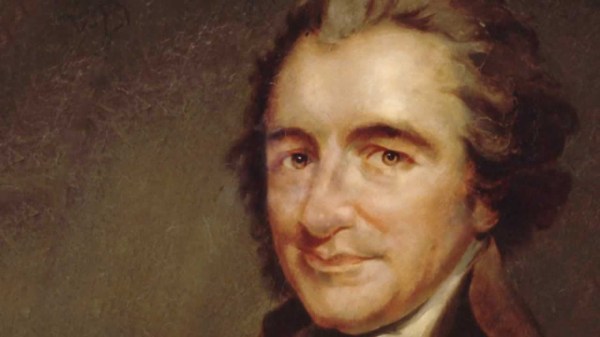
Thomas Paine publishes “The American Crisis”

On this day in 1776, Thomas Paine’s immortal words inspired the revolutionary army…

‘These are the times that try men’s souls. The summer soldier and the sunshine patriot will, in this crisis, shrink from the service of their country; but he that stands it now, deserves the love and thanks of man and woman.

Tyranny, like hell, is not easily conquered; yet we have this consolation with us, that the harder the conflict, the more glorious the triumph.

What we obtain too cheap, we esteem too lightly: it is dearness only that gives every thing its value. Heaven knows how to put a proper price upon its goods; and it would be strange indeed if so celestial an article as FREEDOM should not be highly rated: Thomas Paine publishes “The American Crisis”

While I no longer believe in ‘american exceptionalism’ there is no doubt this is an exceptional example of words that inspired men to great deeds. You can read the entire pamphlet at no cost here (and I believe every American should read this at least once in their lifetime):

Battles of Saratoga

The Battles of Saratoga (September 19 and October 7, 1777) marked the climax of the Saratoga campaign, giving a decisive victory to the Americans over the British in the American Revolutionary War. Continue reading “Battles of Saratoga”

A story about George Washington…

1795 - 1823
1795 – 1823 (Photo credit: Wikipedia)

Have you ever heard this one?

About a dozen years before the Revolutionary War, tensions increased in America between the British and the French with their Indian allies, resulting in battles.
The most notable period of the French and Indian Wars lasted from 1754 to 1763. It is considered the first global war, as allies of the French and English fought all around the world.
On July 9, 1755, about 1,400 British troops marched over the Appalachian Mountains to seize French Fort Duquesne, near present day Pittsburgh. As they marched through a deep wooded ravine along the Monongahela River eight miles from the fort, they were ambushed by French regulars, Canadians, and Potawatomi and Ottawa Indians.
Not accustomed to fighting unless in an open field, over 900 British soldiers were annihilated.
It was known as the Battle of the Wilderness or Battle of Monongahela.
23-year-old Virginia Colonel George Washington rode back and forth during the battle delivering orders for General Edward Braddock, the Commander-in-Chief of British forces in America.
Eventually, Braddock was killed and every officer on horseback was shot, except Washington.
Washington carried Braddock from the field.
Braddock’s field desk was captured, revealing all of the British military plans, enabling the French to surprise and defeat British forces in succeeding battles at Fort Oswego, Fort William Henry, Fort Duquesne, and Carillon. The Iroquois tribes of Senecas and Cayugas decided to switch their allegiance to the French.
Before he died, Braddock gave Washington his battle uniform sash, which Washington reportedly carried with him while serving as Commander-in-Chief and as President.
Washington presided at the burial service for General Braddock, as the chaplain was wounded. Braddock’s body was buried in the middle of the road so as to prevent his body from being found and desecrated.
Shortly thereafter, writing from Fort Cumberland, George Washington described the Battle of Monongahela to his younger brother, John Augustine Washington, JULY 18, 1755:
“As I have heard, since my arrival at this place, a circumstantial account of my death and dying speech, I take this early opportunity of contradicting the first, and of assuring you, that I have not as yet composed the latter.
But by the All-Powerful Dispensations of Providence, I have been protected beyond all human probability or expectation; for I had four bullets through my coat, and two horses shot under me, yet escaped unhurt, although death was leveling my companions on every side of me!”
An Indian warrior later declared:
“Washington was never born to be killed by a bullet! I had seventeen fair fires at him with my rifle and after all could not bring him to the ground!”

Source: William J Federer’s American Minute for January 1st

Start a Blog at WordPress.com.

Up ↑