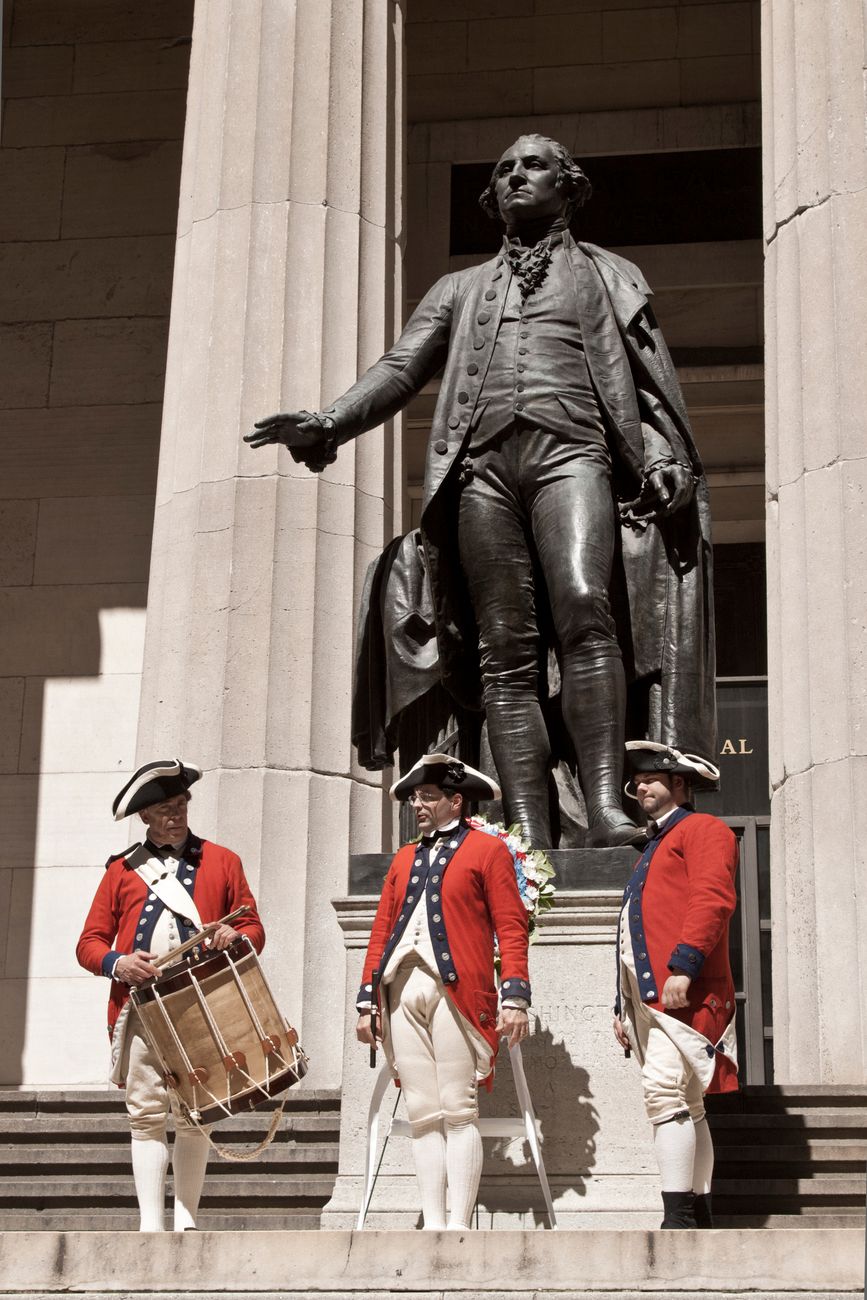
Popular government requires virtue, and public opinion must be enlightened.
George Washington
This is one of the central assumptions behind the Founders’ idea of republican government: a republic could not be sustained by a good constitution alone. It required citizens capable of governing themselves—both morally and intellectually. That theme also fits the broader Revolutionary-era framework we’ve been building.
George Washington put the two ideas almost side by side in his Farewell Address (1796). First, he declared:
“Virtue or morality is a necessary spring of popular government.”
Then he immediately turned to education:
“Promote then as an object of primary importance, Institutions for the general diffusion of knowledge.”
His reason is especially important: “it is essential that public opinion should be enlightened.” In other words, once political power rests with ordinary citizens, the quality of government depends heavily upon the quality of their judgment. (Founders Online)
Read Washington’s Farewell Address at Founders Online
John Adams was even more emphatic about virtue. Writing to the Massachusetts militia in 1798, he argued that constitutional structures could not restrain people whose passions were completely unrestrained by morality:
“Our Constitution was made only for a moral and religious People. It is wholly inadequate to the government of any other.”
The sentence immediately before that is revealing. Adams feared that avarice, ambition and revenge could tear through constitutional restraints “as a Whale goes through a Net.” His point wasn’t simply religious piety. Institutions ultimately depend upon people exercising self-restraint. (Founders Online)
Read Adams’s 1798 letter at Founders Online
James Madison approached the problem from another direction. He certainly valued an educated citizenry, but he was less willing to assume that education and virtue would eliminate selfishness, faction or ambition. That’s why Madisonian constitutionalism is so interesting: educate the people, cultivate civic virtue—but design the government assuming human beings will still behave like human beings.
Hence the famous logic of Federalist No. 51: “If men were angels, no government would be necessary.” Checks and balances exist precisely because virtue cannot always be counted upon.
Thomas Jefferson probably had the greatest faith in education as a defense against tyranny. His plans for public education in Virginia weren’t merely about helping individuals improve their economic prospects. Jefferson wanted ordinary citizens educated sufficiently to recognize ambition, corruption and abuses of governmental power.
That produces a distinctly Revolutionary conception of education:
An educated citizen isn’t merely a better worker. An educated citizen is harder to tyrannize.
And this helps explain something fundamental about the Revolution. The Founders were not merely asking:
“Can Americans defeat Britain?”
By the 1780s, the much more frightening question was:
“Can Americans govern themselves?”
Their answer was essentially that self-government required two kinds of architecture:
Constitutional architecture — separation of powers, checks and balances, elections, federalism, laws and institutions.
Civic architecture — education, knowledge, morality, self-restraint, public spiritedness and what they frequently called virtue.
And here’s the part I think is especially relevant when reading the Founders today: they did not believe liberty meant simply being free to do whatever one wanted. Republican liberty carried obligations. Citizens possessing political sovereignty had to develop the character and knowledge necessary to exercise it responsibly.
Washington’s formulation may be the cleanest summary of the whole idea:
Popular government requires virtue, and public opinion must be enlightened.
That’s remarkably close to the intellectual heart of the American republican experiment; a lack of virtue and education could mean the ‘expirement’ of the American experiment…
 Bright, Shiny Objects!
What do you think?