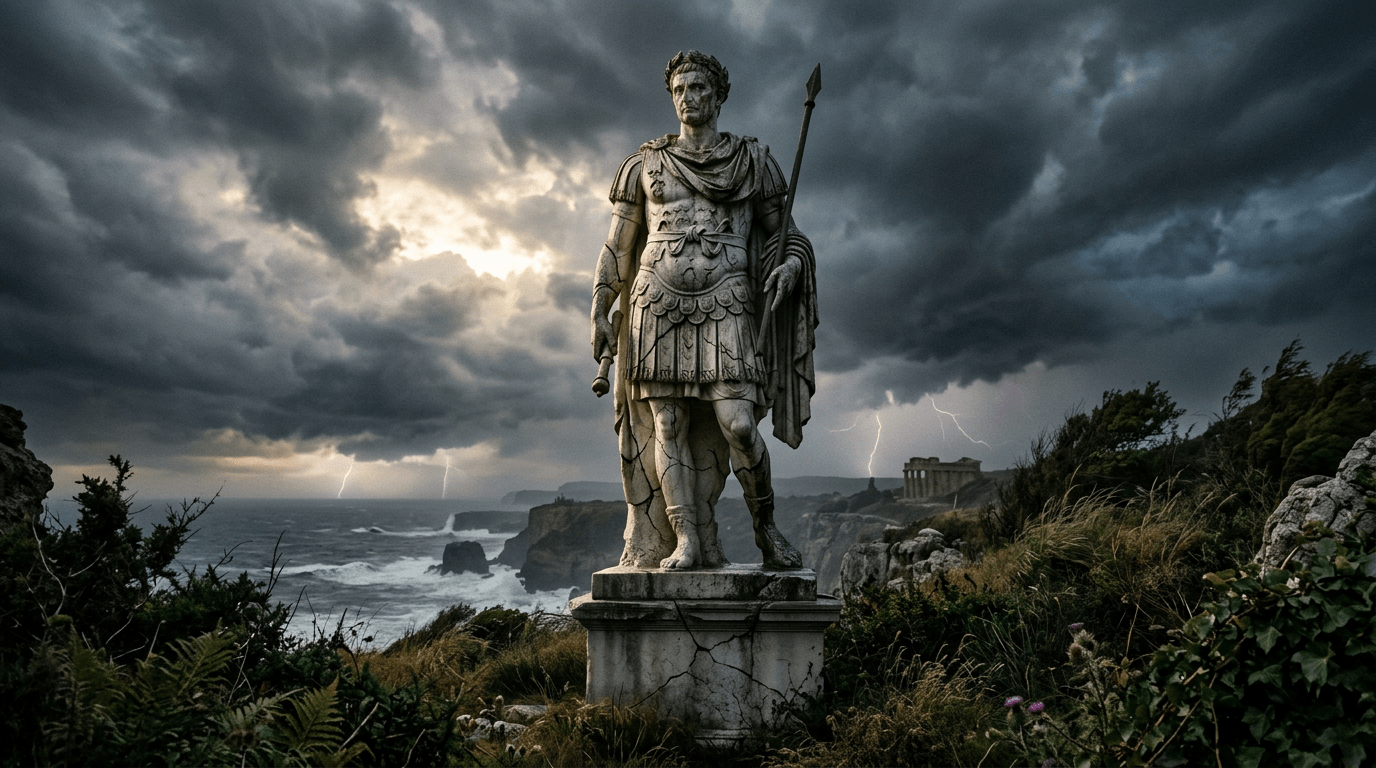
In a previous post, I took a look at the rise and fall of empires since the beginning of the ‘Common Era’ and finished with this:
“Historians often point out that the average lifespan of a major empire is roughly 250 years, though anomalies like the Eastern Romans (Byzantines) managed to survive for over a millennium by constantly adapting their borders and administrative systems.”
While every imperial collapse has its own specific triggers, empires almost never fall to a single isolated event. Instead, they usually suffer from a fatal combination of internal structural decay and external pressure.
Historians generally group the root causes into five recurring catalysts:
1. Imperial Overstretch & Economic Exhaustion
Empires tend to grow until their borders cost more to defend and administer than the territory generates in tax revenue.
- The Burden of Conquest: Maintaining massive standing armies, fortifying thousands of miles of frontiers, and paying regional bureaucrats drains state treasuries.
- Currency Debasement & Inflation: When short on money, states historically diluted their currency (like Rome reducing the silver content in the denarius) or printed unbacked paper money (like late-stage Chinese dynasties), driving rampant inflation.
- Examples:
- The Western Roman Empire spiraled partly because defending thousands of miles along the Rhine and Danube consumed the entire imperial budget, starving domestic infrastructure.
- The Spanish Empire flooded Europe with silver from the Americas, which paradoxically triggered a massive long-term inflation crisis (“The Price Revolution”) that wrecked their own domestic economy.
2. Institutional Corruption & Decentralization
As empires age, local elites, governors, and aristocrats often accumulate power at the expense of the central government.
- Tax Evasion by the Wealthy: Elite landowners frequently find legal loopholes or use influence to avoid paying taxes, shifting the tax burden entirely onto peasants and rural farmers.
- Rise of Warlords: When central authority weakens, distant military commanders realize they command the loyalty of their troops more than the distant emperor does.
- Examples:
- The Tang Dynasty created powerful regional military governors (jiedushi) to guard its borders. One of them, An Lushan, used his troops to launch a devastating rebellion that permanently shattered the central government’s authority.
- The Mughal Empire decentralized after Emperor Aurangzeb’s death, allowing regional governors (Nabobs) and the rival Maratha Confederacy to carve up power, leaving India vulnerable to the British East India Company.
3. Climate Shocks, Disease, and Environmental Failure
An empire is ultimately a machine that runs on agricultural surplus. When the environment fails, the state collapses.
- Megadroughts & Famine: A shift in monsoon patterns or a prolonged cold period reduces crop yields, triggering widespread starvation, mass migration, and peasant rebellions.
- Pandemics: Global trade routes—the lifeblood of empires—also act as super-spreaders for devastating pathogens that wipe out tax bases and military manpower.
- Examples:
- The Khmer Empire relied on a vast, intricate network of reservoirs and canals around Angkor Wat. Volatile monsoon shifts (alternating between intense droughts and severe floods) destroyed the infrastructure, rendering the city uninhabitable.
- The Justinian Plague (541–542 CE) wiped out an estimated 20–25% of the Eastern Roman Empire’s population, permanently derailing Emperor Justinian’s attempt to fully reconquer the Western Mediterranean.
4. Succession Crises & Civil War
A surprising number of empires didn’t fall to foreign invaders—they tore themselves apart from the inside over who got to sit on the throne.
- Lack of Clear Rules: Systems without a clear, unchallenged rule of succession (like primogeniture) routinely descended into bloody civil wars every time a ruler died.
- Civilian Devastation: Internal wars destroy crop fields, burn cities, and consume the very armies needed to guard the borders.
- Examples:
- The Mongol Empire broke apart into four separate realms (the Yuan, Golden Horde, Chagatai, and Ilkhanate) shortly after the death of Möngke Khan because his brothers went to war over who should be Great Khan.
- The Inca Empire was actively locked in a ruinous civil war between half-brothers Huáscar and Atahualpa when Francisco Pizarro arrived. The empire’s political structure was already severely fractured.
5. Technology Traps & External Invasions
An empire can maintain internal stability for centuries, only to be rendered obsolete almost overnight by technological shifts or external movements.
- Asymmetric Warfare & Military Innovation: Established empires are often slow to adapt to new tactics or technology developed by rivals.
- The Domino Effect of Migration: A distant crisis can push entire displaced populations (like nomadic confederations) directly into imperial territory.
- Examples:
- The Songhai Empire in West Africa fielded a massive, brave army, but was wiped out at the Battle of Tondibi (1591) by a much smaller Moroccan force equipped with early gunpowder weapons (arquebuses).
- The Qing Dynasty held a traditional, land-based military model that was completely overwhelmed in the 19th century by the ironclad gunboats and modern artillery of industrial European powers during the Opium Wars.
The General Rule: Barbarians at the gate rarely destroy a healthy empire. They usually just kick in the door of a house whose foundation has already been eaten away by financial strain, corruption, and political division.
This video provides a concise overview of the internal decay, economic pressures, and external invasions that led to the collapse of the Western Roman Empire.
 Bright, Shiny Objects!
What do you think?