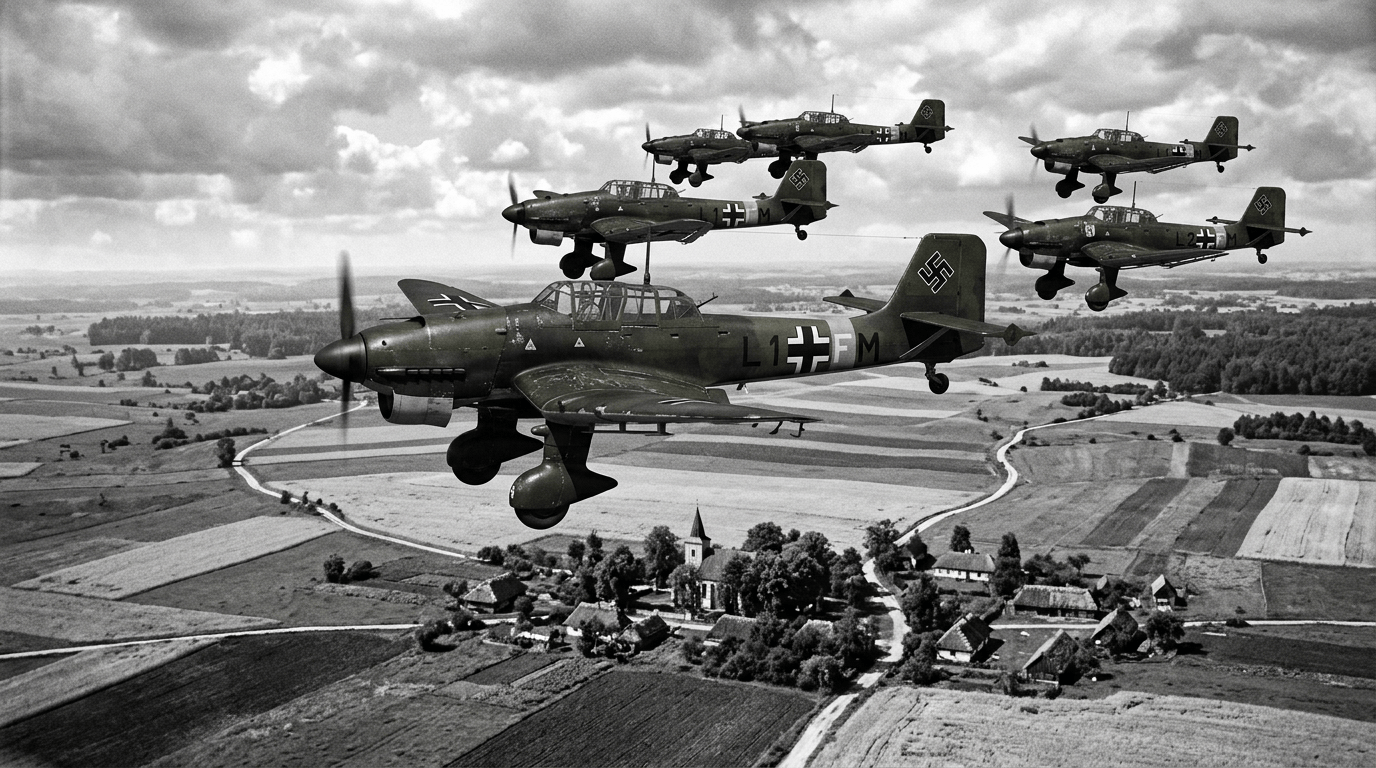
Eighty-seven years ago this morning, the Second World War began.
At roughly 4:40 a.m. on September 1, 1939, German aircraft attacked the Polish town of Wieluń. Minutes later, the German battleship Schleswig-Holstein opened fire on the Polish garrison at Westerplatte.
Most of Europe was still asleep.
There is something about that fact that has always bothered me—not simply the enormity of what followed, but the ordinariness of the morning on which it started.
People had gone to bed the night before. Alarm clocks were waiting to ring. Breakfasts would have been planned. Children were asleep. Somewhere, undoubtedly, someone had left something unfinished at work because it could wait until tomorrow.
Then tomorrow came.
And history divided itself into before and after.
Poland Between Two Monsters
The German invasion wasn’t an impulsive act or a response to Polish aggression. Hitler had already decided upon war.
Nazi Germany even manufactured supposed Polish provocations to provide a pretext for an invasion that had already been planned.
German forces attacked Poland from the west, north and south. Poland fought back, but the disparity in military power was enormous.
Then came the second blow.
On September 17, the Soviet Union invaded Poland from the east, acting under the secret arrangements accompanying the Molotov–Ribbentrop Pact between Nazi Germany and the Soviet Union.
Poland found itself trapped between two of the most murderous regimes of the twentieth century.
Warsaw surrendered on September 28.
But Poland did not.
That distinction matters.
A Country That Refused to Disappear
Poland was occupied, partitioned and subjected to extraordinary brutality.
Its government continued in exile. Polish military units regrouped abroad and fought alongside the Allies throughout the war.
Polish pilots played a remarkable role in the Battle of Britain. Polish soldiers fought in North Africa, Italy and Western Europe. The Polish underground developed into one of the largest resistance movements in occupied Europe.
Even before the war, Polish mathematicians and cryptologists had made crucial breakthroughs against the German Enigma cipher and shared their work with Britain and France—work that would eventually contribute enormously to the Allied war effort.
The country had been conquered.
The nation had not.
That may be one of the most important distinctions in history.
The Dangerous Comfort of Paper
There is another reason September 1 deserves remembering.
Europe in 1939 was not a place without rules.
There were treaties. Borders were recognized by international agreements. Governments exchanged diplomatic assurances. There were conventions about how nations were supposed to behave toward one another.
Poland itself had a non-aggression agreement with Germany.
The paper existed.
The problem was that paper ultimately depends upon people being willing to honor what is written on it.
Hitler viewed agreements differently. An agreement was useful while it served his purposes. When it no longer did, it could be discarded.
And that exposes an uncomfortable truth about civilization.
Institutions matter enormously. Constitutions matter. Laws matter. Treaties matter.
But none of them possesses magical powers.
They depend upon human beings.
They depend upon leaders willing to restrain themselves when they possess the power not to.
They depend upon citizens willing to defend norms before their destruction becomes irreversible.
And ultimately they depend upon character.
History Doesn’t Always Look Like History
We remember September 1, 1939 with the knowledge of everything that came afterward.
We see tanks crossing borders and already know about Dunkirk.
We know about the Blitz.
Pearl Harbor.
Stalingrad.
D-Day.
Auschwitz.
Hiroshima.
We know that tens of millions of people will die before the war finally ends six years later.
The people waking up on that September morning knew none of it.
That’s what makes this anniversary unsettling.
Historical catastrophes don’t necessarily announce themselves as historical catastrophes.
There is rarely a narrator standing nearby saying:
Pay attention. This is the moment everything changes.
People experience history one day at a time.
Often one hour at a time.
Sometimes before breakfast.
Eighty-Seven Years Later
This morning, there is one final thing worth remembering.
After everything that followed—the invasion, occupation, extermination, destruction, Soviet domination and decades behind the Iron Curtain—
Poland is still there.
Warsaw was nearly destroyed and rebuilt.
The Polish state disappeared from the map in 1939 and returned.
The Soviet empire that once controlled Poland is gone.
Poland today is an independent country and a member of NATO and the European Union.
That doesn’t erase what happened on September 1, 1939.
Nothing could.
But perhaps it gives this anniversary its final meaning.
Military power can occupy a country.
Tyranny can suppress its institutions.
A dictator can even erase its borders from a map.
But nations ultimately reside somewhere deeper than lines drawn on paper.
Eighty-seven years ago this morning, Nazi Germany set out to destroy Poland. Sixteen days later, the Soviet Union joined in from the east.
The regimes that divided Poland between them are gone.
Poland is still there.
 Bright, Shiny Objects!
What do you think?