There’s a joke I’ve always liked that Canada is the nice apartment above a really loud American biker bar.
It’s affectionate. Mostly.
We share the building. We hear a lot of noise through the floorboards. We occasionally wonder what on earth is going on down there. But we’re neighbours, we get along pretty well, and at the end of the day there’s a door between the two apartments.
Except there very nearly wasn’t.
In the winter of 1775, the Americans invaded what is now Canada.
And they came remarkably close to changing the history of the continent.
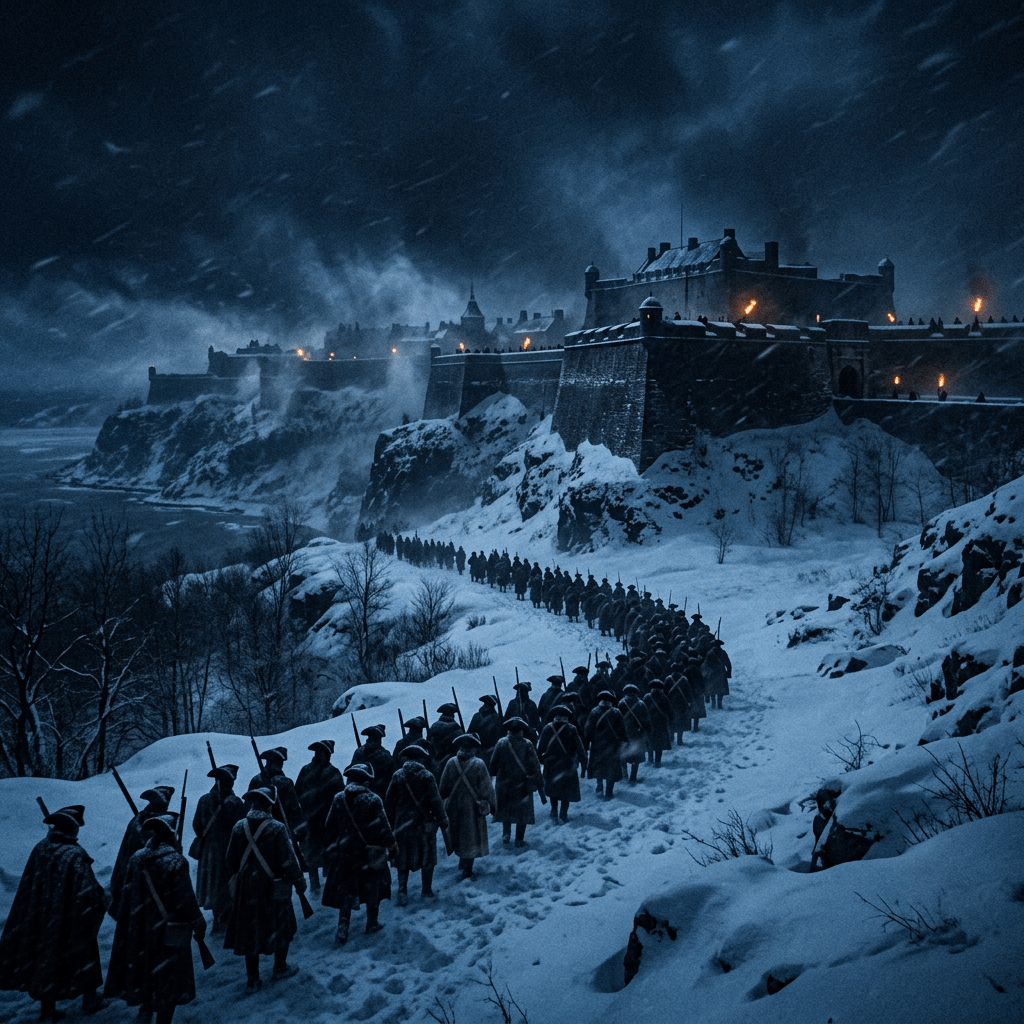
On December 31, in the middle of a Quebec snowstorm, American forces attacked Quebec City.
They lost.
But what if they hadn’t?
What if Quebec had fallen?
What if the American invasion had succeeded?
And what if the territory that eventually became Canada had joined the American Revolution?
For Canadians, this is a particularly strange counterfactual because the obvious consequence is rather personal:
We might not exist.
At least not as Canadians.
Yes, the Americans Really Did Invade Us. Twice
To be fair, there wasn’t technically a Canada for them to invade yet.
The British Province of Quebec occupied much of what we now think of as central Canada, while other British colonies existed along the Atlantic coast.
The American Revolution had begun only months earlier, and the rebels hoped people living in Quebec might join their cause.
The Americans didn’t simply dream about it, either.
They marched north.
One force, commanded by Richard Montgomery, moved up through Lake Champlain and captured Montreal.
Another was led through the wilderness of Maine by Benedict Arnold.
Yes.
That Benedict Arnold.
Before becoming the most infamous traitor in American history, Arnold was one of the Revolution’s boldest field commanders.
His expedition to Quebec was brutal. His men endured hunger, cold, disease and terrain that apparently had been designed specifically to convince Americans to stay home.
Somehow, they reached Quebec City.
On December 31, 1775, Arnold and Montgomery attacked during a snowstorm.
Montgomery was killed.
Arnold was wounded.
The attack collapsed.
Eventually the Americans retreated south.
And Canada remained British.
That failed attack helped create the political geography that Canadians and Americans now take for granted.
But let’s give Montgomery and Arnold their victory.
Quebec Falls
Capturing Quebec City wouldn’t automatically have made Canada American.
That’s important.
The Americans would have needed to hold it against Britain, and they would have needed enough support—or at least acceptance—from the local population to make their occupation sustainable.
Neither was guaranteed.
But suppose they managed it.
Suppose Quebec joins the Revolution.
Now the political experiment taking shape south of us becomes something very different.
And so do we.
Because the new United States suddenly contains a substantial French-speaking Catholic population.
America Gets a Quebec Problem 200 Years Early
Canadians know this story.
Language.
Religion.
Culture.
Civil law.
Provincial autonomy.
The relationship between Quebec and everybody else.
Welcome to Confederation.
Except now imagine George Washington, Thomas Jefferson, Benjamin Franklin and James Madison trying to figure it out.
The early American political culture was overwhelmingly English-speaking and Protestant. Incorporating Quebec would require compromises the Americans hadn’t expected to make.
French Canadians would presumably want to keep their language.
They would want to protect the Catholic Church.
They would want to preserve elements of French civil law.
And they would almost certainly want substantial local autonomy.
Suddenly the American constitutional question isn’t simply how Massachusetts and Virginia can live in the same republic.
It’s how Massachusetts, Virginia and Quebec can live in the same republic.
Imagine delegates from Quebec arriving at the Constitutional Convention in Philadelphia in 1787.
Imagine the negotiations.
Imagine the translation.
Imagine the arguments.
Actually, as a Canadian, that last part isn’t terribly difficult to imagine.
The Great Lakes Aren’t a Border Anymore
Now look at the map.
This is where the consequences become enormous.
In our history, the Great Lakes and eventually the 49th parallel helped define the boundary between Canada and the United States.
Remove that boundary.
The Great Lakes aren’t on the northern edge of the United States.
They’re in the middle of it.
Montreal isn’t a Canadian metropolis across the border.
It’s one of America’s great cities.
Quebec City is one of America’s oldest cities.
Toronto—assuming it develops into anything resembling the Toronto we know—is an American city.
Detroit isn’t staring across the river at another country.
The entire Great Lakes–St. Lawrence system becomes an internal American transportation network stretching deep into the continent.
And the United States possesses the great geographic prize Americans coveted for generations:
the St. Lawrence River.
The economic geography of North America changes completely.
And Canada Never Gets Its Loyalists
This may be even more consequential.
After the American Revolution, tens of thousands of people who remained loyal to Britain left the new United States.
Many came north.
Those Loyalists played an enormous role in shaping English-speaking Canada.
Their migration helped create the society that eventually became Upper Canada and, later, Ontario.
But if the Americans already control the territory north of the Great Lakes, where do the Loyalists go?
Nova Scotia, certainly.
Britain, perhaps.
The Caribbean.
Maybe some simply stay in the United States.
But there is no great Loyalist migration into Upper Canada because there is no Upper Canada.
And that starts knocking down historical dominoes very quickly.
No Upper Canada.
No Upper and Lower Canada.
No Province of Canada.
And quite possibly…
no Confederation in 1867.
No Dominion of Canada.
No Sir John A. Macdonald trying to stitch together an enormous country before the Americans swallow the rest of the continent.
No Canadian Pacific Railway built partly to hold that country together.
No Canada stretching from Atlantic to Pacific.
The country whose flag I live under simply never appears.
That’s an unsettling thought.
The War of 1812 Becomes Very Strange
Canadians have a particular relationship with the War of 1812.
It’s one of those rare historical events where Canadians and Americans can tell noticeably different versions of the same story and both leave feeling rather pleased with themselves.
But in this alternate timeline, much of the war becomes impossible.
The Americans can’t invade Canada.
Canada is already America.
There is no Upper Canada to defend.
No Battle of Queenston Heights as we know it.
No burning of York.
No Laura Secord making her famous journey.
Isaac Brock’s Canadian legacy disappears.
Britain’s principal North American bases might instead be concentrated around Halifax and Newfoundland.
And the Great Lakes are no longer an international battleground.
They’re American interior waters.
But then comes an even larger question.
Where Does America Stop?
Once the Americans control Quebec and the territory around the Great Lakes, why would their expansion stop at the border we know today?
There is no border.
American settlement could move west from Ontario just as it moved west from Ohio.
The Prairies become another American frontier.
Winnipeg might become an American city.
Calgary might become an American city.
And as someone writing this from Calgary, I confess that is where this thought experiment starts feeling considerably less academic.
Alberta without Canada?
That’s weird enough.
Alberta as an American state?
I need a minute.
But geographically, it’s hardly impossible.
An American republic already occupying the Great Lakes and St. Lawrence basin would have powerful reasons to keep moving west.
Eventually the United States might stretch across almost the entire continent.
Atlantic to Pacific.
Florida to the Arctic.
And after the purchase of Alaska, perhaps nearly the whole northern half of North America as well.
It would be one extraordinarily powerful country.
It might also be an extraordinarily difficult country to govern.
Then There’s Slavery
This is where the thought experiment gets darker.
Every major territorial expansion of the nineteenth-century United States eventually collided with the question of slavery.
Would new territories permit it?
Would they become free states?
Would they become slave states?
Would the balance of power in Congress change?
Now add enormous northern territories to that equation.
Quebec.
Ontario.
Eventually the Prairies.
Perhaps the additional northern population makes slavery politically unsustainable earlier.
That’s possible.
But there’s another possibility.
Southern politicians, watching their influence disappear beneath a growing collection of northern states, might become even more determined to acquire territory farther south.
Mexico.
Cuba.
The Caribbean.
More potential slave states.
Instead of preventing America’s sectional crisis, the acquisition of Canada might intensify it.
The American Civil War might come earlier.
It might come later.
It might involve different states.
But it is difficult to imagine the slavery question simply disappearing.
And the Map Was Never Empty
There is another danger in playing alternate-history games like this.
We move borders around on maps as though nobody was living there.
People were.
An American expansion across the territories that became Canada would have profound consequences for Indigenous nations.
Canada’s own record here provides nothing to boast about: broken treaties, residential schools, forced assimilation, dispossession and generations of injustice.
But the American nineteenth-century experience of removal and Manifest Destiny gives us little reason to believe an American conquest of the Canadian West would have produced a gentler outcome.
The history would be different.
Not necessarily better.
But Here’s What Fascinates Me Most
At first glance, this sounds like a story about Canada becoming American.
And obviously it is.
If the American invasion succeeds, there is probably no Canada in the form we recognize today.
But after thinking about it for a while, I’m not sure that’s the most interesting part.
Because absorbing Canada would also change the United States.
Profoundly.
America becomes bilingual much earlier.
It acquires a major Catholic population much earlier.
It has to accommodate Quebec’s distinct culture from the beginning.
The St. Lawrence becomes one of its great commercial arteries.
The Great Lakes become its geographic centre rather than its northern boundary.
Montreal becomes one of its great cities.
The political gravity of the country shifts northward.
Perhaps Americans become accustomed much earlier to the idea that their country contains genuinely different nations, languages and legal traditions.
Perhaps American federalism becomes looser.
Perhaps regional identity becomes stronger.
Perhaps the United States becomes less culturally uniform because it has no choice.
In other words, America certainly would have changed Canada.
But Canada might have changed America just as much.
Which brings me back to the apartment.
Canada has been jokingly described as the nice apartment above the American biker bar.
In this alternate history, there is no upstairs apartment.
There’s one enormous house.
Quebec and Virginia.
New England and Ontario.
The Maritimes and the Carolinas.
The Great Lakes and the Mississippi.
The Prairies and Texas.
Calgary and Dallas.
All living under one roof.
Would we all eventually have become Americans?
Probably.
But after two and a half centuries of Quebec, Ontario, the Maritimes and the West influencing the country from inside it, I suspect those Americans would look rather different from the Americans we know today.
Maybe the most interesting question isn’t:
What if America had conquered Canada?
Maybe it’s:
What kind of America would Canada have created?
And somewhere in the alternate-history version of Calgary, I suppose I’d be sitting here writing about it.
I’d just have a different flag outside.
And probably a much stronger opinion about the Electoral College.
 Bright, Shiny Objects!
What do you think?