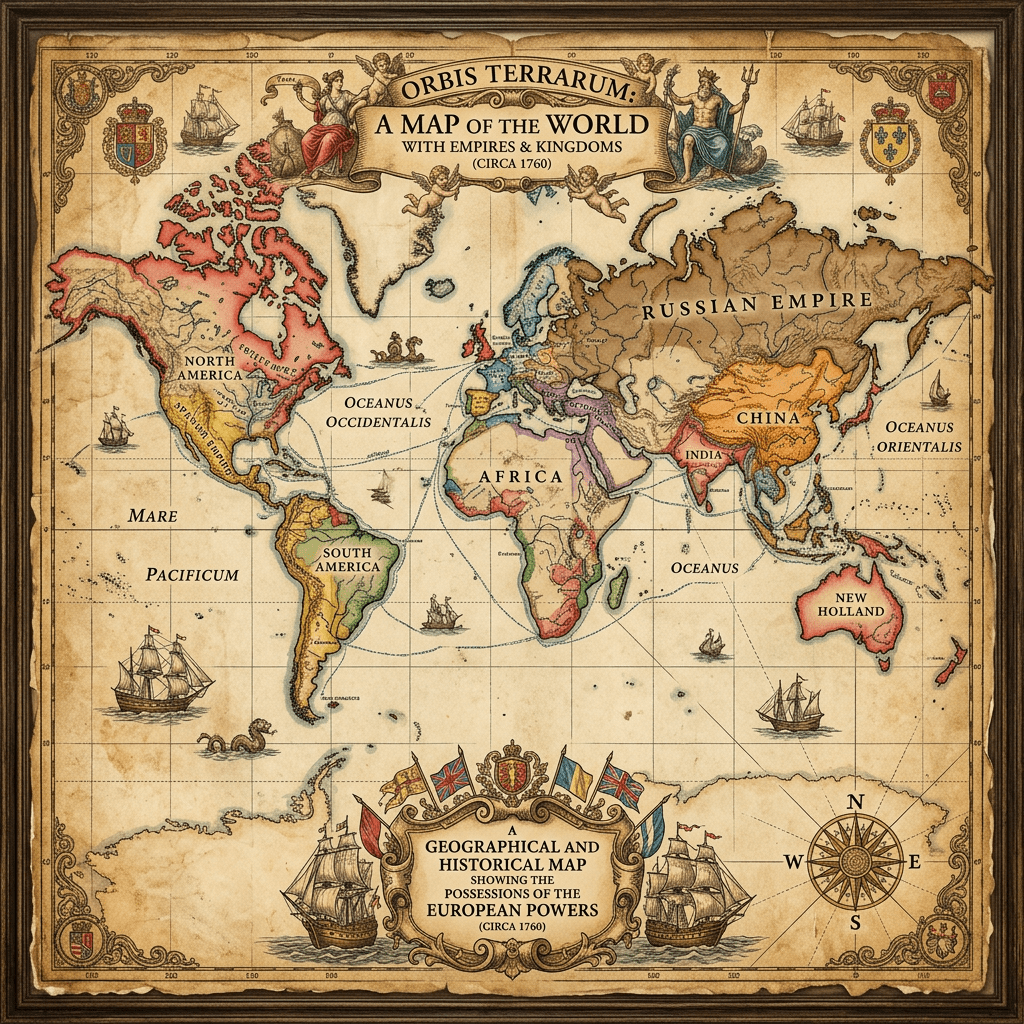
I asked Gemini to compile a list of all the major empires that have risen and fallen since the beginning of the common era, and she threw back around 40 names! She pointed out that “historians often claim that major empires stick around for about 250 years on average, but let’s not forget the Eastern Romans (Byzantines) who crashed that party by hanging in there for over a millennium, constantly reshaping their borders and governance.” So, here’s a thought: are we already living in a post-American reality?
“A complete list of every single empire that rose and fell in the Common Era (CE) would include hundreds of regional powers, nomadic confederations, and short-lived dynasties. To make this digestible, here is a chronological mapping of the major global empires that shaped history from 1 CE onward, organized by the eras in which they reached their peak or collapsed.
Classical & Late Antiquity (1 CE – 600 CE)
This era saw the continuation and eventual fracture of the massive bureaucratic empires that laid the foundations for modern Europe, Asia, and the Middle East.
- Roman Empire (27 BCE – 476 CE / 1453 CE):
- Han Dynasty (202 BCE – 220 CE):
- Kushan Empire (30 CE – 375 CE):
- Sasanian Empire (224 CE – 651 CE):
- Gupta Empire (319 CE – 543 CE):
- The Fall: The Western Roman Empire collapsed in 476 CE under economic instability and Germanic invasions. The Eastern half survived as the Byzantine Empire until 1453.
- The Fall: Internal corruption, peasant rebellions (like the Yellow Turban Rebellion), and military coups fractured China into the Three Kingdoms period.
- The Fall: Centered in Northern India and Central Asia, it was weakened by the rise of the Gupta Empire and ultimately conquered by the Sasanian Empire.
- The Fall: The last pre-Islamic Persian empire fell after being exhausted by long wars with the Byzantines, making them vulnerable to the rapid expansion of the Early Islamic Caliphates.
- The Fall: Known as the “Golden Age of India,” it collapsed primarily due to repeated invasions by the Huna (Hephthalites or White Huns).
The Post-Classical Era & Middle Ages (600 CE – 1450 CE)
Characterized by the rapid spread of Islam, massive nomadic empires sweeping across Eurasia, and the height of Mesoamerican civilization.
- The Islamic Caliphates:
- Tang Dynasty (618 CE – 907 CE):
- Khmer Empire (802 CE – 1431 CE):
- Holy Roman Empire (800 CE / 962 CE – 1806 CE):
- Song Dynasty (960 CE – 1279 CE):
- Mongol Empire (1206 CE – 1368 CE):
- Mali Empire (c. 1235 CE – 1670 CE):
- Rashidun Caliphate (632 CE – 661 CE): Succeeded by the Umayyads.
- Umayyad Caliphate (661 CE – 750 CE): Overthrown by the Abbasids.
- Abbasid Caliphate (750 CE – 1258 CE): The Golden Age of Islam, fractured by regional dynasties and decisively ended when the Mongols sacked Baghdad.
- The Fall: A high point for Chinese civilization, it fell due to regional warlords gaining too much power after the devastating An Lushan Rebellion.
- The Fall: Dominated Southeast Asia (building Angkor Wat). It succumbed to ecological failure (monsoon volatility damaging their complex water network) and Thai invasions.
- The Fall: A decentralized patchwork of territories in Central Europe that dissolved during the Napoleonic Wars.
- The Fall: Renowned for economic and technological innovation, it was completely conquered by Kublai Khan’s Mongol forces.
- The Fall: The largest contiguous land empire in history. It fractured into four separate realms (Chagatai Khanate, Ilkhanate, Golden Horde, and Yuan Dynasty) due to succession disputes, which were then absorbed or overthrown over the following centuries.
- The Fall: The fabulously wealthy West African empire (home to Mansa Musa) declined due to internal succession crises and the rise of the neighboring Songhai Empire.
The Early Modern & Imperial Era (1450 CE – 1920 CE)
The era of “Gunpowder Empires” in Asia and the Middle East, alongside the rise of global maritime European empires fueled by colonization.
- Aztec Empire (1428 CE – 1521 CE):
- Inca Empire (1438 CE – 1572 CE):
- Byzantine Empire (330 CE – 1453 CE):
- Songhai Empire (1464 CE – 1591 CE):
- Spanish Empire (1492 CE – 1976 CE):
- Mughal Empire (1526 CE – 1857 CE):
- Safavid Empire (1501 CE – 1736 CE):
- Ottoman Empire (1299 CE – 1922 CE):
- Qing Dynasty (1644 CE – 1912 CE):
- Russian Empire (1721 CE – 1917 CE):
- Austro-Hungarian Empire (1867 CE – 1918 CE):
- The Fall: Overthrown by a coalition of Spanish conquistadors led by Hernán Cortés and native Tlaxcalan rivals, compounded by smallpox.
- The Fall: Devastated by a civil war of succession and European diseases just before Francisco Pizarro captured the emperor Atahualpa.
- The Fall: The final remnant of the Roman Empire fell when Sultan Mehmed II breached the walls of Constantinople.
- The Fall: Replaced Mali as the dominant power in West African trade, but collapsed after a Moroccan invasion force using early firearms defeated them at the Battle of Tondibi.
- The Fall: One of the first global empires. It peaked in the 16th/17th centuries, lost most of its American colonies in the 1800s, and its final remaining African territories gained independence in the late 20th century.
- The Fall: Ruled the Indian subcontinent; it was severely weakened by internal conflicts and regional powers (like the Marathas) before the British East India Company formally exiled the last emperor after the 1857 Uprising.
- The Fall: The Iranian empire collapsed due to internal decay, economic stagnation, and final invasions by Afghan tribes.
- The Fall: A massive transcontinental empire that slowly declined over centuries (“the sick man of Europe”) and was formally dissolved after siding with the Central Powers in World War I, leading to the creation of modern Turkey.
- The Fall: The final imperial dynasty of China. It collapsed under the weight of foreign imperialism (the Opium Wars), internal rebellions (Taiping and Boxer), and the Xinhai Revolution, establishing the Republic of China.
- The Fall: Overthrown by the Russian Revolution in 1917 amid the economic devastation and military disasters of World War I.
- The Fall: Dissolved into several independent nations immediately following its defeat in World War I.
The Modern Decline (Post-WWII Decolonization)
While these powers did not “fall” via catastrophic military conquest, their global empires dissolved in the mid-to-late 20th century as colonies fought for and won self-determination.
- British Empire: The largest empire in history, covering a quarter of the world’s land at its height. Deconstruction began in earnest with the independence of India and Pakistan in 1947 and wrapped up largely in the 1960s and 70s.
- French Colonial Empire: Centered heavily in Africa and Southeast Asia; collapsed following bitter anti-colonial conflicts like the Algerian War and the First Indochina War.
- Portuguese Empire: The longest-lived modern European colonial empire. It finally dissolved following the Carnation Revolution in 1974, which led to the independence of Angola, Mozambique, and others.
A Note on Imperial Cycles: Historians often point out that the average lifespan of a major empire is roughly 250 years, though anomalies like the Eastern Romans (Byzantines) managed to survive for over a millennium by constantly adapting their borders and administrative systems.”
The United States is right on track…
 Bright, Shiny Objects!