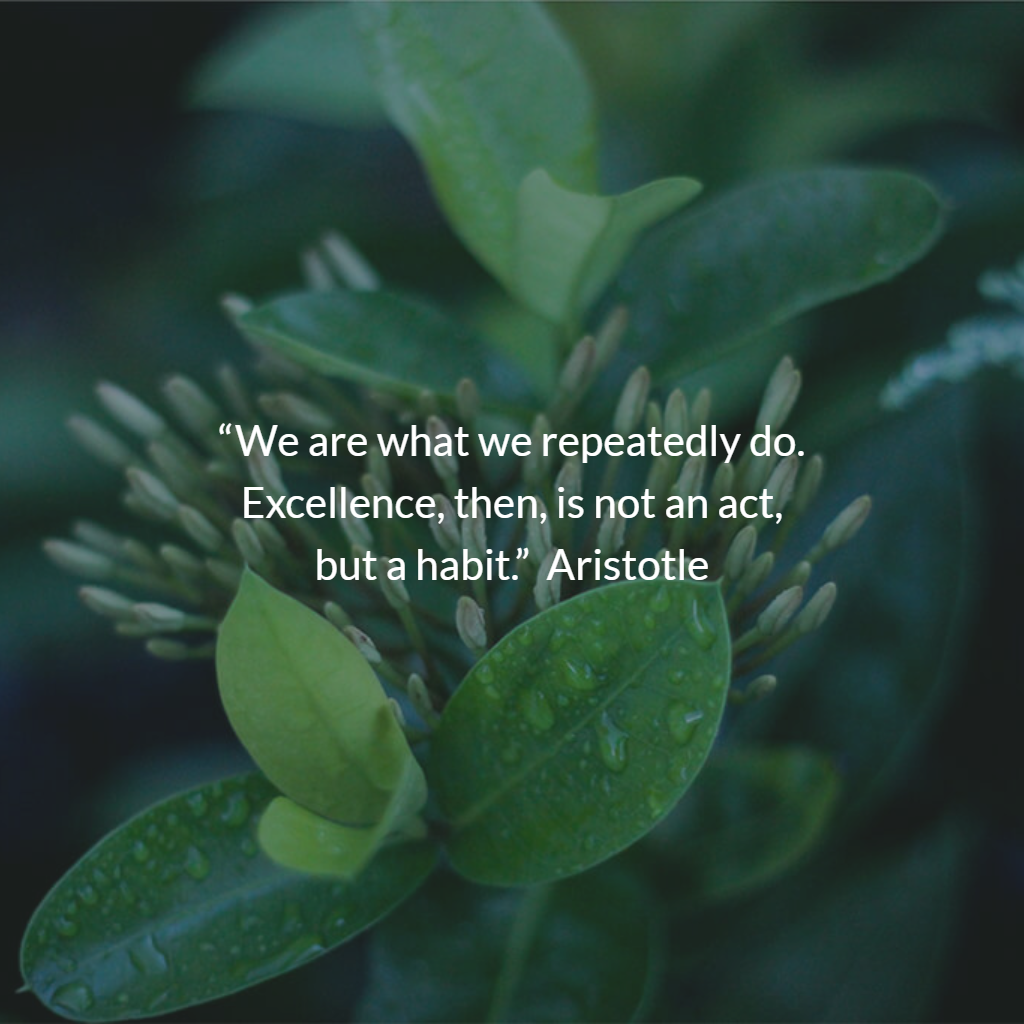
"“We are what we repeatedly do. Excellence, then, is not an act, but a habit.”

Aristotle is credited with saying these 15 famous words. And for most of my life…I didn’t believe him.

I fought against cultivating good habits and routines because I didn’t want to feel like I had to live my life by other people’s rules. I wanted to be my own person and do my own thing. Besides, keeping a routine was hard work.

Know what I discovered?

Having no routine or structure is so much more draining mentally, physically, and emotionally than any routine could ever be!" Go to the source: https://getpocket.com/explore/item/the-ultimate-guide-to-becoming-your-best-self-build-your-daily-routine-by-optimizing-your-mind-body-1070127780

What Does Evolutionary Psychology Have to Do With the Digital World?

Millions of years of evolution have shaped us to best deal with the challenges we face in nature.

Over the course of those years, the human brain has tripled in size, we have transitioned to standing and moving on two legs, and we have become the dominant species in the animal world. Yet none of this has prepared us to cope with a digital environment that constantly challenges our natural tendencies. In recent years, that environment has been changing at such a rapid pace that it is impossible for the forces of evolution to make the necessary adjustments to our natural tendencies, which have not yet adapted to the digital environment: https://www.cmswire.com/customer-experience/what-does-evolutionary-psychology-have-to-do-with-our-digital-world/?utm_source=cmswire.com&utm_medium=web-rss&utm_campaign=cm&utm_content=all-articles-rss

Feeling Superior: Researching the nature effect

The benefits of forest bathing are clear…

Todd Lohenry's avatarOn Forest Bathing

giphy.gif?cid=f19dbcb55b6e35ac624242543661b6a1
via Chris Cubellis on GIPHY

Studies — and studies of studies — support what many health care professionals, scientists, outdoors people and others believe: Time in nature is good for our overall well-being. A random glance at some research: http://www.startribune.com/feeling-superior-nature-science/488105341/

View original post

The Japanese practice of forest bathing (shinrin-yoku) helps ease stress and rejuvenate the spirit: Foreign Correspondence: The nature of happiness? Trees, of course

Get Outside!

giphy.gif?cid=f19dbcb55b6e2b317039722f515e2831
via GIPHY

It’s a familiar problem: "Sitting in front of a computer not long ago, a tenured history professor faced a challenge that billions of us do every day: deciding whether to believe something on the Internet.

On his screen was an article published by a group called the American College of Pediatricians that discussed how to handle bullying in schools. Among the advice it offered: schools shouldn’t highlight particular groups targeted by bullying because doing so might call attention to “temporarily confused adolescents.”

Scanning the site, the professor took note of the “.org” web address and a list of academic-looking citations. The site’s sober design, devoid of flashy, autoplaying videos, lent it credibility, he thought. After five minutes, he had found little reason to doubt the article. “I’m clearly looking at an official site,” he said." Go to the source for more: http://time.com/5362183/the-real-fake-news-crisis/

https://platform.twitter.com/widgets.js

https://platform.twitter.com/widgets.js

"It’s important to pull yourself away from work every now and then. Breaks are one thing, but distractions are another. Breaks are focused and deliberate. Distractions catch you off guard and derail your task entirely. In fact, one study shows it takes about 25 minutes to get back into the swing of things after you’ve been interrupted.

We’ve told you how distractions can cause errors. Even after you’ve removed the interruption, you’re not working at the same capacity you were pre-distraction. In a study from the University of California Irvine, researchers shadowed workers on the job, studying their productivity. Here’s what study lead Gloria Mark told Fast Company of the findings:

You have to completely shift your thinking, it takes you a while to get into it and it takes you a while to get back and remember where you were…We found about 82 percent of all interrupted work is resumed on the same day. But here’s the bad news — it takes an average of 23 minutes and 15 seconds to get back to the task." Source: https://lifehacker.com/how-long-it-takes-to-get-back-on-track-after-a-distract-1720708353

https://platform.twitter.com/widgets.js

https://platform.twitter.com/widgets.js

https://platform.twitter.com/widgets.js

https://platform.twitter.com/widgets.js

https://platform.twitter.com/widgets.js

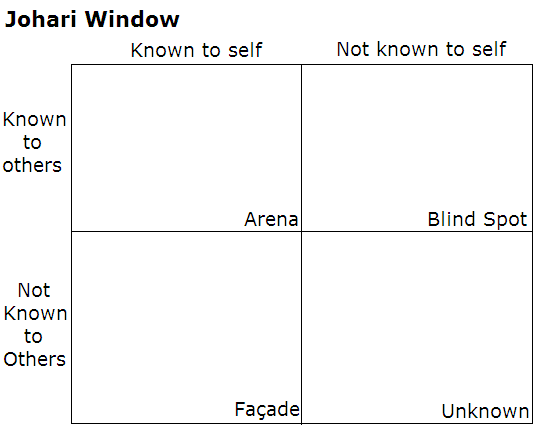
Johari window

The Johari window is a technique[1] that helps people better understand their relationship with themselves and others. It was created by psychologists Joseph Luft (1916–2014) and Harrington Ingham (1916–1995) in 1955, and is used primarily in self-help groups and corporate settings as a heuristic exercise[2][3] . Luft and Ingham called their Johari Window model ‘Johari’ after combining their first names, Joe and Harrington. Source: https://en.wikipedia.org/wiki/Johari_window

Diversity in visual representation matters. Did you know this is part of WordPress.com: Introducing: A Diverse, Free Stock Photo Library


https://platform.twitter.com/widgets.js

https://platform.twitter.com/widgets.js

https://platform.twitter.com/widgets.js

https://platform.twitter.com/widgets.js

"It’s no secret that living in today’s modern world means being busy. From working all day to taking care of children or other responsibilities after work, there isn’t as much time to take care of ourselves.

While you may be familiar with the most common ways in which Americans try to de-stress after a long day, other cultures and countries have rituals you may not have heard of, but which can be equally beneficial. Source: https://www.simplemost.com/wellness-practices-from-around-the-world/"

Start a Blog at WordPress.com.

Up ↑