Breathe into me

Ahhh. Rumi…

Live & Learn's avatarLive & Learn

peyto-lake-full-moon-banff-canada

At night I open the window and ask
the moon to come and press its
face against mine.
Breathe into me.

~ Jalaluddin Rumi, excerpt from “Some Kiss We Want” in A Year with Rumi: Daily Readings by Coleman Barks


Photo of full moon over Peyto Lake by Cath Simard. Peyto Lake is a glacier-fed lake in Banff National Park in the Canadian Rockies. Don’t miss her other shots of Banff here.

View original post

Discussions are better than arguments

Photo

The present

Photo

Clarifying Your Relationship with Alcohol

pablo

Here’s a sharable podcast from Terri Cole!

Do you ever wonder if you drink too much?

Are you concerned about the impact your drinking may be having on your relationships, health, career and overall potential?

There is a hot debate in the recovery world about the plausibility of controlled drinking sometimes referred to as harm reduction, as opposed to total abstinence.

You can listen to it here: Caitlin Padgett – Clarifying Your Relationship with Alcohol

The best way to stand for something

pablo

The best way to build a brand that matters, a story that spreads, an impact that we remember, is to understand a simple but painful trade-off:

If you want to stand for something,

You can’t stand for everything.

“Anyone can be our customer and we will get you what you want…” is almost impossible to pull off. So is, “we are the cheapest and the most convenient and the best.”

It didn’t work for Sears, or for Chevrolet or for Radio Shack. It definitely doesn’t work for the local freelancer, eager to do whatever is asked.

Relentlessly trimming what’s on offer, combined with a resolute willingness to say, “no,” are two characteristics of great brands. And linchpins, too.

Go to the source for more: Seth’s Blog: The best way to stand for something

36 Inspiring Quotes on Letting Go and Moving On

pablo

Letting go can be one of the hardest things to do in life. But at the same time it can be one of the most powerful and liberating things too. So this week I’d like to share 36 of the most thought-provoking and inspiring quotes from the past few thousands of years on letting go, moving on and living your life fully and happily. I hope you’ll find something helpful here…

get more here: 36 Inspiring Quotes on Letting Go and Moving On

This World as We See It

IMG_6483Another lovely post from Tara LeMieux:

“I’m having a bad day,” he said, looking forward through a half-frosted window. The morning was bitterly cold with the coming of winter, and his thoughts were as dark as the sky.

He explained to me his troubles at home; a dishwasher that ‘barely got the job done’ and kids with ‘far too much’ energy. He paused just long enough to sip his coffee – a venti caramel macchiato with just a hint of cinnamon against the edge

I watched his face as he prattled on – lamenting home, work and the traffic both ways. With every word he fell more deeply into ‘self’, creating a ‘reality’ of world absent that much bigger picture.

I watched his face as he stared blankly into the parking lot — missing completely the elderly homeless man now picking through last night’s trash bins.

Nietzsche once asked, “Why does man not see things?” — offering perhaps that it was man, himself, standing in his own way.

We see what we wish to see, arranging this world to suit our ‘vision’. Logically, we understand these aspects of cause and effect – though often fail to see our role within it.

The eyes see clearly, yet also deceive – influenced by the voices which haunt our past history.

“Do you see that man standing out there,” I asked, pointing to the parking area. “He’s here every single day. I’d once asked him the source of his smile – and do you know what he said?”

The young man lowered his eyes and he shook his head slowly.

“He said, ‘I’m alive, I have food and now – the blessing of your company.’”

We see this world as we wish to see it. To some, a paradise; to others, a prison.

And, to those – the truly awakened souls, every moment becomes a cherished blessing.

Go to the source for more: Mindfully Musing – This World as We See It.

Which kind of truth?

seth godinSeth Godin writes:

Organic chemistry doesn’t care if you believe in it. Neither does the War of 1812. 

Truth is real, it’s measurable and it happened. Truth is not in the eye of the beholder.

There are facts that don’t change if the observer doesn’t believe: The age of the Eiffel Tower. The temperature in Death Valley. The number of people in the elevator. 

On the other hand, there are outcomes that vary quite a bit if we believe: The results of the next sales call. Our response to medical treatment. The enjoyment of music…

If you believe that this wine tastes better than that one, it probably will. If you believe you’re going to have a great day at work, it will surely help. Placebos work.

We make two mistakes, all the time. First, we believe that some things are facts (as in true), when in fact, belief has a huge effect on what’s going to happen. In the contest between nature and nurture, nurture has far more power than we give it credit for. In countless ways, our friends and parents matter more than our genes do.

At the same time, sometimes we get carried away. We work to amplify our beliefs by willfully confusing ourselves about whether the truth is flexible. It makes belief a lot more compelling (but a lot less useful) if we start to confuse it with truth.

But belief is too important and too powerful to be a suspect compatriot of the scientific/historical sort of truth. 

We can believe because it gives us joy and strength and the ability to do amazing things. That’s enough.

Go to the source for more: Seth’s Blog: Which kind of truth?

I encourage you to follow his blog!

Artificial Intelligence!

Want to have endless hours of fun? Just get yourself an Amazon Echo and a Google Home and set up two calendar events like this. The result? Madness.

Source: Amazon Echo and Google Home stuck in an infinite loop – Holy Kaw!

Moving Beyond Electoral Trauma

After the 2008 election, I was so despondent over the results I that I caused an accident by turning left into an oncoming car ‘I didn’t see’ in my post-election-trauma fog. At the time, I was the 3rd Vice Chairman of the Republican Party of Wisconsin reporting to Trump’s chief of staff Reince Priebus [Wisconsin Party Chairman at the time] and I thought the election results were the end of my world.
pablo

In hindsight, I see that the growth and development that it caused in my life was some of the most important self work I’ve ever done. I feel the very real pain of my friends who have similar feelings over the election of Donald Trump but I’m telling you from my experience that the sun will still rise over Lake Michigan and you too will survive if you take the time to do some important self work. I offer these thoughts from Psychology Today author James Gordon M.D. as a starting point:

We’ve had a year of angry, clamorous, mean-spirited, often incoherent campaigning, increasing polarization, and now a rude electoral shock for Clinton’s supporters and a surprising vindication for Trump’s.

For the last few weeks, I’ve been listening to and working with large numbers of people of all potential persuasions—in Indiana, Louisiana, California, back here in DC, and with friends and patients on the phone. I’m frequently recognizing the symptoms of posttraumatic stress: anxiety and anger, difficulty focusing and sleeping, threatening dreams, and, often enough, emotional numbness and withdrawal from friends and families– uneasiness about the present and worries about the future.

When my Center for Mind-Body Medicine colleagues and I work with traumatized populations, or individuals, as we have for the last 20 years, we want to begin as early as possible: during rather than after wars, while the rubble is still being cleared after an earthquake or flood, just when the chemotherapy for cancer is beginning. That’s the time to most effectively address the biological, psychological, and social damage that trauma does: to reduce anxiety and agitation, relax bodies tensed against danger, help people gain perspective on what has happened and may happen, and move beyond feelings of powerlessness and despair. In published studies, our model of self-care and group support, whose basics I’m sharing here, has lowered symptoms of posttraumatic stress by 80%.

We also, and importantly, do our best to turn these crises into opportunities for self reflection. The losses and dangers traumatized people experience often make them more aware and appreciative of what really matters most to them.

An election is, of course, not a war, an earthquake, or a life threatening disease. Still, some of the approaches we’ve successfully used feel relevant now. They can help us regain the psychological and physical balance disturbed by this ugly political combat, and its unsettling aftermath, perhaps bring us together to forge a post-electoral future that will feel less contentious and more compassionate.

I’ll share three ways of being, acts of doing that can help us be more fully ourselves, and act more creatively and effectively in the days and months ahead– one in each of three blog posts.

Go to the source for more: Moving Beyond Electoral Trauma | Psychology Today

This is such an important topic, I’ve linked to each of the three blog posts for your convenience here:

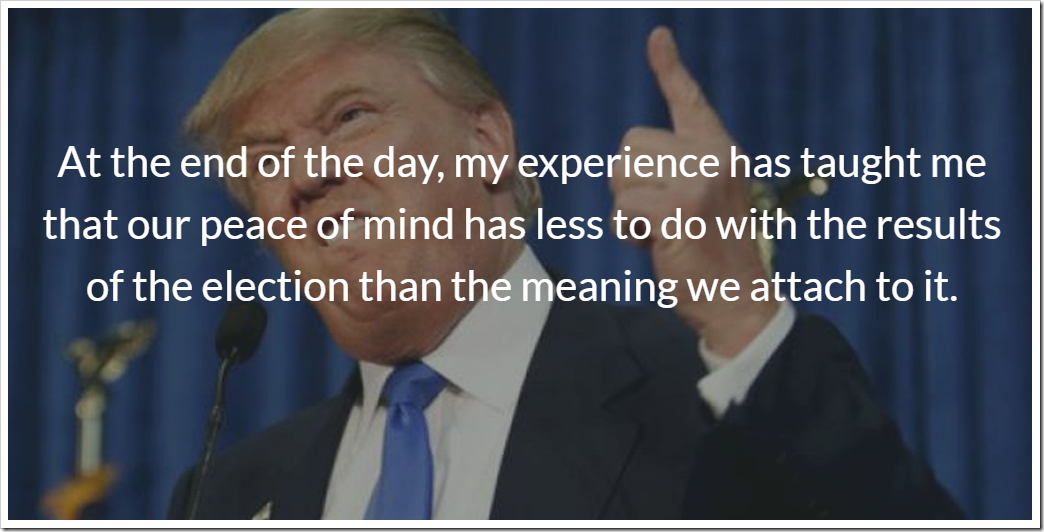
At the end of the day, my experience has taught me that our peace of mind has less to do with the results of the election than the meaning we attach to it and what we do with that meaning.

Life like a real-life Jerry Springer Show?


Bryant McGill writes:

If you want a great life try being kind. It is astounding what power being kind, mannered, polite and considerate has in transforming your life. If you are rude, cynical, negatively-sarcastic or pessimistic, your life options are going to be very limited. Playful, positive sarcasm is different from negative mean sarcasm, and many people don’t know the difference. Be careful with people’s feelings. Elevate your thinking and comportment. Many people live in an induced spiritual coma; they are inherently vicious, and are completely unaware of their malady. They exist in an unconscious, mean-spirited and competitive state of being — always ready to pounce on their next victim. There is a coarse and ugly temperament and tenor observable in the common unconscious person. This piggish coarseness looks like impatience, intolerance, rudeness, vulgarity, selfishness, self-righteousness, ignorance, condescension and mockery. I know what it looks like because it was once in me. Maybe you are a pig and don’t even know it. Have you ever considered it? Maybe you don’t just have “bad luck” — maybe you are caught-up in a stampede of ugliness. The vile are trampled beneath the feet of other pigs. Maybe you’re not a pig but you know someone who is, and you want them to awaken to virtue and righteousness so they can have an incredible life instead of suffering unnecessarily. If you want an incredible life and you have a bad attitude, and are mean to people — you can just forget about it. If you are cynical, pessimistic, judgmental, shallow and petty, you don’t deserve success, because success is empowering, and petty people should never be given power. You have to earn the right to an incredible life by being an incredible person. Your life is always a perfect reflection of your state of heart and mind, and of your truest identity. There is a different world on the other side of your present attitude. You can only access the beautiful world through faith by truthfully embracing beauty and caring. Be open to others; give people a chance. Be open to yourself; give yourself a chance.

Source: Life like a real-life Jerry Springer Show? by +Bryant McGill Your life is no…

Why It’s a Good Thing When Family Members Push Our Buttons

pablo (1)

A positive perspective on families and button pushing…

You love them most of the time. You can’t stand them some of the time. But in the end, family is family.

I’ve never liked to admit it, but I am just like my dad. Close in birthday, same number 5 life path in numerology, both risk takers, very passionate and adventurous, fun-loving, and witty, and we lead by example. That’s positively speaking.

However, it becomes a negative pattern to focus on the other side of the coin. We both have the ability to become angry, withdrawn, and addicted to drama, and we both try to please everyone then resent others for their own imbalance.

Do you think it’s any surprise the family you were born into?

I used to blame my snappy behavior on my dad, whether at work, with girlfriends, or in social environments. “It’s my conditioning,” was my excuse I told myself. That’s exactly what it is from my perspective—an excuse.

On closer self-reflection, I found myself getting angrier and angrier that I was like my dad and becoming more like him.

Go to the source for more: Why It’s a Good Thing When Family Members Push Our Buttons

5 Signs You’re In The Wrong Relationship

pablo

Here’s the one that resonates with me:

You’re constantly trying to prove your worth.

It’s bad enough that we have to constantly seek our worth in the world. But if we’re also doing this in our relationship, there’s something wrong. That’s the one place where you shouldn’t have to prove your worth.

But how do you know if you’re constantly trying to prove your worth? First, start by acknowledging that there’s a difference between seeking approval and validation, which we all do to a certain extent, and seeking your worth or value.

Here are some signs that you’re constantly seeking your worth in a relationship.

Your ideas are shot down.
Your partner doesn’t support your dreams.
You rarely get to talk about you.
Your partner may listen to you but they don’t hear you.
You feel invisible.

It’s not your partner’s job to make you feel valuable, but it is their job to create a safe space where your worth is encouraged and grown instead of ignored or even bashed. Your relationship shouldn’t make you feel invisible. It should make you feel invincible.

Go to the source for more: 5 Signs You’re In The Wrong Relationship | Psychology Today

What comes to those who wait?

Dr. Steve McSwain shares this from Bryant McGill:

Many have said that happiness is an inside job, but be sure to put some emphasis on the word “job.” First, accept that you have responsibility in your own happiness. Stop blaming the world, your past, bad luck or other people. Accept the fact that you have some power and choices in your life. Then begin to use your power and choices.
The most insubordinate obstacle you will encounter is your own limited thinking. How long are you going to keep waiting for happiness to come your way? I guess you’re waiting for happiness to knock your door down and drag you out of your x-year-long streak of “bad luck.”
Quit making excuses, quit denigrating yourself and quit lying to yourself about your lack of ability. Tell the truth; you can, you will and you are. You are not going to move forward unless you firmly commit yourself to change. You must be stubborn about what you can do, not stubborn about why you can’t. Be adamant about your standards.
You may live in a harsh world at times, but you can have a beautiful inner-life, and a beautiful outer-life always begins with a beautiful inner-life.
What are you waiting for?

Go to the source for more: What comes to those who wait? Many have said that happiness is an inside job…

The Forgiveness of Our Choosing

pablo

One of my favorite bloggers – Tara LeMieux – writes:

Grief has its way, does it not? Of exposing the roots of memory’s tallest shadow – and, the seemingly irreconcilable aspects of heart.

We long for that which has passed; we plead for better days. We stand alone in the mists of our guilt-laden thoughts, fearful to allow soul’s forgiveness.

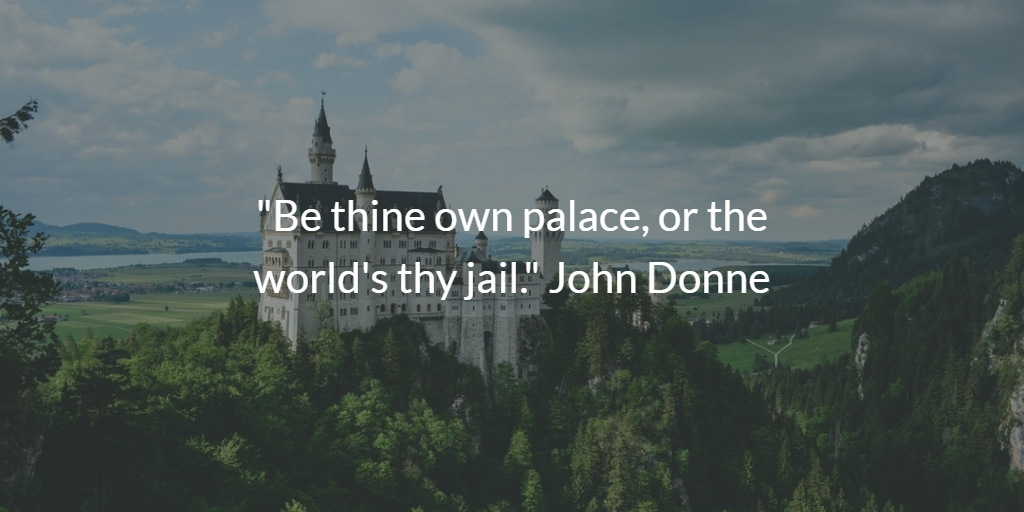
“Be thine own palace,” writes poet, John Donne. “Or the world’s thy jail.”

Yet, yielding ourselves to this expansiveness of light can often prove overwhelming. Though never, my loves – unbearable.

The truth is – we, ourselves, divine these fates. And, we alone, determine our journey.

Whether to suffer a pain tethered to past, or to encourage the wonderment of tomorrow.

Let this be our choosing.

To some, grief is an unwelcome guest. While to others, a guide to forgiveness.

Go to the source for more: Mindfully Musing – The Forgiveness of Our Choosing.

Seth’s Blog: The FLASH drives

The ever-brilliant Seth Godin writes:

Fear, loneliness, anger, shame & hunger.

They drive us. They divide us. They take us away from our work, our mission, our ability to make a difference. And yet, sometimes, they fuel our motion, leading to growth and connection.

When a variety of FLASH shows up, it almost never calls itself by name. Instead, it lashes out. It criticizes what we’ve made or done. And mostly, it hides behind words, argument and actions, instead of revealing itself.

As you’ve guessed, correcting the false argument is futile. Logic doesn’t work either. You can’t reason with FLASH because it is, by definition, unreasonable.

Worth repeating that: We’re rarely reasonable. Most of the time, we’re afraid, lonely, angry, shameful or hungry.

Sometimes, we can address those emotions by seeing that reason can help our problem, but mostly, we start and end with the emotion.

Recognize it.

Pause to allow it be seen and heard.

And then, if we’re willing, we can dance with it. We can put the arguments aside, the demands and the expectations and sit with the emotion. Not get defensive, because the emotion isn’t about us or our work at all.

Then, maybe, we can begin to bring civilization back into the conversation, the story of us, the opportunity for growth and connection, and ultimately, the power of thought and reason and forward motion.

Go to the source for more: Seth’s Blog: The FLASH drives

Lion opens car door with its mouth

This is the last thing you want to happen on a safari. Watch this lion open a car door with its mouth, giving the passengers the scare of a lifetime.

Source: Lion opens car door with its mouth – Holy Kaw!

New Rule: All Purchases Subject to a Mental Quarantine

Overwhelmed by shtuff? Consider this!

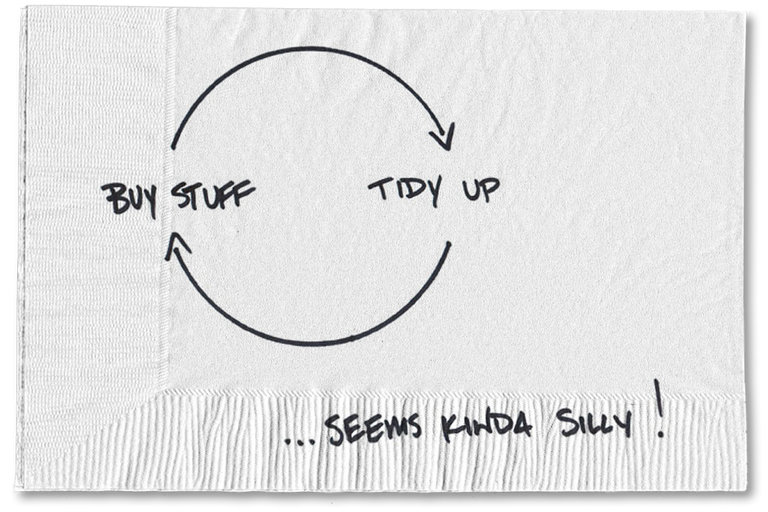
My wife and I are setting up a customs screening station in our driveway. No, we’re not starting an international airport. And it’s not for solicitors, strangers or gift-bearing guests. It’s for us and our stuff. From now on, before anything new comes into the house, resident buyers will need to answer a series of questions. How much did it cost? Are you replacing something you already own? Why do you think it’s amazing? And if it’s food, are you sure you’ll eat it? We’re doing this because stuff is taking over our home. And right now we’re in the process of getting rid of things we never use. We’re organizing, sorting and throwing things out from one end of the house to the other. And it feels. So. Good.

Go to the source for the rest of the article: New Rule: All Purchases Subject to a 7-Day Mental Quarantine – The New York Times

It reminds me of the old Paul McCartney song ‘Singalong Junk’: Buy! Buy! Says the sign in the shop window. Why? Why? Says the junk in the yard…

Marcus Aurelius and stoicism: a lesson in philosophy

Marcus Aurelius, sometimes referred to as the philosopher king à la Plato, is most famous for his philosophical writings called Meditations. This video introduces you to that important text.

Source: Marcus Aurelius and stoicism: a lesson in philosophy – Holy Kaw!

4 Questions to Ask Before Wearing a Safety Pin

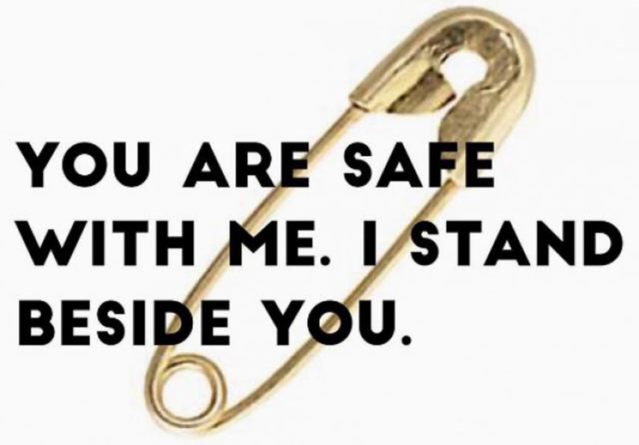
Are you among the many Americans who are considering wearing a safety pin after this election? This simple object has quickly emerged as a sign that the wearer is willing to offer a safe space for women, immigrants, Muslims, LGBTQ, people of color, and other groups marginalized by the rhetoric of President-elect Donald Trump.Members of marginalized groups have good reason to fear. They have been suffering from a sharp spike in hate crimes after the election, part of a broader wave of hate crimes associated with Trump’s election campaign. The surge of hate crimes in the US parallels a similar rise in hate crimes against immigrants in the UK after Brexit. Indeed, the US safety pin movement is adapted from the post-Brexit UK safety pin movement, which symbolizes support for immigrants there.Progressive US media venues are advocating strongly for the seemingly small step of wearing safety pins. Stores across the United States are running out of stock. Yet there are hidden dangers in wearing safety pins, as shown by the post-Brexit safety pin movement. Here are the 4 questions you need to ask before wearing a safety pin to help you avoid these dangers.

Source: 4 Questions to Ask Before Wearing a Safety Pin | Psychology Today

Start a Blog at WordPress.com.

Up ↑