Today in Revolutionary War History — September 8
THE BATTLE
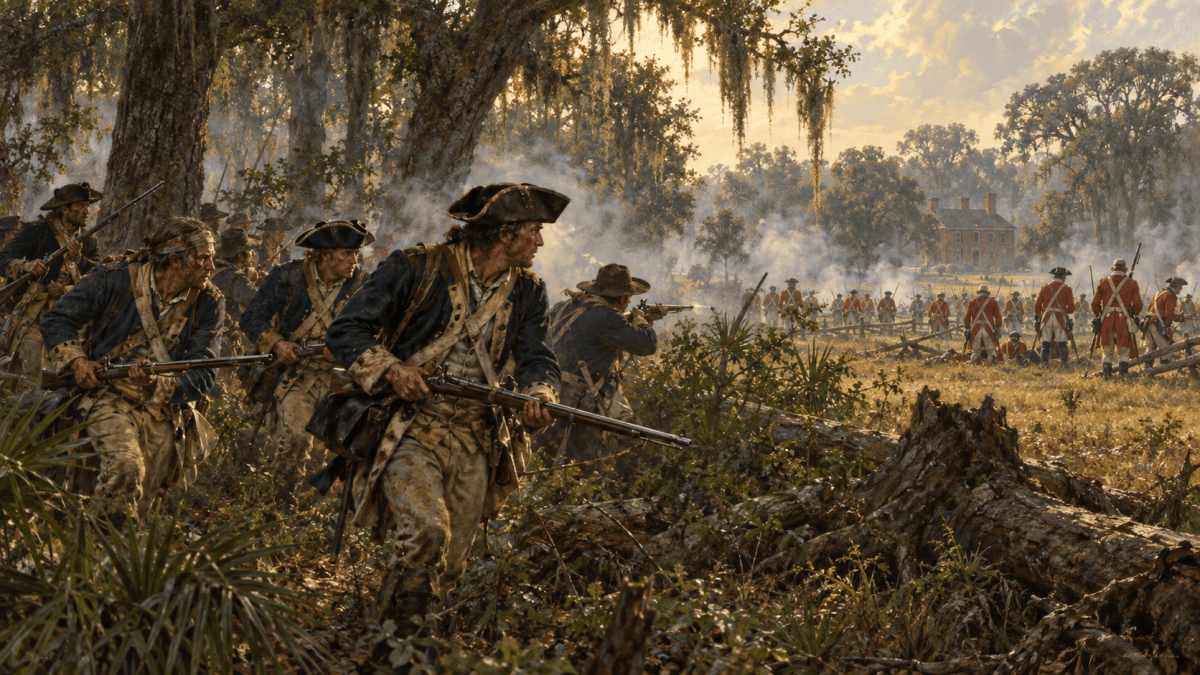
On September 8, 1781, two exhausted armies collided at Eutaw Springs, South Carolina, in one of the fiercest—and most revealing—battles of the American Revolution’s Southern Campaign.
Major General Nathanael Greene marched roughly 2,200 American troops toward a British camp commanded by Lieutenant Colonel Alexander Stewart. Greene had spent months refusing to let battlefield setbacks become strategic defeats. Again and again, he forced the British to spend men and supplies they could not easily replace.
The Americans struck early. Their militia gave way to Continental regulars, who drove much of the British line backward. For a moment, the Patriot attack seemed ready to sweep the field. Then the advance lost momentum. Some American soldiers stopped to plunder the British camp, while determined defenders rallied around a brick house and nearby garden. A British counterattack helped turn the tide.
By day’s end, Greene had withdrawn. The British held the field, so by the usual rules of eighteenth-century warfare they could claim victory. Yet their losses were punishing, and Stewart soon pulled his force closer to Charleston. The British had won the battle while losing more of their ability to control the South Carolina interior.
WHY IT MATTERED
Eutaw Springs reminds us that the meaning of a battle is not always visible at sunset. Greene’s army did not need to possess the ground forever. It needed to make British occupation too costly to sustain. In that larger contest, the Americans were succeeding.
The battle was among the last major engagements in the Carolinas. Just weeks later, British forces under Lord Cornwallis would be trapped at Yorktown. Eutaw Springs did not cause that surrender, but it belonged to the same tightening strategic picture: British armies could still win hard fights, yet their room to maneuver was disappearing.
A NOTE ON “VICTORY”
History likes clean scoreboards. Wars rarely provide them. Eutaw Springs was a British tactical victory and an American strategic gain—a reminder that endurance, logistics, and political purpose can matter as much as possession of a battlefield.
On this September 8, remember the soldiers on both sides who fought through heat, smoke, confusion, and fear. And remember Nathanael Greene’s stubborn lesson: sometimes the path to victory looks, for a while, like retreat.
Sources and further reading: American Battlefield Trust, “Eutaw Springs,” https://www.battlefields.org/learn/revolutionary-war/battles/eutaw-springs ; George Washington’s Mount Vernon, “Battle of Eutaw Springs,” https://www.mountvernon.org/library/digitalhistory/digital-encyclopedia/article/battle-of-eutaw-springs ; National Park Service, “William Washington,” https://www.nps.gov/cowp/learn/historyculture/williamwashington.htm
 Bright, Shiny Objects!
What do you think?