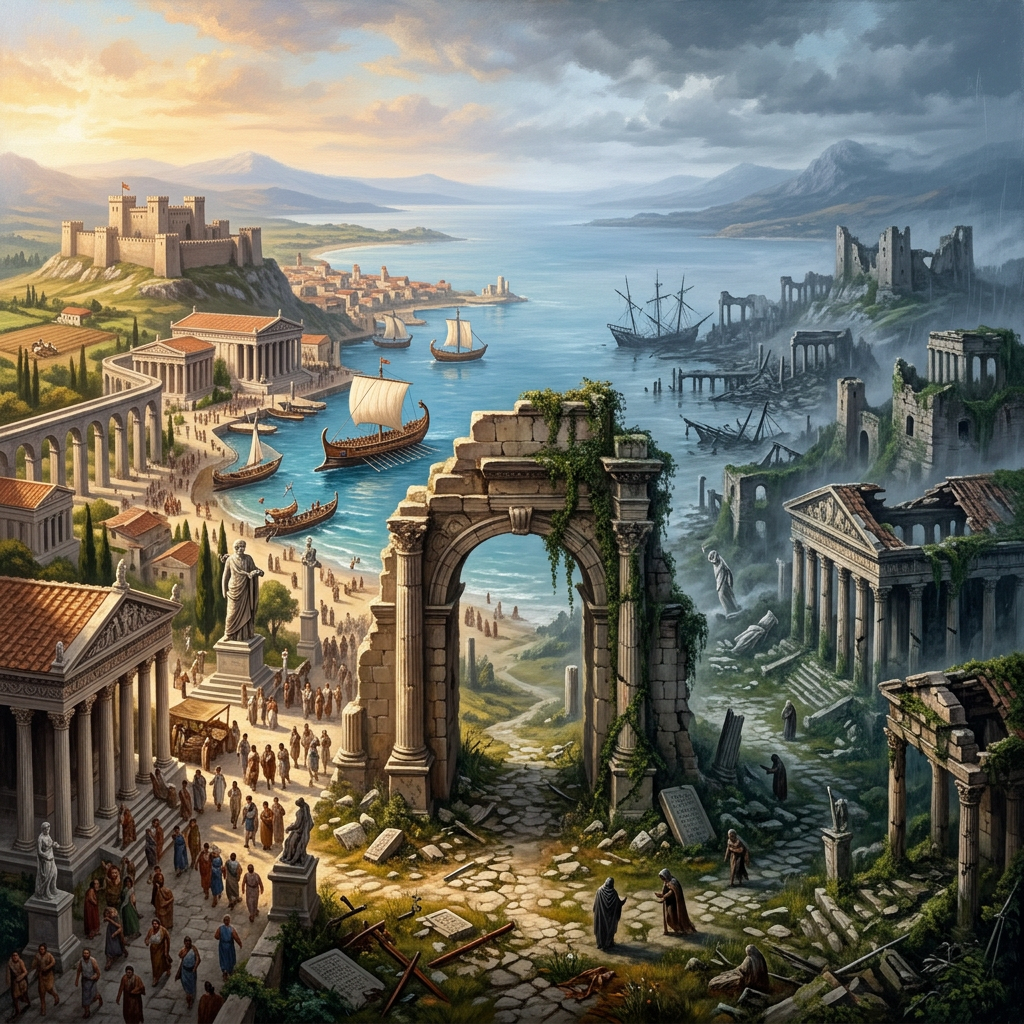
When historians compare current U.S. indicators to past superpowers, they usually look at two distinct archetypes of decline: Western Rome (a story of internal institution failure, hyper-inflation, and sudden structural collapse) and the British Empire (a story of economic exhaustion, managed decolonization, and a peaceful handover of global leadership).
Comparing where the U.S. currently sits against those two historical blueprints reveals key structural similarities and differences:
1. Debt, Inflation, and Financial Hegemony
Era / Empire | Financial Strategy | The Outcome |
Western Rome | Currency Debasement: Reduced the actual silver content of the denarius to fund legions and domestic hand-outs. | Widespread inflation, loss of faith in currency, and a barter-driven economy. |
British Empire | Debt Accumulation: Spent massive capital fighting World War I and II, borrowing heavily from the U.S. | The British Pound lost its status as the prime global reserve currency to the U.S. Dollar. |
United States | Fiscal Deficits & Reserve Currency: $36T+ national debt alongside early “de-dollarization” signals. | Financial leverage remains strong, but interest payments on debt are beginning to strain federal budgets. |
- The Parallel: The U.S. debt and deficit profile looks closer to 20th-century Britain than ancient Rome. Like Britain, the U.S. borrowed heavily to maintain global influence and domestic commitments. However, unlike Rome, the U.S. dollar still benefits from being the world’s chief reserve currency, giving it a financial buffer Rome never possessed.
2. Imperial Overstretch & Military Deterrence
- Rome: Strained its borders along thousands of miles of frontiers (Rhine and Danube rivers). As border defense costs soared, manpower shrank, forcing reliance on foreign mercenary tribes who eventually turned on imperial authorities.
- Britain: Maintained colonies across a quarter of the globe. Post-WWII economic exhaustion meant Britain could no longer afford to police its global network, forcing rapid withdrawal from Asia, Africa, and the Middle East.
- United States: Operates roughly 750 bases across 80+ countries. Managing simultaneous military deterrence in Eastern Europe, the Middle East, and the Indo-Pacific strains defense stockpiles and domestic industrial capacity.
- The Parallel: The U.S. mirrors Britain’s overstretch problem—it isn’t being physically invaded by external forces like Rome was, but its global commitments require more military and economic energy than domestic politics easily supports.
3. Political Polarization & Institutional Health
- Rome: Republican institutions dissolved into political violence, elite infighting, private armies loyal to generals rather than the state, and eventually autocratic rule under the Caesars.
- Britain: Maintained strong, adaptable parliamentary institutions. Its global power shrank, but its domestic democracy and civil society remained intact without a civil war or institutional collapse.
- United States: Experiences deep hyper-polarization, declining public trust in core institutions, and gridlock over long-term strategic policy.
- The Parallel: Analysts who worry about American democratic decline often cite late Republican Rome—not because modern politicians command private armies, but because norm-breaking, institutional paralysis, and extreme factionalism mirror the political instability that preceded Rome’s imperial turn.
4. Peer Competitors and Multipolarity
- Rome: Faced decentralized, non-state nomadic confederations (“barbarians”) rather than an industrial peer superpower.
- Britain: Faced rising industrial peer rivals—primarily the United States and Germany—that gradually outpaced British steel, manufacturing, and trade output.
- United States: Faces China as a massive industrial, naval, and technological peer competitor.
- The Parallel: The U.S. position strongly resembles late 19th-century Britain. Its decline in global manufacturing share is not because domestic production vanished, but because a rival nation with a far larger population industrialized rapidly.
The Takeaway
Most economic and foreign policy historians view the U.S. as following Britain’s path of “relative decline” rather than Rome’s catastrophic collapse. Unlike Rome, the U.S. isn’t facing total administrative collapse or foreign conquest. Instead, like post-imperial Britain, it is navigating a transition from a single dominant superpower (“unipolarity”) to a shared global stage (“multipolarity”).
This video offers a concise breakdown of how monetary inflation in ancient Rome and post-war debt in Britain compare directly to modern American economic trends.
 Bright, Shiny Objects!
What do you think?