The Time of Your Life: More Time for What Really Matters to You

Tony Robbins writes:

When it comes to managing time, most people focus on one question: What do I need to do? Focusing only on what it is you need to do, however, does not guarantee that you are making any real progress. To-do lists can keep you busy, and checking off a series of tasks can provide the illusion of progress. But have you ever crossed off everything on your to-do list and still felt like you had not really accomplished anything? There is a big difference between movement and achievement.

Activity without purpose is the drain to a life of fulfillment.

Those who succeed in life, and more importantly, achieve fulfillment—whether they are consciously aware of it or not—have three things they consistently focus on to produce results in their lives:

  • They know what they want: The target or the result they are after.
  • They know why they want it: The compelling purpose that gives them the drive to follow through.
  • They know how to make it happen: They have a flexible MAP (Massive Action Plan) to get them there.

Start with the end in mind. By focusing on the result you desire and the specific reasons that drive you, you’ll come up with a more effective action plan to get there. There are so many things competing for and demanding your attention in life, if you don’t make a conscious effort to decide in advance which things you’re going to focus on, you’ll live in reaction to demands of the moment.

Focus is the ultimate power that can change the way we think, the way we feel and what we do in any moment. When we change our focus, we change our life.

For a free download of the first session of Tony’s Time of Your Life 10-Day Audio Coaching System, go to www.tonyrobbins.com/time.

via The Time of Your Life: More Time for What Really Matters to You.

You never know…

…how an act of kindness will help. How many times have I said ‘Nahhhhhhhhhhhhhhh’, later or “I’m too tired” to the little voice in my heart?

PostSecret: Sunday Secrets.

Perhaps this is why the Christian Scriptures say: Anyone, then, who knows the good he ought to do and doesn’t do it, sins.

Working With Difficulties

Tara Brach writes:

About twelve years ago, a number of Buddhist teachers began to share a new mindfulness tool that offers in-the-trenches support for working with intense and difficult emotions. Called RAIN (an acronym for the four steps of the process), it can be accessed in almost any place or situation. It directs our attention in a clear, systematic way that cuts through confusion and stress. The steps give us somewhere to turn in a painful moment, and as we call on them more regularly, they strengthen our capacity to come home to our deepest truth. Like the clear sky and clean air after a cooling rain, this mindfulness practice brings a new openness and calm to our daily lives.

I have now taught RAIN to thousands of students, clients, and mental health professionals, adapting and expanding it into the version you’ll find in this chapter. I’ve also made it a core practice in my own life. Here are the four steps of RAIN presented in the way I’ve found most helpful:

R   Recognize what is happening 

A  Allow life to be just as it is

I   Investigate inner experience with kindness

N  Non-Identification

RAIN directly de-conditions the habitual ways in which you resist your moment-to-moment experience. It doesn’t matter whether you resist “what is” by lashing out in anger, by having a cigarette, or by getting immersed in obsessive thinking. Your attempt to control the life within and around you actually cuts you off from your own heart and from this living world. RAIN begins to undo these unconscious patterns as soon as we take the first step.

Full story at: Tara Brach – Working With Difficulties.

Why Sitting is Killing You

Stepcase Lifehack

via Why Sitting is Killing You.

Spirituality and Stilettos

Jackie-portraitOne of my favorite bloggers, Jackie Dumaine, has a beautiful post on her blog on the topic of spirituality:

“Being “Spiritual” does not mean giving up who you are.  In fact, it’s quite the opposite.

It’s about embracing who you are.

Being “Spiritual” does not mean giving up wine night with the girls or refraining from buying a new pair of stilettos (or two).  It means embracing varying levels of friendships and the little pleasures that life has to offer, without being attached to them for your happiness. Continue reading “Spirituality and Stilettos”

Self-compassion…

Neff, Kristin_400Kristin Neff writes:

So what’s the answer? To stop judging and evaluating ourselves altogether. To stop trying to label ourselves as “good” or “bad” and simply accept ourselves with an open heart. To treat ourselves with the same kindness, caring, and compassion we would show to a good friend, or even a stranger for that matter. Sadly, however, there’s almost no one whom we treat as badly as ourselves.

Neff, Kristin. Self-Compassion: Stop Beating Yourself Up and Leave Insecurity Behind (Kindle Locations 105-108). William Morrow. Kindle Edition.

Continue reading “Self-compassion…”

Clearing

Clearing
by Martha Postlewaite

Do not try to save
the whole world
or do anything grandiose.
Instead, create
a clearing
in the dense forest
of your life
and wait there
patiently,
until the song
that is your life
falls into your own cupped hands
and you recognize and greet it.
Only then will you know
how to give yourself
to this world
so worthy of rescue.

Self-acceptance…

Melody-Beattie-8x6.jpgMelody Beattie writes:

Self-acceptance is a more humble term than self-esteem or self-love. Self-love has tones of narcissism—me first and to heck with you. Self-esteem rings of pride—holding our­selves up higher than everybody else. Self-acceptance is that gentle place we get to when we make peace with who we are.

“For a long time, when I talked to certain people. I got squeamish and uncomfortable. like it wasn’t okay to be me.” a friend said. “I thought it was me being uncomfort­able with myself. I’ve finally learned that I’m responding to how uncomfortable some people feel about themselves.”

We might feel so awkward about ourselves that we believe we have to be different from who we are. Some of that comes from low self-worth, not believing that we’re okay. Or it can stem from a need to control. We think if we pretend to be different or better. we can manipulate how other people feel about us.

Continue reading “Self-acceptance…”

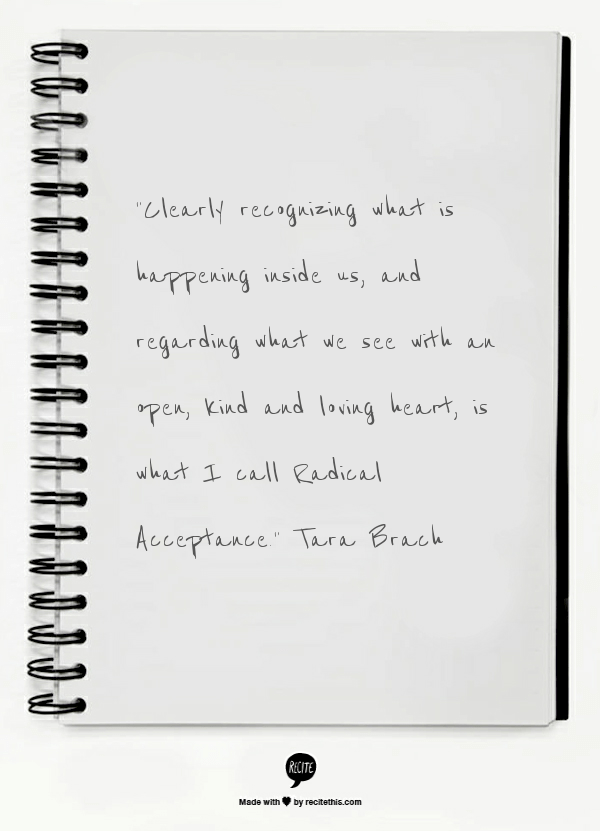
Radical acceptance…

recite-6923-289587727-kgznr6

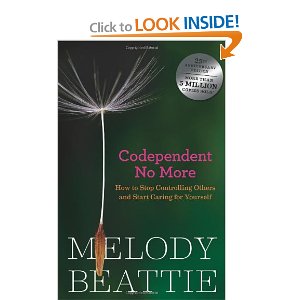
If self-acceptance is an issue with you [as it is with me] may I suggest the following book which has been giving me deep insights in this area:

416XVNN6NRL._BO2,204,203,200_PIsitb-sticker-arrow-click,TopRight,35,-76_AA278_PIkin4,BottomRight,-64,22_AA300_SH20_OU01_
Click the image to view/purchase at amazon.com…

Recovery

Melody-Beattie-8x6.jpgMelody Beattie writes:

Recovery is not about being right; it’s about allowing ourselves to be who we are and accepting others as they are. That concept can be difficult for many of us if we have lived in systems that functioned on the “right-wrong” justice scale. The person who was right was okay; the person who was wrong was shamed. All value and worth may have depended on being right; to be wrong meant annihilation of self and self-esteem. In recovery, we are learning how to strive for love in our relationships, not superiority. Yes, we may need to make decisions about people’s behavior from time to time. If someone is hurting us, we need to stand up for ourselves. We have a responsibility to set boundaries and take care of ourselves. But we do not need to justify taking care of ourselves by condemning someone else. We can avoid the trap of focusing on others instead of ourselves. In recovery, we are learning that what we do needs to be right only for us. What others do is their business and needs to be right only for them. It’s tempting to rest in the superiority of being right and in analyzing other people’s motives and actions, but it’s more rewarding to look deeper.
Today, I will remember that I don’t have to hide behind being right. I don’t have to justify what I want and need with saying something is “right” or “wrong.” I can let myself be who I am.

Beattie, Melody (2009-12-15). The Language of Letting Go (Hazelden Meditation Series) (p. 47). BookMobile. Kindle Edition.

How to Practice Radical Acceptance

Kristin Barton Cuthriell got me started with her post this morning and I can’t let this thought go. Here, an eHow contributor give instructions on how to practice radical acceptance:

Radical acceptance is the practice of accepting life on its own terms and finding effective strategies to cope with whatever is happening. It doesn’t mean being passive, but accepting “what is” with the understanding that you have the power of choice. Practicing radical acceptance is a choice that can ease stress and depression and enhance your overall quality of life.

Get the instructions here: How to Practice Radical Acceptance | eHow.com.

Stop! 9 WARNING Signs That You May Be in a Dangerous Relationship

Ponder this:

Any relationship can be an unhealthy one. Bad relationships aren’t just limited to marriages or partnerships—they can occur while dating, in friendships, or families. Any relationship that is harmful or destructive to your physical, mental, or emotional well-being is an unhealthy one.

There are many reasons why people stay in an unhealthy relationship. Some don’t recognize or aren’t willing to accept that the relationship is unhealthy, or they are fearful or lack the inner strength to leave. Or, they believe that they can change their partner and things will improve. The sad truth is that unhealthy relationships rarely get better; instead, they get progressively worse, leaving scars that are difficult to recover from.

Full story at: Stop! 9 WARNING Signs That You May Be in a Dangerous Relationship – Lifehack.

Letting go in love…

codependent no moreMelody Beattie writes:

When people with a compulsive disorder do whatever it is they are compelled to do, they are not saying they don’t love you – they are saying they don’t love themselves.
Codependent No More

Gentle people, gentle souls, go in love.

Yes, at times we need to be firm, assertive: those times when we change, when we acquire a new behavior, when we need to convince others and ourselves we have rights.

Those times are not permanent. We may need to get angry to make a decision or set a boundary, but we can’t afford to stay resentful. It is difficult to have compassion for one who is victimizing us, but once we’ve removed ourselves as victims, we can find compassion.

Our path, our way, is a gentle one, walked in love – love for self, love for others. Set boundaries. Detach. Take care of ourselves. And as quickly as possible, do those things in love.

Today, and whenever possible. God let me be gentle with others and myself. Help me find the balance between assertive action taken in my own best interests, and love for others. Help me understand that at times those two ideas are one. Help me find the right path for me.

via Blog | Just For Today Meditations.

Leave It. Change It. Accept It…

Claire Obeid writes:

I’ll never forget the first and only time I read Eckhart Tolle’s The Power of Now. Forever etched in my heart and mind is one key message…

“Leave it. Change it. Accept it.”

No other concept has run clearer bells for me since then. Despite the hours I spend devouring up as many spiritual, self-help and wellness books, I still find myself reciting those words like my own personal mantra – it’s how I live my life. It flutters in my mind during yoga, it catches my attention when I’m alone, it nestles into my heart when I need it the most. Not to mention that I enthusiastically pass this little gem on to my health-coaching clients in an effort to incite some calm into their world.

Every time you’re faced with a stressful situation, when you’re working at something without a return or when your ego and emotions get the better of you, just look to these three steps. See them as your spiritual compass to guide you into a calmer, clearer frame of mind.

via Leave It. Change It. Accept It: How Eckhart Tolle Changed My Life.

How To Let Go Of Codependency

SunsetHoldingHands660Shelly Bullard writes:

Codependency is one of those words that gets tossed around a lot, but I’m not sure many people really know what it means. The definition can be both vague and all-encompassing.

Codependency is not a word I use too often because I find that it can come off sounding derogatory—like something is wrong with you if you’re codependent. And I personally like to steer clear from labeling people as flawed.

But another reason I don’t use the word often is because I prefer the phrase “to be human”—because from my experience, we all have codependent tendencies. (So let’s agree to drop the pejorative label right here, shall we?)

The reality is, codependent behavior is quite common in relationships. Therefore it seems appropriate to give it some air-time. In this article I am going to discuss what I know about codependency and give you some suggestions on how to shift this pattern in your life.

Codependency is a word used to describe the process of using another person’s feelings to dictate how you feel.

So this could mean that you are dependent on someone else’s positive attention or positive affect to feel good. And this could mean that someone’s negative attention or negative affect makes you feel bad. (And anything in between.)

When you are codependent, you make another person your higher power. Your sense of well-being (and lack thereof) is dependent on them.

Full story at: How To Let Go Of Codependency.


Wholeheartedness = courage, compassion and connection…

220px-Brene_portrait_cropWEBTime to mix things up again. Thanks to my friend Tim Kastelle for sharing Brené Brown’s TED Talk on vulnerability. She writes here on cultivating worthiness…

Practicing courage, compassion, and connection in our daily lives is how we cultivate worthiness. The key word is practice. Mary Daly, a theologian, writes, “Courage is like—it’s a habitus, a habit, a virtue: You get it by courageous acts. It’s like you learn to swim by swimming. You learn courage by couraging.” The same is true for compassion and connection. We invite compassion into our lives when we act compassionately toward ourselves and others, and we feel connected in our lives when we reach out and connect. Before I define these concepts and talk about how they work, I want to show you how they work together in real life—as practices. This is a personal story about the courage to reach out, the compassion that comes from saying, “I’ve been there,” and the connections that fuel our worthiness.

Brown, Brene (2010-09-20). The Gifts of Imperfection: Let Go of Who You Think You’re Suppose to Be and Embrace Who You Are (p. 7). BookMobile. Kindle Edition.

Here’s the TED Talk in case you haven’t seen it yet…

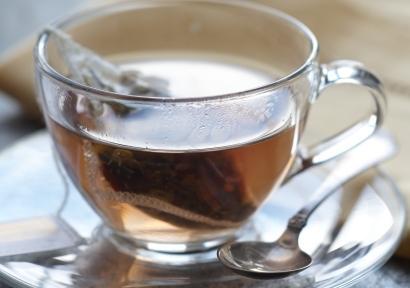
How to Make Tea

How to Make Tea - Prevention.com

Lately, I have been turned on to the joy of loose leaf tea. My ‘tealologist’ Jenelle of Caffe Tlazo in Algoma, WI says that the tea we buy in the grocery store is the ‘hot dog‘ of teas made of from the floor sweepings of the good stuff. You can learn more about making good tea here: How to Make Tea – Prevention.com. Ask Jenelle if you want to know more about buying good tea once you know how to make it…

Oh, Discipline! We Need To Hang Out More Often!

donnagatesDonna Gates writes:

Chop wood and carry water. According to meditation masters and seasoned yogis, the path to greater awareness is unadorned and practical.

In order to awaken to our essential self, all we need is determined effort.

And after we “wake up,” the story is the same: Chop wood and carry water.

Too often, we glamorize spirituality. We are accustomed to finding peace in a place that we need to go to. In reality, our greatest source of strength and peace is within.

And the only way to get there is with consistent effort and discipline.

Discipline can take us to deeper and more fulfilling places in life. It can make our dreams a reality and it can bring our goals within arm’s reach.

Full story at: Oh, Discipline! We Need To Hang Out More Often!.

Why Feeling Like a Victim Makes You Unhappy

shelley-bullardShelly Bullard writes:

We all get caught in the victim-trap from time to time. Feeling like we’ve been wronged; like we were right and they were, well, I’m sure we can complete the sentence with lots of words. It’s true, being a victim is not an uncommon stance to take in this world.

But you should know that feeling like a victim only makes you feel worse. Many of us don’t realize this. In fact, often we hang-out in victim-land because we unconsciously believe that it will get us what we want (which is care, concern, and love). On some level we think being a victim will make us feel better! We are sorely mistaken.

If you recognize that sometimes you identify as a victim and you want to stop the pattern, then keep reading. In this article I’m going to discuss why feeling like a victim ultimately leads to more unhappiness, and how to turn the pattern around. Continue reading “Why Feeling Like a Victim Makes You Unhappy”

20 Videos That Went Viral in 2012

See on Scoop.itWhat I see, what I feel, what I’d like to see…

Since the advent of YouTube, short, homemade videos have skyrocketed to Internet fame in just a few days time. We’ve got some of the best videos in health and fitness to go viral over the past year.

See on greatist.com


IMG_20121228_075016

Start a Blog at WordPress.com.

Up ↑