The Grass Is Greener Somewhere Else . . . NOT!

Tony Meindl shares some great insight here:

The grass is greener syndrome.

If you suffer from it, it’s yet another way of postponing your life. Putting the things you desire on the back burner. When we covet another person’s journey, we think if only we had what they had, our life would be more fun. Or more exciting. Or more magical.

Your life already is magical.

We’re just not awake to it, so it feels as if we’re moving around in a monochromatic haze while everyone else seems to be living in Technicolor.

That’s the illusion.

The truth is that your grass is very green. It’s lush and tropical and exotic and fertile and full of possibilities. But it requires you to fully embrace it. All of it. Even the stuff you don’t like, because actually, that’s the stuff that becomes the catalyst for change.

That stuff is your grass’s fertilizer. It’s the essential stuff needed for your growth and expansion. And it holds the potential to unlock the doors you’ve shut to the things you’re seeking:  your joy, your passion, your peace of mind, your self-acceptance.

We can never get to where we’d like to be except by starting in the place we’re currently residing – emotionally, psychologically, spiritually. There’s no escaping you.

Wherever you are, there you are.

We can move to another city, or get another girlfriend or change jobs, but the common denominator in all these experiences is you.

So if you don’t like where you are, then change who you are. But don’t think that being somewhere else, or having a different lover or having a career like someone else is the answer.

The transformation occurs from the inside out. Not the outside in.

Start with your stuff. And watch how green your grass will grow.

Source: The Grass Is Greener Somewhere Else . . . NOT!

I’ve always heard that the grass is greener where you water it! Take care of your own lawn today…

Insisting on the Best

Melody Beattie writes:

We deserve the best life and love has to offer, but we are each faced with the challenge of learning to identify what that means in our life. We must each come to grips with our own understanding of what we believe we deserve, what we want, and whether we are receiving it.

There is only one place to start, and that is right where we are, in our current circumstances. The place we begin is with us.

What hurts? What makes us angry? What are we whining and complaining about? Are we discounting how much a particular behavior is hurting us? Are we making excuses for the other person, telling ourselves we’re “too demanding”?

Are we reluctant, for a variety of reasons, especially fear, to tackle the issues in our relationships that may be hurting us? Do we know what’s hurting us and do we know that we have a right to stop our pain, if we want to do that?

We can begin the journey from deprived to deserving. We can start it today. We can also be patient and gentle with ourselves as we travel in important increments from believing we deserve second best, to knowing in our hearts that we deserve the best, and taking responsibility for that.

Today, I will pay attention to how I allow people to treat me, and how I feel about that. I will also watch how I treat others. I will not overreact by taking their issues too personally and too seriously; I will not under react by denying that certain behaviors are inappropriate and not acceptable to me.” Source: Language of Letting Go – July 16 – SoberRecovery : Alcoholism Drug Addiction Help and Information

Find Out What Makes You Tick

Susan Krauss Whitbourne, Ph.D. writes:

If you’ve ever been asked the question “What makes you tick?” you may have found it harder to answer than you realized. After all, if you don’t know yourself, who does? The reason this question is so hard to answer is that we don’t often think about our basic thoughts, feelings, and behavior. By learning about psychology’s major personality theories, you’ll gain self-insights into why you do what you do and how, if you want, you can change.

You might think that psychology decided long ago how to define personality. After all, this is one of the basic concepts that psychologists study. It turns out that there are almost as many definitions of personality as there are psychologists. From Freudians to Skinnerians, and everything in between, psychologists offer definitions that reflect their basic philosophy about the fundamentals of human nature.

If you’re not given to philosophical debates and would just like to know how to understand yourself, there’s hope.  Most psychologists agree on a working definition of personality to guide them in their professional work, research, and even personal lives, that personality is an individual’s characteristic ways of feeling or behaving. Different psychologists emphasize feelings, behavior, and the underlying reasons that people feel and behave in certain ways. However, all psychologists view personality as a characteristic of the individual, meaning that it is the basis for differences from person to person.

Get the answer here: Find Out What Makes You Tick | Psychology Today

Family Buttons

Melody Beattie writes:

“I was thirty five years old the first time I spoke up to my mother and refused to buy into her games and manipulation. I was terribly frightened and almost couldn’t believe I was doing this. I found I didn’t have to be meant. I didn’t have to start an argument. But I could say what I wanted and needed to say to take care of myself. I learned I could love and honor myself, and still care about my mother – the way I wanted to – not the way she wanted me to.” –Anonymous

Who knows better how to push our buttons than family members? Who, besides family members, do we give such power?

No matter how long we or our family members have been recovering, relationships with family members can be provocative.

One telephone conversation can put us in an emotional and psychological tailspin that lasts for hours or days.

Sometimes, it gets worse when we begin recovery because we become even more aware of our reactions and our discomfort. That’s uncomfortable, but good. It is by beginning this process of awareness and acceptance that we change, grow, and heal.

The process of detaching in love from family members can take years. So can the process of learning how to react in a more effective way. We cannot control what they do or try to do, but we can gain some sense of control over how we choose to react.

Stop trying to make them act or treat us any differently. Unhook from their system by refusing to try to change or influence them.

Their patterns, particularly their patterns with us, are their issues. How we react, or allow these patterns to influence us, is our issue. How we take care of ourselves is our issue.

We can love our family and still refuse to buy into their issues. We can love our family but refuse their efforts to manipulate, control, or produce guilt in us.

We can take care of ourselves with family members without feeling guilty. We can learn to be assertive with family members without being aggressive. We can set the boundaries we need and want to set with family members without being disloyal to the family.

We can learn to love our family without forfeiting love and respect for ourselves.

Today, help me start practicing self care with family members. Help me know that I do not have to allow their issues to control my life, my day, or my feelings. Help me know it’s okay to have all my feelings about family members, without guilt or shame.

Source: Detachment – Cyber Recovery Social Network Forums – Alcohol and Drug Addiction Help/Support

Go to the source for additional self-care thoughts on attachment and detachment.

We Are Lovable

Do you ever find yourself thinking: How could anyone possibly love me? For many of us, this is a deeply ingrained belief that can become a self-fulfilling prophecy.

Thinking we are unlovable can sabotage our relationships with co-workers, friends, family members, and other loved ones. This belief can cause us to choose, or stay in, relationships that are less than we deserve because we don’t believe we deserve better. We may become desperate and cling as if a particular person was our last chance at love. We may become defensive and push people away. We may withdraw or constantly overreact.

While growing up, many of us did not receive the unconditional love we deserved. Many of us were abandoned or neglected by important people in our life. We may have concluded that the reason we weren’t loved was because we were unlovable. Blaming ourselves is an understandable reaction, but an inappropriate one. If others couldn’t love us, or love us in ways that worked, that’s not our fault. In recovery, we’re learning to separate ourselves from the behavior of others. And we’re learning to take responsibility for our healing, regardless of the people around us.

Just as we may have believed that we’re unlovable, we can become skilled at practicing the belief that we are lovable. This new belief will improve the quality of our relationships. It will improve our most important relationship: our relationship with our self. We will be able to let others love us and become open to the love and friendship we deserve.

Today, God, help me be aware of and release any self-defeating beliefs I have about being unlovable. Help me begin, today, to tell myself that I am lovable. Help me practice this belief until it gets into my core and manifests itself in my relationships.

From The Language of Letting Go by Melody Beattie ©1990, Hazelden Foundation. “via We Are Lovable – Language of Letting Go – SoberRecovery : Alcoholism Drug Addiction Help and Information.

Is He Worth It? Six Questions to Ask When Sacrificing in Relationships

What about ‘is she worth it?’ Despite the slant, I think this is worth a read if you’re asking yourself this question:

We must all face situations in our close relationships that require us to make a sacrifice. Perhaps, your spouse receives a big promotion, and it requires that you quit your job and move across the country. Or your boyfriend wants you to miss an important work event to attend his family reunion. Maybe you and your wife get jobs in different cities and must decide who has to make the long commute. For me, it was deciding whether to apply to graduate programs in areas that weren’t near where my husband (then boyfriend) was working. When faced with these situations, what information do we use to decide whether or not to make the sacrifice? In addition to consulting the pros and cons list, there are also important questions we should be asking ourselves. Below, I suggest six questions that might help when deciding whether or not making a sacrifice is right for you.” Get the answer here: Is He Worth It? Six Questions to Ask When Sacrificing in Relationships | Psychology Today.

Top Ten Rules for Being Human

Mastin Kipp writes:

Rule One – You will receive a body. Whether you love it or hate it, it’s yours for life, so accept it. What counts is what’s inside.

Rule Two – You will be presented with lessons. Life is a constant learning experience, which every day provides opportunities for you to learn more. These lessons are specific to you, and learning them ‘is the key to discovering and fulfilling the meaning and relevance of your own life’.

Rule Three – There are no mistakes, only lessons. Your development towards wisdom is a process of experimentation, trial and error, so it’s inevitable things will not always go to plan or turn out how you’d want. Compassion is the remedy for harsh judgment – of ourselves and others. Forgiveness is not only divine – it’s also ‘the act of erasing an emotional debt’. Behaving ethically, with integrity, and with humour – especially the ability to laugh at yourself and your own mishaps – are central to the perspective that ‘mistakes’ are simply lessons we must learn.

Rule Four – The lesson is repeated until learned. Lessons repeat until learned. What manifest as problems and challenges, irritations and frustrations are more lessons – they will repeat until you see them as such and learn from them. Your own awareness and your ability to change are requisites of executing this rule. Also fundamental is the acceptance that you are not a victim of fate or circumstance – ‘causality’ must be acknowledged; that is to say: things happen to you because of how you are and what you do. To blame anyone or anything else for your misfortunes is an escape and a denial; you yourself are responsible for you, and what happens to you. Patience is required – change doesn’t happen overnight, so give change time to happen.

Rule Five – Learning does not end. While you are alive there are always lessons to be learned. Surrender to the ‘rhythm of life’, don’t struggle against it. Commit to the process of constant learning and change – be humble enough to always acknowledge your own weaknesses, and be flexible enough to adapt from what you may be accustomed to, because rigidity will deny you the freedom of new possibilities.

Rule Six – “There” is no better than “here”. The other side of the hill may be greener than your own, but being there is not the key to endless happiness. Be grateful for and enjoy what you have, and where you are on your journey. Appreciate the abundance of what’s good in your life, rather than measure and amass things that do not actually lead to happiness. Living in the present helps you attain peace.

Rule Seven – Others are only mirrors of you. You love or hate something about another person according to what love or hate about yourself. Be tolerant; accept others as they are, and strive for clarity of self-awareness; strive to truly understand and have an objective perception of your own self, your thoughts and feelings. Negative experiences are opportunities to heal the wounds that you carry. Support others, and by doing so you support yourself. Where you are unable to support others it is a sign that you are not adequately attending to your own needs.

Rule Eight – What you make of your life is up to you. You have all the tools and resources you need. What you do with them is up to you. Take responsibility for yourself. Learn to let go when you cannot change things. Don’t get angry about things – bitter memories clutter your mind. Courage resides in all of us – use it when you need to do what’s right for you. We all possess a strong natural power and adventurous spirit, which you should draw on to embrace what lies ahead.

Rule Nine – Your answers lie inside of you. Trust your instincts and your innermost feelings, whether you hear them as a little voice or a flash of inspiration. Listen to feelings as well as sounds. Look, listen, and trust. Draw on your natural inspiration.

Rule Ten – You will forget all this at birth. We are all born with all of these capabilities – our early experiences lead us into a physical world, away from our spiritual selves, so that we become doubtful, cynical and lacking belief and confidence. The ten Rules are not commandments, they are universal truths that apply to us all. When you lose your way, call upon them. Have faith in the strength of your spirit. Aspire to be wise – wisdom the ultimate path of your life, and it knows no limits other than those you impose on yourself.” via Today’s Quotes: RULES for being HUMAN!.


Your Other Half Is Within You!

Jenna Phillips writes:

We LOVE love. We write poems about it. We sing songs about it. We create lines that wrap around the building to watch the latest film about it.

We crave it, want it and search for it on a daily basis. At times, the search for our idealistic love – or soul mate – can be exhausting and disappointing. We go on unfulfilling dates and wonder why our fantasy of meeting our life partner while we both reach for the same apple at farmers’ market hasn’t happened yet. We people-watch and measure up possible contenders for the position of our “other half”. You know – that person who will complete us, make us happy or fulfill our innermost desires.

Jeez! That’s a whole lot of pressure to put on another person, and giving anyone that kind of power takes away from our own. What if you were to realize, in this exact moment, that you are 100% fulfilled? Yes, your other half is already within you. There is no separation of the incredible being that you’ve always been. Your authentic Self is whole and complete.

The truest part about your existence is pure love. You already have it within you, and you’ve had it all along. You don’t need to go find it from someone else to feel or be loved. It’s no one else’s job to make sure you smile. You can smile whenever you want. Smile right now. Do it! See how great that feels? That was actually 100% your choice. I didn’t make you do it. That choice was entirely up to you.

We have the ability, the power and the choice to acknowledge that we are perfect RIGHT NOW. When we accept that we are fulfilled, lovable and powerful – we seem to attract people who, in fact, add to those qualities. When we search for people to bring us up and out of our state of misery, we attract people who reflect exactly that. Instead of searching for love, own it. Instead of talking about it, BE about it. Instead of complaining about it, celebrate it.

Every person we encounter is a perfect reflection of what’s going on within us. Instead of looking for someone, and then trying to mold them into a “perfect something” we want to look at, what about splashing water on our own face? What about combing our own hair and straightening our own shirt? What about choosing to be the best versions of ourselves?

Well, luckily for us, since everyone is our reflection we get to look at LOVE, beauty, awesomeness and fulfillment if we choose to BE all of that. True love starts with YOU. Search no more.” via Your Other Half Is Within You!.

4 Ways to Declutter and Draw the Meditative Space Back Into Your Life

Many of us have calm meditative spaces we retreat to whenever possible. Some may take a little effort to reach like a mountain top, the edge of a canyon, or the center of a field of flowers. Others are closer to home like a harbor view, seat in the garden surrounded by nature, or on the rooftop under the stars.

These places are meant for escape and recharging yet it very often occurs that when we return back to our usual domains we’re drained almost immediately after walking through the door. Why? The claws of clutter or variations of it have us in a hold.

Clutter develops quickly, especially when there’s little time in our routine to keep things organized. It can also be a result of past accumulations from childhood that are stuffed in a loft, attic or basement but still have a knack for taking over homes. The good thing is even when the situation feels overwhelming it’s still possible to make a change.

The key is simply making an effort to sift through everything by taking out sentimental tchotchkes and other belongings that haven’t been looked at for years and distinguishing between what is and what isn’t expendable.

If this sounds easier said than done don’t fret. The following are a few mental exercises to keep in mind to help you through the process and hopefully draw the meditative space back into your life.” Get more here: 4 Ways to Declutter and Draw the Meditative Space Back Into Your Life.

Birthdays

Kute Blackson writes:

Everyday is your birthday.

Each day a new day filled with a blank slate of possibilities for you to create.

Each day a new day filled with opportunity where something new can be birthed out of your creative imagination.

Just because you made your bed in the past does not mean you have to lie in it in your present or your future. At any moment, if you decide, you can unmake the bed you made in the past and remake your bed in the present.

This moment is an invitation to make a new choice. You can start with the choice to choose again in this moment. Once you give that up you are powerless.

The past is gone. Wallowing in it just keeps you stuck, preventing you from moving forward. It robs you of vital energy with which to create your future.

What happened happened. You cannot change the past. What you can change is the meaning you give it and focus on the present which will alter the course in your future.

Mistakes are a part of life. They are simply the price you paid to learn life’s lessons. Just make sure you get the lesson and move forward. The more time you spend holding onto what was not, the less time you have available to create what can be.

Wasting your present wallowing about the past is like going through the toilet after you use it and crying about yesterday’s meal. (You get my point.)

The past has as much power over you as you give it. Learn from the past but don’t live in it. If you live in it, you miss today and the past will live you and keep recreating over and over and over and over and…… OVER!

So declare today your birthday, too. A new day. The day you will be born anew. It’s never too late to begin again. It’s never too late to follow your dreams.  It’s only too late if you decide it is.  What matters is now. Forgive yourself. This is a great gift you can GIVE yourself.

So celebrate my birthday with me today as a new beginning for yourself also.

Let go of what no longer serves you so that you can step fully into who you were born to be.” via It’s My Birthday!!! WOOT! WOOT! And I Made A Special Video For YOU!!!!.

Couples 911 – LaShelle’s Top 3 Tips for Couples

Taylor Duvall shares this:

I have followed CNVC Trainer LaShelle Lowe-Charde for years now and feel so grateful for learning how I typically ‘react’ in my long term relationships and how I can break any habitual pattern.  Her main focus is supporting couples and watch my interview with her on YouTube to hear her top 3 tips:

  • Spend a designated time each day focused on each other.
  • Share even small appreciations as often as possible.
  • Develop a language of feeling and needs to communicate what’s in our heart (what we want) not what’s wrong.

She also shares her relationship saving request and why once we ‘get’ the floor, we tend to go on and on…” via Couples 911 – LaShelle’s Top 3 Tips for Couples | The Center for Nonviolent Communication.

Here are a couple of bonus videos from LaShelle…

See Your Imperfect Self As Precious

Leslie Becker-PhelpsLeslie Becker-Phelps writes:

As a therapist, I am often faced with people who struggle with feeling essentially flawed in some way. They are quick to take responsibility for their errors or to blame themselves for problems with friends. And, they experience their struggles, mistakes, and imperfections as proof that they are lesser as a person.

As I listen to them, I know that when they look in the mirror, they do not see the value in them that I see. It is this negative self-perception that is the real source of their torture, not the daily issues that loom so large for them. Being overweight, shy, depressed, or socially awkward may cause them great pain; but I see this pain as a distress that requires caring – not condemnation. Making mistakes at work or becoming upset with your children is just part of life. After all, there’s a reason that “It’s only human” has come to be an expression. No one – and I mean no one – handles everything well all the time. And everyone – and, again, I mean everyone – has things they really struggle with.” Get more here: See Your Imperfect Self As Precious | Psychology Today.

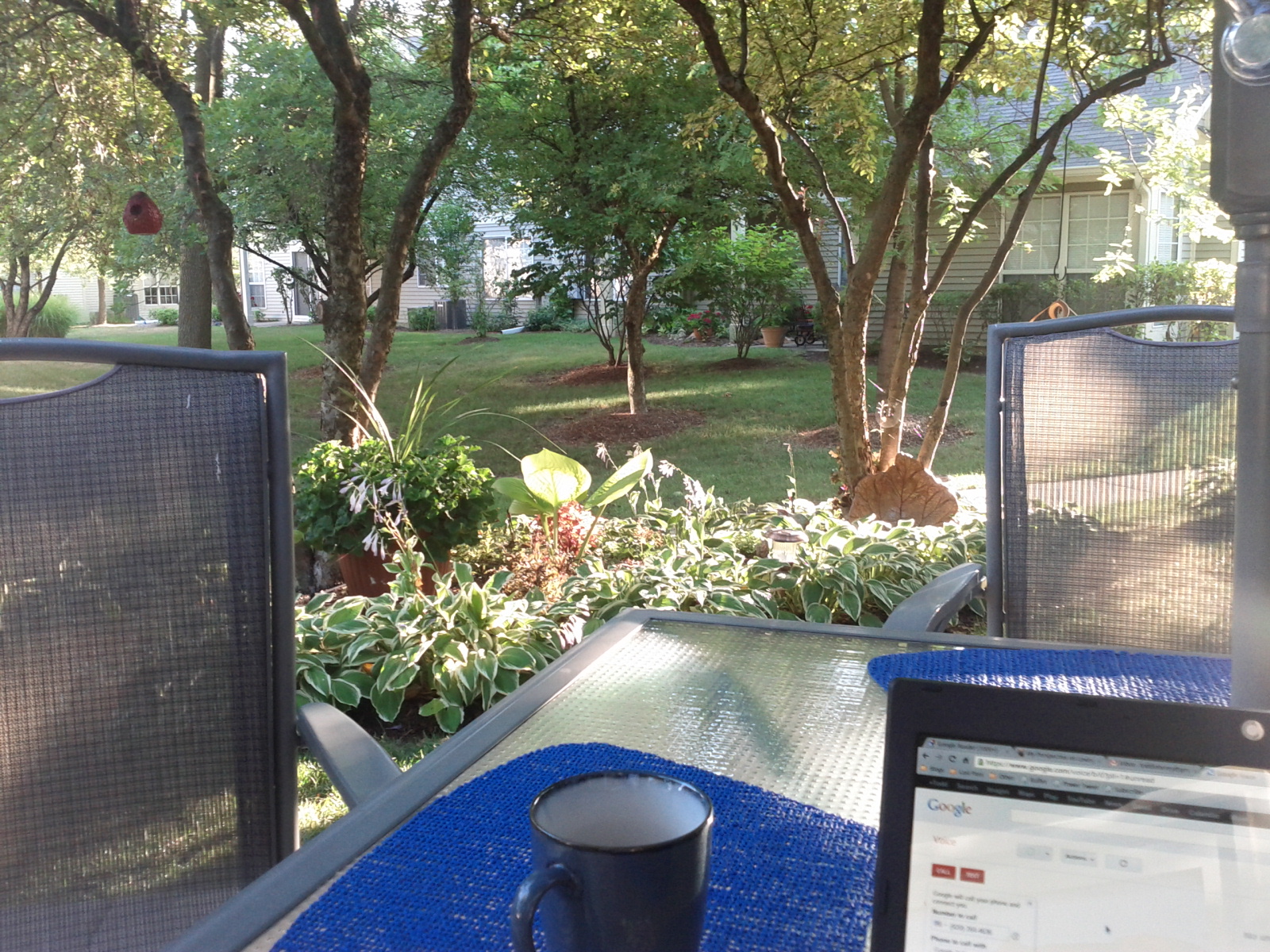
Blogging from my parents’ patio…

image

Too nice not to sit outside!

Posted from WordPress for Android

Don’t Look Back In Anger!

The Daily Love via Visual Inspiration: Don’t Look Back In Anger!.

Apparently there is nothing that cannot happen today

BrainyQuote via Apparently there is nothing that cannot happen today. – Mark….

How to Not Let Words Hurt You

The echoes of what someone else has said about you keeps repeating over and over in your head. You can’t seem to shut it out.The worst part is, it has made you upset or extremely angered by that person who said those mean things about you. That’s all you feel and think about all day. Your day is ruined. Has this ever happened to you?” Get the answer here: How to Not Let Words Hurt You.

Is Your Life “Bucket” Leaking?

A plastic yellow bucket.

“Each of has a psychological “bucket.”

It’s our inner reservoir of positive energy that enables us to engage other people with good will, kindness, consideration, generosity, care and concern, acceptance, and respect.

And all of our buckets are leaky, to some extent or other.

At those times when our buckets are pretty well topped up, and not leaking very much, we feel good about ourselves and we’re likely to act in ways other people experience as “nourishing” – we help them feel good about themselves.

And when our internal buckets get leaky, we’re more inclined to treat others in ways they experience as “toxic” – we say and do things that cause them to feel offended, insulted, ignored, devalued, disrespected, unappreciated, or unloved.

Most of us manage to keep our buckets fairly well topped up, most of the time. Some days we’re more “up” than others, but over the long run most of us realize the value of expressing this positive energy to those around us.” Get the rest here: Is Your “Bucket” Leaking? | Psychology Today.

4 Easy Steps to Deal with Difficult People

“There is a huge amount of freedom that comes to you when you take nothing personally.” ~Don Miguel Ruiz

It seemed like a simple task. Please switch my gym membership from gold to silver level. I’m not cancelling, just switching.

That was now the third time I repeated my request, each time a little more calmly and a little more slowly, despite the beginnings of blood boiling feelings.

The person on the other end of the phone could not have been ruder. It was as if I was asking for a kidney instead of a membership change. A harsh tone and harsher words ensued. Why, I still have no idea.

You have undoubtedly met them. You have maybe been one, once or twice.

Why are some people continually difficult to deal with? What makes Joe easy to get along with and John such a struggle? Here are the major reasons and what can be done about it.” via 4 Easy Steps to Deal with Difficult People | Tiny Buddha.

Imperfection

Mastin Kipp writes:

“We learn from Tony Robbins that everyone’s core fear is that they are not enough, and that because they aren’t enough, they won’t get Love. And LOVE is the oxygen of the Soul.

This much we know already.

But then I thought about what made me successful and what made so many people I know successful and what I love about my favorite characters. And there was always something in common.

The imperfect person overcomes. It boils down to that.

So I had an “ah-ha!” on the phone with my client and I blurted out, “We become successful by admitting we are not perfect, rather than trying to be perfect and thinking that we’re not enough.”

And I think this about sums it up.” via OK, I just had a MAJOR AHA moment! Check it out!.

Success and achievement

English: Maslow's hierarchy of needs. Resized,...

“We fear our highest possibility (as well as our lowest one). We are generally afraid to become that which we can glimpse in our most perfect moments.” Abraham Maslow

In our daily lives, we may dream of success and achievement. We strive and compete in the workplace. We go to meetings and do our part on each Step in the program searching for better lives. When success comes, we are faced with a new problem we could not have expected. It comes as an outcome of some hard work, some good luck, and some help from our friends. It is frightening to have a good thing in our lives and not be in control of it.

We are just as powerless over our successes as we are over the worst of our behaviors. We can only be faithful to our duties and ourselves. The successes, which flow from our work, come and go. Since we can’t nail them down, they may make us feel insecure. Many a man has destroyed his moment of success because he couldn’t stand the powerless feeling. We must return to our program and allow success to rise and fall, as it will.

Today, I turn to my Higher Power for help in accepting success.” via Just For Today Meditations » Daily Recovery Readings – June 28, 2012.

When Things Don’t Work

Melody Beattie writes:

Frequently, when faced with a problem, we may attempt to solve it in a particular way. When that way doesn’t work, we may continue trying to solve the problem in that same way.

We may get frustrated, try harder, get more frustrated, and then exert more energy and influence into forcing the same solution that we have already tried and that didn’t work.

That approach makes us crazy. It tends to get us stuck and trapped. It is the stuff that unmanageability is made of.

We can get caught in this same difficult pattern in relationships, in tasks, in any area of our life. We initiate something, it doesn’t work, doesn’t flow, we feel badly, then try the same approach harder, even though it’s not working and flowing.

Sometimes, it’s appropriate not to give up and to try harder. Sometimes, it’s more appropriate to let go, detach, and stop trying so hard.

If it doesn’t work, if it doesn’t flow, maybe life is trying to tell us something. Life is a gentle teacher. She doesn’t always send neon road signs to guide us. Sometimes, the signs are more subtle. Something not working may be a sign!

Let go. If we have become frustrated by repeated efforts that aren’t producing desired results, we may be trying to force ourselves down the wrong path. Sometimes, a different solution is appropriate. Sometimes, a different path opens up. Often, the answer will emerge more clearly in the quietness of letting go than it will in the urgency, frustration, and desperation of pushing harder.

Learn to recognize when something isn’t working or isn’t flowing. Step back and wait for clear guidance.

Today, I will not make myself crazy by repeatedly trying solutions that have proven themselves unsuccessful. If something isn’t working, I will step back and wait for guidance.” via Just For Today Meditations » Daily Recovery Readings – June 28, 2012.

Start a Blog at WordPress.com.

Up ↑