Coping with Families

Melody Beattie writes about dealing with families while in recovery:

There are many paths to self-care with families. Some people choose to sever connections with family members for a period of time. Some people choose to stay connected with family members and learn different behaviors. Some disconnect for a time, and then return slowly on a different basis.

There is no one or perfect way to deal with members of our family in recovery. It is up to each of us to choose a path that suits us and our needs at each point in time.

The idea that is new to us in recovery is that we can choose. We can set the boundaries we need to set with family members. We can choose a path that works for us, without guilt and obligation or undue influence from any source, including recovery professionals.

Our goal is to detach in love with family members. Our goal is to be able to take care of ourselves, love ourselves, and live healthy lives despite what family members do or don’t do. We decide what boundaries or decisions are necessary to do this.

It’s okay to say no to our families when that is what we want. It’s okay to say yes to our families if that feels right. It’s okay to call time out and it’s okay to go back as a different person.

God, help me choose the path that is right for me with family. Help me understand there is no right or wrong in this process. Help me strive for forgiveness and learn to detach with love, whenever possible. I understand that this never implies that I have to forfeit self-care and health for the good of the system.” via Just For Today Meditations » Daily Recovery Readings – October 2, 2012.

Dialectical progress…

Looking back at this past week and trying to understand the lessons the Universe has for me is ‘progress’ and in particular I’m thinking about the dialectical nature of progress. Dialectical? I’ll have more on that later. First, here are the two posts that got me thinking. The first, an excellent lesson from Christine Hassler on why change or progress is not linear called ‘Ever Feel Like You’re backtracking?. I read another good one one from Jason Wachob earlier this week called Forget Perfection: Strive Toward Progress. There are other good ones I’ve curated as well — just search for ‘progress’ or ‘perfection’ in the search bar…

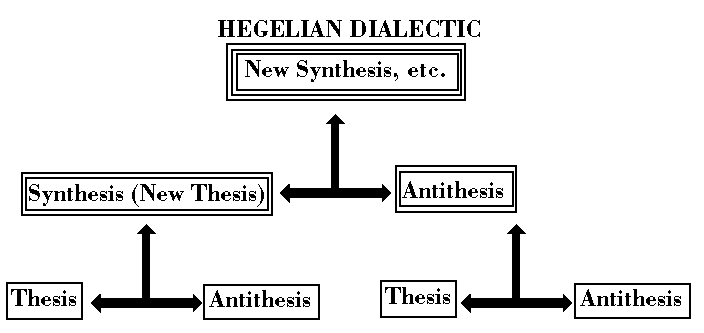
These posts made me think about my incomplete doctoral thesis on the relationship between Hermann Hesse’s writings and Hegel’s Dialectic. What is Hegel’s Dialectic? Here’s the wikipedia definition:

“Hegelian dialectic, usually presented in a threefold manner, was stated by Heinrich Moritz Chalybäus as comprising three dialectical stages of development: a thesis, giving rise to its reaction, an antithesis, which contradicts or negates the thesis, and the tension between the two being resolved by means of a synthesis. Although this model is often named after Hegel, he himself never used that specific formulation. Hegel ascribed that terminology to Kant.[28] Carrying on Kant’s work, Fichte greatly elaborated on the synthesis model, and popularized it.

On the other hand, Hegel did use a three-valued logical model that is very similar to the antithesis model, but Hegel’s most usual terms were: Abstract-Negative-Concrete. Hegel used this writing model as a backbone to accompany his points in many of his works.

The formula, thesis-antithesis-synthesis, does not explain why the thesis requires an Antithesis. However, the formula, abstract-negative-concrete, suggests a flaw, or perhaps an incomplete-ness, in any initial thesis—it is too abstract and lacks the negative of trial, error and experience. For Hegel, the concrete, the synthesis, the absolute, must always pass through the phase of the negative, in the journey to completion, that is, mediation. This is the actual essence of what is popularly called Hegelian Dialectics.

To describe the activity of overcoming the negative, Hegel also often used the term Aufhebung, variously translated into English as “sublation” or “overcoming,” to conceive of the working of the dialectic. Roughly, the term indicates preserving the useful portion of an idea, thing, society, etc., while moving beyond its limitations. (Jacques Derrida’s preferred French translation of the term was relever).[29]

In the Logic, for instance, Hegel describes a dialectic of existence: first, existence must be posited as pure Being (Sein); but pure Being, upon examination, is found to be indistinguishable from Nothing (Nichts). When it is realized that what is coming into being is, at the same time, also returning to nothing (in life, for example, one’s living is also a dying), both Being and Nothing are united as Becoming.[30]

As in the Socratic dialectic, Hegel claimed to proceed by making implicit contradictions explicit: each stage of the process is the product of contradictions inherent or implicit in the preceding stage. For Hegel, the whole of history is one tremendous dialectic, major stages of which chart a progression from self-alienation as slavery to self-unification and realization as the rational, constitutional state of free and equal citizens. The Hegelian dialectic cannot be mechanically applied for any chosen thesis. Critics argue that the selection of any antithesis, other than the logical negation of the thesis, is subjective. Then, if the logical negation is used as the antithesis, there is no rigorous way to derive a synthesis. In practice, when an antithesis is selected to suit the user’s subjective purpose, the resulting “contradictions” are rhetorical, not logical, and the resulting synthesis is not rigorously defensible against a multitude of other possible syntheses. The problem with the Fichtean “Thesis-Antithesis-Synthesis” model is that it implies that contradictions or negations come from outside of things. Hegel’s point is that they are inherent in and internal to things. This conception of dialectics derives ultimately from Heraclitus.” Full story at: Dialectic – Wikipedia, the free encyclopedia.”

Pretty heady stuff, eh? Basically, it’s just another way of describing that ‘two steps forward one step back’ process we call progress. Wherever you’re at as you read this, stop, look yourself in the mirror and say “I’m enough and I’ve come as far as I can”. Remember, your best days are still ahead…

Practice Awareness of God

Melody Beattie writes:

I can remember the moment when I was willing to be truly vulnerable with life again. I was walking around in a beach town, talking to my friend. I was talking about my safe little life back in Stillwater, Minnesota, where I thought I had everything under control. I had avoided living in big cities and thought small town living would be safe. In that small town, working for its daily newspaper, I had found all the potential held in life. I got that big break that put me, an unknown author, on the New York Times best-seller list. And my son had died. Small town life wasn’t as limiting as I feared or as safe as I had hoped.

I told my friend about the time, many years later, I was wandering around the Middle East. I was talking to my daughter on a cell phone. She was on her cell, too, driving through the heart of Los Angeles.

“Aren’t you scared over there?” she asked. “Isn’t your life in danger?”

Just then a man honked at her. I heard him scream through her window, “If you don’t get that car out of the way, I’m going to have you killed.”

“Complete safety is an illusion,” I said to my friend. “Maybe the only time we’re really safe is when we’re willing to acknowledge how vulnerable we really are, no matter what we’re doing, and be okay with that.”

“Ask God to be with me,” I said to an older woman who was my mentor at the time.

“Foolish child,” she said. “You don’t have to ask God to be with you. He’s already there, wherever you are.”

God, help me feel safe, comfortable, and in your presence wherever I am today. via September 30: Practice Awareness of God.”

Self Love: The Path to True Love

Terri Cole writes:

Are you looking for love? Maybe you’re partnered but looking for more satisfying love?

If so, let me share a truth I know for sure: Self Love Is the Path to True Love.

I want you to carve out some time over the next couple of days to think about how much you love yourself and how you treat yourself. Pay attention when you talk about yourself both to others and internally. Are you positive or negative? Are you constantly putting yourself down or are you kind and gentle?

Who you draw into your life and how they treat you is influenced by how you treat and regard yourself. If you are your own worst critic or feel unworthy, you will inevitably draw people into your life who agree with your self-assessment. At the other end of the spectrum, if you treat yourself with respect, love, and high regard, others will to.

People look to you to set the example of what you believe is acceptable behavior.

Remember: you reap what you sow!

Along with being mindful of how you talk about yourself, I want to give you a 7-Day Self-Love Challenge: every day, do something super sweet for yourself. Treat yourself with the same kindness you would a small child whom you adore. What will you do? Tell us!” Full story at:  Self Love: The Path to True Love « Positively Positive.

11 More Life Lessons for Peace, Love, and Happiness

“A man is not old until regrets take the place of his dreams.” ~Proverb

Get the lessons here: 11 More Life Lessons for Peace, Love, and Happiness | Tiny Buddha.


Let Enlightenment Come

The everwise Melody Beattie writes:

Sometimes, the harder we try to see a lesson, the more lost and confused we become. “What does it mean?” we ask, squinting at the problem.

Relax. Let go of your expectations and your interpretations. Quit trying so hard to see.

Sometimes the lesson may be a simple reminder to see the sacred in your ordinary life or to practice compassion for yourself as well as for others. Sometimes what we’re going through is part of a larger lesson, one that may take us years to complete and comprehend. It’s easy to fall into the false belief that there’s some lesson that we have to push and struggle to learn. There isn’t.

We only have to see what we see and know what we know right now.

Sometimes, the harder we try to see a lesson, the more lost and confused we become. “What does it mean?” we ask, squinting at the problem.

Relax. Let go of your expectations and your interpretations. Quit trying so hard to see.

Sometimes the lesson may be a simple reminder to see the sacred in your ordinary life or to practice compassion for yourself as well as for others. Sometimes what we’re going through is part of a larger lesson, one that may take us years to complete and comprehend. It’s easy to fall into the false belief that there’s some lesson that we have to push and struggle to learn. There isn’t.

We only have to see what we see and know what we know right now.

Experience your life.

More shall be revealed when it’s time. Practice seeing without squinting.

God, help me be present to the situations in my life without trying to read too deeply into them. Help me trust that my lessons will become clear when it’s time.” via September 27: Let Enlightenment Come.

The Danger in Your Meat

Rodale writes:

Unless you’re eating organic meat, you’re getting a mouthful of antibiotics with every burger, fried chicken wing, or turkey sandwich you eat. The Food and Drug Administration (FDA) estimates that 80 percent of the antibiotics used in this country are fed to farm animals or slipped into the animals’ drinking water to promote growth and protect the creatures against the diseases that thrive in the filthy living conditions they are raised in. And most of those are given when the animals aren’t even sick.

That has to stop, say the 200 farmers, food producers, physicians, and scientists who signed on to two letters last week vehemently urging the FDA to put the brakes on the rampant overuse of these vital drugs in animals raised for food.” via The Danger in Your Meat | Rodale News.

Other links…

9 Appalling Meat Facts You Need to Know

3 Dirty Chicken Facts Exposed

7 Habits of Extraordinary People

Get them here: 7 Habits of Extraordinary People – by Dumb Little Man.

9 Warning Signs That Your Friends Are Emotional Vampires

Do you ever notice how some people seem to suck all of the energy out of you; you come away from them feeling exhausted and drained?

You spend time with them and even though they were all smiles, you still felt like you had been attacked in some way, and it leaves you feeling confused?

You have just been in the company of an emotional vampire.

So, how do you spot an emotional vampire?

We all know about mythological Vampires, well EV’s (Emotional Vampires) aren’t much different, except they don’t drink blood, but instead they feed on energy of others.” Get more here: 9 Warning Signs That Your Friends Are Emotional Vampires (And How To Save Yourself) – by Dumb Little Man.

Don’t Beat Yourself Up. Wait, DO!

Chris Brogan writes:

Where are you with your self-talk? How do you talk to yourself? I will bet that you wouldn’t say half of what you say to yourself to someone you love, and I bet you wouldn’t say the other half to a stranger with whom you would act polite. Am I right? Do you call yourself a lot of names? I sure do.

Part of being brave is learning how to observe your self-talk. But I think we can take it further. I think we should ambush the evil bastard who lives in our head and let him or her have it.” Get more here: Don’t Beat Yourself Up. Wait, DO!.

3 Simple Steps To Living An Extraordinary Life

In those quiet, but magnificent moments of life – where we are suddenly given a glimpse of something so meaningful, tireless, beautiful, or otherwise majestic that it quiets the mind – we know we stand in the presence of something that represents a part of ourselves.

We stand as a silent witness to a yet unrealized possibility that we somehow know belongs to a new and higher order of ourselves. What we’ve yet to understand about these timeless and vital forces is that our fleeting experience of them is actually an invitation to become fully conscious of them as a living part of who and what we are in reality.

In such moments we know, without having to think about it, as beautiful as may be the world around us, it pales in comparison to the world that awaits within us.” Get more here: 3 Simple Steps To Living An Extraordinary Life | FinerMinds.

Be Aware of the Illusion of Control

Melody Beattie writes:

Remember how it feels when we try to control someone else.

“I was driving down the road one day behind a car that I decided was driving too slowly,” a friend said to me. “I was yelling, raging, and carrying on about the driver in front of me, trying to mentally will him out of my way. I wanted him to move over and let me by.

“While I was driving I observed myself. Then I started to laugh. I wasn’t angry about this driver in front of me. I was angry because I was trying to control something that I couldn’t change.”

Be aware of all your feelings. But also remember to be aware that sometimes it’s not the other person that’s making us crazy. We’re doing it to ourselves.

God, help me be aware of the self-created drama in my life. Help me let go of my need to control. Give me the courage of my feelings. And help me be aware of when my self-will is running riot.” via September 26: Be Aware of the Illusion of Control.

Tolerance


Practice tolerance.

Tolerate our quirks, our feelings, our reactions, our peculiarities, and our humanness. Tolerate our ups and downs, our resistance to change, and our struggling and sometimes awkward nature.

Tolerate our fears, our mistakes, our natural tendency to duck from problems, and pain. Tolerate our hesitancy to get close, expose ourselves, and be vulnerable.

Tolerate our need to occasionally feel superior, to sometimes feel ashamed, and to occasionally share love as an equal. Tolerate the way we progress – a few steps forward, and a couple back.

Tolerate our instinctive desire to control and how we reluctantly learn to practice detachment. Tolerate the way we say we want love, and then sometimes push others away. Tolerate our tendency to get obsessive, forget to trust God, and occasionally get stuck.

Some things we do not tolerate. Do not tolerate abusive or destructive behaviors toward others or ourselves.

Practice healthy, loving tolerance of ourselves, said one man. When we do, we’ll learn tolerance for others. Then, take it one step further; learn that all the humanness we’re tolerating is what makes ourselves and others beautiful.

Today, I will be tolerant of myself. From that, I will learn appropriate tolerance of others.” via Just For Today Meditations » Blog.


Find and Respect Your Own Stride

Melody Beattie writes:

“Do not seek to follow in the footsteps of the men of old; seek what they sought.” Basho.

One of the dangers of following a hero is the temptation to emulate them too much instead of walking our own path. John quit his job and started his own company when he was twenty-four years old. Five years later he sold out for mil­lions of dollars. We want to be like John so we try the same thing and go broke. What happened? Is the universe against us? No. We just got confused about the difference between learning from a hero and trying to walk his path. John’s path may have led him to start a company; your path may also lead you on that course, just not at the same time in your life.

We can still learn much from our heroes and the people we admire. Just be aware that their path and time frame may be different from ours.

When the time comes for you to start that business, learn a new skill, enter into a relationship, or whatever you’re hop­ing to do, the experience will be there. The experience will be ready for you when you’re ready for it. Your timing may be different from everyone else’s.

I know people who got married after knowing each other only two weeks and then stayed mostly happily married for more than thirty years. I know people who date each other for years and still can’t decide if they’re ready to commit. My friend made the transition from living in the Midwest to living in California in months. That transition took me several years.

We each have our own stride and path. And while many of our lessons are similar, each of us is unique. If we spend our time trying to emulate a person rather than an idea, we’ll at best be an inferior version of our teacher and at worst will never discover our own path. Their stride will be too long or too short for us, and we won’t learn the true lesson, which is to trust our inner guide.

Gautama Buddha found enlightenment while sitting under a banyan tree; Milarepa found it while living as a hermit in a Himalayan cave. Gaining enlightenment isn’t an exercise in following a person; it’s an exercise in following your heart.

God, help me let go of any expectations of perfection I may have of myself or others. Help me be aware of the messages you send me, then help me discern my own truth.” via September 22: Find and Respect Your Own Stride.

Parents night

image

Posted from WordPress for Android

Stop Being Offended Today: The Cure For Everything That Irritates You


Get the idea here: Stop Being Offended Today: The Cure For Everything That Irritates You – by Dumb Little Man.

The World’s Problem…

The World’s Problem Is Not That The Rich.


Take Back Your Power and Start Loving Your Life

“People are always blaming their circumstances for what they are. I don’t believe in circumstances. The people who get on in this world are the people who get up and look for the circumstances they want, and, if they can’t find them, make them.” ~George Bernard Shaw

Get the scoop here: Take Back Your Power and Start Loving Your Life | Tiny Buddha.


Why Forgiveness Doesn’t Work and How to Change That

“Forgiveness does not change the past, but it does enlarge the future.” ~Paul Boese

Get the answer here: Why Forgiveness Doesn’t Work and How to Change That | Tiny Buddha.

Create a Positive Space and Break the Cycle of Negativity

“Man stands in his own shadow and wonders why it’s dark.” ~Zen Proverb

Get more here: Create a Positive Space and Break the Cycle of Negativity | Tiny Buddha.


Embrace Your Inner Life Coach: 5 Meaningful Ways To Help Others

“We choose our destiny in the way we treat others.” ~Wit

Get more here: Embrace Your Inner Life Coach: 5 Meaningful Ways To Help Others | Tiny Buddha.


Start a Blog at WordPress.com.

Up ↑