Emotional Communication: What Are Your Words Really Saying?

The FinerMinds teams shares:

Do your words convey an acceptance of responsibility for your feelings and actions, or are they unwittingly laced with blame and maybe even portraying a victim mentality?

In this insightful 3-minute video, co-founder of the Chopra Centre, the late Dr. David Simon, discusses how much our words – whether intentional or not – can create a hostile or defensive response; hampering our communication skills.

Listen to the video to learn how you can honestly convey your feelings, while accepting responsibility and not placing blame.

via Emotional Communication: What Are Your Words Really Saying?.

Parents and prom…

We celebrated a rite of passage in our community yesterday; prom. I found both sides of the ‘photo op’ process humorous…

This slideshow requires JavaScript.

The Dalai Lama on the Ultimate Source of Happiness

Tara Lemieux shared this:

“So inner peace is the ultimate source of happiness, joyfulness.”

His Holiness, the Dalai Lama (in an excerpt from the film “Dalai Lama Renaissance”) provides a simple view of inner peace, happiness, God and money.

And, it’s not what you think it is.

Why do I practice compassion?

It’s not for the “him,” or the “them,” or the “they”—it’s for me, and to bring inner peace to all of my days.

via Mindful Musings: The Dalai Lama on the Ultimate Source of Happiness..

On loving no matter what…

Tara Lemieux shared this video on her lovely blog

Negative Relationships: Are We Always Responsible for How We’re Treated?

The team at FinerMinds offers:

Her advice was wise as well as somewhat of a prickly reminder: remove negative people from your life unless they change the way they interact with you.

We agree with this advice, especially if your energy is constantly being drained by their negativity, although in some situations, such as when dealing with colleagues or immediate family members, this isn’t always so easy.

Continue reading “Negative Relationships: Are We Always Responsible for How We’re Treated?”

How to Embrace Shame and Not Allow it to Make You Feel Ashamed

The FinerMinds team writes:

How do you address your shame?

We all experience it in some way, shape or form, but the more we try to hide what we don’t like about ourselves, the more power we hand over to it.

In this thought-provoking 8-minute video, research professor and author Brené Brown delves into the human psyche and our responses to shame, vulnerability and empathy – particularly in a society that puts pressure on being “perfect”.

If you’re short on time, fast-forward along to the 2:10 mark, where she begins to really share why in order for us to remain connected and embrace our full spirit, we need to understand and accept our full continuum of emotions.

via How to Embrace Shame and Not Allow it to Make You Feel Ashamed.

Brené Brown and her work have had a profound impact on my life. If you were intrigued by the video above, may I suggest these resources from my Brené Brown page at Living Business…

The freedom of yes…

How do we accept ourselves or others when our actions are causing harm? Does acceptance mean passivity? Does it undermine our efforts towards change? This talk responds to these questions with a simple, illuminating and challenging principle about genuine transformation: Acceptance is the prerequisite of true healing and awakening. Only when we’ve paused to recognize and allow this moment’s experience to be fully as it is, can we respond from our intelligence and compassion to prevent future suffering…

You Don’t Have to React

Jason Moskovitz writes:

You don’t have to react.

What do you do when confronted? When someone calls whom you’d rather not hear from? When you disagree with someone? When your financial picture changes abruptly? When your car breaks down? What do you do? How do you feel? Do you react? Do you lose control somewhere inside to the point of not feeling well? Have you noticed you get triggered by certain things or people and not by others? Have you considered that you’re choosing to react this way? And at such a pace that one bad thing swells into several and everything seems hopeless? And that all of this swells up in a split second?

You don’t have to react.

Continue reading “You Don’t Have to React”

Forget Self-Esteem: You Need Self-Compassion to Succeed

Heidi Grant Halvorson writes:

If you look under the Self-Help heading on Amazon, you’ll find roughly 5,000 books listed under the sub-head Self-Esteem. The vast majority of these books aim to not only tell you why your self-esteem might be low, but to show you how to get your hands on some more of it. It’s a thriving business because self-esteem is, at least in Western cultures, considered the bedrock of individual success.

You can’t possibly get ahead in life, the logic goes, unless you believe you are perfectly awesome. Continue reading “Forget Self-Esteem: You Need Self-Compassion to Succeed”

Foolproofing your life?

Hmmm. I’m pondering this thinking that was shared by a friend. The teacher’s name is Jan Silvious…

You can find more here…

51BkPtvgTeL._BO2,204,203,200_PIsitb-sticker-arrow-click,TopRight,35,-76_SX225_SY300_CR,0,0,225,300_SH20_OU01_

More self-compassion…

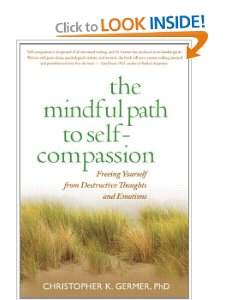
51RDx3TrpPL._BO2,204,203,200_PIsitb-sticker-arrow-click,TopRight,35,-76_SX225_SY300_CR,0,0,225,300_SH20_OU01_I’m reading a new book on self-compassion that looks very promising. It’s called The Mindful Path to Self-Compassion: Freeing Yourself from Destructive Thoughts and Emotions. Here is an excerpt from the introduction:

Life is tough. Despite our best intentions, things go wrong, sometimes very wrong. Ninety percent of us get married, full of hope and optimism, yet 40% of marriages end in divorce. We struggle to meet the demands of daily life, only to find ourselves needing care for stress-related problems like high blood pressure, anxiety, depression, alcoholism, or a weakened immune system. How do we typically react when things fall apart? More often than not, we feel ashamed and become self-critical: “What’s wrong with me?” “Why can’t I cope?” “Why me?” Continue reading “More self-compassion…”

Growth Mindset: Why You Should Be Willing to Fail and Make Mistakes

More good stuff from Brian Johnson:

Do you consider them to be failures and a reflection of the individual (including yourself), or do you view them as being opportunities for growth and a natural part of being human?

In this 4-minute video, the Philosopher’s Notes author, Brian Johnson discusses the importance of having a healthy mindset when it comes to making mistakes.

We love the reassuring analogy he uses that life is similar to a great long movie and that – as with any movie where scenes are often filmed many times in order to get them right – the setbacks or failures we may experience are really just “mis-takes”, rather than actual mistakes.

Continue reading “Growth Mindset: Why You Should Be Willing to Fail and Make Mistakes”

Thoughts on the true meaning of forgiveness…

I used to be ‘turned off’ by people who looked and talked like this but lately I find I’m learning more about being ‘Christlike’ from Buddhists…

Intimacy with our inner life

Jung wrote that our suffering arises from the unseen, unfelt parts of our psyche. This talk explores ways we can establish a healing presence by recognizing and communicating with the parts of our being that we habitually ignore or judge…

The Liberating Truth Behind Happiness

FinerMinds writes:

With most of us constantly projecting our minds to the future, or re-living the dusty roads of the past, are we ever really able to experience complete joy in a moment – or authentic happiness – if our minds are constantly somewhere else?

In this 5-minute video, Sam Harris, author, philosopher and neuroscientist, takes you on a thought-provoking journey forcing you to consider how you’d feel about your life if this very moment was your last; making you realize how obsolete the events of the past or the future really are.

via The Liberating Truth Behind Happiness – It’s Yours Now.

Dove Experiment Aims to Change the Way You See Yourself

Mashable writes:

Dove posted on Monday a three-minute ad on YouTube that teaches a vital lesson about how we view ourselves compared to how others see us. Trust us, it’s worth your time.

A former forensic artist for the San Jose police department met a series of women and asked each to describe the way they look. He had no way of seeing them behind a curtain. He prompted them to detail everything: hair length, facial structure, their most prominent features. He then sketched each participant from their self-description.

Each woman was asked before the study to get to know one of the other participants. The forensic artist then prompted each woman to describe the other’s face.

via Dove Experiment Aims to Change the Way You See Yourself.

Continue reading “Dove Experiment Aims to Change the Way You See Yourself”

The True Meaning of Compassion

From Evernote:

The True Meaning of Compassion

Clipped from: http://taralemieux.blogspot.com/2013/04/the-true-meaning-of-compassion-dalai.html

"As man draws nearer to the stars, why should he not also draw nearer to his neighbor?" ~ Lyndon B. Johnson

It’s precisely the thought we should all be holding near to our hearts this evening—pushing aside judgement, and offering instead the best parts of our most human spirit.
I suspect there will be much information flooding our networks over these next hours and days; and it will be quite easy to fall backwards and into our emotions…causing us to lose our touch with the humanity of this place.
And though, it’s perfectly human to feel such huge emotions—we must remember to use those emotions to help carry forward a much more positive…and much needed change.
We are all just visitors here—all members of the family, ‘human.’
And though, our spirits are all so brilliantly unique—in matters of the heart, you’ll find, we’re not so very much different.

Continue reading “The True Meaning of Compassion”

I me mine…

The trance of selfing…

You are more than you think

You are more creative than you think.

You are more powerful than you think.

You are more resourceful than you think.

You are more important than you think.

You are more intelligent than you think.

You are more extraordinary than you think.

You are more desired than you think.

You are more polished than you think.

You are more capable than you think.

You are more loved than you think.

You are more loving than you think.

You are more ready than you think.

You are MORE than you think.

via You are more than you think | Tanya Geisler – Step into Your Starring Role.

@Nilofer Merchant on ‘Onlyness’

Yesterday on my business blog I interviewed thought leader and TEDTalker Nilofer Merchant on the topic of ‘Onlyness’:

In her book 11 Rules for Creating Value in the Social Era, she writes:

Celebrate onlyness. The foundational element starts with celebrating each human and, more specifically, something I’ve termed onlyness. Onlyness is that thing that only one particular person can bring to a situation. It includes the skills, passions, and purpose of each human. Onlyness is fundamentally about honoring each person, first as we view ourselves and second as we are valued. Each of us is standing in a spot that no one else occupies. That unique point of view is born of our accumulated experience, perspective, and vision. Some of those experiences are not as “perfect” as we might want, but even those experiences are a source of ideas and creativity. Without this tenet of celebrating onlyness, we allow ourselves to be simply cogs in a machine—dispensable and undervalued. Continue reading “@Nilofer Merchant on ‘Onlyness’”

Live The Meaning Of Namaste Every Day

Brigitte Meinders writes:

The word “Namaste” has become quite mainstream thanks to the explosive popularity of the yoga industry in recent years.  I’m sure you’ve said it before, and you probably have an idea of the general meaning of it. It’s a way for your soul to recognize and acknowledge the soul of another.

It would be amazing if more people took the time to really understand why we should ALL be saying Namaste to one another, and were able to shift their perspective a little bit to see other people for what they really are.

Think of yourself as a vessel filled with light. Light that changes colors depending on what angle you are looking at it, and those colors represent the many experiences you’ve had in your life. Your soul has become all of the sunsets you’ve watched, the ocean air you’ve breathed, the friends you’ve made, the love you’ve shared, the times that made you laugh and cry. You are all of your experiences.

Each and every person out there is the same way. The person in the car next to you, the cashier at the grocery store, your mailman, your friend, your spouse, even that annoying co-worker… they all carry with them that same ever-changing light, a spectrum of colors that uniquely defines them and their life experiences. They too have experienced love and pain, they have their history, their own things they hold dear, and have seen their own beautiful sights. No two are the same, yet we all have it inside us.

It’s so easy to see only the surface of a person and dismiss them for only what they are presenting to you in a given situation. But we’re all connected in that we carry around our entire life — each experience you have, each interaction, all of it is with you all the time. 

The next time you find yourself passing a person on the street, in a meeting, or talking with your friends, try to be aware of the enormity of what they’re actually carrying around with them. Practicing this makes the ability to forgive and accept much easier.

To me, Namaste means that I see you. I understand we’re both souls trying to make our way in this world, all part of some larger plan. I know that while the color of our lights may shine differently, we all share the same internal fire, and my soul bows to and acknowledges that in your soul.

via Live The Meaning Of Namaste Every Day.

Start a Blog at WordPress.com.

Up ↑