What is a blog?

What is a blog? It can be everything and it can be nothing. As the Bard said “Nothing is good or bad but thinking makes it so”. During my blogging career, I estimate that I have created between 15 and 20,000 blog posts on every topic from A-to-Z — most of them, unfortunately, ineffective…

And this is only my business blog...
And this is only my business blog…

In this next phase of my business I’m attempting to become more mindful and intentional about what I’m doing online and why in this post is an attempt to unpack blogging from that perspective; more mindfulness and awareness of why we actually do social media and what we can expect from the effort.

What blogging isn’t…

A get rich quick scheme. If you are thinking that this was one of those articles I think you’ll be happier somewhere else on the Internet. But if you’re looking for deeper insight into what blogging is from perspective of mindfulness and intention and what it can do for you then please read on… Continue reading “What is a blog?”

WATCH: How You Can Choose Happiness (Even When It Feels Impossible)

See on Scoop.itLiving Business

Watch this video to hear a little bit about my personal struggle with this concept, how I got through it and how you can take better care of yourself when it gets challenging to choose happiness.

See on www.huffingtonpost.com

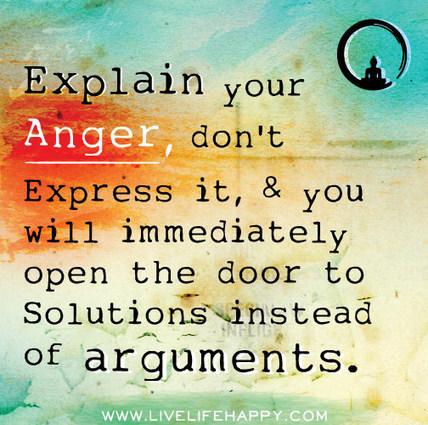
Explain Your Anger…

See on Scoop.itLiving Business

Explain your anger, don’t express it, and you will immediately open the door to solutions instead of arguments.

See on www.livelifehappy.com

The Chemicals of Care: How Self-Compassion Manifests in Our Bodies

Neff, Kristin_400Kristin Neff writes:

In my work I have defined self-compassion as having three main interacting components: self-kindness, a sense of common humanity and mindfulness. Self-kindness refers to the tendency to be caring and understanding with oneself rather than being harshly critical or judgmental. Instead of taking a cold “stiff-upper-lip” approach in times of suffering, self-kindness offers soothing and comfort to the self. Common humanity involves recognizing that all humans are imperfect, fail and make mistakes. It connects one’s own flawed condition to the shared human condition so that one can take greater perspective towards one’s personal shortcomings and difficulties. Mindfulness involves being aware of one’s painful feelings in a clear and balanced manner so that one neither ignores nor obsesses about disliked aspects of oneself or one’s life.

For the past decade or so I’ve been conducting research on self-compassion and have found that people who are compassionate to themselves are much less likely to be depressed, anxious and stressed and are much more likely to be happy, resilient and optimistic about their future. In short, they have better mental health.

The power of self-compassion is not just an idea; it’s very real and actually manifests in our bodies. When we soothe our own pain, we are tapping into the mammalian care-giving system. And one important way the care-giving system works is by triggering the release of oxytocin. Research indicates that increased levels of oxytocin strongly increase feelings of trust, calm, safety, generosity and connectedness and facilitates the ability to feel warmth and compassion for ourselves. Oxytocin is released in a variety of social situations, including when a mother breastfeeds her child, when parents interact with their young children or when someone gives or receives a soft, tender caress. Because thoughts and emotions have the same effect on our bodies whether they’re directed to ourselves or to others, this research suggests that self-compassion may be a powerful trigger for the release of oxytocin.

Self-criticism appears to have a very different effect on our body. The amygdala is the oldest part of the brain and is designed to quickly detect threats in the environment. When we experience a threatening situation, the fight-or-flight response is triggered: the amygdala sends signals that increase blood pressure, adrenaline and the hormone cortisol, mobilizing the strength and energy needed to confront or avoid a threat. Although this system was designed by evolution to deal with physical attacks, it is activated just as readily by emotional attacks — by ourselves or others. Recent research indicates that generating feelings of self-compassion actually decreases our cortisol levels. In one study conducted by Helen Rockliff and her colleagues, researchers asked participants to imagine receiving compassion and feeling it in their bodies. Every minute they were told things like, “Allow yourself to feel that you are the recipient of great compassion; allow yourself to feel the loving-kindness that is there for you.” It was found that the participants given these instructions had lower cortisol levels after the imagery than those in the control group. Participants also demonstrated increased heart rate variability afterwards. The safer people feel, the more open and flexible they can be in response to their environment, and this is reflected in how much their heart rate varies in response to stimuli. So you could say that by giving themselves compassion, participants’ hearts actually opened and became less defensive.

When we soothe our painful feelings with the healing balm of self-compassion, not only are we changing our mental and emotional experience, we’re also changing our body chemistry. An effective aspect of self-compassion practice, therefore, is to tap into our body’s self-healing system through physical sensations.

This means that an easy way to calm and comfort yourself when you’re feeling bad is through soothing touch. It seems a bit silly at first, but your body doesn’t know that. It just responds to the physical gesture of warmth and care, just as a baby responds to being held in its mother’s arms. Remember, physical touch releases oxytocin, reduces cortisol and calms cardiovascular stress. So why not try it? If you notice that you’re feeling tense, upset or self-critical, try giving yourself a warm hug, or tenderly stroking your arm or face, or gently rocking your body. What’s important is that you make a clear gesture that conveys feelings of love, care and tenderness. If other people are around, you can often fold your arms in a non-obvious way, gently squeezing yourself in a comforting manner. Notice how your body feels after receiving the hug or caress. Does it feel warmer, softer, calmer? It’s amazing how easy it is to tap into mammalian care-giving system and change your biochemical experience.

via Kristin Neff: The Chemicals of Care: How Self-Compassion Manifests in Our Bodies.

Why We Need to Have Compassion for Our Inner Critic

Kristin Neff writes:

We know how much it hurts. “I’m an idiot!” “I’m disgusting.” “No one will ever love me.” “What a lame-ass.”

So why do we do it? As soon as we ask ourselves this question, we often just pile on more self-criticism. “I’m such a bitch, even to myself.” “That’s why I’m such a loser, I’m always putting myself down.”

Don’t beat yourself up for beating yourself up in the vain hope that somehow it will help you stop beating yourself up. Instead, take a step back, and give your inner critic some slack. In its ineffective, counterproductive way, your inner critic is actually trying to keep you safe.

As humans we have two main evolved safety systems. The oldest and most quickly triggered is the threat defense system, which involves the amygdala. When we sense danger, our response is typically fight, flight, freeze, or submit: We turn and fight the threat, run like hell away from the threat, play dead in hopes the threat will pass, or show our bellies and hope the threat will be placated. These strategies are very successful for animals living in the wild, helping them to survive and pass on their genes. For humans, however, these responses often just make things worse. That’s because the threat we’re usually facing is a threat to our self-concept. We confuse our thoughts and representations of ourselves for our actual selves, meaning that when our self-image is under siege, we react as if our very existence is threatened. When this happens, our threat defense system uses the same strategies to stay safe:

Fight — we beat ourselves up emotionally, using cruel language to cut ourselves down.

Flight — we become anxious and restless, fleeing from ourselves by numbing out or using distractions like food or alcohol.

Freeze — we get stuck in rumination, thinking about our perceived inadequacies over and over again.

Submit — we admit that yes, we’re terrible, and accept all the harsh judgments we throw at ourselves.

More often than not we engage in some combination of all these strategies. Our stress levels go up as our amygdala activates our sympathetic nervous system (which arouses us so we can deal with threats) and floods our system with adrenaline and cortisol. And it’s a double whammy because when we criticize ourselves, we are both the attacker and the attacked. This type of chronic stress can eventually lead to anxiety and depression, undermining our physical and emotional wellbeing.

Still, it’s important to remember that when our inner critic attacks, at root it is trying to ward off danger. Marshal Rosenberg, author of the book Non-Violent Communication, says self-criticism is the “tragic expression of an unmet need.” It’s tragic because self-criticism makes us feel horrible and doesn’t effectively motivate productive change. (See my blog “The Motivational Power of Self-Compassion.”) But if we look closely — our inner critic cares. There is some safety need it is trying to meet. Our inner critic wants us to be happy, but doesn’t know a better way to go about it. Let’s say you criticize yourself for not going to the gym, calling yourself a “lazy slob.” At some level, your inner critic is reacting out of concern that if you don’t go to the gym you won’t be healthy, or that you’ll be rejected by others. We can be kind and compassionate to this part of ourselves, because at some level it has our best interests at heart. And believe it or not, by giving compassion to our inner critic, we are moving out of the threat defense system and into our other safety system.

As mammals, we also evolved the attachment/affiliation system as a survival strategy. Mammals have the innate capacity to be soothed by warmth and affection, meaning that our young are likely to stay near caregivers, be protected, and survive. The care-giving system deactivates the sympathetic nervous system (reducing cortisol) and activates the parasympathetic nervous system, which calms us down. This route to emotional safety is much more effective — reducing our stress and anxiety rather than exacerbating it. And it gives us the emotional balance needed to make wise decisions, including making behavioral changes if needed. (I write about self-compassion and the mammalian care-giving system in my blog “The Chemicals of Care.”)

So the next time you find yourself in the throws of harsh self-criticism, instead of beating yourself up for beating yourself up, thank your inner critic for its efforts, then try the strategy of giving yourself some compassion instead. It’s more effective, and a lot less painful!

Full story at: Kristin Neff: Why We Need to Have Compassion for Our Inner Critic.

When Things Get Crazy, Do This!

Christine Hassler writes:

How you respond to the not-so-good times is an even better reflection of how far you’ve come in your growth. Keep reading as I share a powerful meditation that will support being peaceful in the midst of a storm. By peaceful I don’t mean that you aren’t going to have emotions. You deserve to express your feelings when it feels like life is handing you a 1,000 piece jigsaw puzzle. Just don’t sit in them too long and become a victim.  And don’t remain in such righteousness that you stop trusting the divine plan of the Uni-verse. Continue reading “When Things Get Crazy, Do This!”

The 7-Step Guide to Misery


Dr. Margaret Paul shares this handy guide:

I doubt that anyone would say out loud that they love being miserable. Yet many people wallow in misery, doing the same things over and over that create their misery. While life is often challenging, lonely and heartbreaking, misery is a choice.

Why would someone make the choice to be miserable? Because it is often a way of getting attention and of attempting to get someone else to be responsible for them. If this is what you want, here is a roadmap to make sure you accomplish your goal

Continue reading “The 7-Step Guide to Misery”

Why The Fantasy Of Prince (Or Princess) Charming Is Dangerous

Shelly Bullard shares:

Happiness is contingent upon who you are, how you choose to live your life, and aligning yourself with love (inside first, then outside as well).

Full story at: Why The Fantasy Of Prince (Or Princess) Charming Is Dangerous.

Self-acceptance…

Melody-Beattie-8x6.jpgMelody Beattie writes:

Self-acceptance is a more humble term than self-esteem or self-love. Self-love has tones of narcissism—me first and to heck with you. Self-esteem rings of pride—holding our­selves up higher than everybody else. Self-acceptance is that gentle place we get to when we make peace with who we are.

“For a long time, when I talked to certain people. I got squeamish and uncomfortable. like it wasn’t okay to be me.” a friend said. “I thought it was me being uncomfort­able with myself. I’ve finally learned that I’m responding to how uncomfortable some people feel about themselves.”

We might feel so awkward about ourselves that we believe we have to be different from who we are. Some of that comes from low self-worth, not believing that we’re okay. Or it can stem from a need to control. We think if we pretend to be different or better. we can manipulate how other people feel about us.

Continue reading “Self-acceptance…”

Stop! 9 WARNING Signs That You May Be in a Dangerous Relationship

Ponder this:

Any relationship can be an unhealthy one. Bad relationships aren’t just limited to marriages or partnerships—they can occur while dating, in friendships, or families. Any relationship that is harmful or destructive to your physical, mental, or emotional well-being is an unhealthy one.

There are many reasons why people stay in an unhealthy relationship. Some don’t recognize or aren’t willing to accept that the relationship is unhealthy, or they are fearful or lack the inner strength to leave. Or, they believe that they can change their partner and things will improve. The sad truth is that unhealthy relationships rarely get better; instead, they get progressively worse, leaving scars that are difficult to recover from.

Full story at: Stop! 9 WARNING Signs That You May Be in a Dangerous Relationship – Lifehack.

Letting go in love…

codependent no moreMelody Beattie writes:

When people with a compulsive disorder do whatever it is they are compelled to do, they are not saying they don’t love you – they are saying they don’t love themselves.
Codependent No More

Gentle people, gentle souls, go in love.

Yes, at times we need to be firm, assertive: those times when we change, when we acquire a new behavior, when we need to convince others and ourselves we have rights.

Those times are not permanent. We may need to get angry to make a decision or set a boundary, but we can’t afford to stay resentful. It is difficult to have compassion for one who is victimizing us, but once we’ve removed ourselves as victims, we can find compassion.

Our path, our way, is a gentle one, walked in love – love for self, love for others. Set boundaries. Detach. Take care of ourselves. And as quickly as possible, do those things in love.

Today, and whenever possible. God let me be gentle with others and myself. Help me find the balance between assertive action taken in my own best interests, and love for others. Help me understand that at times those two ideas are one. Help me find the right path for me.

via Blog | Just For Today Meditations.

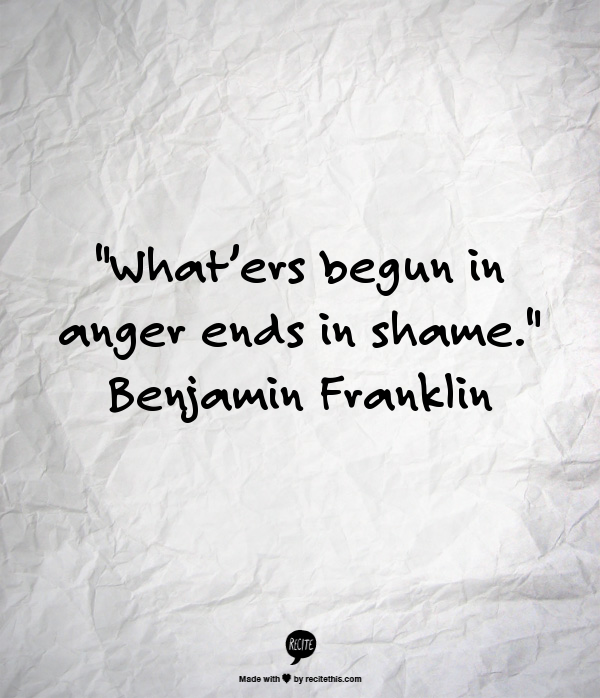
Anger and shame…

recite-17116-2001583443-1nq45bc

h/t Kristin Barton Cuthriell

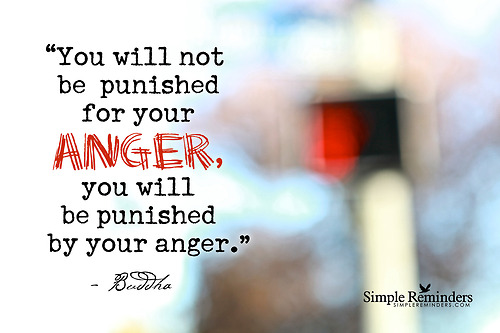
You will not be punished for your anger…

Simple Reminders

via “You will not be punished for your anger, you will be punished….

Nurturing Self Care

Today you get a double shot of Melody Beattie because I need it!

“…there isn’t a guidebook for setting boundaries. Each of us has our own guide inside ourselves. If we continue to work at recovery, our boundaries will develop. They will get healthy and sensitive. Our selves will tell us what we need to know, and we’ll love ourselves enough to listen.” Beyond Codependency

What do we need to do to take care of ourselves? Listen to that voice inside. What makes you angry? What have you had enough of? What don’t you trust? What doesn’t feel right? What can’t you stand? What makes you uncomfortable? What do you want? Need? What don’t you want and need? What do you like? What would feel good? In recovery, we learn that self care leads us on the path to God’s will and plan for our life. Self-care never leads away from our highest good; it leads toward it. Learn to nurture that voice inside. We can trust ourselves. We can take care of ourselves. We are wiser than we think. Our guide is within, ever present. Listen to, trust, and nurture that guide.

Today, I will affirm that gift to the Universe and myself. I will remember that nurturing self care delivers that gift in its highest form.

via Blog | Just For Today Meditations | Maintaining A Life.

Behind Great Anger is Great Pain; Don’t Take It Personally

“More important than the quest for certainty is the quest for clarity.” ~Francois Gautier

via Behind Great Anger is Great Pain; Don’t Take It Personally | Tiny Buddha.

The Most Dangerous Word in the World

noMark Waldman and Andrew Newberg, M.D. write:

If I were to put you into an fMRI scanner—a huge donut-shaped magnet that can take a video of the neural changes happening in your brain—and flash the word “NO” for less than one second, you’d see a sudden release of dozens of stress-producing hormones and neurotransmitters. These chemicals immediately interrupt the normal functioning of your brain, impairing logic, reason, language processing, and communication.

In fact, just seeing a list of negative words for a few seconds will make a highly anxious or depressed person feel worse, and the more you ruminate on them, the more you can actually damage key structures that regulate your memory, feelings, and emotions.[1] You’ll disrupt your sleep, your appetite, and your ability to experience long-term happiness and satisfaction.

If you vocalize your negativity, or even slightly frown when you say “no,” more stress chemicals will be released, not only in your brain, but in the listener’s brain as well.[2] The listener will experience increased anxiety and irritability, thus undermining cooperation and trust. In fact, just hanging around negative people will make you more prejudiced toward others![3]

via 3. The Most Dangerous Word in the World | Psychology Today.

How to Reflect on 2012 and Set Yourself Up for Success in 2013

2013-with-globeThe good folks at Stepcase Lifehack share this:

How to reflect on the previous year

Find yourself a peaceful and quiet location to reflect on the past year, a place where there are no distractions around so you can really focus your thoughts. An ideal location would be somewhere outside of your own home—perhaps a beach or a nearby park. Find somewhere you can set your mind free.

Take a notepad and pen with you, or if you’re into technology, take your iPad or similar device.

Write down your answers to the questions below, but note that these questions are just a guide: depending on your individual circumstances, you may want to add your own questions that are more specific or relevant to your life.

Ready? Here goes:

  • What are the 5 things of 2012 that you are most proud of?
  • What new connections have you made, and how have these shaped your life?
  • What experience has made you the happiest?
  • Who has made you happiest?
  • What have been the best moments in your career this year?
  • What changes would you make to your career in 2013?
  • What challenges did you overcome this year? How did you do it?
  • What has held you back from achieving what you wanted to do this year?
  • What can you do in 2013 to ensure this doesn’t happen again?
  • What habit did you acquire this year that has made a difference?
  • What habit has prohibited you from achieving what you wanted this year?
  • What habit do you want to enable in 2013 that will make a difference?
  • What was your biggest mistake in 2012? What have you learned from this?
  • What else have you learned this year?
  • What are 3 words that sum up your year?
  • If you were to live 2012 all over again, what would you do differently?
  • Add your own!

The Next Steps

Now that you have reflected on the past year, keep your answers at the front of your mind, and file your notes about them nearby so you can refer to them regularly. Your reflections will become the starting point for setting your goals for the year, and those goals for 2013 will be much more targeted and more relevant to what it is that truly makes you happy.

It only takes 20 to 30 minutes to do this, and this short reflection can have a huge impact on your overall well-being, your learning, and your success for 2013.

Let me know how it goes as I would love to hear your experiences! 2013 is going to be an amazing year. I can feel it!

via How to Reflect on 2012 and Set Yourself Up for Success in 2013.

Catch Anger Before It Catches You

“For every moment you are angry, you lose 60 seconds of happiness.” ~Ralph Waldo Emerson

Full story at: Catch Anger Before It Catches You | Tiny Buddha.

Don’t beat yourself up

In Year 1 of recovery, i was so excited to be free of the disease that i did not care where i had come from. Now in Year 2, the sheer distance i’ve covered makes it impossible not to notice where i was.

We will not regret the past nor wish to shut the door on it.

That quote is from the AA Big Book, more specifically The Promises. That quote is testament to the fact that i am not fully recovered, because i still disagree with many of my readers and harbor regrets about my past actions.Lately, memories come back to me at random moments, like stepping on shards of broken mirrors hidden in the carpet. Memories of how i mistreated friends, hurt those that love me, and even damaged my children cut me to my core.The further i distance myself from the asshole i was, the more i realize what an asshole i was. It hurts to see how i behaved. That i did not know better does not lessen the pain.That it means i am far enough removed from that guy to be shocked, however, does take away the sting, if only a little.

via Past – Tense « Al K Hall-ic Anonymous.

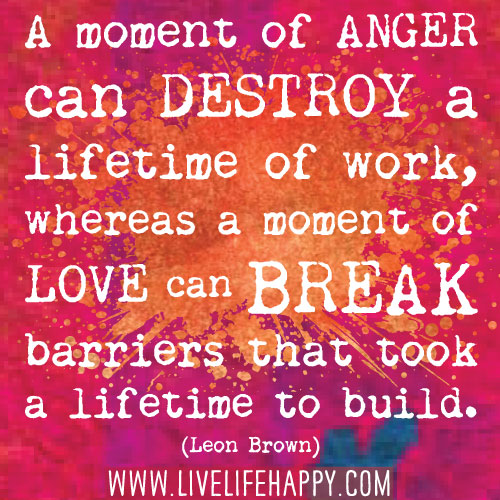
A Moment Of Anger Can Destroy

Live Life Quotes, Love Life Quotes, Live Life Happy

via A Moment Of Anger Can Destroy.

And for good measure: “Like a city whose walls are broken through is a person who lacks self-control.” Proverbs 25:27-28

Start a Blog at WordPress.com.

Up ↑