
If you can’t stand the heat, get out of the kitchen. But if you’re a Michelin Star chef with a restaurant to run, you’re going to need a better coping strategy.
Source: Heaven’s Kitchen: How Buddhism Helped Eric Ripert Tame His Anger | Big Think
Thinks I find along the way
If you can’t stand the heat, get out of the kitchen. But if you’re a Michelin Star chef with a restaurant to run, you’re going to need a better coping strategy.
Source: Heaven’s Kitchen: How Buddhism Helped Eric Ripert Tame His Anger | Big Think
 “If another can easily anger you, it is because you are off balance with yourself.” — Unknown Author
Source: mysimplereminders
 In inter-personal relationships, the one playing the blame game will never really find happiness as they won’t ever fully experience their own power, they’re giving it away with the blame to someone else. So, instead of indulging in the game, here’s what you can do when the beast of blame rears its ugly head.
Read more: Dangers of the “Blame Game” (& What Blame Really Reveals) –
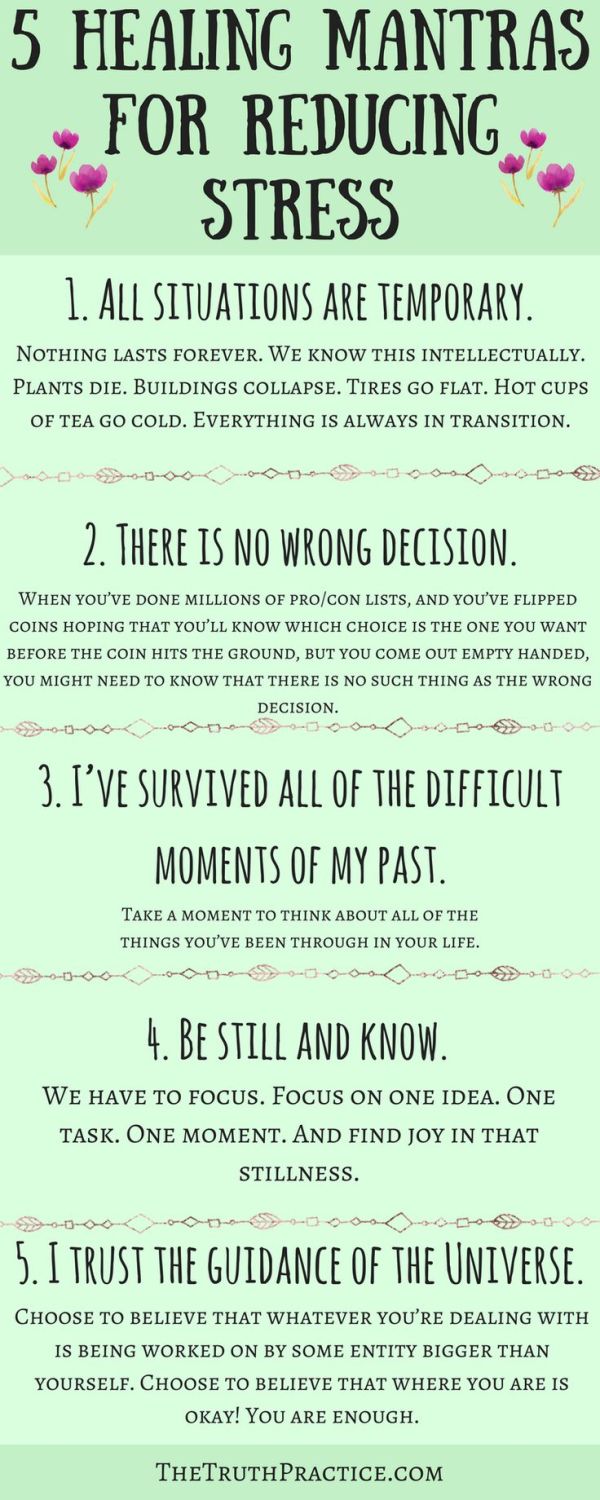
CLICK THE PIN TO READ ALL 10 healing mantras and affirmations for reducing stress and anxiety. These positive affirmations help you find peace and joy in life. Check out The Truth Practice to read about inspiration, authenticity, happy living, manifestation, getting rid of fear, intuition, self-love, self-care, words of wisdom, relationships, affirmations, finding passion, positive quotes, life lessons, and mantras.
 The love and attention you always thought you wanted from someone else is the love and attention you first need to give to yourself. — Bryant McGill
Source: SimpleReminders.com — The love and attention you always thought you…
 Steve Austin writes:
I’ve been a pastor for nearly a decade, but I tried to kill myself four years ago. Since that dark season, I have been actively focusing on recovery from a suicide attempt, plus the underlying wounds of: childhood sexual abuse, church hurts, and a pornography addiction. I have learned that recovery is about digging. About finding. And about facing realities. And, equally as important, recovery is about self-care. Self-care is giving yourself permission to be first for a little while. It’s not making excuses about why you can’t do what you know in your gut you need to do. If you’re new to this, here are 3 reasons why your self-care matters:
Source: 3 Simple Reasons Why Your Self-Care Matters | The Huffington Post
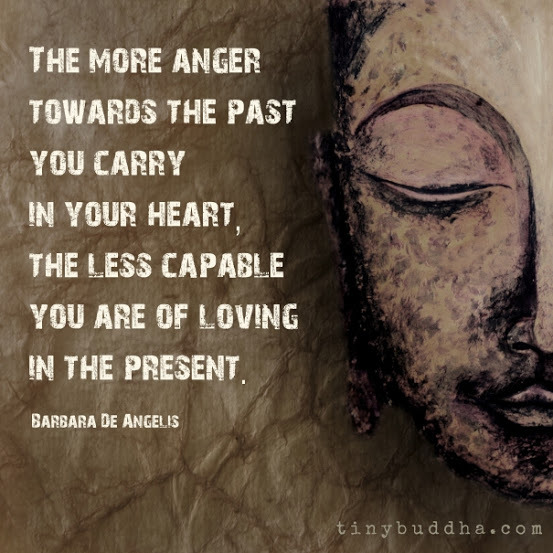
“The more anger towards the past you carry in your heart, the less capable you are of loving in the present.” — Barbara de Angelis
Source: SimpleReminders.com — “The more anger towards the past you carry in your…
What comes to mind when you think about self-care? Do you associate self-care with being selfish? Or do you see the benefits, but feel you’re coming up short in sticking with your own plan? Perhaps you find yourself wishing: “If I could just stick with a regular self-care practice, then everything would feel right in my world.”
Whatever comes up for you when you think about self-care, imagine what it might be like to realize you already have a solid self-care practice – you just have to recognize it. What I am talking about is shifting the way you think about self-care to appreciate yourself for everything you ARE doing on a regular basis.
Often what is missing in our self-care practice is self-awareness. When we grow our awareness of everything we already do, we begin to appreciate the gifts we regularly give ourselves.
Here are 3 easy tricks to help you adopt a self-care mindset that will stick:
http://www.huffingtonpost.com/emily-madill/adopting-a-selfcare-minds_b_13883786.html?utm_hp_ref=gps-for-the-soul&ir=GPS+for+the+Soul
Fran Simone writes this on her blog:
Approximately 22 million Americans struggle daily with addition to drugs and alcohol. Another 100 million family members and friends share their pain. James Graham writes that there are two great human resources on alcoholism: recovering alcoholics who have had front line experience and combat veterans who have been exposed to the active drinking of a loved one for long periods of time. I am combat veteran whose husband lost his battle with alcoholism.
On Christmas Day, 1996, my husband, Terry, committed suicide. He was only forty-seven years old. Although he admitted he was an alcoholic, he hated the label with its image of street drunks clutching pints of rotgut liquor beside dumpsters in dark alleys. My husband was more than a lush, a drunk, a barfly. He was a gifted lawyer, loving son, proud step-dad, loyal friend, supportive husband, and rabid Dallas Cowboy fan who eventually succumbed to this cunning disease. He was never mean, nasty, or violent. When drunk, he simply wasn’t there. He was immobile, like a corpse. Once I asked, “Why do you drink when it causes such heartache?” “Oblivion,” he responded. “I like the oblivion.”
Terry inhabited a parallel universe: his hidden self and his public self. Like light which consists of wave and particle, my husband was both things at once—a baffling paradox. Shortly after he died, I composed a poem to “my husband of a thousand joys and sorrows.” For every sad episode associated with alcohol, there was an equally joyful time when Terry was sober. We careened between the highs and lows of our roller coaster marriage. Looking back, I recognize my part in this risky journey. I thrived on the melodrama. That may have been why I didn’t embrace my own recovery.
Years passed. Terry progressed from the middle to the late stage of the disease. At one point, he attended a one month residential treatment program. At a weekend event for family and friends I was first introduced to the twelve-step philosophy. It made sense but I didn’t follow through when I returned home. I believed that I could fix my husband. Shortly after treatment Terry relapsed. For the remaining years we resumed our life of managing the disease until his tragic death.
Go to the source for more: Embracing the Cs and More | Psychology Today
After the 2008 election, I was so despondent over the results I that I caused an accident by turning left into an oncoming car ‘I didn’t see’ in my post-election-trauma fog. At the time, I was the 3rd Vice Chairman of the Republican Party of Wisconsin reporting to Trump’s chief of staff Reince Priebus [Wisconsin Party Chairman at the time] and I thought the election results were the end of my world.
In hindsight, I see that the growth and development that it caused in my life was some of the most important self work I’ve ever done. I feel the very real pain of my friends who have similar feelings over the election of Donald Trump but I’m telling you from my experience that the sun will still rise over Lake Michigan and you too will survive if you take the time to do some important self work. I offer these thoughts from Psychology Today author James Gordon M.D. as a starting point:
We’ve had a year of angry, clamorous, mean-spirited, often incoherent campaigning, increasing polarization, and now a rude electoral shock for Clinton’s supporters and a surprising vindication for Trump’s.
For the last few weeks, I’ve been listening to and working with large numbers of people of all potential persuasions—in Indiana, Louisiana, California, back here in DC, and with friends and patients on the phone. I’m frequently recognizing the symptoms of posttraumatic stress: anxiety and anger, difficulty focusing and sleeping, threatening dreams, and, often enough, emotional numbness and withdrawal from friends and families– uneasiness about the present and worries about the future.
When my Center for Mind-Body Medicine colleagues and I work with traumatized populations, or individuals, as we have for the last 20 years, we want to begin as early as possible: during rather than after wars, while the rubble is still being cleared after an earthquake or flood, just when the chemotherapy for cancer is beginning. That’s the time to most effectively address the biological, psychological, and social damage that trauma does: to reduce anxiety and agitation, relax bodies tensed against danger, help people gain perspective on what has happened and may happen, and move beyond feelings of powerlessness and despair. In published studies, our model of self-care and group support, whose basics I’m sharing here, has lowered symptoms of posttraumatic stress by 80%.
We also, and importantly, do our best to turn these crises into opportunities for self reflection. The losses and dangers traumatized people experience often make them more aware and appreciative of what really matters most to them.
An election is, of course, not a war, an earthquake, or a life threatening disease. Still, some of the approaches we’ve successfully used feel relevant now. They can help us regain the psychological and physical balance disturbed by this ugly political combat, and its unsettling aftermath, perhaps bring us together to forge a post-electoral future that will feel less contentious and more compassionate.
I’ll share three ways of being, acts of doing that can help us be more fully ourselves, and act more creatively and effectively in the days and months ahead– one in each of three blog posts.
Go to the source for more: Moving Beyond Electoral Trauma | Psychology Today
This is such an important topic, I’ve linked to each of the three blog posts for your convenience here:
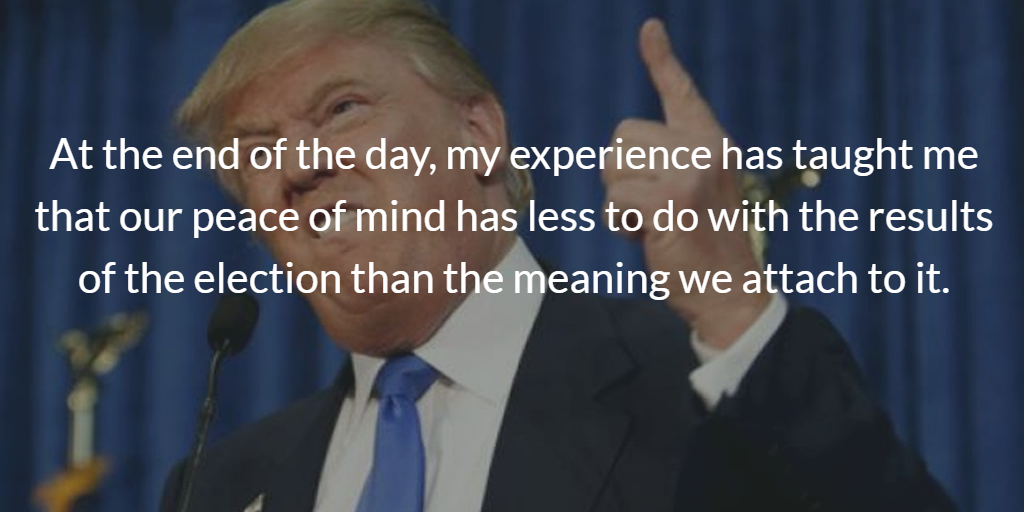
At the end of the day, my experience has taught me that our peace of mind has less to do with the results of the election than the meaning we attach to it and what we do with that meaning.
Bryant McGill writes:
If you want a great life try being kind. It is astounding what power being kind, mannered, polite and considerate has in transforming your life. If you are rude, cynical, negatively-sarcastic or pessimistic, your life options are going to be very limited. Playful, positive sarcasm is different from negative mean sarcasm, and many people don’t know the difference. Be careful with people’s feelings. Elevate your thinking and comportment. Many people live in an induced spiritual coma; they are inherently vicious, and are completely unaware of their malady. They exist in an unconscious, mean-spirited and competitive state of being — always ready to pounce on their next victim. There is a coarse and ugly temperament and tenor observable in the common unconscious person. This piggish coarseness looks like impatience, intolerance, rudeness, vulgarity, selfishness, self-righteousness, ignorance, condescension and mockery. I know what it looks like because it was once in me. Maybe you are a pig and don’t even know it. Have you ever considered it? Maybe you don’t just have “bad luck” — maybe you are caught-up in a stampede of ugliness. The vile are trampled beneath the feet of other pigs. Maybe you’re not a pig but you know someone who is, and you want them to awaken to virtue and righteousness so they can have an incredible life instead of suffering unnecessarily. If you want an incredible life and you have a bad attitude, and are mean to people — you can just forget about it. If you are cynical, pessimistic, judgmental, shallow and petty, you don’t deserve success, because success is empowering, and petty people should never be given power. You have to earn the right to an incredible life by being an incredible person. Your life is always a perfect reflection of your state of heart and mind, and of your truest identity. There is a different world on the other side of your present attitude. You can only access the beautiful world through faith by truthfully embracing beauty and caring. Be open to others; give people a chance. Be open to yourself; give yourself a chance.
Source: Life like a real-life Jerry Springer Show? by +Bryant McGill Your life is no…

Here’s my suggestion for what to do when you find yourself in the company of people whose views differ from yours. Grant them the benefit of the doubt as to their intentions unless their views are morally indefensible to you. (My list of morally indefensible includes discrimination against people based on their race, religion, ethnicity, country of birth, gender, sexual orientation, disability.) Prejudice against any of these people is a deal-breaker for me because it’s an attack on our fundamental human right to be who we are and to live as we please so long as we’re not harming others.
I suggest that if a friend or relative crosses your deal-breaker line, speak up—but not in anger. Without attacking the other person—and with as much care as you can muster—state your views as skillfully as you can. Then, if the other person wants to start an argument with you, refuse to contend with him or her. I love these words from the Thai Buddhist monk Ajahn Chah: “If there is no one to receive it, the letter is sent back.”
Source: 3 Suggestions for Responding Wisely to the Election Results | Psychology Today

Good stuff from Rick Hanson…
As the most social and loving species on the planet, we have the wonderful ability and inclination to connect with others, be empathic, cooperate, care, and love. On the other hand, we also have the capacity and inclination to be fearfully aggressive toward any individual or group we regard as “them.” (In my book – Buddha’s Brain: The Practical Neuroscience of Happiness, Love and Wisdom – I develop this idea further, including how to stimulate and strengthen the neural circuits of self-control, empathy, and compassion.) To tame the wolf of hate, it’s important to get a handle on “ill will” – irritated, resentful, and angry feelings and intentions toward others. While it may seem justified in the moment, ill will harms you probably more than it harms others. In another metaphor, having ill will toward others is like throwing hot coals with bare hands: both people get burned. Avoiding ill will does not mean passivity, allowing yourself or others to be exploited, staying silent in the face of injustice, etc. There is plenty of room for speaking truth to power and effective action without succumbing to ill will. Think of Gandhi, Martin Luther King, or the Dalai Lama as examples. In fact, with a clear mind and a peaceful heart, your actions are likely to be more effective. Ill will creates negative, vicious cycles. But that means that good will can create positive cycles. Plus good will cultivates wholesome qualities in you.
Go to the source: Do People Ever Make You Mad? | Psychology Today

Good post from Guy Finley on PositivelyPositive…
Read the next three sentences very carefully. I [the author] have separated this trio of important ideas for ease of reading, but they are very much connected to each other. Each higher idea leads to the next one, and when they are absorbed all together, they will tell you a great secret.
Before you can get anything different from this life, you must first do something different.
Before you can do anything different with your life, you must first know something different.
Before you can know anything different, you must first suspect and then confirm that it is your present level of understanding that has brought you what you now wish you could change.
Now let’s reverse the order of these right ideas so that we can see how they work from the other way around.
Until you know something different you cannot do anything different.
Until you do something different you will not get anything different.
And until you really get something different from your life you cannot know what you have missed and how much more there is to understand.
Trying to change what you get from life without first changing what you know about life is like putting on dry clothes over wet ones and then wondering why you keep shivering. You must stop trying to change what you are getting for yourself and go to work on changing what you are giving to yourself.
Go to the source for more: How to Change the Life You’re Giving Yourself
I found this article interesting because thanks to an app I recently installed, I am already doing this and receiving the benefits of it…
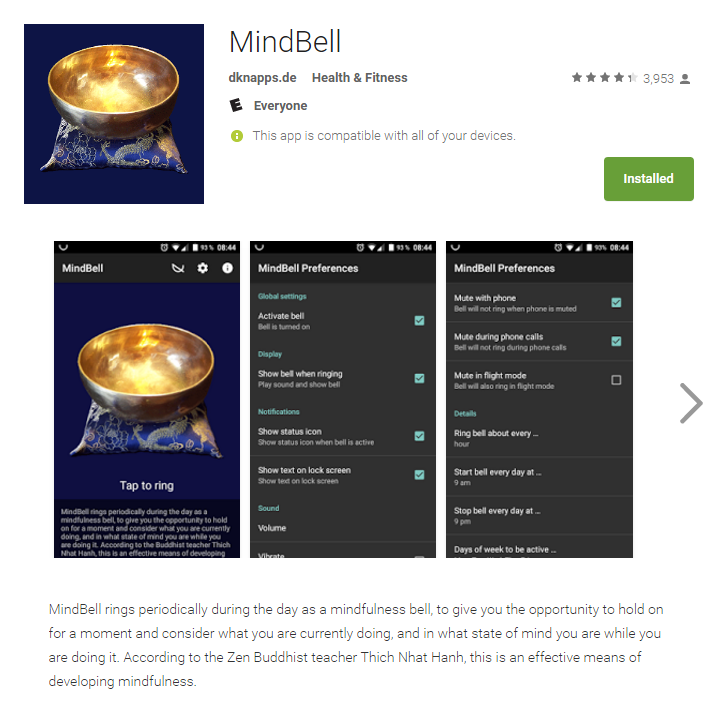
So, if the “monkey mind,” as the Eastern practitioners call it, has a mind of its own, how does one become more “mindful?” How can your mind remind itself to be mindful, when it loves to wander? Isn’t mindlessness the more typical – and even normal – condition?Here’s an easy way. Let’s imagine that you have a special relationship with a helpful little bird, one that likes to keep your attention in the now. Imagine that your feathered friend takes on the mission of reminding you, periodically, to just “tune in.” Only you can see and hear her, of course, and she comes to you only during your waking hours.Imagine that once every hour, she lights on your shoulder, politely chirps into your ear, and flies away. That little chirp is your signal to interrupt whatever you’re doing, however engrossing it might be (unless it’s reacting to a dangerous situation), and take five or ten seconds to look around, reorient to your surroundings, and remind yourself how great it is to be alive.This can be your moment of gratitude; or your moment of acknowledging the wonderment of the experience of life; a moment of giving thanks for all that you have in life; taking joy in the rewarding relationships you have with others; recommitting to taking care of your health; and for living wisely and gently. Just five or ten seconds, every waking hour, can have a remarkable effect on your sense of well being, and it can begin to condition you to return to immediate reality more often, and to appreciate what joy there can be in just living.“But,” you ask, “where is this magical little bird, and how do I make a deal with her to wake me from my trance every hour?”
Source: If You Want to Become More Mindful, Check Your Watch | Psychology Today
The app is called Mindbell and you can find it here…

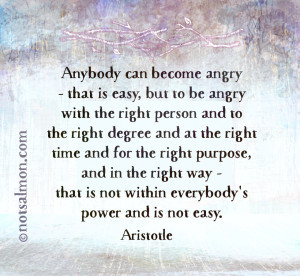
Anger is an agitated state of mind that can easily lead to hatred and violence if unchecked. Yet I don’t believe it’s possible to get rid of anger; it is a universal emotion deeply rooted in ingrained survival reactions. My goal is to live with anger—as well as other difficult emotions—in a skillful way so it doesn’t cause harm.
How do I practice with anger in order to achieve that?
There are many types of anger. For example, there’s the anger I feel after watching or reading about social injustice. The energy of this type of anger can be helpful. Taking action requires experiencing enough outrage that I’m compelled to volunteer, protest, or support the causes that address social injustice—without allowing my indignation to erupt into violence.
Another type of anger is made up of grudges that camouflage grief. I mentor many people who carry around unending resentments at those who’ve abandoned them, whether lovers, spouses, partners, parents, or family members. What I find is that harboring such resentment creates the illusion that we can protect ourselves from ever being abandoned again.
Source: You Can’t Get Rid of Your Anger— And That’s OK – Lion’s Roar

We grew up hearing that anger is a weakness. It’s shameful. It’s a monster. But I’ve learned that anger can actually be helpful if we know how to manage it.


 Bright, shiny objects!
You must be logged in to post a comment.