Organic chemistry doesn’t care if you believe in it. Neither does the War of 1812.
Truth is real, it’s measurable and it happened. Truth is not in the eye of the beholder.
There are facts that don’t change if the observer doesn’t believe: The age of the Eiffel Tower. The temperature in Death Valley. The number of people in the elevator.
On the other hand, there are outcomes that vary quite a bit if we believe: The results of the next sales call. Our response to medical treatment. The enjoyment of music…
If you believe that this wine tastes better than that one, it probably will. If you believe you’re going to have a great day at work, it will surely help. Placebos work.
We make two mistakes, all the time. First, we believe that some things are facts (as in true), when in fact, belief has a huge effect on what’s going to happen. In the contest between nature and nurture, nurture has far more power than we give it credit for. In countless ways, our friends and parents matter more than our genes do.
At the same time, sometimes we get carried away. We work to amplify our beliefs by willfully confusing ourselves about whether the truth is flexible. It makes belief a lot more compelling (but a lot less useful) if we start to confuse it with truth.
But belief is too important and too powerful to be a suspect compatriot of the scientific/historical sort of truth.
We can believe because it gives us joy and strength and the ability to do amazing things. That’s enough.
Anger is an agitated state of mind that can easily lead to hatred and violence if unchecked. Yet I don’t believe it’s possible to get rid of anger; it is a universal emotion deeply rooted in ingrained survival reactions. My goal is to live with anger—as well as other difficult emotions—in a skillful way so it doesn’t cause harm.
How do I practice with anger in order to achieve that?
There are many types of anger. For example, there’s the anger I feel after watching or reading about social injustice. The energy of this type of anger can be helpful. Taking action requires experiencing enough outrage that I’m compelled to volunteer, protest, or support the causes that address social injustice—without allowing my indignation to erupt into violence.
Another type of anger is made up of grudges that camouflage grief. I mentor many people who carry around unending resentments at those who’ve abandoned them, whether lovers, spouses, partners, parents, or family members. What I find is that harboring such resentment creates the illusion that we can protect ourselves from ever being abandoned again.
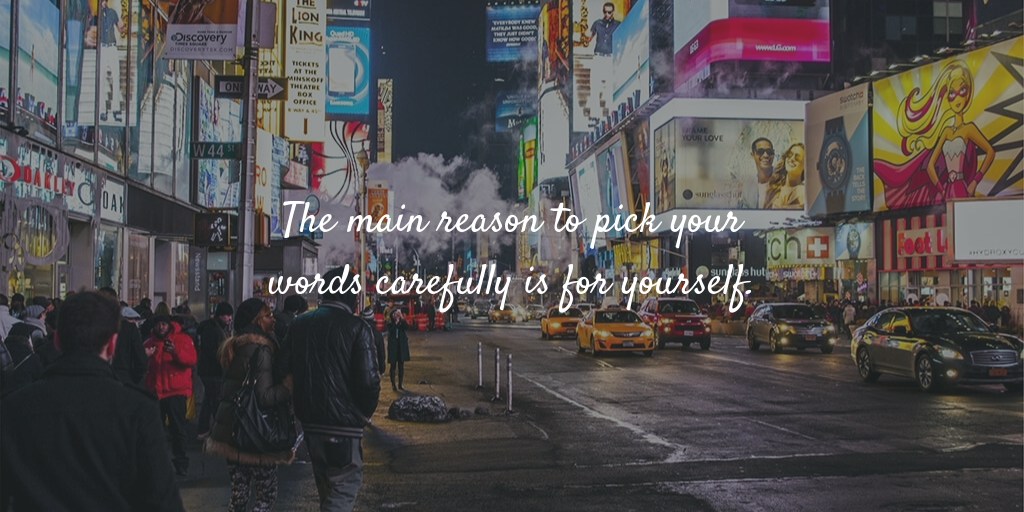
However the main reason to pick your words carefully is for yourself. We constantly hear ourselves describing ourselves and although it may be unconscious, we choose particular words to describe ourselves and our deeds. If you are someone who minimises themselves on a regular basis this is how you and others will see you. You may create the belief that you are “only” or “just” or “quite” rather than powerfully occupying who you are in whatever role you have chosen for yourself. Drop those qualifiers. Additionally, don’t use frightening or exaggerating words when describing a forthcoming event that you are not looking forward to. If you describe a visit to the doctor or dentist as horrid or scary, then like as not this is how it will be for you. Incidentally, many parents prejudice their children prior to inoculations or having to take medicine by telling their children how awful it will be. Don’t do it.
“Sometimes crazy behavior is a symptom of trauma and pain. A lot of times crazy behavior hides deeper issues. From the moment we are born we start to develop a sense of self and belonging. We start to develop an idea of whom we are, how others feel about us, and where we fit in the world. Our first feelings and ideas of self come from the relationship we have with our parents. Generally speaking, if children have healthy parents and feel loved and secure at home, they will grow up secure and will have secure adult relationships. But if children come from homes where there is any type of trauma, abuse, or abandonment, where they don’t learn to build a secure sense of self, then they will grow up anxious and insecure and will have difficulty trusting others and themselves. Most of the time, people who act “crazy” are subconsciously playing out their childhood wounds. These wounds need to be worked through; otherwise, they continue to manifest over and over again with every new relationship.” Source: http://tinybuddha.com/blog/how-pain-can-cause-us-to-act-crazy-in-relationships/?platform=hootsuite
I have become lazy and sloppy on this blog — posting pithy memes instead of writing what they mean to me — so this post is really something outstanding if only because it’s the first post in ages where I’ve written more than 7 words. :-D
I believe that yesterday was a great day for all Americans, regardless of their sexual orientation. Years ago, however, I would have been apoplectic and spewing hatred and ranting about how yesterday’s Supreme Court decision signalled the death of America, blah, blah, blah. What changed? I did. Why? A simple thought rocked my world:
Who am I to judge? No one. I am not worthy!
Here’s a bit of a backstory: I have spent a big part of my life on ‘the right’; the political right [for two years, I was the 3rd Vice Chairman of the Republican Party and consulted with the RNC] and the religious right [I am a recovering Shiite evangelical fundamentalist].
Oh, yeah! I was in deep…
The irony of it all is that while I was obsessed with being RIGHT on the outside I was so wrong on the inside. My binary [true/false, black/white] orientation meant that I didn’t really need to THINK about a lot of things including the idea that all beings deserve happiness regardless of whether we agree on issues like with whom we want to cuddle up on a cold Wisconsin night.
Fundamental to my growth path or dharma over the past few years is a wonderful teacher named Tara Brach who introduced me to the idea of metta, or lovingkindness, practice. When you pray this:
May all beings have happiness and the causes of happiness;
May all be free from sorrow and the causes of sorrow;
May all never be separated from the sacred happiness which is sorrowless;
And may all live in equanimity, without too much attachment and too much aversion,
And live believing in the equality of all that lives.
…it is difficult to deny any being what they consider happiness regardless of what they believe or their ‘orientation’ on any one of a number of issues. May all beings have happiness and the causes of happiness…
It’s not that I don’t care anymore — it’s that I care more deeply than I ever did about all beings and not so much the issues themselves. The reason I celebrate the decision is because I am ok with it when only 5 years ago I would have been beside myself with anger and fear and I feel that I am a better person now than I was then. May all beings have happiness and the causes of happiness…
One of the many people I want to thank for the part they have played in my conversion is a beautiful man named Michael Rohrer who blogs in a raw, powerful, and transparent way about the struggles of being a gay man who comes from a religious background. I don’t know how I first came across his work but I’m grateful I did. Through his writing he has opened my eyes and heart to the idea we are all on the same journey even if we follow different paths and I cherish the friendship that has developed via Twitter and Facebook! I don’t agree with everything that Michael posts but I will defend to the death his right to post it and he opens my mind. May all beings have happiness and the causes of happiness…
Today I celebrate not only the Supreme Court decision but also the joy of having an open mind and how much nicer it is than needing to be RIGHT all the time! May all beings have happiness and the causes of happiness…
Earl Perkins has an interesting post on the Gartner Blog Network about the topic of security.
I thought it would be appropriate to start off 2015 by adding my voice to a rising chorus from advisors, consultants and others in the cybersecurity industry with a short and simple message. We as an industry cannot help you if you’re not willing to help yourselves. And helping yourselves means you have to do (at the very least) the minimum required to secure yourselves from the most common types of cybersecurity threats and attacks.
Now this may seem to be an obvious comment and you may be wondering “why is he wasting my time telling me this”. I’m taking the time to do so because frankly many of you do not appear to be listening. It may be time to be a bit more blunt and direct. There are and have been reams of research and guidance written and delivered over the years that outline the basic principles and practices to establish cybersecurity strategy, governance, planning, management and operations. Descriptions of these steps to core competence can be found not only in Gartner research but from many other sources. Establishing this core competence for many of you does not require large or expensive purchases of technology and services, nor does it require major shifts or changes in process or organization. But it DOES require a level of discipline, structure and cultural change regarding where cybersecurity fits within your organization and the priority that you give changes that must and should occur. This core competence does require a level of communication and awareness that is apparently not working in its current form of delivery. It requires a level of coordination with service providers, supply chain partners and external parties that does not appear to be taking place.
Last summer, I read Michael J. Daugherty’s book “The Devil inside the Beltway” and I thought ‘Thank God I don’t have to deal with his issues’, however, I just took a position with a healthcare firm that must comply with HIPAA and HITTECH and as the Marketing Manager who is also involved in technology issues, there is nothing more important than cybersecurity — to ignore it is to risk losing your business!
In our case, we rely heavily on our partner Netgain in St. Cloud to ‘watch our six’ but there’s always the fear that someone could install LimeWire or its modern day equivalent and bring down the house a la LabMD. Every employee must understand that the technology they use is not theirs and that it’s provided to do a job and that they must comply with security requirements. Cybersecurity is the responsibility of EVERY employee…
No, but apparently they can still be used for some aspects of healthcare marketing. I cite this example from The Huffington Post about a Google Hangout on Air hosted by a physician from the world renowned Mayo Clinic:
A new study shows that doctor fatigue raises the risk of car accidents after long shifts. How does fatigue impair medical care?
Circulation:The Huffington Postattracts over 28 million monthly unique viewers.
Context: This study appeared in the Dec. 5 issue of the Journal of the American Medical Association. Colin West., M.D., Ph.D., the lead author, is a General Internal Medicine physician at Mayo Clinic. His research focuses primarily on physician well-being, evidence-based medicine and biostatistics, and medical education. Dr. West participated in this Google Hangout with eight other people. This function within Google Plus allows users to have live, face-to-face, multi-person video chats with chosen participants. Google Hangouts On Air are Hangouts in which the video stream displays publicly on the Google Plus profile page of the user who launched the chat. They can also be displayed on the user’s YouTube channel or website.
If the Mayo Clinic is using Google Hangouts on Air, perhaps it’s a good indication that they are safe for other medical institutions to use for marketing when done correctly.
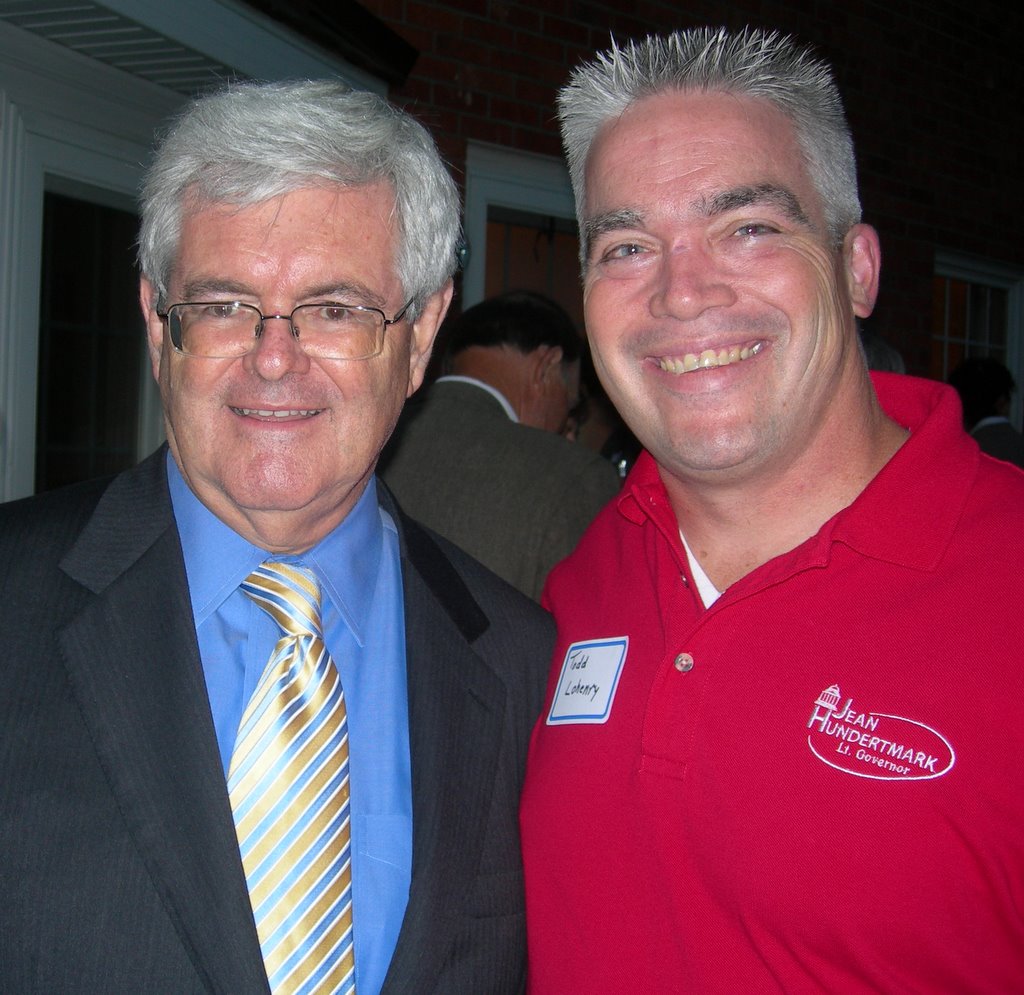
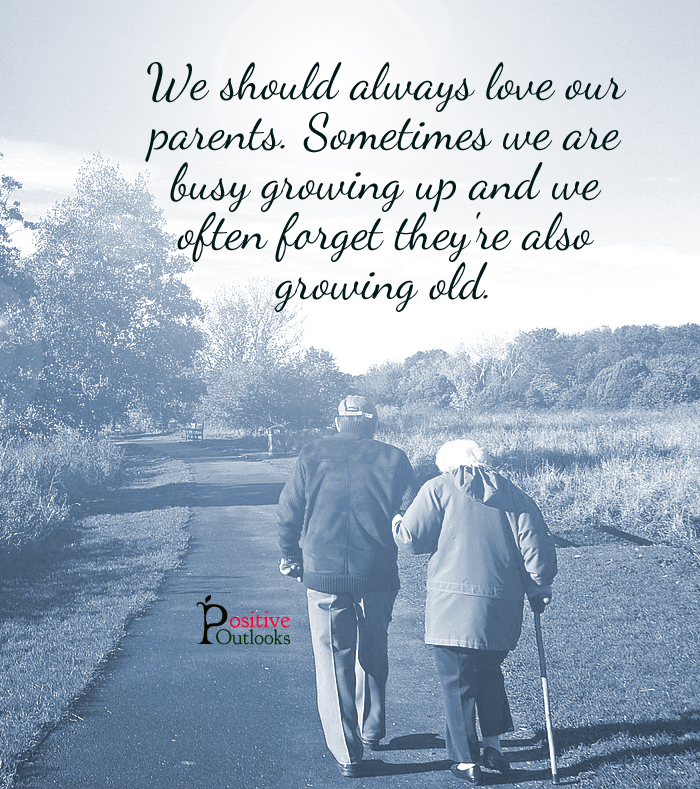
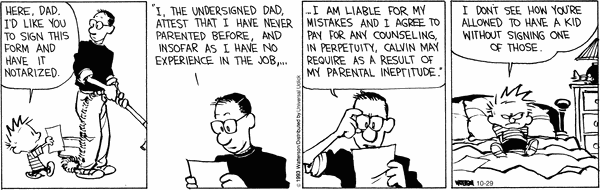
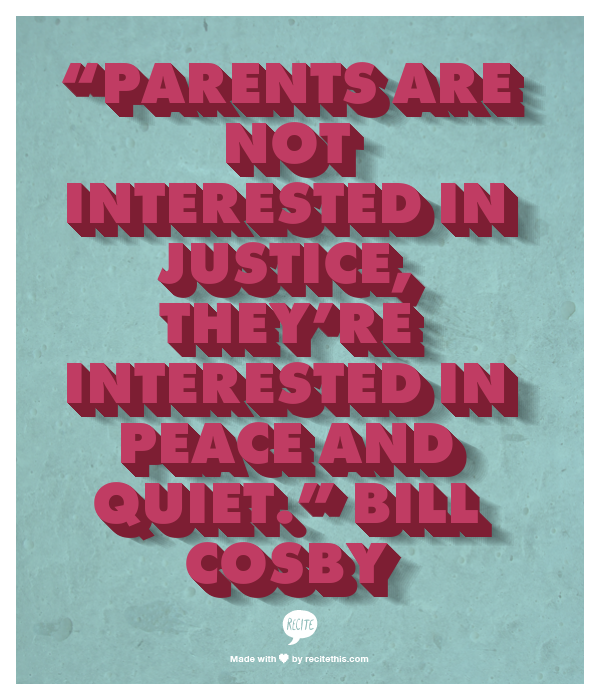
This one goes out to my dad who is celebrating his 77th birthday today and while he refused to sign one of these waivers, he becomes a better father every day…
 Seth Godin writes:








 Bright, shiny objects!
You must be logged in to post a comment.