For those of us who live our lives in the real world, there is one branch of philosophy created just for us: Stoicism. It’s a philosophy designed to make us more resilient, happier, more virtuous and more wise–and as a result, better people, better parents and better professionals. Source: What Is Stoicism? A Definition & 9 Stoic Exercises To Get You Started
Want to go deeper? Check out this summary of Marcus Aurelius’ Meditations…
Brian Johnson offer’s a great overview here but you have to create a free account…
The pandemic’s lockdowns and school closures put parents under unprecedented pressure—and moms, not dads, took the strain. Source: The Help That Never Came
When you are upset, your window is blurred. And…you’re going to straighten out all the buildings just because your window is blurred with the rain?
Could we clean our windows first?
We see people not as they are, but as we are. And it’s amazing how in the beginning we saw people as rude; then when we change, we see frightened people. They are so scared that they’re driven to hostility. Then you are understanding, you are compassionate, whereas before you’d react with anger, with hate.
Me? I used to be a very black and white thinker and it make me miserable. It was only when I started to ‘think in the gray’ that life became much better. Use these strategies to feel happier. Source: How Flexible Thinking Leads to Greater Happiness
I hope you can live your life with slightly less firmly clenched fists and slightly more open hands. Slightly less control. Slightly more trust. Slightly less I need to know everything beforehand. Slightly more take life as it comes. It does all of us a world of good. Life doesn’t have to be lived with constant anxiety about things not turning out the way we want. We don’t have to make ourselves smaller than we are. We have a choice. Do we want to grab life by he throat or do we want to embrace it?
Relax that fist as often as you can.
Bjorn Natthiko Lindeblad, I May be Wrong, and other wisdoms from life as a Forest Monk.
“Most of us would agree that cats and humans are vastly different. We tend to think of ourselves as more developed, as a higher species, not just because of our superior intelligence but also because we gave ourselves the gift of morality and ethics. Unlike cats, weknow about what’s good and evil, right and wrong, and we aspire to transcend our animalistic tendencies to improve morally and make the world a better place. Cats, on the other hand, don’t care about morals. They don’t have ambitions to improve the world either, nor themselves.
Two people attend a house party, where they socialize with the same guests, drink from the same beer tap, and are exposed to the same music and atmosphere. They decide to share a taxi and drive home when the party is over as they live closely together. “That party really sucked,” one person says. “The beer was terrible, the DJ was really bad, and the guests were insufferable.” Then the other person says smiling joyfully: “Really? I just had the best party in years. It was awesome.”
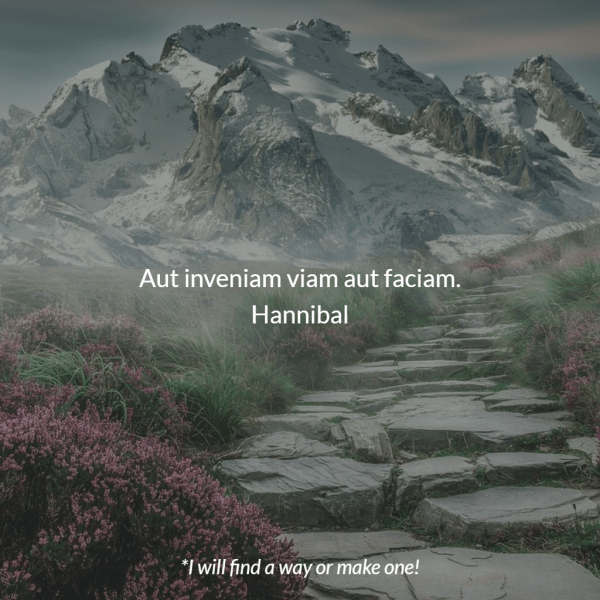
“Aut inveniam viam aut faciam” (or “Aut viam inveniam aut faciam“) is Latin for “I shall either find a way or make one.”[1][2][3] The first word “aut” may be omitted, corresponding to omitting the English word “either” from the translation.
The phrase has been attributed to Hannibal; when his generals told him it was impossible to cross the Alps by elephant, this was supposedly his response. The first part of the sentence, “inveniam viam”, “I shall find a way,” also appears in other contexts in the tragedies of Seneca, spoken by Hercules and by Oedipus, and in Seneca’s Hercules Furens (Act II, Scene 1, line 276) the whole sentence appears, in third person: “inveniet viam, aut faciet.”[4] Source: Inveniam viam – Wikipedia










 Bright, shiny objects!
You must be logged in to post a comment.