I have come to believe that the way the term self-esteem is used is actually a misnomer. The first half of the expression, self, would seem to indicate that esteem, the second half of the expression, is derived from one’s self. Yet if we look closer, we find that most people seek a sense of worthiness from that which lies outside of them. For a student, it might come from good grades; for a businessperson or worker, it’s derived from a promotion or a raise; and for most individuals, praise or acknowledgement provide a temporary increase in esteem. Our society generates billions of dollars in revenues from inducing people to seek the quick fix of vanity as a means toward feeling better. Yet none of these actually contributes one iota to self-esteem. Ironically, they may even get in the way.
“Our greatest fear is that when we die we will become nothing. Many of us believe that our entire existence is only a life span beginning the moment we are born or conceived and ending the moment we die. We believe that we are born from nothing and that when we die we become nothing. And so, we are filled with fear of annihilation.
The Buddha has a very different understanding of our existence. It is the understanding that birth and death are notions. They are not real. The fact that we think they are true makes a powerful illusion that causes all our suffering. The Buddha taught there is no birth, there is no death; there is no coming, there is no going; there is no same, there is no different; there is no permanent self, there is no annihilation. We only think there is. When we understand that we cannot be destroyed, we are liberated from fear. It is a great relief. We can enjoy life and appreciate it in a new way.
The same thing happens when we lose any of our beloved ones. The day my mother died I wrote in my journal, A serious misfortune of my life has arrived. I suffered for more than one year after the passing away of my mother. But one night, in the highlands of Vietnam, I was sleeping in the hut in my hermitage. I dreamed of my mother. I saw myself sitting with her and we were having a wonderful talk. She looked young and beautiful, her hair flowing down. It was so pleasant to sit there and talk to her as if she had never died.
When I woke up it was about two in the morning and I felt very strongly as though I had never lost my mother. The impression that my mother was still with me was very clear. I understood then that the idea of having lost my mother was just an idea. It was obvious in that moment that my mother was just an idea. It was obvious in that moment that my mother is always alive in me.”
Thich Nhat Hanh is a Buddhist monk, poet, peace activist, and the author of more than one hundred books, including the national bestsellers ‘Anger’ and ‘Living Buddha, Living Christ.’ He lives in Plum Village, a monastic community in southwestern France.
A guy is driving around the back woods of Montana and he sees a sign in front of a broken down shanty-style house: ‘Talking Dog For Sale ‘ He rings the bell and the owner appears and tells him the dog is in the backyard.
The guy goes into the backyard and sees a nice looking Labrador retriever sitting there.
‘You talk?’ he asks.
‘Yep,’ the Lab replies.
After the guy recovers from the shock of hearing a dog talk, he says
‘So, what’s your story?’
The Lab looks up and says, ‘Well, I discovered that I could talk when I was pretty young. I wanted to help the government, so I told the CIA.
In no time at all they had me jetting from country to country, sitting in rooms with spies and world leaders, because no one figured a dog would be eavesdropping.’
‘I was one of their most valuable spies for eight years running. But the jetting around really tired me out, and I knew I wasn’t getting any younger so I decided to settle down. I signed up for a job at the airport to do some undercover security, wandering near suspicious characters and listening in. I uncovered some incredible dealings and was awarded a batch of medals.’
‘I got married, had a mess of puppies, and now I’m just retired.’
The guy is amazed. He goes back in and asks the owner what he wants for the dog.
‘Ten dollars,’ the guy says.
‘Ten dollars? This dog is amazing! Why on earth are you selling him so cheap?’
‘Because he’s a liar. He never did any of that shit.
Sadly, some people are so entrenched in seeing the negative side of things that they leave zero room for positive things to grow. People like this inhabit our families, work environments and social circles. It can be emotionally draining just being around them, and you must be careful because their negative attitudes and opinions are venomous and contagious. Negativity perpetuates itself, breeds dissatisfaction and clutters the mind. And when the mind is cluttered with negativity, happiness is hard to come by.
Ignore these people and move on from them when you must. Seriously, be strong and know when enough is enough! Letting go of negative people doesn’t mean you hate them, or that you wish them harm; it just means you care about your own well-being. Because every time you subtract negative from your life, you make room for more positive.
Here are seven such people you might need to put on your ignore list:
All the suffering that goes on inside our minds is not reality, says Byron Katie. It’s just a story we torture ourselves with. She has a simple, completely replicable system for freeing ourselves of the thoughts that make us suffer. “All war begins on paper,” she explains. You write down your stressful thoughts, and then ask yourself the following four questions: Continue reading “Byron Katie’s Four Questions”→
Richard Rohr (Photo credit: Wikipedia)
Dr. Steve McSwain writes:
In an authentic search for God, the cosmos of inclusiveness just keeps widening and expanding, not unlike the ever-expanding universe in which we live.
That’s a bit of a paraphrase of something Fr. Richard Rohr says in his book Immortal Diamond. It has been my experience, too. It seems the more aware I become of the Immortal Presence, the wider my heart stretches to include all persons…all faiths…all traditions.
We all experience moments of insecurity, frustration, stress and even depression, but for some of us, these moments last longer than others.
Like many people, I’ve gone through some major life changes over the past few years. I was stuck in depression tied to my corporate job. My breakdown turned into a breakthrough, which gave me clarity to follow my heart and change direction in my life. I moved across the country to live my soul’s purpose: to be a travel writer, life coach and public speaker.
One important step I took in my transition was to align myself with happy and successful people. I studied their behavior and learned that there’s a clear system and pattern in place to tap into true happiness. Through difficult life changes, we can learn a lot about ourselves as we grow into the people we’re meant to be.
I used to be sad, depressed, and insecure. Today my life is much different; I’m happy, healthy, fulfilled, and I love every second of my life. I attribute my newfound freedom to this magical list of habits of highly happy people.
Whenever I feel out of alignment, I return to this list and it gets me back on track. These are the steps of highly happy and successful people, but I reframed it to be in the present tense, so it becomes a go-to list to pull anyone into a happier state. Maybe it can help you through a tough time.
Paula Davis-Laack has a great post on HuffPo today:
Here are five ways to begin crafting more meaningful connections and lives:
Be clear when it comes to “purpose.” My friend, Carin Rockind, defines purpose as “the active way in which we uniquely impact the world.” Help your kids hone in on this as early as possible by noting the activities they find most rewarding and the activities they crave or are drawn to. Adults should be thinking about this too.
Create your own blend of drive and meaning. When I finished law school, I was driven to develop my career and make some money. As my career progressed, I focused solely on work to the exclusion of my relationships, and I burned out. It was almost too late before I realized that I had to pull back on my drive and increase my focus on meaning. I notice this same pattern in many of my high-achieving friends and coaching clients — at some point you’ll hit the wall if you forget to build in connection and meaning along the way. Continue reading “Your Other Biological Clock: When Do You Start Pursuing a Life That Matters?”→
Being desired is such a basic craving. We all want to be desired: by our family, by our friends, by a lover, by our coworkers. What happens when we don’t desire ourselves?
I’m beginning to realize that I don’t like myself very much. All these years of feeling like I couldn’t raise the eyebrow or pique the interest of an attractive man might actually stem from the fact that I’m exuding the pheromones of one who feels unworthy of being loved and therefore thinks he’s undesirable to all. Could it be that simple? I’m sure I’m not the only gay man — or person — who feels or has felt this way. Do you have to love yourself before you can love someone else or be loved by someone else? Is that a myth?
I keep wondering if I’ll ever love myself enough to be loved by another person. I hate being vulnerable, but vulnerability is key to opening one’s heart to another person. For years I’ve told myself, “When the right person shows up, I’ll know, and my heart will automatically open.” Is that utter bullshit?
A few years ago, I would not have touched the HuffingtonPost with a 10 foot mouse [now I have 100 fans there!] and I certainly would not have curated an article by a gay man. In the time between, however, many thinks [intentional] have changed. “We all want to be desired: by our family, by our friends, by a lover, by our coworkers.” This desire makes us all human and should unite, rather than divide…
Over 10 years ago, The Telegraph reported:
Whether you hail from Surbiton, Ulan Bator or Nairobi, your genetic make-up is strikingly similar to that of every other person on Earth, an analysis concludes today.
Although scientists have long recognised that, despite physical differences, all human populations are genetically similar, the new work concludes that populations from different parts of the world share even more genetic similarities than previously assumed.
All humans are 99.9 per cent identical and, of that tiny 0.1 per cent difference, 94 per cent of the variation is among individuals from the same populations and only six per cent between individuals from different populations.
Nonetheless, the team found that tiny differences in DNA can provide enough information to identify the geographic ancestry of individual men and women.
The results of the study, published today in the journal Science, have implications for understanding ancient human migrations and for resolving an ongoing debate about the use of family histories in medical research, said Prof Marcus Feldman of Stanford University who led the team.
Because so many of us grew up without a cohesive and nourishing sense of family, neighborhood, community or “tribe,” it is not surprising that we feel like outsiders, on our own and disconnected. We learn early in life that any affiliation—with family and friends, at school or in the workplace—requires proving that we are worthy. We are under pressure to compete with each other, to get ahead, to stand out as intelligent, attractive, capable, powerful, wealthy. Someone is always keeping score.
After a lifetime of working with the poor and the sick, Mother Teresa’s surprising insight was: “The biggest disease today is not leprosy or tuberculosis but rather the feeling of not belonging.” In our own society, this disease has reached epidemic proportions. We long to belong and feel as if we don’t deserve to.
D.H. Lawrence described our Western culture as being like a great uprooted tree with its roots in the air. “We are perishing for lack of fulfillment of our greater needs,” he wrote, “we are cut off from the great sources of our inward nourishment and renewal.”
Lo, these many years I turned to ‘tribes’ — Christian Fundamentalists, The Republican Party, The Green Bay Packers — to make me feel right inside when in truth everything inside me was screaming at me from the mirror that everything inside me was wrong, and to compensate for the lack of a cohesive, nourishing sense of belonging. By learning about and practicing self-compassion, however, I am making progress in making peace with myself, my past, my present and my future…
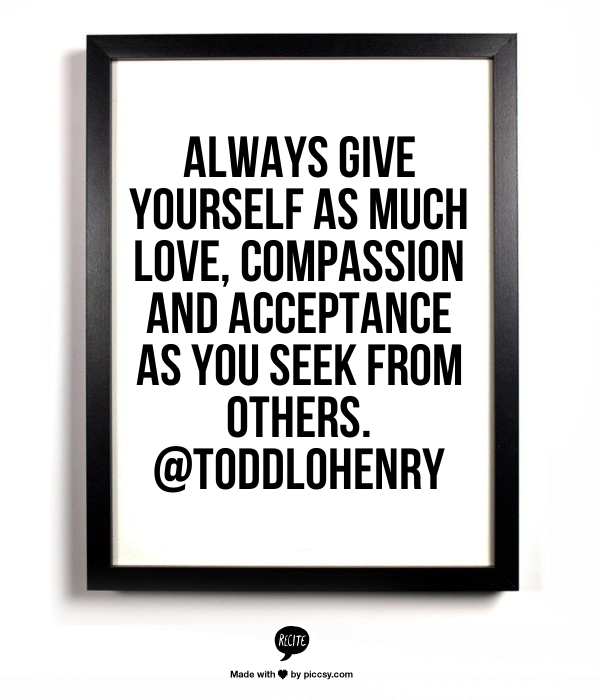
Thank you for your post, Michael, and for giving me pause to think about this topic. I agree that thinking our hearts will ‘automatically open’ is utter bullshit but, that if we practice self-compassion our hearts may slowly and gently open to the possibility of healthy interdependence and my hope is that when we are able to give ourselves at least the same amount of love, compassion and acceptance we seek from others, the craving to be desired may pass away. Namasté!
All of us live with fear. Whenever fear takes over, we’re caught in what I call the trance of fear. As we tense in anticipation of what may go wrong, our heart and mind contract. We forget that there are people who care about us, and about our own ability to feel spacious and openhearted. Trapped in the trance, we can experience life through the filter of fear, and when we do, the emotion becomes the core of our identity, constricting our capacity to live fully.
This trance usually begins in childhood, when we experience fear in relating to our significant others. Perhaps as an infant our crying late at night may have frustrated our exhausted mother. When we saw her frowning face and heard her shrill tone, suddenly we felt unsafe with the person we most counted on for safety. Our arms and fists tightened, our throat contracted, our heartbeat raced.
This physical reaction of fear in response to disapproval may have happened repeatedly through our early years. We might have tried out something new—putting on our clothes all by ourselves and gotten them backwards. We might have poured a cup of grape juice—but spilled it on the living room carpet. Each time our mother’s disapproving look and tone of frustration were directed at us, we felt the same chain reaction of fear in our body.
Did you ever realize that everything going on in your mind — every thought, feeling, sensation, everything you are aware of — is in fact happening only in your private internal world? Your thoughts appear only to you, and are not being heard by anyone else whatsoever. There is one physical world here on earth, but billions of different internal worlds. We are all in our own separate theaters, witnessing entirely different shows, and yet we behave as it we are in the same audience, watching the very same event we call life.
Why is it important to contemplate this truth? To meditate on this is liberating, because it implies that what we are personally living inside our heads is not real. We are aware of our thoughts, so in that sense they are real. And yet, our thoughts do not exist outside of our awareness. There is nowhere else where the thought that is appearing to you at this moment is actually occurring. Unlike the way we imagine it, our thoughts are not solid, like trees or rocks that exist outside of us in some tangible way. Certainly I have never seen a thought walk by me on the street. Where, how and if thoughts even exist within the body is not clear. That thoughts appear to our awareness, on a giant projection screen (to which we are the audience), is all we know.
Let’s say that at this moment you are having a thought about a friend and something specific that she did, and what you want to say to her in response. That friend who you are thinking about is not experiencing your thought (about her) at this moment. If you don’t engage with, or entertain that thought, it will literally not exist. The thought appears only within you. Your friend knows nothing of it. And making it even stranger, you did not even have the thought that you are calling “yours.” Rather, it appeared to and within your awareness, without your ever choosing it or asking it to show up! If that thought is not fueled with your attention or interest, it will already have disappeared.
Quite often we put too much importance on our thoughts and take them so seriously that they can lead us into all kinds of emotional turmoil. Some thoughts are inspiring, while others can be misleading. One time we were teaching meditation. and Ed said to Mary, a participant, that when we meditate all sorts of outrageous thoughts may arise. In response, Mary blurted out, “Wow, how’d you know?” Because of her negative thoughts, Mary felt she was a terrible person. Yet thoughts are simply words in our mind. Those we thought yesterday are gone and new thoughts arise only to disappear into the next moment.
We lived in Dartmouth, on the south coast of England, and each day we would take walks along the wide river Dart to the estuary. One day we were standing and gazing at the flowing water when it struck us that though the river always looked the same, day after day, it was no more the same than it was even a second ago. It was constantly changing, always moving, always different.
Which is just like our thoughts and feelings. Can you remember what you were thinking yesterday that seemed so important? Who we are now is not who we were last week, an hour ago, even a few minutes ago. Like the river, we are always changing. Continue reading “Today’s Thoughts Are Tomorrow’s History”→
I am the latest Rabbi Evan Moffic fanboy — he actually stopped to comment on a post I did [did I mention lately I <3 the internet?] curating his work this morning…
As I explore the body of his work online, I came across this post on a topic of current interest and I share his reasoned perspective here:
As President Obama said, the jury has spoken. The case has concluded. One side won, and another side lost. Yet, no one is happy. A 17-year-old boy is dead. Grieving parents will never be the same. What now?
Some want to continue the conflict. Facebook and Twitter are filled with words of vitriol and vengeance. Others, like Trayvon Martin‘s parents, have conveyed their sadness and hope. They have turned to faith not in the name of anger. They have turned to God in the name of healing. This morning Trayvon Martin’s mom tweeted, “Lord during my darkest hour I lean on you. You are all that I have. At the end of the day, God is still in control. Thank you all for your prayers and support.”
This year, I completely unplugged on my birthday. I wish I could say it was intentional, but it had more to do with poor phone reception and not wanting to pay for wireless internet. Nontheless, the benefits of being disconnected from the internet and present with my family were wonderful. Seems like it’s a trend:
Randi Zuckerberg called it exactly right. In her recent roundup of the top 10 social media trends, the former Facebook chief marketing officer said it was time for a digital detox, arguing that people need to understand that while “the phone is an amazing tool… we own our devices, they don’t own us.”
Picking up on the same theme, Alice G. Walton recently wrote in Forbes that our dependence on mobile technology could be harming our mental health, noting:
“It may be time to take the workday back, at least in part, and when it comes to responding to a colleague at some ungodly hour, to just say ‘no.’ Or at least, ‘I’ll get back to you during business hours’.”
Here is the thing. Most of us have no idea that we are hiding behind our bad behavior because we refuse to admit to ourselves that we are doing anything wrong. If we were to acknowledge our undesirable actions, we would feel guilty (which we don’t want to feel), or we would have to change (which we don’t want to do).
No, we want to continue doing whatever it is that we do- guilt free.
So if deep deep down, or even not so deep down, we know that what we are doing is wrong, how do we keep doing it without feeling guilty? We use our defenses. Yes, we find ways to defend our bad behaviors to others and to ourselves. As long as we can make it “not so bad”, then all is good. Or so we think.
We all use defenses to a certain extent. See if you recognize any of the following as your defenses.













 Bright, shiny objects!
You must be logged in to post a comment.