Healthy Dependency?

I didn’t know what it looked like either until I read this book. I knew what it looked like to be unheathily attached — it looked like codependency. I knew what it looked like to be unheathily detached — it looked like ‘eff you — I’m taking my marbles and leaving’. If you struggle with either being overly detached or attached, this book will help evision what healthy dependency looks like…

Click the image to learn more…

You are Loveable

Melody Beattie writes:

Even i f the most important person in your world rejects you, you are still real, and you are still okay. Codependent No More

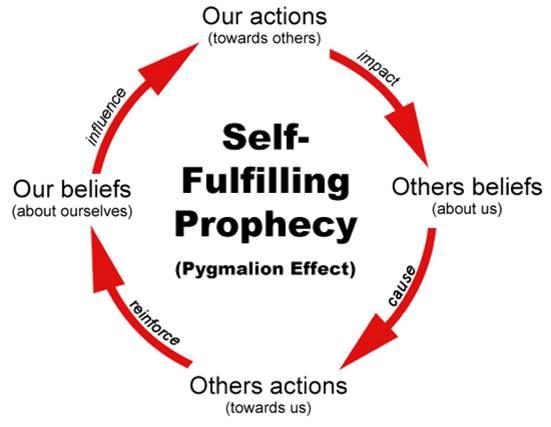
Do you ever find yourself thinking: How could anyone possibly love me? For many of us, this is a deeply ingrained belief that can become a self-fulfilling prophecy.

Thinking we are unlovable can sabotage our relationships with co-workers, friends, family members, and other loved ones. This belief can cause us to choose, or stay in, relation­ships that are less than we deserve because we don’t believe we deserve better. We may become desperate and cling as if a particular person was our last chance at love. We may become defensive and push people away. We may withdraw or constantly overreact.

While growing up, many of us did not receive the uncon­ditional love we deserved. Many of us were abandoned or neglected by important people in our life. We may have con­cluded that the reason we weren’t loved was because we were unlovable. Blaming ourselves is an understandable reaction, but an inappropriate one. If others couldn’t love us, or love us in ways that worked, that’s not our fault. In recovery, we’re learning to separate ourselves from the behavior of others. And we’re learning to take responsibility for our healing, regardless of the people around us.

Just as we may have believed that we’re unlovable, we can become skilled at practicing the belief that we are lovable. This new belief will improve the quality of our relationships.

It will improve our most important relationship: our rela­tionship with our self. We will be able to let others love us and become open to the love and friendship we deserve.

Today, God, help me be aware of and release any self-defeating be­liefs I have about being unlovable. Help me begin, today, to tell myself that I am lovable. Help me practice this belief until it gets into my core and manifests itself in my relationships.” via November 5: We are Loveable.

Using Self-Fulfilling Prophecies to Your Advantage

Why “fake it ’til you make it” is good advice!

Full story at: Using Self-Fulfilling Prophecies to Your Advantage | Psychology Today.

Hmmm…

“You cannot force someone to want to change their behavior. After all, they are not just “behaviors” to the person suffering from the disorder — they are coping mechanisms they have used all their life.” John M. Grohol, Psy.D.

Kreger, Randi; Mason, Paul (2010-01-01). Stop Walking on Eggshells: Taking Your Life Back When Someone You Care About Has Borderline Personality Disorder (p. 15). New Harbinger Publications, Inc.. Kindle Edition.

Payoffs from Destructive Relationships

Melody Beattie writes:

Sometimes it helps to understand that we may be receiving a payoff from relationships that cause us distress.

The relationship may be feeding into our helplessness or our martyr role.

Maybe the relationships feeds our need to be needed, enhancing our self-esteem by allowing us to feel in control or morally superior to the other person.

Some of us feel alleviated from financial or other kinds of responsibility by staying in a particular relationship.

“My father sexually abused me when I was a child,” said one woman. “I went on to spend the next twenty years blackmailing him emotionally and financially on this. I could get money from him whenever I wanted, and I never had to take financial responsibility for myself.”

Realizing that we may have gotten a codependent payoff from a relationship is not a cause for shame. It means we are searching out the blocks in ourselves that may be stopping our growth.

We can take responsibility for the part we may have played in keeping ourselves victimized. When we are willing to look honestly and fearlessly at the payoff and let it go, we will find the healing we’ve been seeking. We’ll also be ready to receive the positive, healthy payoffs available in relationships, the payoffs we really want and need.

Today, I will be open to looking at the payoffs I may have received from staying in unhealthy relationships, or from keeping destructive systems operating. I will become ready to let go of my need to stay in unhealthy systems; I am ready to face myself.” via Just For Today Meditations – Maintaining A Life.

And, there are ALWAYS payoffs. They just might not be so obvious…

Creating Calm and Releasing Anxiety: Go Deeper, Not Faster

“It’s not the load that breaks you down; it’s the way you carry it.” ~Lena Horne

Full story at: Creating Calm and Releasing Anxiety: Go Deeper, Not Faster | Tiny Buddha.

Let Enlightenment Come

The everwise Melody Beattie writes:

Sometimes, the harder we try to see a lesson, the more lost and confused we become. “What does it mean?” we ask, squinting at the problem.

Relax. Let go of your expectations and your interpretations. Quit trying so hard to see.

Sometimes the lesson may be a simple reminder to see the sacred in your ordinary life or to practice compassion for yourself as well as for others. Sometimes what we’re going through is part of a larger lesson, one that may take us years to complete and comprehend. It’s easy to fall into the false belief that there’s some lesson that we have to push and struggle to learn. There isn’t.

We only have to see what we see and know what we know right now.

Sometimes, the harder we try to see a lesson, the more lost and confused we become. “What does it mean?” we ask, squinting at the problem.

Relax. Let go of your expectations and your interpretations. Quit trying so hard to see.

Sometimes the lesson may be a simple reminder to see the sacred in your ordinary life or to practice compassion for yourself as well as for others. Sometimes what we’re going through is part of a larger lesson, one that may take us years to complete and comprehend. It’s easy to fall into the false belief that there’s some lesson that we have to push and struggle to learn. There isn’t.

We only have to see what we see and know what we know right now.

Experience your life.

More shall be revealed when it’s time. Practice seeing without squinting.

God, help me be present to the situations in my life without trying to read too deeply into them. Help me trust that my lessons will become clear when it’s time.” via September 27: Let Enlightenment Come.

Ever feel like you are backtracking?

Christine Hassler has a real beauty of a post today that I grabbed in its entirety for you…

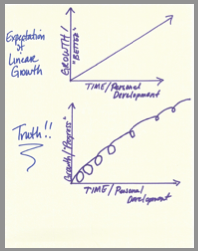
One of my pet peeves about the personal growth industry is that there is a lot of expectation placed on consistently making positive changes. The promise is that over time as we do our work, we gradually and continuously “get better” (whatever “better” means).  What often isn’t addressed is that our learning and growth isn’t linear.  It’s not a straight shot from an “aha” moment to being totally transformed.

Please don’t torture yourself by buying into the misunderstanding that your growth needs to be straight up. That’s a lot of pressure – and also not possible.  Growth is more fluid.  And over time the lows (or perceived backtracking) we experience become shorter in duration and the length of time in between them becomes longer. I drew this picture for you to illustrate what I am talking about:

Screen-shot-2012-09-26-at-7.05.27-PM
The original image was kinda small; I think this is still legible…

The human experience is about contrast and sometimes the best way we learn is when we take a few steps that feel backwards.  Often when we have a big “aha” so much to the extent that we feel transformed, the Universe will bring us a situation that feels very similar to past experiences. Often people get frustrated and think, “This again? I thought I learned this already!” That may be accurate; you may have learned the lesson and now the Universe is bringing you an amazing opportunity to practice the learning so that you can fully integrate it. I give some examples of this in today’s video.

If you feel like you are backtracking in your own behavior, choices, or feelings rest assured you are not flunking life.  You learned from my UPdate last week that only about 95% of our processing power is conscious so there is a lot of subconscious programming that you are working through. Your so-called issues and programmed responses got implemented decades ago so it may take some time before you totally shift something.  So if you find yourself slipping into old habits, reactions, behaviors or choices that you thought were behind you, cut yourself some slack.

Growth is a process not an event. You can’t upgrade yourself like you do your iPhone.

When you perceive yourself taking steps backwards, that does not mean change is not occurring. You may take ten steps forward and then eight steps back. But the next time you will take eleven steps forward and only seven steps back.  You are making progress!! Whatever you do, just keep going. And forgive yourself! This is super duper important.  Nothing will hold you back more than judging yourself and allowing your inner critic to have its way with you.  Immediately say to yourself, “I forgive myself for judging myself for back-tracking.  I’m doing the best I can.”  Then re-commit to your vision and intentions and keep going.

Keep going.

Keep going.

Source: Ever feel like you are backtracking? | Christine Hassler

Here are some of the points she makes I think are worthy of review…

“It’s not a straight shot from an “aha” moment to being totally transformed.”

“Only about 95% of our processing power is conscious so there is a lot of subconscious programming that you are working through”; this is why we say in Celebrate Recovery that we don’t claim perfection, only progress…

“Growth is a process not an event. You can’t upgrade yourself like you do your iPhone.” As a tech guy, there have been many times I have wished I could upgrade myself like hardware. If only I could reformat my brain and delete all the old Beatles‘ lyrics! I’d have so much more room! I do think, however, you CAN upgrade your thinking. There is an old computer programming acronym GIGO; Garbage In, Garbage Out. It applies to thinking and food as well…

And finally, this bears repeating…

“Nothing will hold you back more than judging yourself and allowing your inner critic to have its way with you.  Immediately say to yourself, “I forgive myself for judging myself for back-tracking.  I’m doing the best I can.”  Then re-commit to your vision and intentions and keep going.”

And perhaps the most important lesson of all? Go easy on yourself and practice ‘self-forgiveness’…

I really need to do this more often… Updated!

…via Instagram!
I am blessed to live an work less than 1 mile from Lake Michigan on the ‘right side’ of Wisconsin. I love the many ‘moods’ of the lake as I travel back and forth between home and work or while doing errands. Yesterday, for the first time I went to the wayside less than a mile from my home, pulled out a folding chair, put my feet up on a fence, listened to good music over the bluetooth headphones and sat and looked at the lake for half an hour. Priceless! What opportunities to ‘stop and smell the roses’ are you overlooking in your life? Need justification? Try this article on 6 reasons to cherish your alone time from Positively Positive…

Drain Pain

Melody Beattie wrote:

No, I don’t mean a clogged kitchen sink or a shower stall that empties slowly.

I’m talking about allowing people, places and things to slowly and insidiously creep in and begin sucking the soul, energy, life force – and resources – out of us.  No matter how many years ago we learned about not being codependent, it can still happen to us. Again.

Drain Pain occurs so slowly and subtly, we may not see it happening.  Following you’ll find a list of symptoms and the remedy for each:

  • We leave our bodies – disconnect from ourselves. We’re experts at fleeing the body. We hover around ourselves doing everything except feeling what we feel and valuing ourselves. When this happens, we often feel numb, confused and afraid.  We may also feel emotional (generalized) pain. The thoughts that accompany this condition include:  I CAN’T STAND THIS ANYMORE.  IT, HE, SHE OR THEY IS OR ARE DRIVING ME INSANE.  This means it’s boundary-setting time again.
  • We complain about the same thing, behavior or person or problem for days, weeks, months or years but nobody hears us.  The cure for this means listening to ourselves.
  • We know that something’s wrong but we aren’t sure what it is (because we’re not listening to ourselves).   When we mention the problem to the Drainer(s) — the people or institutions in the first symptom above — they look at us askance and reassure us that nothing is wrong except us – who we are, how we feel and what we think is going on just isn’t occurring, they insist.  Remember the story from the first Language of Letting Go, about the scene in a movie where a wife catches her husband in his pickup truck?  He’s parked at the drive-in movie theatre all cuddled up and kissing with another woman. When the wife confronts him about having this affair, he denies it vehemently while the other woman sits there kissing his neck, arm, hand and more.  “What are you going to believe?” the infidel asks his wife.  “Me or what you think you see?”  Crazy as that sounds, it can easily describe us when we’re in codependent mode.
  • We feel tired, unfocused and somewhat like a Boxer looks (the dog, not Mohammed Ali) when it’s chasing not a tail, but the remnants of one before the vet clipped or docked it.  We’re caught up in trying to do the impossible. It’s time to assess what we can and can’t change and then put energy into assessing and solving the right problem – the real issue that’s going on.
  • We feel increasingly angry at the people, places or things in our personalized list in the first symptom above, but as soon as we feel anger we also start to feel guilt. The guilt’s not real.  It’s the codependent guilt that’s followed us around for most of our life. The guilt yammers about how there must be something wrong with us because the other person wouldn’t do that — whatever that is. We wonder what’s wrong with us for feeling this angry and then decide that the problem is us. ZZZZZT.   Wrong answer. Solution?  Look in the mirror and tell ourselves that who we are is okay.
  • Of all the signals that someone’s manipulating or lying to us, feeling cruddy and confused after our interactions with this person or institution — if they’ll stand still long enough to talk to us — ranks highest and indicates that it’s time to open our eyes, shake off the denial dust and start a self-care revival.” This is a long post. You can get the rest here: Drain Pain | Melody Beattie.

Forget Perfection: Strive Toward Progress

Chris Freytag writes:

I used to be a total perfectionist, but I have had a total change of heart. I’ve learned that it isn’t worth it to be consumed with the little things, or sweat the small stuff as they say. I no longer bicker with my husband or kids about the stupid stuff. I’ve incorporated a progress over perfection philosophy throughout my life—from how I live to what I teach to my fitness followers.

Perfection is unachievable. It often leads to disappointment and it can set you up for failure. Strive for progress, not perfection.

I now call myself a recovering perfectionist and there are so many benefits to letting go of perfection.

You can be less concerned about what others think of you.  I am less worried about what others think about me as long as I’m proud of my behavior. I don’t have to look perfect or act perfect. It is liberating to let go of what other people think. Start to value your own opinion more than anyone else’s. Your confidence will soar when you alone determine how you should feel about you.

Teach your kids progress over perfection. I want my kids to escape the whole perfectionist pursuit, so as long as they are giving their best effort, I am happy. I want my kids to be hard workers and caring citizens, to acknowledge their weaknesses, admit when they are wrong, and strive to be better and improve where they can—progress over perfection.

By letting go of perfectionism, you can stop procrastinating. Fear of making a mistake can keep people stuck. Some people may not even take step one on something they want to accomplish for fear of not doing it flawlessly. Perfection stalls progress. What if you flipped perfection on its head and gave yourself permission that it’s okay to fail miserably, but you are just going to try anyway.  I guarantee if try, you will make progress. Just give it your best and have some compassion for yourself if you aren’t flawless.

Giving up on perfection doesn’t mean you work less hard. I work hard at my job, my family and my relationships; I just don’t expect or need perfection anymore.” via Forget Perfection: Strive Toward Progress.

Life Is Messy

“Control, or lack thereof, is one of the greatest sources of suffering.”

Maggie Lyon writes:

For someone like me, whom I affectionately call a control freak in recovery, with a chaotic walking-on-eggshells childhood, it is obvious why I became (in my teens) so obsessed with having maniacal control over all aspects of my environment. At age sixteen, the most obvious place to start was with my body.

If you haven’t read or heard by now, I became a major anorexic at this time. This brutally domineering mindset lasted on and off in bouts well into my twenties. I’d be lying to say its creepy little ways didn’t present in more feeble moments (and when I got severely ill) in my early thirties.

Anorexia is, of course, all about control, and it has, in various moments, thoroughly taken over my life by leeching out into arenas far beyond what went into my mouth. There have literally been times when I couldn’t stomach any kind of mess. If something didn’t fit into my intense vision of perfection, it got tossed, and fast.” Get the rest here: Life Is Messy « Positively Positive.

Me?

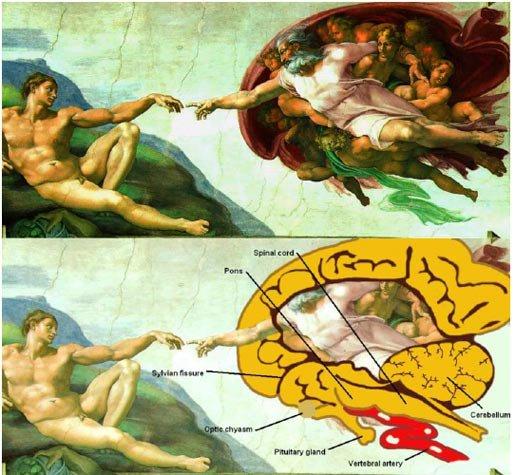
Michaelangelo and The Creation of God

Here’s something to ponder over the weekend. Was Michelangelo sending a ‘secret message’?

Get the scoop here and tell me what you think about this below: The Creation of God | Psychology Today.

Take responsibility for your life and choices

Melody Beattie writes:

When we are soul searching, be it for the smaller or larger decisions we face during the day, we can learn to ask, is this good for me?… Is this what I really want?… Is this what I need?…Does this direction feel right for me?…or am I succumbing to the control and influence that I sometimes allow others to have over me?

It is not unhealthy selfishness to question if something is good for us. That is an old way of thinking. To ask if something is good for us is a healthy behavior, not to be ashamed of, and will probably work out in the other person’s best interests too.

We shall not wander down a selfish path of self-indulgence by asking if a thing is good for us. We shall not stray from God’s intended plan, God’s highest good, by asking if a thing is good for us. By asking ourselves this simple question, we participate in directing our life toward the highest good and purpose; we own our power to hold ourselves in self-esteem.

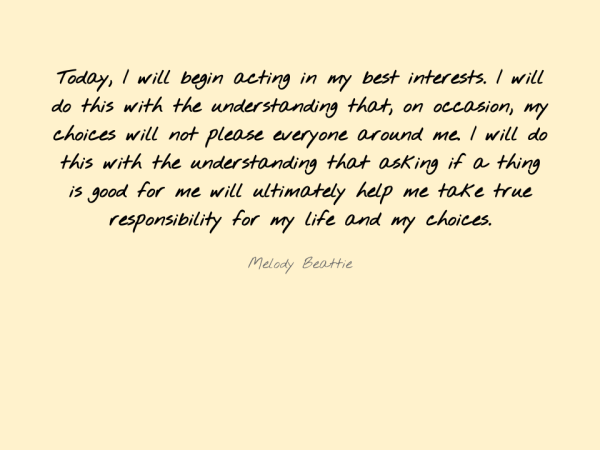
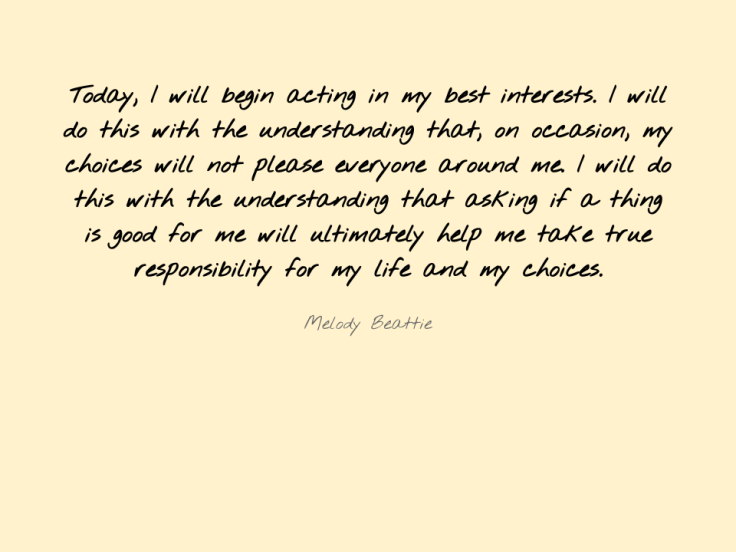
Today, I will begin acting in my best interests. I will do this with the understanding that, on occasion, my choices will not please everyone around me. I will do this with the understanding that asking if a thing is good for me will ultimately help me take true responsibility for my life and my choices.” via Just For Today Meditations – Daily Recovery Readings – September 14, 2012.

Conflict and Detachment

Melody Beattie writes:

In a relationship, there are those wonderful times when things go smoothly for both people, and neither person needs to focus too heavily on the concept of detachment. But there are those challenging times when one person is in crisis or changing – and we need to detach.

Then there are stressful cycles when both people in a relationship are in the midst of dealing with intense issues. Both are needy and neither has anything to give.

These are times when detachment and taking care of ourselves are difficult.

It is helpful, in these moments, to identify the problem. Both people are in the midst of dealing and healing. Neither has much to give, at least at the moment. And both are feeling particularly needy.

That is the problem.

What’s the solution?

There may not be a perfect solution. Detachment is still the key, but that can be difficult when we need support ourselves. In fact, the other person may be asking for support rather than offering it.

We can still work toward detachment. We can still work through our feelings. We can accept this as a temporary cycle in the relationship, and stop looking to the other person for something he or she cannot give at the moment.

We can stop expecting ourselves to give at the moment as well.

Communication helps. Identifying the problem and talking about it without blame or shame is a start. Figuring out alternative support systems, or ways to get our needs met, helps.

We are still responsible for taking care of ourselves – even when we are in the best of relationships. We can reasonably expect conflicts of need and the clashing of issues to occur in the most loving, healthy relationships.

It is one of the cycles of love, friendship, and family.

If it is a healthy relationship, the crisis will not go on endlessly. We will regain our balance. The other person will too. We can stop making ourselves so crazy by looking for the other person to be balanced when he or she isn’t.

Talk things out. Work things out. Keep our expectations of other people, our relationships, and ourselves healthy and reasonable.

A good relationship will be able to sustain and survive low points. Sometimes we need them, so we can both grow and learn separately.

Sometimes, people who are usually there for us cannot be there for us. We can find another way to take care of ourselves.

Today, I will remember that my best relationships have low points. If the low point is the norm, I may want to consider the desirability of the relationship. If the low point is a temporary cycle, I will practice understanding for myself and the other person. God, help me remember that the help and support I want and need does not come in the form of only one person. Help me be open to healthy options for taking care of myself, if any normal support system is not available.” via Just For Today Meditations – Daily Recovery Readings – September 11, 2012.

Where do addictions come from? “Elf Esteem”!


Karen Salmansohn shares a cute, but powerful, perspective that I wanted to share with you this morning:

Self sabotaging behavior often is a sign of low self esteem.

Or I guess that would be “elf esteem,” because it’s low esteem.

Okay, about as low as this joke! Although addictions are no joke. I am however a big believer if we can laugh at ourselves, we can loosen our ego’s grasp on tightly held beliefs, and we’re more open to change.

I’d like to help you loosen your ego’s grasp on maintaining addictions, and change over to more healthful behavior.

How?

If you want to break an addiction, you must heighten your low “elf-esteem” to high self esteem.

Interestingly, in studies on happiness the happiest people are those with high self esteem.

And just as interestingly, the happiest people are reported to be those who do consistent acts of altruism.

There’s a do-good-feel-good-do-good-feel-good cause and effect.

My belief: the more good you do for others, the more you raise your self esteem, and the better you feel about yourself, and so the more you want to do good, and on and on the upward cycle goes.

Ironically, the more you do your addiction, the worst you feel about yourself, and the lower your elf esteem, then the more you seek your addiction, which further lowers your elf esteem, and downward do you go.

In other words, you create a do-bad-feel-bad-do-bad-feel-bad cause and effect.

YOUR ASSIGNMENT: If you have a bad habit you’re trying to break, start by doing more positive habits: donate time in an old age home or read to the blind. Of course “elf esteem” also comes from deeper subconscious forces that you need to delve into as well – and I suggest you do some delving.  But it’s a good jump start to loving yourself more if you start to do more good in the world – so you can feel what a powerful spirit you can be – thereby you start to believe more in the awesome goodness inside you!

And keep in mind the words of Abraham Lincoln: “Most people are about as happy as they make up their minds to be.”

Aren’t you worthy of happiness?” via Where do addictions come from? “Elf Esteem”! Karen Salmansohn.

We take care of what we value. Value your self…


Detaching in Relationships

Melody Beattie writes:

When we first become exposed to the concept of detachment, many of us find it objectionable and questionable. We may think that detaching means we don’t care. We may believe that by controlling, worrying, and trying to force things to happen, we’re showing how much we care.

We may believe that controlling, worrying, and forcing will somehow affect the outcome we desire. Controlling, worrying, and forcing don’t work. Even when we’re right, controlling doesn’t work. In some cases, controlling may prevent the outcome we want from happening.

As we practice the principle of detachment with the people in our life, we slowly begin to learn the truth. Detaching, preferably detaching with love, is a relationship behavior that works.

We learn something else too. Detachment – letting go of our need to control people – enhances all our relationships. It opens the door to the best possible outcome. It reduces our frustration level, and frees us and others to live in peace and harmony.

Detachment means we care, about others and ourselves. It frees us to make the best possible decisions. It enables us to set the boundaries we need to set with people. It allows us to have our feelings, to stop reacting and initiate a positive course of action. It encourages others to do the same.

It allows our Higher Power to step in and work.” via Detaching in Relationships – Saturday, August 21 – Adult Children Anonymous.

Asking for What We Need


Melody Beattie writes:

Decide what it is you want and need, and then go to the person you need it from and ask for it.

Sometimes, it takes hard work and much energy to get what we want and need. We have to go through the pains of identifying what we want, then struggle to believe that we deserve it. Then, we may have to experience the disappointment of asking someone, having the person refuse us, and figuring out what to do next.

Sometimes in life, getting what we want and need is not so difficult. Sometimes, all we need to do is ask.

We can go to another person, or our Higher Power, and ask for what we need.

But because of how difficult it can be, at times, to get what we want and need, we may get trapped in the mind set of believing it will always be that difficult. Sometimes, not wanting to go through the hassle, dreading the struggle, or out of fear, we may make getting what we want and need much more difficult than it needs to be.

We may get angry before we ask, deciding that we’ll never get what we want, or anticipating the “fight” we’ll have to endure. By the time we talk to someone about what we want, we may be so angry that we’re demanding, not asking; thus our anger triggers a power play that didn’t exist except in our mind.

Or we may get so worked up that we don’t ask–or we waste far more energy than necessary fighting with ourselves, only to find out that the other person, or our Higher Power, is happy to give us what we want.

Sometimes, we have to fight and work and wait for what we want and need. Sometimes, we can get it just by asking or stating that this is what we want. Ask. If the answer is no, or not what we want, then we can decide what to do next.

Today, I will not set up a difficult situation that doesn’t exist with other people, or my Higher Power, about getting what I want and need. If there is something I need from someone, I will ask first, before I struggle.” via Just For Today Meditations » Blog.


Open Your Mind… or you may miss something

Open Mind (album)

Kristin Barton Cuthriell writes:

Often, people come into counseling because something in their lives is not working for them. They may be depressed. They may have anxiety. Their marriage may be falling apart. Maybe they have been grieving old wounds for years, and they just can’t find joy in life. Teenagers may be rebelling. People feel stuck in dead-end jobs. Addictions are impacting the family. People have lost the ability to let life in.

People want help. They want to feel better. Some, come in with an open mind and are ready to look at things in new ways; do things in new ways. They are ready to change. Others, however, resist change, no matter how bad they feel. They continue to do the same thing over and over again, bringing them the same undesirable results.

We are creatures of habit. We often resist change and stay with the status quo no matter how miserable we feel. We avoid doing something different.

We must stop and think about what we are doing. We must ask ourselves if what we are doing is working for us. We need to remember that if we always do what we have always done, we will always get what we have always gotten.

Let go of always being right.

Let go of thinking that there is only one way to do something.

If it is not working for you, try something different.

Be open to suggestions.

Open your mind… or you may miss something.” via Open Your Mind… or you may miss something.

One of the tools I use to keep my mind open is this quote: Nietszche said “You have your way. I have my way. As for the right way, the correct way, and the only way, it does not exist.” I agree with Kristin! Let go of always being right — it’s a terrible burden to bear and you’ll feel much better when you put it down… :-D

Saying thanks

Melody Beattie writes:

“We learn the magical lesson that making the most of what we have turns it into more.” Codependent No More

Say thank you, until we mean it.

Thank God, life, and the universe for everyone and everything sent your way.

Gratitude unlocks the fullness of life. It turns what we have into enough, and more. It turns denial into acceptance, chaos to order, and confusion to clarity. It can turn a meal into a feast, a house into a home, a stranger into a friend. It turns problems into gifts, failures into successes, the unexpected into perfect timing, and mistakes into important events. It can turn an existence into a real life, and disconnected situations into important and beneficial lessons. Gratitude makes sense of our past, brings peace for today, and creates a vision for tomorrow.

Gratitude makes things right.

Gratitude turns negative energy into positive energy. There is no situation or circumstance so small or large that it is not susceptible to gratitude’s power. We can start with whom we are and what we have today, apply gratitude, then let it work its magic.

Say thank you, until you mean it. if you say it long enough, you will believe it.

Today, I will shine the transforming light of gratitude on all the circumstances of my life.” via Just For Today Meditations » Blog.

Why do I curate Karen Salmansohn’s [@notsalmon] ‘pattern interrupt’ posters so often?

Because they make me happy, plain and simple, and remind me of positive values. A mentor of mine once told me ‘never confuse the artist with the art’. In this case, however, it does not apply! Karen Salmansohn has mastered the art of pattern interrupts — positive flashcards — to remind me of what is truly important. Read her thoughts on her craft here:

“I believe that my posters work to inspire people to feel happier because they create what’s called “A Pattern Interrupt” – which is a proven psychological tool, recommended by practitioners of Neural Linguistic Programming, to help stop limiting beliefs.

If you saw the movie Shallow Hal, then you saw a Pattern Interrupt in action in that elevator scene – albeit a humorously reenacted example of a Pattern Interrupt. If you haven’t seen Shallow Hal, here’s a quickie synopsis: Tony and Jack get trapped in an elevator, and begin to talk about dating. Tony speedily discovers that Jack’s character engages in a limited thought pattern – stubbornly only dating stunning women for shallow reasons. Tony helps Jack to break his superficial thought pattern by surprising Jack with a clunk on his head – then shouting “Devils come out!” Sure enough, instantly a new mental window opens for Jack. He is now able to think about dating with a less shallow lens.

Other known methods for Pattern Interrupts have included: snapping a rubber band on your wrist, playing powerful music, being hit with unexpected comic relief, doing calming meditations, repeating positive affirmations – and reading an INSTANT HAPPY premium wall graphic! All these various Pattern Interrupts work like a “Thought Intervention” – creating a jiggling affect upon a person’s tightly held negative beliefs – then jumpstarting a new positive pattern of thought.

A Pattern Interrupt works in real life like this: Let’s say an event happens which puts you in a grumpy mood. If you’re not careful, your negative thoughts about this one solo circumstance can create a downward spiral, where you quickly go from merely thinking THIS ONE THING SUCKS to MY WHOLE DAY SUCKS to MY WHOLE LIFE SUCKS to THE WORLD SUCKS to DISTANT GALAXIES SUCK! Basically, without a Pattern Interrupt, a sad person can get grumpier, and an angry person can get grumblier!

There’s a famous Albert Einstein quote: “We can’t solve problems by using the same kind of thinking we used when we created them.” Well, Albert’s philosophy is a good explanation for why a Pattern Interrupt can snap you out of a negative thought loop. A Pattern Interrupt literally changes your brain’s energy state.

Here’s the neuroscientific scoop: MRI’s of the brain show that every time a person thinks angry thoughts or imagines worst-case scenarios, they literally send a surge of blood flowing into brain regions associated with depression and anger (the right prefrontal cortex) – thereby refueling depression and anger. Happily, MRI’s have also shown that when a person starts to think happy thoughts, they can send a surge of blood flowing into brain regions associated with happiness (the left prefrontal cortex) – thereby literally refueling your positivity.

Plus, recent studies on learning show that when you incorporate visuals into your learning process, you can better “record” a message into your permanent memory bank.

More of the neuroscientific scoop: When you put words within pictures, your brain immediately perks up in an effort to make sense of how/why these words relate to the picture – thereby stimulating more neuron activity. The more neurons you have firing up, the greater the chance that your brain is paying attention and recording what it is perceiving. This is why using flashcards with pictures help people to learn info better! Similarly, my INSTANT HAPPY posters work like Inspirational Flashcards – reminding you with a playful combo of stylish pictures and feisty words how best to live your happiest life!

I’ve joked in today’s uber-busy, espresso-chugging, hyper-active world, it’s often hard to find time to read an inspirational book – but – you always have time to read a poster.

Except, well, I’m not simply joking!” via Artwork – Karen Salmansohn.”

Click here to admire my collection and go to http://notsalmon.com to connect with her.

Start a Blog at WordPress.com.

Up ↑