Payoffs from Destructive Relationships

Melody Beattie writes:

Sometimes it helps to understand that we may be receiving a payoff from relationships that cause us distress.

The relationship may be feeding into our helplessness or our martyr role.

Maybe the relationships feeds our need to be needed, enhancing our self-esteem by allowing us to feel in control or morally superior to the other person.

Some of us feel alleviated from financial or other kinds of responsibility by staying in a particular relationship.

“My father sexually abused me when I was a child,” said one woman. “I went on to spend the next twenty years blackmailing him emotionally and financially on this. I could get money from him whenever I wanted, and I never had to take financial responsibility for myself.”

Realizing that we may have gotten a codependent payoff from a relationship is not a cause for shame. It means we are searching out the blocks in ourselves that may be stopping our growth.

We can take responsibility for the part we may have played in keeping ourselves victimized. When we are willing to look honestly and fearlessly at the payoff and let it go, we will find the healing we’ve been seeking. We’ll also be ready to receive the positive, healthy payoffs available in relationships, the payoffs we really want and need.

Today, I will be open to looking at the payoffs I may have received from staying in unhealthy relationships, or from keeping destructive systems operating. I will become ready to let go of my need to stay in unhealthy systems; I am ready to face myself.” via Just For Today Meditations – Maintaining A Life.

And, there are ALWAYS payoffs. They just might not be so obvious…
Find and Respect Your Own Stride

Melody Beattie writes:

“Do not seek to follow in the footsteps of the men of old; seek what they sought.” Basho.

One of the dangers of following a hero is the temptation to emulate them too much instead of walking our own path. John quit his job and started his own company when he was twenty-four years old. Five years later he sold out for mil­lions of dollars. We want to be like John so we try the same thing and go broke. What happened? Is the universe against us? No. We just got confused about the difference between learning from a hero and trying to walk his path. John’s path may have led him to start a company; your path may also lead you on that course, just not at the same time in your life.

We can still learn much from our heroes and the people we admire. Just be aware that their path and time frame may be different from ours.

When the time comes for you to start that business, learn a new skill, enter into a relationship, or whatever you’re hop­ing to do, the experience will be there. The experience will be ready for you when you’re ready for it. Your timing may be different from everyone else’s.

I know people who got married after knowing each other only two weeks and then stayed mostly happily married for more than thirty years. I know people who date each other for years and still can’t decide if they’re ready to commit. My friend made the transition from living in the Midwest to living in California in months. That transition took me several years.

We each have our own stride and path. And while many of our lessons are similar, each of us is unique. If we spend our time trying to emulate a person rather than an idea, we’ll at best be an inferior version of our teacher and at worst will never discover our own path. Their stride will be too long or too short for us, and we won’t learn the true lesson, which is to trust our inner guide.

Gautama Buddha found enlightenment while sitting under a banyan tree; Milarepa found it while living as a hermit in a Himalayan cave. Gaining enlightenment isn’t an exercise in following a person; it’s an exercise in following your heart.

God, help me let go of any expectations of perfection I may have of myself or others. Help me be aware of the messages you send me, then help me discern my own truth.” via September 22: Find and Respect Your Own Stride.

Drain Pain

Melody Beattie wrote:

No, I don’t mean a clogged kitchen sink or a shower stall that empties slowly.

I’m talking about allowing people, places and things to slowly and insidiously creep in and begin sucking the soul, energy, life force – and resources – out of us.  No matter how many years ago we learned about not being codependent, it can still happen to us. Again.

Drain Pain occurs so slowly and subtly, we may not see it happening.  Following you’ll find a list of symptoms and the remedy for each:

  • We leave our bodies – disconnect from ourselves. We’re experts at fleeing the body. We hover around ourselves doing everything except feeling what we feel and valuing ourselves. When this happens, we often feel numb, confused and afraid.  We may also feel emotional (generalized) pain. The thoughts that accompany this condition include:  I CAN’T STAND THIS ANYMORE.  IT, HE, SHE OR THEY IS OR ARE DRIVING ME INSANE.  This means it’s boundary-setting time again.
  • We complain about the same thing, behavior or person or problem for days, weeks, months or years but nobody hears us.  The cure for this means listening to ourselves.
  • We know that something’s wrong but we aren’t sure what it is (because we’re not listening to ourselves).   When we mention the problem to the Drainer(s) — the people or institutions in the first symptom above — they look at us askance and reassure us that nothing is wrong except us – who we are, how we feel and what we think is going on just isn’t occurring, they insist.  Remember the story from the first Language of Letting Go, about the scene in a movie where a wife catches her husband in his pickup truck?  He’s parked at the drive-in movie theatre all cuddled up and kissing with another woman. When the wife confronts him about having this affair, he denies it vehemently while the other woman sits there kissing his neck, arm, hand and more.  “What are you going to believe?” the infidel asks his wife.  “Me or what you think you see?”  Crazy as that sounds, it can easily describe us when we’re in codependent mode.
  • We feel tired, unfocused and somewhat like a Boxer looks (the dog, not Mohammed Ali) when it’s chasing not a tail, but the remnants of one before the vet clipped or docked it.  We’re caught up in trying to do the impossible. It’s time to assess what we can and can’t change and then put energy into assessing and solving the right problem – the real issue that’s going on.
  • We feel increasingly angry at the people, places or things in our personalized list in the first symptom above, but as soon as we feel anger we also start to feel guilt. The guilt’s not real.  It’s the codependent guilt that’s followed us around for most of our life. The guilt yammers about how there must be something wrong with us because the other person wouldn’t do that — whatever that is. We wonder what’s wrong with us for feeling this angry and then decide that the problem is us. ZZZZZT.   Wrong answer. Solution?  Look in the mirror and tell ourselves that who we are is okay.
  • Of all the signals that someone’s manipulating or lying to us, feeling cruddy and confused after our interactions with this person or institution — if they’ll stand still long enough to talk to us — ranks highest and indicates that it’s time to open our eyes, shake off the denial dust and start a self-care revival.” This is a long post. You can get the rest here: Drain Pain | Melody Beattie.

Revenge

Melody Beattie writes:

No matter how long we’ve been recovering, no matter how solid our spiritual ground, we may still feel an overwhelming desire at times to punish, or get even, with another person.

We want revenge.

We want to see the other person hurt the way he or she has hurt us. We want to see life deal that person just rewards. In fact, we would like to help life out.

Those are normal feelings, but we do not have to act on them. These feelings are part of our anger but it’s not our job to deal justice.

We can allow ourselves to feel the anger. It is helpful to go one step deeper and let ourselves feel the other feelings – the hurt, the pain, the anguish. But our goal is to release the feelings, and be finished with them.

We can hold the other person accountable. We can hold the other person responsible. But it is not our responsibility to be judge and jury. Actively seeking revenge will not help us. It will block us and hold us back.

Walk away. Stop playing the game. Unhook. Learn your lesson. Thank the other person for having taught you something valuable. And be finished with it. Put it behind, with the lesson intact.

Acceptance helps. So does forgiveness – not the kind that invites that person to use us again, but a forgiveness that releases the other person and sets him or her free to walk a separate path, while releasing our anger and resentments. That sets us free to walk our own path.

Today, I will be as angry as I need to be, with a goal of finishing my business with others. Once I have released my hurt and anger, I will strive for healthy forgiveness – forgiveness with boundaries. I understand that boundaries, coupled with forgiveness and compassion, will move me forward.” via Just For Today Meditations – Daily Recovery Readings – September 16, 2012.

Take responsibility for your life and choices

Melody Beattie writes:

When we are soul searching, be it for the smaller or larger decisions we face during the day, we can learn to ask, is this good for me?… Is this what I really want?… Is this what I need?…Does this direction feel right for me?…or am I succumbing to the control and influence that I sometimes allow others to have over me?

It is not unhealthy selfishness to question if something is good for us. That is an old way of thinking. To ask if something is good for us is a healthy behavior, not to be ashamed of, and will probably work out in the other person’s best interests too.

We shall not wander down a selfish path of self-indulgence by asking if a thing is good for us. We shall not stray from God’s intended plan, God’s highest good, by asking if a thing is good for us. By asking ourselves this simple question, we participate in directing our life toward the highest good and purpose; we own our power to hold ourselves in self-esteem.

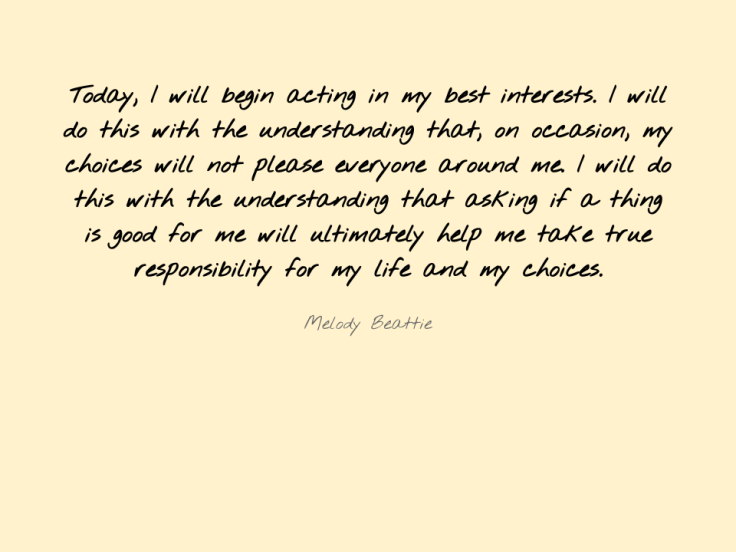
Today, I will begin acting in my best interests. I will do this with the understanding that, on occasion, my choices will not please everyone around me. I will do this with the understanding that asking if a thing is good for me will ultimately help me take true responsibility for my life and my choices.” via Just For Today Meditations – Daily Recovery Readings – September 14, 2012.

Conflict and Detachment

Melody Beattie writes:

In a relationship, there are those wonderful times when things go smoothly for both people, and neither person needs to focus too heavily on the concept of detachment. But there are those challenging times when one person is in crisis or changing – and we need to detach.

Then there are stressful cycles when both people in a relationship are in the midst of dealing with intense issues. Both are needy and neither has anything to give.

These are times when detachment and taking care of ourselves are difficult.

It is helpful, in these moments, to identify the problem. Both people are in the midst of dealing and healing. Neither has much to give, at least at the moment. And both are feeling particularly needy.

That is the problem.

What’s the solution?

There may not be a perfect solution. Detachment is still the key, but that can be difficult when we need support ourselves. In fact, the other person may be asking for support rather than offering it.

We can still work toward detachment. We can still work through our feelings. We can accept this as a temporary cycle in the relationship, and stop looking to the other person for something he or she cannot give at the moment.

We can stop expecting ourselves to give at the moment as well.

Communication helps. Identifying the problem and talking about it without blame or shame is a start. Figuring out alternative support systems, or ways to get our needs met, helps.

We are still responsible for taking care of ourselves – even when we are in the best of relationships. We can reasonably expect conflicts of need and the clashing of issues to occur in the most loving, healthy relationships.

It is one of the cycles of love, friendship, and family.

If it is a healthy relationship, the crisis will not go on endlessly. We will regain our balance. The other person will too. We can stop making ourselves so crazy by looking for the other person to be balanced when he or she isn’t.

Talk things out. Work things out. Keep our expectations of other people, our relationships, and ourselves healthy and reasonable.

A good relationship will be able to sustain and survive low points. Sometimes we need them, so we can both grow and learn separately.

Sometimes, people who are usually there for us cannot be there for us. We can find another way to take care of ourselves.

Today, I will remember that my best relationships have low points. If the low point is the norm, I may want to consider the desirability of the relationship. If the low point is a temporary cycle, I will practice understanding for myself and the other person. God, help me remember that the help and support I want and need does not come in the form of only one person. Help me be open to healthy options for taking care of myself, if any normal support system is not available.” via Just For Today Meditations – Daily Recovery Readings – September 11, 2012.

Self approval


Melody Beattie writes:

Most of us want to be liked. We want other people to think of us as nice, friendly, kind, and loving. Most of us want the approval of others.

Since childhood, some of us have been trying to get approval, trying to get people to like us and think highly of us. We may be afraid people will leave us if they disapprove of our actions. We may look for approval from people who have none to give. We may not know that we’re lovable now and can learn to approve of ourselves.

In order to live happily, to live consistently with the way our Higher Power wants us to live, and to tap into a way of life that is in harmony with the universe, we need to let go of our extreme need for approval. These unmet needs for approval and love from our past give others control over us today. These needs can prevent us from acting in our best interest and being true to ourselves.

We can approve of ourselves. In the end, that’s the only approval that counts.

Today, I will let go of my need for approval and my need to be liked. I will replace them with a need to like and approve of myself. I will enjoy the surprise I find when I do this. The people who count, including myself, will respect me when I am true to myself.” via Just For Today Meditations – Daily Recovery Reading – September 10, 2012.


The lesson may be a test

Sometimes, problems and challenges come to move us to the next place in our lives. Sometimes, they come to challenge and reinforce what we already know and believe.

Maybe that problem in your life has come along to teach you something new.

Maybe it’s an opportunity to remember and practice what you already know to be true.

Push against the problem. Push your ideals and beliefs against what’s going on. Examine what you think, believe, and feel. Stay open to change. But remember that, sometimes, it’s not about changing what you believe. It’s an opportunity for you to validate yourself and your beliefs.

We’re not always learning something new. Sometimes, the lesson is to remember and trust what we already know.

God, help me to be open to change, help me also to stand fast by my beliefs when they are right.” via Just For Today Meditations » Blog.

Discover what works for YOU

http://www.amazon.com/gp/product/B0030UDW9I/ref=as_li_ss_tl?ie=UTF8&camp=1789&creative=390957&creativeASIN=B0030UDW9I&linkCode=as2&tag=makrai-20More Melody Beattie!

“Enroll in this weight loss program and you’ll lose thirty pounds in five days!” “Come to this free seminar and after spending one hundred dollars on books you’ll be a millionaire!”

There is no quick fix, no panacea that will work for every person. Success rarely happens overnight or in five days. Even the Twelve Steps are only suggestions. Although proven to work, the details and decisions about how we apply those Steps in our lives are left to each one of us.

And few things happen overnight, except the beginning of a new day.

Listen to your mentors. Examine what’s been tried and true, and has worked and helped countless others along their paths. The Twelve Steps are one of those approaches. But don’t be taken in by false claims of overnight success and instant enlightenment along your path.

True change takes time and effort, especially when we’re changing and tackling big issues. We can often get exactly the help we need at times from a therapist, book, or seminar– the best things in life really are free and available to each one of us. The Twelve Steps, again, qualify in this area.

Discover what works for you.

Trust that you’ll be guided along your path and receive exactly the help and guidance you need. Then give it time.

There really isn’t an easier, softer way.

God, give me permission to tackle my problems.” via Just For Today Meditations – Daily Recovery Readings – September 9, 2012.

Lower Your Expectations

You’ve heard it said ‘when all else fails, lower your expectations’ — I say ‘before!’. Why? Long ago I heard this quote and took it with me: “Discouragement is the illegitimate child of false expectations!” Loyd Ogilive. I believe most, if not all, of our disappointment comes from what expect in a certain situation. In jest I say to my wife, “if only you’d lower your expectations, I could be the man of your dreams” and there is some truth in that. The only time I get frustrated with her is when I forget that people are unmanageable and that my expectations are just that; my expectations and not anyone else’s truth or reality…

One of my favorite authors Melody Beattie shares this on the topic:

When you’re starting a first creative project or beginning the study of an art or craft, what I want you to do is lower your standards until they disappear. That’s right. You’re not supposed to be any good at the beginning. So you might as well give your­self the liberating gift of joyously expecting yourself to be bad.

— Barbara Sheer and Annie Gotlieb, Wishcraft

When I first began writing newspaper and magazine arti­cles, it took me anywhere from one to three months to com­plete a short article. After writing for a few years, I brought a timer into my office one day. I told myself I knew how to do what I was doing, now I was going to learn to do it more quickly. Before long, I was able to write in two hours what had previously taken me months to accomplish. The key words here are in time.

When I first began recovering from chemical dependency, it took me eight months of treatment to understand what other people were comprehending in six weeks. In time, I became a chemical dependency counselor. In time, I wrote books on the subject. The key words here are in time.

When I first began recovering from codependency, I couldn’t tell a control gesture from setting a boundary I didn’t know when I was taking care of myself or what that even meant. I didn’t know manipulation from an honest attempt at expressing my emotions. In time, I wrote a best-seller on the subject. Again, the key words here are in time.

Start where you are. Start poorly. Just begin. Let yourself fumble, be awkward and confused. If you already knew how to do it, it wouldn’t be a lesson in your life. And you wouldn’t get the thrill of victory two, five, or ten years from now when you look back and say, “Wow. I’ve gotten good at that over time.”

All things are possible to him or her that believeth, the Bible says. Enjoy those awkward beginnings. Revel in them. They’re the key to your success.

God, help me stop putting off living out of fear of doing it poorly. Help me lower my expectations to allow room for awkward begin­nings.” via September 8: Lower Your Expectations.

Tell Yourself How Simple it is


Melody Beattie writes:

Here’s another example about the power of simplification.

For years, I heard about hiking. It sounded so elusive, diffi­cult, and mysterious. I didn’t do it, but I thought about hik­ing wistfully. One day, a friend asked me to go hiking with him. “Sure,” I said. As the day of our hike approached, I began thinking things through. I was getting a little nervous. What if I couldn’t do it well enough? What if I didn’t know how to do it at all?

Don’t be ridiculous, I scolded myself. You’re making this much more complicated than it really is. Hiking is just walking, and you’ve been doing that since you were ten months old.

The next day, I arose at 6:00 A.M., and my friend and I left for our hike. I followed my friend as he began walking up the steep incline.

Just walk, I told myself after the first ten steps. Put one foot in front of another. Walk like you’ve done all your life.

I didn’t make it to the top of the mountain that day, but I made it almost halfway.

Is there something you’ve wanted to do but have put off because it sounds too difficult and complicated? Are you say­ing no to something in your life that you’d like to say yes to, but it seems elusive and out of your reach? Try reducing the task or activity to its simplest form.

I have a friend who hadn’t dated for years. One day, a girl he liked asked him to go to the movies. He was anxious and nervous.

“Going to a movie is just sitting down and staring at the screen, then getting up and going home when you’ve fin­ished,” I said. “I think you can do that.”

“You’re right,” he said. He went and had a great time.

Sometimes, we can scare ourselves out of doing the easiest things in life. Yes, hiking involves more than walking. And going on a date with someone involves a little more than sit­ting and staring at a screen. But not that much more. Simplify things. Bring them down to their most manageable level. Instead of talking yourself out of living, learn to talk yourself into it.

God, give me the courage to fully live my life. Help me deliberately talk myself into doing things, instead of scaring myself away.” via September 6: Tell Yourself How Simple it is.


See it Simple


God, if I’m complicating a task or making it too big and unmanage­able in my mind, help me to simplify what I see.

Melody Beattie writes:

“It’s too much,” I said to my instructor. “Jumping out of a plane is too much for my mind to comprehend.”

“Then keep it simple,” he said. “Break it down into parts. You have the ride up, where you practice relaxing, your exit, your free-fall time; then you deploy your parachute. Then you decide if it’s working or if you need to go to plan B. Next set up your landing pattern. When you get near the ground, pull your strings and flare.”

I could handle the steps, but the big picture of jumping out of an airplane was too much to envision. But exiting, falling stable, pulling, and flaring were simple parts that felt man­ageable. My mind could comprehend these simple tasks.

You may never make a skydive. Or maybe you will. But there’s a lot of things in life that seem like too much if we try to see them all as one big thing. I never thought I could stay sober and drug-free for twenty-seven years. But with God’s help and the help of the program, I believed I could refrain from using drugs and alcohol for twenty-four hours. Then the next day, I got up and believed the same thing again.

There have been times I didn’t think I could start my life over. But I could get up in the morning and do the things I thought best for that day.

Are you facing something now in your life that feels too overwhelming? Then simplify it. Break it down into manage­able parts until you can see how simple it is.

God, if I’m complicating a task or making it too big and unmanage­able in my mind, help me to simplify what I see.” via September 5: See it Simple.

Celebrate

Melody Beattie writes:

Take time to celebrate.

Celebrate your successes, your growth, your accomplish­ments. Celebrate you and who you are.

For too long you have been too hard on yourself. Others have spilled their negative energy — their attitudes, beliefs, pain — on you. It had nothing to do with you! All along, you have been a gift to yourself and to the Universe.

You are a child of God. Beautiful, a delight, a joy. You do not have to try harder, be better, be perfect, or be anything you are not. Your beauty is in you, just as you are each moment.

Celebrate that.

When you have a success, when you accomplish something, enjoy it. Pause, reflect, rejoice. Too long you have listened to admonitions not to feel good about what you have done, lest you travel the downward road to arrogance.

Celebration is a high form of praise, of gratitude to the Creator for the beauty of God’s creation. To enjoy and celebrate the good does not mean that it will be taken from you. To celebrate is to delight in the gift, to show gratitude.

Celebrate your relationships! Celebrate the lessons from the past and the love and warmth that is there today. Enjoy the beauty of others and their connection to you.

Celebrate all that is in your life. Celebrate all that is good. Celebrate you!

Today, I will indulge in the joy of celebrating.” via August 26: Celebrate | Language of Letting Go.

Self care

Melody Beattie writes:

“When will we become lovable?  When will we feel safe?  When will we get all the protection, nurturing, and love we so richly deserve?  We will get it when we begin giving it to ourselves.”Beyond Codependency

The idea of giving ourselves what we want and need can be confusing, especially if we have spent many years not knowing that it’s okay to take care of ourselves.  Taking our energy and focus off others and their responsibilities and placing that energy onto ourselves and our responsibilities is a recovery behavior that can be acquired.  We learn it by daily practice.

We begin by relaxing, by breathing deeply, and letting go of our fears enough to feel as peaceful as we can.  Then, we ask ourselves:  What do I need to do to take care of myself today, or for this moment?

What do I need and want to do? What would demonstrate love and self-responsibility?

Am I caught up in the belief that others are responsible for making me happy, responsible for me?  Then the first thing I need to do is correct my belief system.  I am responsible for myself.

Do I feel anxious and concerned about a responsibility I’ve been neglecting?  Then perhaps I need to let go of my fears and tend to that responsibility.

Do I feel overwhelmed, out of control?  Maybe I need to journey back to the first of the Twelve Steps.

Have I been working too hard?  Maybe what I need to do is take some time off and do something fun.

Have I been neglecting my work or daily tasks?  Then maybe what I need to do is get back to my routine.

There is no recipe, no formula, no guidebook for self-care.  We each have a guide, and that guide is within us.  We need to ask the question:  What do I need to do to take living responsible care of myself?  Then, we need to listen to the answer.  Self-care is not that difficult.  The most challenging part is trusting the answer, and having the courage to follow.

Today, I will focus on taking care of myself.  I will trust myself and God to guide me in this process.” via Blog Archives – help and hope ministry.

Detaching in Relationships

Melody Beattie writes:

When we first become exposed to the concept of detachment, many of us find it objectionable and questionable. We may think that detaching means we don’t care. We may believe that by controlling, worrying, and trying to force things to happen, we’re showing how much we care.

We may believe that controlling, worrying, and forcing will somehow affect the outcome we desire. Controlling, worrying, and forcing don’t work. Even when we’re right, controlling doesn’t work. In some cases, controlling may prevent the outcome we want from happening.

As we practice the principle of detachment with the people in our life, we slowly begin to learn the truth. Detaching, preferably detaching with love, is a relationship behavior that works.

We learn something else too. Detachment – letting go of our need to control people – enhances all our relationships. It opens the door to the best possible outcome. It reduces our frustration level, and frees us and others to live in peace and harmony.

Detachment means we care, about others and ourselves. It frees us to make the best possible decisions. It enables us to set the boundaries we need to set with people. It allows us to have our feelings, to stop reacting and initiate a positive course of action. It encourages others to do the same.

It allows our Higher Power to step in and work.” via Detaching in Relationships – Saturday, August 21 – Adult Children Anonymous.

Asking for What We Need


Melody Beattie writes:

Decide what it is you want and need, and then go to the person you need it from and ask for it.

Sometimes, it takes hard work and much energy to get what we want and need. We have to go through the pains of identifying what we want, then struggle to believe that we deserve it. Then, we may have to experience the disappointment of asking someone, having the person refuse us, and figuring out what to do next.

Sometimes in life, getting what we want and need is not so difficult. Sometimes, all we need to do is ask.

We can go to another person, or our Higher Power, and ask for what we need.

But because of how difficult it can be, at times, to get what we want and need, we may get trapped in the mind set of believing it will always be that difficult. Sometimes, not wanting to go through the hassle, dreading the struggle, or out of fear, we may make getting what we want and need much more difficult than it needs to be.

We may get angry before we ask, deciding that we’ll never get what we want, or anticipating the “fight” we’ll have to endure. By the time we talk to someone about what we want, we may be so angry that we’re demanding, not asking; thus our anger triggers a power play that didn’t exist except in our mind.

Or we may get so worked up that we don’t ask–or we waste far more energy than necessary fighting with ourselves, only to find out that the other person, or our Higher Power, is happy to give us what we want.

Sometimes, we have to fight and work and wait for what we want and need. Sometimes, we can get it just by asking or stating that this is what we want. Ask. If the answer is no, or not what we want, then we can decide what to do next.

Today, I will not set up a difficult situation that doesn’t exist with other people, or my Higher Power, about getting what I want and need. If there is something I need from someone, I will ask first, before I struggle.” via Just For Today Meditations » Blog.


Saying thanks

Melody Beattie writes:

“We learn the magical lesson that making the most of what we have turns it into more.” Codependent No More

Say thank you, until we mean it.

Thank God, life, and the universe for everyone and everything sent your way.

Gratitude unlocks the fullness of life. It turns what we have into enough, and more. It turns denial into acceptance, chaos to order, and confusion to clarity. It can turn a meal into a feast, a house into a home, a stranger into a friend. It turns problems into gifts, failures into successes, the unexpected into perfect timing, and mistakes into important events. It can turn an existence into a real life, and disconnected situations into important and beneficial lessons. Gratitude makes sense of our past, brings peace for today, and creates a vision for tomorrow.

Gratitude makes things right.

Gratitude turns negative energy into positive energy. There is no situation or circumstance so small or large that it is not susceptible to gratitude’s power. We can start with whom we are and what we have today, apply gratitude, then let it work its magic.

Say thank you, until you mean it. if you say it long enough, you will believe it.

Today, I will shine the transforming light of gratitude on all the circumstances of my life.” via Just For Today Meditations » Blog.

Letting Go

Melody Beattie writes:

“For those of us who have survived by controlling and surrendering, letting go may not come easily.” Beyond Codependency

In recovery, we learn that it is important to identify what we want and need. Where does this concept leave us? With a large but clearly identified package of currently unmet wants and needs. We’ve taken the risk to stop denying and to start accepting what we want and need. The problem is, the want or need hangs there, unmet.

This can be a frustrating, painful, annoying, and sometimes obsession-producing place to be.

After identifying our needs, there is a next step in getting our wants and needs met. This step is one of the spiritual ironies of recovery. The next step is letting go of our wants and needs after we have taken painstaking steps to identify them.

We let them go, we give them up – on a mental, emotional, spiritual, and physical level. Sometimes, this means we need to give up. It is not always easy to get to this place, but this is usually where we need to go.

How often I have denied a want or need, then gone through the steps to identify my needs, only to become annoyed, frustrated, and challenged because I don’t have what I want and don’t know how to get it. If I then embark on a plan to control or influence getting that want or need met, I usually make things worse. Searching, trying to control the process, does not work. I must, I have learned to my dismay, let go.

Sometimes, I even have to go to the point of saying, “I don’t want it. I realize it’s important to me, but I cannot control obtaining that in my life. Now, I don’t care anymore if I have it or not. In fact, I’m going to be absolutely happy without it and without any hope of getting it, because hoping to get it is making me nuts – the more I hope and try to get it, the more frustrated I feel because I’m not getting it.”

I don’t know why the process works this way.

I know only that this is how the process works for me. I have found no way around the concept of letting go.

We often can have what we really want and need, or something better. Letting go is part of what we do to get it.

Today, I will strive to let go of those wants and needs that are causing me frustration. I will enter them on my goal list, then struggle to let go. I will trust God to bring me the desires of my heart, in God’s time and in God’s way.” via Just For Today Meditations » Blog.

Accepting powerlessness

Back to back Melody Beattie! Here she writes:

Since I’ve been a child, I’ve been in an antagonistic relationship with an important emotional part of myself: my feelings. I have consistently tried to ignore, repress, or force my feelings away. I have tried to create unnatural feelings or force away feelings that were present.

I’ve denied I was angry, when in fact I was furious. I have told myself there must be something wrong with me for feeling angry, when anger was a reasonable and logical response to the situation.

I have told myself things didn’t hurt, when they hurt very much. I have told myself stories such as “That person didn’t mean to hurt me.” . . . “He or she doesn’t know any better.” . . . “I need to be more understanding.” The problem was that I had already been too understanding of the other person and not understanding and compassionate enough with myself.

It has not just been the large feelings I have been at war with; I have been battling the whole emotional aspect of myself. I have tried to use spiritual energy, mental energy, and even physical exertion to not feel what I need to feel to be healthy and alive.

I didn’t succeed at my attempts to control emotions. Emotional control has been a survival behavior for me. I can thank that behavior for helping me get through many years and situations where I didn’t have any better options. But I have learned a healthier behavior – accepting my feelings.

We are meant to feel. Part of our dysfunction is trying to deny or change that. Part of our recovery means learning to go with the flow of what we’re feeling and what our feelings are trying to tell us.

We are responsible for our behaviors, but we do not have to control our feelings. We can let them happen. We can learn to embrace, enjoy, and experience – feel – the emotional part of ourselves.

Today, I will stop trying to force and control my emotions. Instead, I will give power and freedom to the emotional part of myself.” via Just For Today Meditations » Blog.

Owning Our Power

Melody Beattie to the rescue!

Don’t you see? We do not have to be so victimized by life, by people, by situations, by work, by our friends, by our love relationships, by our family, by our feelings, our thoughts, our circumstances, and ourselves.

We are not victims. We do not have to be victims. That is the whole point!

Yes, admitting and accepting powerlessness is important. But that is the first step, an introduction to this business of recovery. Later, comes owning our power. Changing what we can. This is as important as admitting and accepting powerlessness. And there is so much we can change.

We can own our power, wherever we are, wherever we go, whomever we are with. We do not have to stand there with our hands tied, groveling helplessly, submitting to whatever comes along. There are things we can do. We can speak up. Solve the problem. Use the problem to motivate ourselves to do something good for ourselves.

We can make ourselves feel good. We can walk away. We can come back on our terms. We can stand up for ourselves. We can refuse to let others control and manipulate us.

We can do what we need to do to take care of our selves. That is the beauty, the reward, the crown of victory we are given in this process called recovery. It is what it is all about!

If we can’t do anything about the circumstance, we can change our attitude. We can do the work within: courageously face our issues so we are not victimized. We have been given a miraculous key to life.

We are victims no more unless we want to be.

Freedom and joy are ours for the taking, for the feeling, for the hard work we have done.

Today, I will remind myself as often as necessary that I am not a victim, and I do not need to be victimized by whatever comes my way. I will work hard to remove myself as a victim, whether that means setting and enforcing a boundary, walking away, dealing with my feelings, or giving myself what I need. God, help me let go of my need to feel victimized.” via Just For Today Meditations » Blog.

Letting Go


Melody Beattie writes:

Stop trying so hard to control things. It is not our job to control people, outcomes, circumstances, and life. Maybe in the past we couldn’t trust and let things happen. But we can now. The way life is unfolding is good. Let it unfold.

Stop trying so hard to do better, be better, and be more. Who we are and the way we do things is good enough for today.

Who we were and the way we did things yesterday was good enough for that day.

Ease up on ourselves. Let go. Stop trying so hard.

Today, I will let go. I will stop trying to control everything. I will stop trying to make myself be and do better, and I will let myself be.” via Just For Today Meditations » Blog.


Start a Blog at WordPress.com.

Up ↑