#Reinventing Yourself by Steve Chandler

Find good s*** and share it

One of the best definitions of content marketing I ever heard was simply this; find good s*** and share it. that little beauty comes from thought leader Jason Falls and I have never found a better definition since the day I came across it.

The Divine is in the details however and it’s not the simple process of just finding good s*** anywhere and sharing it anywhere; it is developing a simple leather rinse repeat process that will get you and your ideas the attention you crave.

I have been studying this process for over a decade and I think it’s time to revisit the essentials of how to use content marketing to get a following in 2018. Interested? Let’s keep going…

Today I want to talk with you about the first part of the equation — finding good s***. In my opinion it’s easy to find good s*** — what most people don’t realize is that you can make good s*** find you. There is a little appreciated technology called RSS that can make all the difference in your thought leadership world. Here is the best and simplest explanation I have ever found and even though it was done in 2007 it’s still a great explanation:

Here’s what I hope you will take away from the video above. RSS is like a radio signal and just like with radio there are many devices that can tune into that signal and take advantage of the content. There are actually three different “devices” that I use on a regular basis: the first is the WordPress Reader, the second is Google News and the best is Inoreader. In the following video I’m going to break them down and show you what I mean.

Hopefully after this video you’ll see that Making good s*** come to you can be fun and easy and it will also give you a competitive advantage. According to the Pew study on the internet in the American Life only about 11% of All American internet users know that such a technology and Tool exists. If you do the work and continue to master content readers you will always be ahead of the game.

WordPress is just one of the feed readers that are available. If you’re not using WordPress as your website, it probably doesn’t make much sense to use that as your feed reader. A far better and more advance feed reader tool is Inoreader. I have included a couple of screencasts for you here:

Some of the most popular screencasts I’ve ever done are about how to use it:

Before I continue on please let me know in the comments what questions you have about content readers.

Interesting insights from an unlikely source: Dolph Lundgren on healing and forgiveness

4 Steps for Effective Social Media Arguments

New sociological trends on the inability to disagree. Source: 4 Steps for Effective Social Media Arguments | Psychology Today

Infographic: What Type of Learner Are You?

We all have our own way of doing things and that includes learning. It’s really no wonder so many kids struggle in school! Source: Infographic: What Type of Learner Are You? | Self Help Daily


Top 10 Tools for a Free Online Education

For lifelong learners and self-made scholars, the internet is a priceless resource. Continue your education with these top free online tools. Source: Top 10 Tools for a Free Online Education

Matrix; Neo vs. Morpheus and fast learning

Fast Learning

Would you like to learn like this? It’s tempting…

Literacy Rampage: So, You Wanna Be Literate?

“Learning Disabled,” Exceptional, Special Needs: Deplorable or Transformative?

Source: Literacy Rampage: So, You Wanna Be Literate? | Psychology Today

How to Learn Anything

Timothy Ferriss
Timothy Ferriss (Photo credit: Wikipedia)

Leo Babauta shares this:

It’s not often you get to talk to someone so intensely focused on learning.

I had that chance recently, as I sat down with Tim Ferriss, who just launched his massive new book, The 4-Hour Chef: The Simple Path to Cooking Like a Pro, Learning Anything, and Living the Good Life.

Tim spent some intense months learning how to do the thing that has kicked his butt for his entire life: cooking. He sucked at cooking, and decided to conquer it, and in the process shows us how to learn anything, from languages to sports to survival skills. The book teaches us how to cook, but more importantly, it teaches us the art and science of learning.

So I sat down with Tim to talk about learning, and asked questions submitted by Zen Habits readers the week before:

  • What is your set protocol for when you catch yourself procrastinating?
  • How are we supposed to devote several months to learning when we have 9-5 job, family, etc?
  • Do rules set us free? More specifically, is habit essential when trying to be productive?
  • Do you know any secrets to self-imposed moderation? For alcohol, food, or anything really.
  • Learning something new involves memory. How important is a good memory in learning? How can I improve my memory?

via » How to Learn Anything :zenhabits.

Holding Your Own

Melody Beattie writes:

Trust yourself. Trust what you know.

Sometimes, it is hard to stand in our own truth and trust what we know, especially when others would try to convince us otherwise.

In these cases, others may be dealing with issues of guilt and shame. They may have their own agenda. They may be immersed in denial. They would like us to believe that we do not know what we know; they would like us not to trust ourselves; they would prefer to engage us in their nonsense.

We don’t have to forfeit our truth or our power to others. That is codependency.

Believing lies is dangerous. When we stop trusting our truth, when we repress our instincts, when we tell ourselves there must be something wrong with us for feeling what we feel or believing what we believe, we deal a deadly blow to our self and our health.

When we discount that important part of ourselves that knows what is the truth, we cut ourselves off from our center. We feel crazy. We get into shame, fear, and confusion. We can’t get our bearings when we allow someone to pull the rug from under us.

This does not mean that we are never wrong. But we are not always wrong.

Be open. Stand in our truth. Trust what you know. And refuse to buy into denial, nonsense, bullying, or coercion that would like to take you off course.

Ask to be shown the truth, clearly – not by the person trying to manipulate or convince you, but by yourself, your Higher Power, and the Universe.

Today, I will trust my truth, my instincts, and my ability to ground myself in reality. I will not allow myself to be swayed by bullying, manipulating, games, dishonesty, or people with peculiar agendas.” via Just For Today Meditations – Maintaining A Life.

Ever feel like you are backtracking?

Christine Hassler has a real beauty of a post today that I grabbed in its entirety for you…

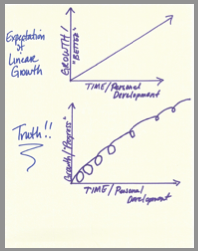
One of my pet peeves about the personal growth industry is that there is a lot of expectation placed on consistently making positive changes. The promise is that over time as we do our work, we gradually and continuously “get better” (whatever “better” means).  What often isn’t addressed is that our learning and growth isn’t linear.  It’s not a straight shot from an “aha” moment to being totally transformed.

Please don’t torture yourself by buying into the misunderstanding that your growth needs to be straight up. That’s a lot of pressure – and also not possible.  Growth is more fluid.  And over time the lows (or perceived backtracking) we experience become shorter in duration and the length of time in between them becomes longer. I drew this picture for you to illustrate what I am talking about:

Screen-shot-2012-09-26-at-7.05.27-PM
The original image was kinda small; I think this is still legible…

The human experience is about contrast and sometimes the best way we learn is when we take a few steps that feel backwards.  Often when we have a big “aha” so much to the extent that we feel transformed, the Universe will bring us a situation that feels very similar to past experiences. Often people get frustrated and think, “This again? I thought I learned this already!” That may be accurate; you may have learned the lesson and now the Universe is bringing you an amazing opportunity to practice the learning so that you can fully integrate it. I give some examples of this in today’s video.

If you feel like you are backtracking in your own behavior, choices, or feelings rest assured you are not flunking life.  You learned from my UPdate last week that only about 95% of our processing power is conscious so there is a lot of subconscious programming that you are working through. Your so-called issues and programmed responses got implemented decades ago so it may take some time before you totally shift something.  So if you find yourself slipping into old habits, reactions, behaviors or choices that you thought were behind you, cut yourself some slack.

Growth is a process not an event. You can’t upgrade yourself like you do your iPhone.

When you perceive yourself taking steps backwards, that does not mean change is not occurring. You may take ten steps forward and then eight steps back. But the next time you will take eleven steps forward and only seven steps back.  You are making progress!! Whatever you do, just keep going. And forgive yourself! This is super duper important.  Nothing will hold you back more than judging yourself and allowing your inner critic to have its way with you.  Immediately say to yourself, “I forgive myself for judging myself for back-tracking.  I’m doing the best I can.”  Then re-commit to your vision and intentions and keep going.

Keep going.

Keep going.

Source: Ever feel like you are backtracking? | Christine Hassler

Here are some of the points she makes I think are worthy of review…

“It’s not a straight shot from an “aha” moment to being totally transformed.”

“Only about 95% of our processing power is conscious so there is a lot of subconscious programming that you are working through”; this is why we say in Celebrate Recovery that we don’t claim perfection, only progress…

“Growth is a process not an event. You can’t upgrade yourself like you do your iPhone.” As a tech guy, there have been many times I have wished I could upgrade myself like hardware. If only I could reformat my brain and delete all the old Beatles‘ lyrics! I’d have so much more room! I do think, however, you CAN upgrade your thinking. There is an old computer programming acronym GIGO; Garbage In, Garbage Out. It applies to thinking and food as well…

And finally, this bears repeating…

“Nothing will hold you back more than judging yourself and allowing your inner critic to have its way with you.  Immediately say to yourself, “I forgive myself for judging myself for back-tracking.  I’m doing the best I can.”  Then re-commit to your vision and intentions and keep going.”

And perhaps the most important lesson of all? Go easy on yourself and practice ‘self-forgiveness’…

Top Ten Rules for Being Human

Mastin Kipp writes:

Rule One – You will receive a body. Whether you love it or hate it, it’s yours for life, so accept it. What counts is what’s inside.

Rule Two – You will be presented with lessons. Life is a constant learning experience, which every day provides opportunities for you to learn more. These lessons are specific to you, and learning them ‘is the key to discovering and fulfilling the meaning and relevance of your own life’.

Rule Three – There are no mistakes, only lessons. Your development towards wisdom is a process of experimentation, trial and error, so it’s inevitable things will not always go to plan or turn out how you’d want. Compassion is the remedy for harsh judgment – of ourselves and others. Forgiveness is not only divine – it’s also ‘the act of erasing an emotional debt’. Behaving ethically, with integrity, and with humour – especially the ability to laugh at yourself and your own mishaps – are central to the perspective that ‘mistakes’ are simply lessons we must learn.

Rule Four – The lesson is repeated until learned. Lessons repeat until learned. What manifest as problems and challenges, irritations and frustrations are more lessons – they will repeat until you see them as such and learn from them. Your own awareness and your ability to change are requisites of executing this rule. Also fundamental is the acceptance that you are not a victim of fate or circumstance – ‘causality’ must be acknowledged; that is to say: things happen to you because of how you are and what you do. To blame anyone or anything else for your misfortunes is an escape and a denial; you yourself are responsible for you, and what happens to you. Patience is required – change doesn’t happen overnight, so give change time to happen.

Rule Five – Learning does not end. While you are alive there are always lessons to be learned. Surrender to the ‘rhythm of life’, don’t struggle against it. Commit to the process of constant learning and change – be humble enough to always acknowledge your own weaknesses, and be flexible enough to adapt from what you may be accustomed to, because rigidity will deny you the freedom of new possibilities.

Rule Six – “There” is no better than “here”. The other side of the hill may be greener than your own, but being there is not the key to endless happiness. Be grateful for and enjoy what you have, and where you are on your journey. Appreciate the abundance of what’s good in your life, rather than measure and amass things that do not actually lead to happiness. Living in the present helps you attain peace.

Rule Seven – Others are only mirrors of you. You love or hate something about another person according to what love or hate about yourself. Be tolerant; accept others as they are, and strive for clarity of self-awareness; strive to truly understand and have an objective perception of your own self, your thoughts and feelings. Negative experiences are opportunities to heal the wounds that you carry. Support others, and by doing so you support yourself. Where you are unable to support others it is a sign that you are not adequately attending to your own needs.

Rule Eight – What you make of your life is up to you. You have all the tools and resources you need. What you do with them is up to you. Take responsibility for yourself. Learn to let go when you cannot change things. Don’t get angry about things – bitter memories clutter your mind. Courage resides in all of us – use it when you need to do what’s right for you. We all possess a strong natural power and adventurous spirit, which you should draw on to embrace what lies ahead.

Rule Nine – Your answers lie inside of you. Trust your instincts and your innermost feelings, whether you hear them as a little voice or a flash of inspiration. Listen to feelings as well as sounds. Look, listen, and trust. Draw on your natural inspiration.

Rule Ten – You will forget all this at birth. We are all born with all of these capabilities – our early experiences lead us into a physical world, away from our spiritual selves, so that we become doubtful, cynical and lacking belief and confidence. The ten Rules are not commandments, they are universal truths that apply to us all. When you lose your way, call upon them. Have faith in the strength of your spirit. Aspire to be wise – wisdom the ultimate path of your life, and it knows no limits other than those you impose on yourself.” via Today’s Quotes: RULES for being HUMAN!.

Work and recovery

Melody Beattie writes this about work:

Just as we have relationship histories, most of us have work histories.

Just as we have a present circumstance to accept and deal with in our relationship life, we have a present circumstance to accept and deal with in our work life.

Just as we develop a healthy attitude toward our relationship history – one that will help us learn and move forward – we can develop a healthy attitude toward our work history.

I have worked many jobs in my life, since I was eleven years old. Just as I have learned many things about myself through my relationships, I have learned many lessons through my work. Often, these lessons run parallel to the lessons I’m learning in other areas of my life.

I have worked at jobs I hated but was temporarily dependent on. I have gotten stuck in jobs because I was afraid to strike out on my own and find my next set of circumstances.

I have been in some jobs to develop skills. Sometimes, I didn’t realize I was developing those skills until later on when they become an important part of the career of my choice.

I have worked at jobs where I felt victimized, where I gave and gave and received nothing in return. I have been in relationships where I manufactured similar feelings.

I have worked at some jobs that have taught me what I absolutely didn’t want; others sparked in me an idea of what I really did want and deserve in my career.

Some of my jobs have helped me develop character; others have helped me fine tune skills. They have all been a place to practice recovery behaviors.

Just as I have had to deal with my feelings and messages about myself in relationships, I have had to deal with my feelings and messages about myself, and what I believed I deserved at work.

I have been through two major career changes in my life. I learned that neither career was a mistake and no job was wasted time. I have learned something from each job, and my work history has helped create who I am.

I learned something else: there was a Plan, and I was being led. The more I trusted my instincts, what I wanted, and what felt right, the more I felt that I was being led.

The more I refused to lose my soul to a job and worked at it because I wanted to and not for the paycheck, the less victimized I felt by any career, even those jobs that paid a meager salary. The more I set goals and took responsibility for achieving the career I wanted, the more I could decide whether a particular job fit into that scheme of things. I could understand why I was working at a particular job and how that was going to benefit me.

There are times I have even panicked at work and about where I was in my employment history. Panic never helped. Trust and working my program did.

There were times I looked around and wondered why I was where I was. There were times people thought I should be someplace different. But when I looked into myself and at God, I knew I was in the right place, for the moment.

There were times I have had to quit a job and walk away in order to be true to myself. Sometimes, that was frightening. Sometimes, I felt like a failure. But I learned this: If I was working my program and true to myself, I never had to fear where I was being led.

There have been times I couldn’t survive on the small amount of money I was receiving. Instead of bringing that issue to a particular employer and making it his or her fault, I have had to learn to bring the issue to my Higher Power and myself. I’ve learned I’m responsible for setting my boundaries and establishing what I believe I deserve. I’ve also learned God, not a particular employer, is my source of guidance.

I’ve learned that I’m not stuck or trapped in a job no more than I am in a relationship. I have choices. I may not be able to see them clearly right now, but I do have choices. I’ve learned that if I really want to take care of myself in a particular way on a job, I will do that. And if I really want to be victimized by a job, I will allow that to happen too.

I am responsible for my choices, and I have choices.

Above all else, I’ve learned to accept and trust my present circumstances at work. That does not mean to submit; it does not mean to forego boundaries. It means to trust, accept, then take care of myself the best I’m able to on any given day.

God, help me bring my recovery behaviors to my career affairs.” via Thought for the Day — Hazelden.

Loving Ourselves Unconditionally

But most of all? You deserve it from YOURSELF! Melody Beattie writes:

Love yourself into health and a good life of your own.

Love yourself into relationships that work for you and the other person. Love yourself into peace, happiness, joy, success, and contentment.

Love yourself into all that you always wanted. We can stop treating ourselves the way others treated us, if they be­haved in a less than healthy, desirable way. If we have learned to see ourselves critically, conditionally, and in a diminishing and punishing way, it’s time to stop. Other people treated us that way, but it’s even worse to treat ourselves that way now.

Loving ourselves may seem foreign, even foolish at times. People may accuse us of being selfish. We don’t have to believe them.

People who love themselves are truly able to love others and let others love them. People who love themselves and hold themselves in high esteem are those who give the most, contribute the most, love the most.

How do we love ourselves? By forcing it at first. By faking it if necessary. By “acting as if.” By working as hard at lov­ing and liking ourselves as we have at not liking ourselves.

Explore what it means to love yourself.

Do things for yourself that reflect compassionate, nurtur­ing, self-love.

Embrace and love all of yourself — past, present, and fu­ture. Forgive yourself quickly and as often as necessary. Encourage yourself. Tell yourself good things about yourself.

If we think and believe negative ideas, get them out in the open quickly and honestly, so we can replace those beliefs with better ones.

Pat yourself on the back when necessary. Discipline your­self when necessary. Ask for help, for time; ask for what you need.

Sometimes, give yourself treats. Do not treat yourself like a pack mule, always pushing and driving harder. Learn to be good to yourself. Choose behaviors with preferable consequences — treating yourself well is one.

Learn to stop your pain, even when that means making difficult decisions. Do not unnecessarily deprive yourself. Sometimes, give yourself what you want, just because you want it.

Stop explaining and justifying yourself. When you make mistakes, let them go. We learn, we grow, and we learn some more. And through it all, we love ourselves.

We work at it, then work at it some more. One day we’ll wake up, look in the mirror, and find that loving ourselves has become habitual. We’re now living with a person who gives and receives love, because that person loves him- or herself. Self-love will take hold and become a guiding force in our life.

Today, I will work at loving myself. I will work as hard at loving myself as I have at not liking myself. Help me let go of self-hate and behaviors that reflect not liking myself. Help me replace those with behaviors that reflect self-love. Today, God, help me hold my­self in high self-esteem. Help me know I’m lovable and capable of giving and receiving love.” via June 16: Loving Ourselves Unconditionally.

Enjoyment

Melody Beattie writes:

Life is not to be endured; life is to be enjoyed and embraced.

The belief that we must square our shoulders and get through a meager, deprived existence for far-off “rewards in Heaven” is a codependent belief.

Yes, most of us still have times when life will be stressful and challenge our endurance skills. But in recovery, were learning to live, to enjoy our life, and handle situations as they come.

Our survival skills have served us well. They have gotten us through difficult times — as children and adults. Our abil­ity to freeze feelings, deny problems, deprive ourselves, and cope with stress has helped us get where we are today. But we’re safe now. We’re learning to do more than survive. We can let go of unhealthy survival behaviors. We’re learning new, better ways to protect and care for ourselves. We’re free to feel our feelings, identify and solve problems, and give ourselves the best. We’re free to open up and come alive.

Today, I will let go of my unhealthy endurance and survival skills. I will choose a new mode of living, one that allows me to be alive and enjoy the adventure.” via June 14: Enjoyment.

Living Our Lives

Melody Beattie writes:

“Don’t stop living your life!

So often, when a problem occurs, inside or around us, we revert to thinking that if we put our life on hold we can posi­tively contribute to the solution. If a relationship isn’t work­ing, if we face a difficult decision, if we’re feeling depressed, we may put our life on hold and torment ourselves with obsessive thoughts.

Abandoning our life or routines contributes to the problem and delays us from finding the solution.

Frequently, the solution comes when we let go enough to live our life, return to our routine, and stop obsessing about the problem.

Sometimes, even if we don’t feel like we have let go or can let go, we can “act as if” we have, and that will help bring about the letting go we desire.

You don’t have to give up your power to problems. You can take your focus off your problem and direct it to your life, trusting that doing so will bring you closer to a solution.

Today, I will go on living my life and tending to my routine. I will decide, as often as I need to to stop obsessing about whatever is bothering me. If I don’t feel like letting go of a particular thing, I will “act as if” I have let go of it until my feelings match my behavior.” via June 9: Living Our Lives.

The most important skill to master


Leo Babauta

Leo Babauta writes:

If you’re like me, you are constantly learning new skills — gardening, carpentry, pizza-making, languages, sports, and so on. And I think this is a fun and wonderful thing to do.

But what’s the most important skill?

That’s debatable. I think compassion is a huge one, as is mindfulness. I’d go with those two any day of the week.

But if I had to pick just one, it would be this: learning to be happy with yourself.

That seems too simple, to trite! Too mushy and New-Agey! And I’ll grant all of that, but I stand firmly by my pick.

Why? The answer has to do with how this one thing can affect everything else in your life. If you are not happy with yourself, or your body, you become insecure. You think you’re not good enough. You fear being abandoned and alone. You do lots of other things to compensate, and these lead to problems.

So many of the problems people have stem from this one thing — being unhappy with themselves (often in the form of being unhappy with their bodies). Let’s take a look at why, and then look at some ideas of how to master the skill.

Get more here: » The Most Important Skill to Master :zenhabits

For the Next 24 Hours…

Melody Beattie writes:

For the next twenty-four hours…

In recovery, we live life one day at a time, an idea requiring an enormous amount of faith. We refuse to look back—unless healing from the past is part of today’s work. We look ahead only to make plans. We focus on this day’s activity, living it to the best of our ability. If we do that long enough, we’ll have enough connected days of healthy living to make something valuable of our life.

…I pray for knowledge of Your will for me only,…

We surrender to God’s will. We stop trying to control, and we settle for a life that is manageable. We trust our Higher Power’s will for us—that it’s good, generous, and with direction. We’re learning, through trial and error, to separate our will from God’s will. We’re learning that God’s will is not offensive. We’ve learned that sometimes there’s a difference between what others want us to do and God’s will. We’re also learning that God did not intend for us to be codependent, to be martyrs, to control or caretake. We’re learning to trust ourselves.

…and the power to carry that through.

Some of recovery is accepting powerlessness. An important part of recovery is claiming the power to take care of ourselves. Sometimes, we need to do things that are frightening or painful. Sometimes, we need to step out, step back, or step forward. We need to call on the help of a Power greater than ourselves to do that. We will never be called upon to do anything that we won’t be empowered to do.

Today, I can call upon an energizing Power Source to help me. That Power is God. I will ask for what I need.

Beattie, Melody (2009-12-15). The Language of Letting Go (Hazelden Meditation Series) (pp. 122-123). Hazelden. Kindle Edition.

Affirm Yourself…

Cover of "The Language of Letting Go (Haz...

Melody Beattie writes:

Who or what do you want to become? A good parent? A sober, recovering person? A good girlfriend, boyfriend, or spouse? Do you want to become happy, peaceful, tolerant? Don’t wait until you’re successful to tell yourself you’re that. Start now by saying you are what you want to become instead of reinforcing the words I’m not. Yes, you have much to learn. Yes, there’s a ways to go on that path. And you may not be proficient at it, or an expert, yet. But you don’t have to be to say those two little words I am.

Help create the new part of your personality by using and affirming those powerful words I am. Then watch as a new part of yourself emerges.

God, help me use my creative powers to create a better, more fulfill­ing life. Help me use the words I am to create who you and I want me to be…

via April 23: Affirm Yourself | Language of Letting Go.

When Other People Won’t Change

Lori Deschene writes:

“I’ve discovered that you can’t change people. They can change themselves.” Jim Rohn

We all want to be loved and accepted, just as we are. We want people to honor our interests, value our needs, and respect our choices in life.

So why, then, do we expect other people to sacrifice theirs for us?

Why do we hope people will change their goals, habits, and values to better align with ours when they haven’t given us any indication they’d be happier for doing it?

Why do we hope for it, bank on it, and then assume it will eventually happen just because of how badly we want it?

Sometimes we think we know what’s best for others, but if we’re honest with ourselves, we’ll likely realize we want people to change when it somehow benefits us.

I’m not talking about people who are violent, dangerous to themselves and others, or in any way abusive.

I’m talking about the boyfriend who isn’t as open-minded as you. Or the girlfriend who doesn’t value fitness like you. Or the husband who isn’t as social as you. Or the wife who doesn’t take risks like you.

I spent most of my twenties dating people who were completely incompatible with me.

I got involved with stoic men hoping they’d become more sentimental. I pursued self-professed bachelors hoping I’d be the one to make them want to commit. I even dated men who said they never wanted kids, hoping they’d change their minds because I did.

And why? Because those were the men who were there, and it felt safer to be with the wrong men than leave and risk not finding the right one.

Relationships are all about compromise, and there’s no such thing as a perfect match.

But we owe it to ourselves to recognize what’s non-negotiable in relationships so we don’t end up resentfully sacrificing our needs while secretly hoping the people we’re with will make it worth our while.

The people we want to change—there are others out there who’d accept and even value them, just as they are. We can choose to do that and appreciate them for all their unique quirks, interests, and preferences. Or we can set them free and create the possibility of finding people we’d never want to change.” via Tiny Wisdom: When Other People Won’t Change | Tiny Buddha: Wisdom Quotes, Letting Go, Letting Happiness In.

Start a Blog at WordPress.com.

Up ↑