Letting Go of Sh*tty Relationships

Joshua Fields Millburn writes:

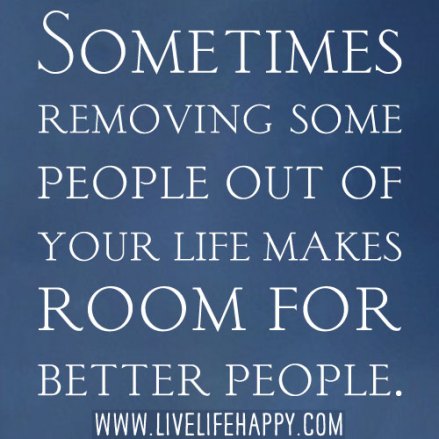
Some relationships are incredibly pernicious. We often develop relationships out of convenience, without considering the traits necessary to build a successful bond with another person—important traits like unwavering support and shared trust and loving encouragement.

When a relationship is birthed out of convenience or proximity or chemistry alone, it is bound to fail. We need more than a person’s physical presence to maintain a meaningful connection, but we routinely keep people around because … well, simply because they’re already around

We’ve all held on to someone who didn’t deserve to be there before. And most of us still have someone in our lives who continually drains us: Someone who doesn’t add value. Someone who isn’t supportive. Someone who takes and takes and takes without giving back to the relationship. Someone who contributes very little and prevents us from growing. Someone who constantly plays the victim.

But victims become victimizers. And these people are dangerous. They keep us from feeling fulfilled. They keep us from living meaningful lives. Over time, these negative relationships become part of our identity—they define us, they become who we are.

Fortunately, this needn’t be the case. Several actions can be taken to rid ourselves of negative relationships.

Go to the source: Letting Go of Shitty Relationships | The Minimalists

Express your power gently

Cover of "The Tao of Pooh"

Melody Beattie writes:

Express your power naturally and as gently as you can.

When I started learning what it meant to take care of myself and to own my power, I talked loudly, spoke up, and yelled in order to set boundaries, limits, and to express myself. That was the way to get my point across. That’s how I’d showed people I meant what I said.

I had to say it loudly.

About five years after I started this process of learning what it meant to own my power, I met a bear called Winnie the Pooh. The book that introduced me was The Tao of Pooh. Lights started coming on. The seeds of new lessons began to sprout.

To own my power, I could quietly say what I meant. The clearer I was about what I had to say and who I was, the less I had to shout. Owning my power wasn’t something I had to plan out, premeditate, and obsess about.

The more I took care of myself and connected to myself, and the clearer I became, the more natural and easier it became to own my power. My power–including setting limits, saying no, refusing to be manipulated, and saying I’d changed my mind– often became a natural, graceful, timely expression of me.

There are still times in our lives when we have to be firm, sometimes forceful, and repeat what we’ve said, sometimes loudly. The quieter and more relaxed we can be when we say what we mean is usually in direct proportion to how much we believe in ourselves.

Let your power, boundaries, and expressions of who you are arise naturally.

Learn and respect the value of responding as gently, but as firmly, as you can.

God, help your power flow through me. Teach me to take care of myself gently, in a way that reflects harmony with myself and as much as possible, the people in my life.” via Just For Today Meditations – Maintaining A Life.

The best of ‘what I see’ for 11/25/2012

  1. The human relationship system is guided fundamentally by needs for relational value, navigated on the dimensions of power, love, and freedom. Neurotic relationship patterns emerge when people adopt rigid styles or express extreme interpersonal reactions in response to fears that their relational value needs won’t be met. Susan’s needs for relational value drove her to respond in a maladaptive way. Individuals who hide in their apartments out of social anxiety, individuals who hunt for any signs of betrayal, and individuals who vacillate between being needy and fearing control all engage in neurotic relational patterns in that they each are attempting to manage their needs for relational value, but are doing so in a way that ultimately produces intense conflict or pushes others away leaving such needs fundamentally unmet. Our defenses are the way we manage tension between conflicting goals and filter stuff out of our full consciousness. The defensive system tries to bring harmony to the various other systems of adaptation, but sometimes does so at significant costs. Two very common defenses are repression and rationalization. Repression is when material is blocked out of self-conscious recognition (see here for an example). Rationalization is when we make up reasons that hide our true needs or feelings. Research on cognitive dissonance offers some compelling examples, and I highly recommend the book, Mistakes were Made but Not by Me, for an excellent analysis of ego defensive processes via rationalization and how such processes lead to maladaptive patterns.
  2. Neurotic emotional patterns come in two basic flavors, over-regulated (meaning suppressed and not expressed) and under-regulated (meaning hyper-sensitized and over-expressed). Feeling states per se are almost never bad. However, feeling states can become hyperactive (or chronically accessible) such that they can be triggered at the slightest stimuli and can then dominate the individual’s mind set. Individuals with depressive or anxious disorders are generally under-regulated in those feeling states and need help containing them. Often, however, the problem isn’t that an individual is feeling too much, but that he or she is walled off from some or all of their emotions. Some common examples are the “always nice” person who “never” feels angry, the competitor who attacks others instead of feeling shame, the unemotional distancing person who can’t feel anything at all. These individuals usually have a form of “affect phobia,” which is maladaptive because it blocks them from key aspects of their human experience.
  3. Neurotic habits are automatic or ritualized patterns of overt behavior that people engage in to alleviate anxiety and provide a sense of familiar security. The problem is that, carried out over the long term, the habitual patterns are maladaptive. A classic example is the anxious drinker. Stressed all day, riddled with achievement and relational anxieties, alcohol becomes a short term, medicating balm. Unfortunately over time, it comes with significant costs (hangovers, weight gain, health problems, etc). Binging and purging, ritualistic ordering or cleaning, nail biting or trichotillomania (hair pulling) are all common examples of neurotic, maladaptive habits.
  4. “When you are immune to the opinions and actions of others, you won’t be the victim of needless suffering.” ~Miguel Ruiz
  5. “Worthiness, in very simple terms, means, I have found a way to let the Energy reach me, the Energy that is natural, reach me. Worthiness, or unworthiness, is something that is pronounced upon you by you. You are the only one that can deem yourself worthy or unworthy. You are the only one who can love yourself into a state of allowing, or hate yourself in a state of disallowing. There is not something wrong with you, nor is there something wrong with one who is not loving you. You are all just, in the moment, practicing the art of not allowing, or the art of resisting.” – Esther Hicks
  6. “Challenges come so we can grow and be prepared for things we are not equipped to handle now. When we face our challenges with faith, prepared to learn, willing to make changes, and if necessary, to let go, we are demanding our power be turned on.” – Iyanla Vanzant

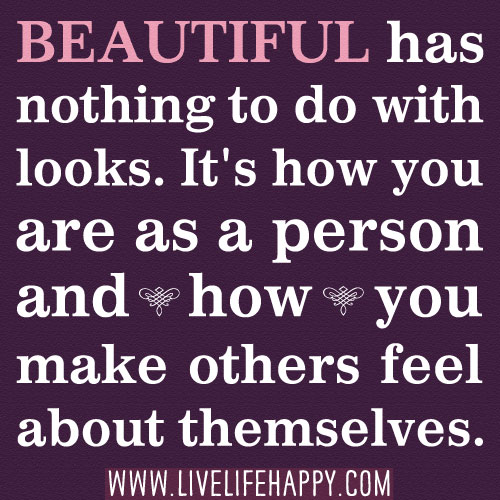
Beautiful Has Nothing To Do With Looks

Live Life Quotes, Love Life Quotes, Live Life Happy

via Beautiful Has Nothing To Do With Looks.

You’re Worth More than This!

This? Whatever you’re settling for in yourself or others…

via Visual Inspiration: You’re Worth More than This!.

5 Reasons Detachment Can Save Your Relationship

Jasmin Bedria writes:

When most people envision the ideal relationship, they think of engulfing, inseparable love. Being “attached at the hip” is typically an early sign that you and your new love share the ever-consuming, romantic high of a Nicholas Sparks novel.

You want to keep learning about each other, acting as sponges to the other’s every word and affection.

So, how in the world can detachment actually strengthen an intensely loving and growing relationship?

Detachment is one of the most important aspects in achieving true, profound fulfillment. Believe it or not, practicing detachment while remaining vulnerable will benefit you in remarkable ways.

Get the full story here: 5 Reasons Detachment Can Save Your Relationship

And, for me it’s one of the most difficult concepts imaginable. Sigh…

A flock of wild turkeys

Off in the field.

image

Posted from WordPress for Android

Letting Go

Melody Beattie writes:

Stop trying so hard to control things. It is not our job to control people, outcomes, circumstances, life. Maybe in the past we couldn’t trust and let things happen. But we can now. The way life is unfolding is good. Let it unfold.

Stop trying so hard to do better, be better, be more. Who we are and the way we do things is good enough for today.

Who we were and the way we did things yesterday was good enough for that day.

Ease up on ourselves. Let go. Stop trying so hard.

Today, I will let go. I will stop trying to control everything. I will stop trying to make myself be and do better, and I will let myself be.

via November 19: Letting Go.


The best of @toddlohenry for 11/24/2012

Have You Made Any Mistakes?

Stepcase Lifehack

Full story at: 30s Tip: Have You Made Any Mistakes?.

(When) Are You Neurotic?

I find it interesting that Dr. Gregg Henriques’ title implies many of us are a bit neurotic from time to time; reading his article may help some ‘get a grip’:

Although the term “neurotic” has more recently fallen out of favor, it was used by psychiatrists for most of the 20th Century to describe a broad category of conditions that were associated with poor functioning, anxiety and depression, but were clearly differentiated from “psychotic” in that in contrast to individuals in the latter category, neurotics maintained contact with reality and were rarely engaged in highly deviant, socially unacceptable behavior. (A factoid worth noting is that the term “borderline”, of borderline personality disorder fame, originated from the conceptual space between neurotic and psychotic. Originally, borderline individuals were those who generally maintained contact with reality, but under duress exhibited extreme volatility and primitive defenses and were not good candidates for psychoanalysis).

Get more here: (When) Are You Neurotic? | Psychology Today

I agree with Dr. Henriques when he says later in the article “The importance of understanding the meaning of “neurotic” in terms of character adaptations is that we are all neurotic some of the time, even if we might be low on trait Neuroticism.” Reading the rest of his thoughts gave me some valuable insights…

1929: Field of children, Germany

I realize that this is kind of a morbid thought, but I couldn’t help but think that 10 to 15 years later the same children were strewn across a battlefield in Russia or France or North Africa in many of the same positions. That, for me, summarizes in a succinct way the horror of war…

via 1929 : Field of children, Germany.

Challenge: Buy Nothing Until 2013

Leo Babauta has an interesting answer to this season of rampant consumerism. Don’t buy anything except essentials until next year:

Today is one of the worst days of the year: overconsumption day (or Black Friday as some call it). Or you could call it one of the best days of the year: Buy Nothing Day.

I prefer the latter — it means we waste less, consumer fewer resources, stop looking to shopping to solve our problems and make us happy, and instead find simpler ways of finding contentment.

And so today I extend a challenge to all of you, and the world: Buy Nothing Until 2013.

Yes, I’m taking Buy Nothing Day and extending it through the end of the year.

Why the hell would you want to do this challenge?

Do it as a protest against consumerism and corporate influences on our lives. Do it as a tool for contentment, for simplicity. Do it to reclaim the holidays as a time of connection and love, not of buying and debt. Do it just to see if you can.

And yes, you can still do it if you’ve already done some Black Friday shopping. We’ll forgive our past sins and start afresh. :)

Get the rest of the plan here: » Challenge: Buy Nothing Until 2013 :zenhabits

Me, I think I could easily do this — it’s the other people in my family I’m not so sure about! What about you? And how do you plan to proceed this holiday season?

I don’t know why…

I don’t know why I find big ships out on Lake Michigan fascinating — I just know that I do. Here is one heading to winter port…

image

Posted from WordPress for Android

Right back at you, David! I’m grateful for WordPress and what it enables me to do but more importantly, the people with whom it connects me…

Live & Learn's avatarLive & Learn

Thanksgiving, Thanks, Thank you, Blog, Blogger, Blogging, Grateful

…for your inspiring posts, your comments, your friendship and your followership.  B.G. captured my thoughts this morning, I’m grateful for you.

Susan, Mimi, LaDona, Lori, Lorne, Alex, Anake, Anneli, Ashi, Beth, BeckyBonnie, Brenna, Caitlin, Carol, Carolyn, Christian, Clanmother, Cristi, Currie, David, Dale, Darlene, Dogdaz, Frank, Frank, Feygirl, Francine, George, Gretchen, Grisa, Indira, Ioanna, Ivon, Jaz, Jeff, Jenni, John, John, John, Joyce, Kalabalu, Katrina, Keith, Kevin, Kim, Kristin, Kurt, Laurie, Leonard, Lu, LukeManoli, Maralee, Marina, Marion, Mark, MBB, Meikah, Melody, Misafusa, MindfulDiary, MixandMatchmeme, Michael, Michael, Michael, Mirta, OneHot(Mess),

View original post 87 more words

Create Healthy Habits!

Take 21 days to create a new healthy habit and the habits you create will take care of you! With what healthy habits would you like to start the new year? A year from now, you’ll wish you had started today…

Oh, and by the way if you’re a geeky type you might want to look into tools like Habitforge to get you started!

image via Visual Inspiration: Create Healthy Habits!.

The fortunate 5

Enjoying a temporary stay of execution. Next year will be a different story…

image

image

image

Posted from WordPress for Android

Missing Strip

Bizarro Blog!

via Missing Strip.

A reminder about “thankfulness” on Thanksgiving Day

notsalmon

via A reminder about “thankfulness” on Thanksgiving Day.

Start a Blog at WordPress.com.

Up ↑