This may not seem like much, but this is HUGE news from WordPress.com:
Linking to your Google+ Profile creates an official connection between your WordPress.com content and your Google+ account. The benefit? It adds a layer of verification, confirming you are the author of your posts, and helps Google understand who created certain pages, which helps to increase the accuracy of search results.
In some cases, Google may also use this information to make your posts stand out more in search results by including your Google+ Profile information next to your listing.
Some of you in other parts of the country [or the world for that matter], who have school-aged children, may be shocked to know that this is the first day of school in Algoma, Wisconsin. To be honest, I don’t know if the first day of school is more difficult on parents or children. For me, the start of school means an end to my flexible summer routine and I must now live on a ‘school schedule’ for the foreseeable future so for me, I think it’s harder on me than the kids…
This is a period of shifting paradigms in my life; I am taking on new responsibilities and deciding which old ones that should hold onto. For example, next week I will teach my first class as an adjunct professor at Northeast Wisconsin Technical College. It will be the first time since graduate school that I have taught a class of predominantly college-aged students and I’m willing to bet that some things have changed about teaching at that level in a generation. Even though I have taught on and off over the past 30 years and have been teaching at NWTC at the continuing education level I am looking forward to entering this new phase of my career. I think the dirty little secret about teaching is that if done correctly, the teacher is the one who learns the most. I look forward to teaching at this level; may I mindful. May I be at peace. May I be the best version of my Self so that I can give my students the things they need to draw from my class…
I came across a quote a few weeks ago reading Eckhart Tolle‘s book “The Power of Now”. He says:
“Instead of quoting the Buddha, be the Buddha, be “the awakened one,” which is what the word Buddha means.” 1
This quote will not let me alone! I think about it often throughout the day. Why do I settle for quoting other people’s thoughts on the Internet when I really should be sharing my own? Over the weekend I had a lovely exchange with a lovely blogger named Melanie about how she needed to write her own book and yet for the past two years, I have been threatening to write a book of my own. Why is it that I encourage other people to do what I do not have the courage or discipline to do myself? Is it the imposter syndrome? Perhaps, but most likely it is a failure to discipline myself to do the work that real writing requires…
The great philosopher Wally of the Dilbert cartoon strip shares this perspective:
I’m going to start by not being a ‘social media Wally’, transporting huge quantities of quotes from my RSS reader to my blog and social media. Instead, I need to document the things I am thinking and use the tools I have to get a share of voice, which may get me a share of mind and may result in a share of market. Henceforth, I’ll be focusing on what thought leader Nilofer Merchant calls my ‘onlyness‘ and work on documenting the insights the Uni-verse has shared with me before the Uni-verse decides to share them with someone more worthy.
I almost forgot to share this; I have a friend named Tim who sends me witty things via email. In the past, many of them ended up posted to my blog and I thank him for making the contribution. Last week I told him ‘you need a blog’. His response? “Blogs are for something you write not regurgitated other people materials.” Out of the mouths of babes! The Uni-verse can stop now with the not so subtle hints. I GET IT ALREADY!!!
I’m asking you to hold me accountable as I attempt to ‘be the Buddha’. I won’t be curating as much content as I have in the past that everything I share online will end up here and I encourage you to subscribe to my updates if you would like. In the meantime however I’ll be focusing on finishing my book “Zen and the Art of Thought Leadership” which is due by the end of September…
There are a lot of great external blog editors in the world, but you may not be aware of the one that I consider the best; Microsoft Word for Windows. Microsoft Word for Windows you say? How is Microsoft Word considered an external blog editor? What most people don’t realize is that anything that you can write in Microsoft Word can be sent to your blog in less than three clicks. That means you can use all the features of Microsoft Word to create stunningly beautiful blog posts that are spelling and grammar checked. It also means that if you already know how to use Microsoft Word you already know how to blog!
Some of my favorite Microsoft Word blogging features…
Anything can do in Word can be easily uploaded to my blog. Let me show you how here:
PS Sorry my Mac using friends; Microsoft does not include this feature in Microsoft Word for Mac…
Jeff Lieberman, an MIT-trained artist, scientist and engineer, discusses the possibility of completely eliminating certain sources of suffering from humanity. Sounds impossible, right?
In this thought-provoking video, Jeff explores some fascinating topics which stir up some profound questions and realizations. From exploring our consciousness, to demonstrating our ability to create alternate realities, to reminding us that we are all one. He pinpoints a key element that if we accept and trust, would make suffering no longer be part of our existence.
A ‘quote*’ from Tara Brach’s meditation “From Story to Presence”…
“The reality is each one of us has caused hurt to other people and each one of us has been hurt by other people. But if we keep running the story of “You hurt me; you’re bad” or “I hurt you; I’m bad” all that happen is a looping that creates separation. What if instead we say the story is that I hurt you and we let that story be there, we don’t put it aside too quickly…
We let it be there and we feel what it feels like in our body. The very presence with that vulnerability awakens compassion. Now the trick — because this is where there can be more suffering is to take the story “I caused you suffering” and to get stuck on the “I’m bad, I’m bad, I’m bad”. We’re wedded to the story and we don’t have access to deeper presence…
So the pathway I am describing to you, and it takes a real sensitivity, is that when stories arise in our mind — to not to quickly go ‘it’s just a story, back to the breath’ because that is just another form of aversion and denial — is to let it be there a bit, but not to believe the story.”
She goes on to say “the story behind some of the more drama stories is really the story of Self. As we open to this presence, we wake up out of that core story that keeps us separate”.
You can hear the whole talk here:
*I tried to transcribe it as best I could; this is NOT an official transcription…
Michael Moon – author of the book Firebrands – hypothesized prophetically and correctly 15 years ago when he stated that we had moved beyond the information age to the age of trusted relationships. I always found this curious because we had just entered the era of the personal internet – surely THIS was the information age! What was Moon thinking?
Every two days now we create as much information as we did from the dawn of civilization up until 2003, according to Schmidt. That’s something like five exabytes of data, he says.
Let me repeat that: we create as much information in two days now as we did from the dawn of man through 2003.
“The real issue is user-generated content,” Schmidt said. He noted that pictures, instant messages, and tweets all add to this.
So apparently Moon really nailed it when he said that we would need to rely on trust networks in order to manage all the information we need to do our jobs; networks of trusted sites, searches and sources that would wade through all these exabytes with surgical precision and deliver the goods we need to do nourish our expertise.
Recently, author Nilofer Merchant added a new aspect to the ‘trust network’ discussion in her book 11 Rules for Creating Value in the Social Era [affiliate link] when she pointed out that another aspect of work in the #socialera – work is now freed from jobs:
“This means that human resources change when most of the people who create value are neither hired nor paid by you. And competition has changed so that any company can achieve the benefits of scale through a network of resources”.
Merchant, Nilofer (2012-09-12). 11 Rules for Creating Value in the Social Era (Kindle Locations 665-676). Perseus Books Group. Kindle Edition.
As Schmidt says the real issue is user-generated content. People all over the internet are posting, pinning and tweeting up a storm! We can leverage all this activity for our own thought leadership if we simply track the sites, searches and sources that publish in our brand space and then leverage that content to provide social proof of our own thought leadership…
I’ll try to explain it better here:
Here’s a growing list of tools that help me track the sites, searches and sources I need to nourish my thinking:
[listly id=”6P9″ layout=”full”]
This list will have a permanent home on the site here. Questions? Feedback? Specifically, do you have a cool tool that I missed?
Being desired is such a basic craving. We all want to be desired: by our family, by our friends, by a lover, by our coworkers. What happens when we don’t desire ourselves?
I’m beginning to realize that I don’t like myself very much. All these years of feeling like I couldn’t raise the eyebrow or pique the interest of an attractive man might actually stem from the fact that I’m exuding the pheromones of one who feels unworthy of being loved and therefore thinks he’s undesirable to all. Could it be that simple? I’m sure I’m not the only gay man — or person — who feels or has felt this way. Do you have to love yourself before you can love someone else or be loved by someone else? Is that a myth?
I keep wondering if I’ll ever love myself enough to be loved by another person. I hate being vulnerable, but vulnerability is key to opening one’s heart to another person. For years I’ve told myself, “When the right person shows up, I’ll know, and my heart will automatically open.” Is that utter bullshit?
A few years ago, I would not have touched the HuffingtonPost with a 10 foot mouse [now I have 100 fans there!] and I certainly would not have curated an article by a gay man. In the time between, however, many thinks [intentional] have changed. “We all want to be desired: by our family, by our friends, by a lover, by our coworkers.” This desire makes us all human and should unite, rather than divide…
Over 10 years ago, The Telegraph reported:
Whether you hail from Surbiton, Ulan Bator or Nairobi, your genetic make-up is strikingly similar to that of every other person on Earth, an analysis concludes today.
Although scientists have long recognised that, despite physical differences, all human populations are genetically similar, the new work concludes that populations from different parts of the world share even more genetic similarities than previously assumed.
All humans are 99.9 per cent identical and, of that tiny 0.1 per cent difference, 94 per cent of the variation is among individuals from the same populations and only six per cent between individuals from different populations.
Nonetheless, the team found that tiny differences in DNA can provide enough information to identify the geographic ancestry of individual men and women.
The results of the study, published today in the journal Science, have implications for understanding ancient human migrations and for resolving an ongoing debate about the use of family histories in medical research, said Prof Marcus Feldman of Stanford University who led the team.
Because so many of us grew up without a cohesive and nourishing sense of family, neighborhood, community or “tribe,” it is not surprising that we feel like outsiders, on our own and disconnected. We learn early in life that any affiliation—with family and friends, at school or in the workplace—requires proving that we are worthy. We are under pressure to compete with each other, to get ahead, to stand out as intelligent, attractive, capable, powerful, wealthy. Someone is always keeping score.
After a lifetime of working with the poor and the sick, Mother Teresa’s surprising insight was: “The biggest disease today is not leprosy or tuberculosis but rather the feeling of not belonging.” In our own society, this disease has reached epidemic proportions. We long to belong and feel as if we don’t deserve to.
D.H. Lawrence described our Western culture as being like a great uprooted tree with its roots in the air. “We are perishing for lack of fulfillment of our greater needs,” he wrote, “we are cut off from the great sources of our inward nourishment and renewal.”
Lo, these many years I turned to ‘tribes’ — Christian Fundamentalists, The Republican Party, The Green Bay Packers — to make me feel right inside when in truth everything inside me was screaming at me from the mirror that everything inside me was wrong, and to compensate for the lack of a cohesive, nourishing sense of belonging. By learning about and practicing self-compassion, however, I am making progress in making peace with myself, my past, my present and my future…
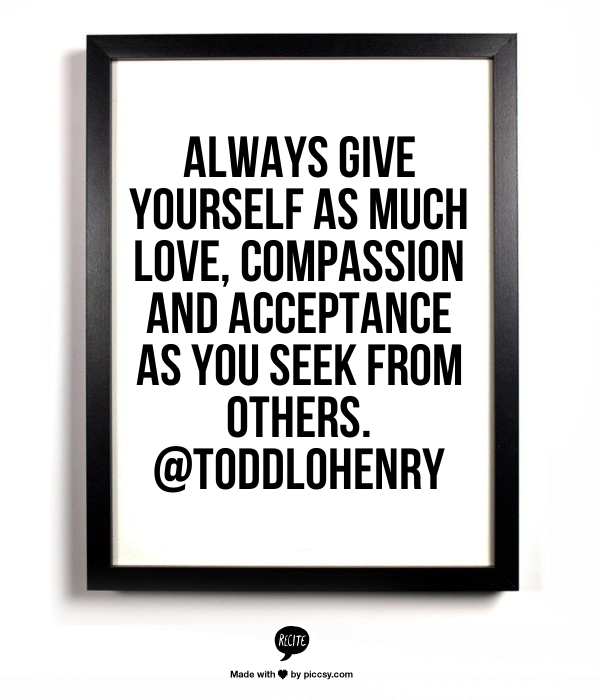
Thank you for your post, Michael, and for giving me pause to think about this topic. I agree that thinking our hearts will ‘automatically open’ is utter bullshit but, that if we practice self-compassion our hearts may slowly and gently open to the possibility of healthy interdependence and my hope is that when we are able to give ourselves at least the same amount of love, compassion and acceptance we seek from others, the craving to be desired may pass away. Namasté!
Reject shame in all its forms.
Practice self-compassion and lovingkindess and wholeheartedness will follow.
Practice mindfulness and live in the now.
Remember what other people do is their karma. How I respond is mine.
Follow my dharma…
That’s all…
“May all beings everywhere be happy and free. May the thoughts and actions of our lives contribute to that happiness and to that freedom for all.”
Random images [click to enlarge]…
I’m no longer political but I still cherish this picture…
If this poem resonates with you as well, here are two Tara Brach meditations on self-compassion that I’d like to share with you. “All I plead with you is this” she says “make love of yourself perfect”…
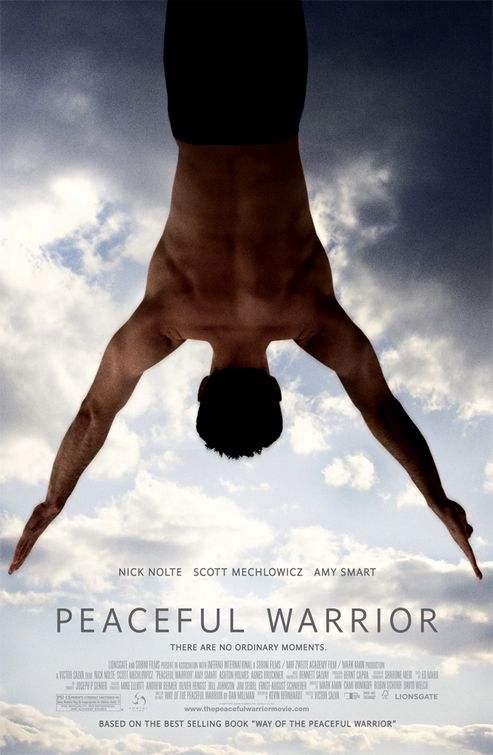
A few weeks ago, I came across the movie ‘Peaceful Warrior‘ via streaming Netflix through one of those ‘list posts’ something like the top 20 inspirational movie speeches of all time. All the standards were there; Braveheart, Rocky, etc. but in the list I also found this clip:
I became interested in Dan Millman‘s story and writing and this morning I found this on FinerMinds:
“Life comes at us in waves of change. We cannot predict or control those waves, but we can become better surfers.” – Dan Millman
How can we as humans develop a talent for living?
In life, we all have moments of perfection. For example, the day you embarked on the sojourn of a lifetime. The moment you realized you found true love. The birth of your child. Or the moment you finally realized your self-worth is more important than anyone else’s opinion of you.
But with these delicious moments comes many more moments in life that are sent to test us. Whether they come in the form of everyday routine, or more significant life events that irrecoverably change us – we must learn how to strengthen our minds, body and soul so we don’t continuously get caught in the undercurrent of these challenging times.
In this wonderful TED Talk, best-selling author Dan Millman (he’s the guy who wrote Way of the Peaceful Warrior) explains how.
As the great philosopher Eric Clapton reminds us — it’s not the tools, but it in the way that you use them!
Still, for those who are curious, here is a dynamic list of social media tools that I use and recommend. Questions? Feedback? I’m also available for Personal Digital Coaching in how to use these tools ‘on purpose’ to prevent ‘random acts of social media’… Continue reading “It’s in the way that you use it…”→
First, denial. “No way, dude, that’s got to be a rumor.”
Then anger. “Don’t Be Evil my $%&! How could they do this to me?”
Bargaining. “Could a new version of Google Reader really save Digg?”
Depression. “I can haz no more LOLz.”
And finally, we come to acceptance. Yes, it’s true. Google Reader really is going away on July 1. So if you haven’t rustled up an alternative yet, it’s time.
If you’re a Google Reader user, obviously you need a new tool to read your subscriptions. We have a few thoughts for you on that.
But if you’re a content publisher, you’ll also need to make sure that your audience has a way to continue tuning in for everything you do.
Feel free to point your audience to this post, or you may want to craft a message of your own with more individualized suggestions for your audience’s needs. But be sure you send out a clear, specific call to action and keep those subscribers on board — no one wants to lose a big chunk of their audience just because a tool goes away.
Frankly, I went through all these stages a month or so ago and happily shifted my attention to feedly which I had used as an alternative to Google Reader since 2009. I’m happy to say that the folks at feedly have really shone in stepping up as the only logical choice to replace Google Reader…
It syncs flawlessly in the cloud
You can automate it with ifttt.com now
It has better features and is more eye appealing than Google Reader
Take a look;
So, Google Reader — good riddance! feedly rocks…
PS I do NOT agree with Simone that email is a replacement for Google Reader! Email should be preserved for ‘just in time’ information; send the just in case stuff to feedly!
Whether you’re actively posting or just browsing through your social streams, things move pretty fast. A post is often there one minute and gone the next. With hundreds of millions of status updates and tweets sent every day, finding them later is next to impossible. Here are 5 tools to help you hang on to those updates through archiving social media posts you’d like to save.
The title is not a typo. Watch the first video and you’ll know what I mean!
Some thoughts on searching for the ‘middle way’ and attempting to apply it to transformational thought leadership. Some very rough thinking along the perilous path of ‘becoming known’…
5/10/2013; apparently I blew the first video. I’ve been informed that there’s no sound but I won’t be able to redo it until Monday. Enjoy the rest of the post…
Another wonderful meditation by Tara Brach that I’d like to share with you:
Living with chronic blame or resentment is a trance that confines us to a limited fragment of what we are. This talk looks at the ways this trance is fueled and the process by which we release the armoring around our hearts.
Self-aggression, whether it’s low key blame or deep condemnation, prevents us from intimacy with others and discovering the truth and wholeness of our Being. This talk explores how we can release self-blame, and free ourselves to access our natural warmth and creativity in responding to our world.
How do we accept ourselves or others when our actions are causing harm? Does acceptance mean passivity? Does it undermine our efforts towards change? This talk responds to these questions with a simple, illuminating and challenging principle about genuine transformation: Acceptance is the prerequisite of true healing and awakening. Only when we’ve paused to recognize and allow this moment’s experience to be fully as it is, can we respond from our intelligence and compassion to prevent future suffering…
Jung wrote that our suffering arises from the unseen, unfelt parts of our psyche. This talk explores ways we can establish a healing presence by recognizing and communicating with the parts of our being that we habitually ignore or judge…
The word “Namaste” has become quite mainstream thanks to the explosive popularity of the yoga industry in recent years. I’m sure you’ve said it before, and you probably have an idea of the general meaning of it. It’s a way for your soul to recognize and acknowledge the soul of another.
It would be amazing if more people took the time to really understand why we should ALL be saying Namaste to one another, and were able to shift their perspective a little bit to see other people for what they really are.
Think of yourself as a vessel filled with light. Light that changes colors depending on what angle you are looking at it, and those colors represent the many experiences you’ve had in your life. Your soul has become all of the sunsets you’ve watched, the ocean air you’ve breathed, the friends you’ve made, the love you’ve shared, the times that made you laugh and cry. You are all of your experiences.
Each and every person out there is the same way. The person in the car next to you, the cashier at the grocery store, your mailman, your friend, your spouse, even that annoying co-worker… they all carry with them that same ever-changing light, a spectrum of colors that uniquely defines them and their life experiences. They too have experienced love and pain, they have their history, their own things they hold dear, and have seen their own beautiful sights. No two are the same, yet we all have it inside us.
It’s so easy to see only the surface of a person and dismiss them for only what they are presenting to you in a given situation. But we’re all connected in that we carry around our entire life — each experience you have, each interaction, all of it is with you all the time.
The next time you find yourself passing a person on the street, in a meeting, or talking with your friends, try to be aware of the enormity of what they’re actually carrying around with them. Practicing this makes the ability to forgive and accept much easier.
To me, Namaste means that I see you. I understand we’re both souls trying to make our way in this world, all part of some larger plan. I know that while the color of our lights may shine differently, we all share the same internal fire, and my soul bows to and acknowledges that in your soul.






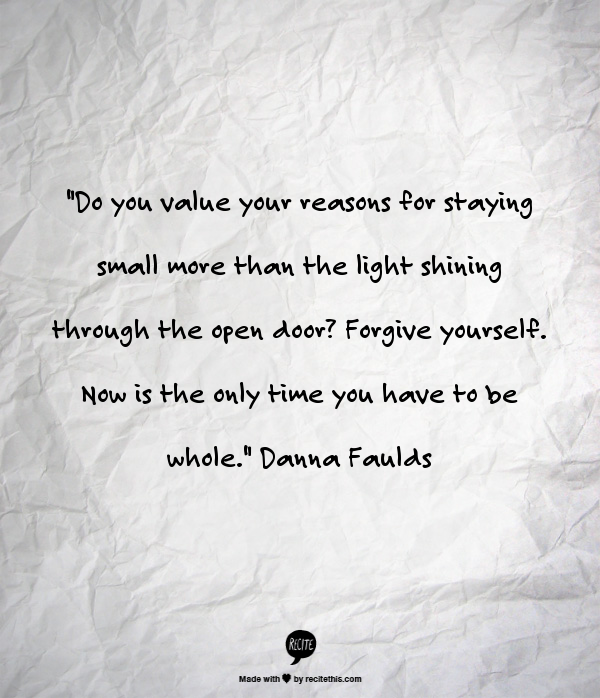





 Bright, shiny objects!
You must be logged in to post a comment.