Rebuilding Trust After Being Hurt

Letting Go

“When mistrust comes in, love goes out.” ~Irish saying.

An old friend of mine felt betrayed by her boyfriend, but chose not to leave him. Instead, she made him pay for it over and over again.

Through subtle digs and less subtle slights, she repeatedly expressed that she felt contempt for him. But instead of forgiving or walking away, she stayed behind a wall of resentment.

Soon he started responding in kind, until their relationship became a container for mutual silent bitterness. It was two people sharing a suffocating space, overwhelmed by the weight of everything they didn’t say.

I suspect many of us can relate to that feeling of clinging to a grievance. In at least one of our relationships, we’ve felt angry and indignant, and despite wanting to forgive, we just couldn’t.

I know I’ve been there before.

It’s not easy to forget when someone breaks your trust, especially if you fear it might be broken again, but holding onto doubt is a surefire way to suffer.

Little hurts worse than the suspicion that someone else might hurt you.

This isn’t the kind of thing you can just brush off through positive thinking. You can’t make yourself feel trusting by telling yourself you should be, or rationalizing away your feelings.

The reality is it takes time and effort to trust again. It takes the courage to acknowledge how you feel and willingness from the other person to hear and honor it. It takes a mutual commitment to move beyond what happened instead of reliving and rehashing.

But most importantly, it requires you to believe in the goodness of the person who hurt you.

You have to believe someone can treat you with respect and consideration—even if it takes you a while to get there—or else you’ll never let your guard down. That’s a painful place to be.

The thing about being defensive is that everything becomes a battle, and no one ever wins.

Of course this doesn’t mean we can ever know for certain that someone won’t hurt us again. The only way we can know if we’re able to trust someone is by first giving them trust.

That means we need to ask ourselves: Is this relationship worth that risk?

Is it worth feeling vulnerable?

Is it worth letting go of the story?

And if it’s worth it, what would it look like to give trust, starting right now?

via Tiny Wisdom: Rebuilding Trust After Being Hurt | Tiny Buddha: Wisdom Quotes, Letting Go, Letting Happiness In.

Here’s What You Can Do!

Terri Cole has an amazing post over at The Daily Love today. She writes:

Are you wasting your energy, youth and beauty focusing on things you cannot change? Thinking too much about situations where you have no control or experiences that have already happened? Oftentimes we get so wrapped up in what’s happening in the world and political systems, in what the neighbors are doing and in the mistakes we’ve made, that we lose focus on what we CAN DO right here, right now to help make our lives and those around us better.

Focusing on that over which you have no control (the past, the state of the world and the drama of other people’s lives… to name a few) is a common cause of stress. This type of thinking makes us feel powerless, leading to feelings of hopelessness, anxiety, and depression, which are all key players in the game of stress. I could go on and on about the myriad of the side effects from stress, but you can check them out for yourself while we focus on what you CAN DO to switch your thinking from what you should have done to what you will do now.

This week, I want to challenge you to pay attention to what thoughts are taking up real estate in your mind. When you are ruminating about people and situations over which you have no control, jot down a quick line about the issue at hand. Over the course of the week, what patterns are you discovering? What is the content of your predominant thoughts? How do they make you feel?

Now make a plan to Do Something. If it’s politics that sets you into a tailspin, volunteer for a political campaign, get to know the issues, VOTE. If it’s an ethical or world issue (e.g. animal welfare, bullying, the environment, researching/living with/preventing/curing a particular disease), volunteer for an organization focusing on that particular agenda.

Now, to the biggie…. How often are you ruminating about the past? When you find yourself living anywhere but in the present moment, ask yourself why you are still holding onto the past incident or regret. Try to break down what really happened. Once you have established the facts around the scenario, dial into what you are meant to learn from the experience and use that information to inform your decisions now.

Remaining in a state of frustrated helplessness takes a toll – physically and emotionally. You can relieve stress and feel more empowered by getting into action. Being part of the solution, instead of stressing about the problem, will contribute to your ability to build a more peaceful and productive life. You have the power to change your life and your perspective. Do not give that power to politicians, lawmakers, your neighbors or anyone else. Most of these people you do not even know, so why be dominated by their choices? And the ones you do know most likely do not want to have power over your thoughts and feelings. Keep your side of the street clean and use your special talents to make life better. Interestingly enough, you will make others’ better in the process.

Share your thoughts and comments with us. Let’s start a rich dialogue with the focus on what is possible rather than what is wrong. I am curious to see what changes you notice physically and mentally when you become aware of your thoughts and flip the script.

I hope you have a meaningful week, filled with positive action, and, as always, take care of you.

Source: Here’s What You Can Do!

The Good Feelings

Sunrise 3

Melody Beattie writes:

Let yourself feel the good feelings too.
Yes, sometimes, good feelings can be as distracting as the painful, more difficult ones. Yes, good feelings can be anxiety producing to those of us unaccustomed to them. But go ahead and feel the good feelings anyway.
Feel and accept the joy. The love. The warmth. The excitement. The pleasure. The satisfaction. The elation. The tenderness. The comfort.
Let yourself feel the victory, the delight.
Let yourself feel cared for.
Let yourself feel respected, important, and special.
These are only feelings, but they feel good. They are full of positive, upbeat energy – and we deserve to feel that when it comes our way.
We don’t have to repress. We don’t have to talk ourselves out of feeling good – not for a moment.
If we feel it, it’s ours for the moment. Own it. If it’s good, enjoy it.

Today, God, help me be open to the joy and good feelings available to me.

Source: Daily Meditation ~ The Good Feelings – Miracles In Progress Codependents Anonymous Group

Leadership Is a Conversation

The command-and-control approach to management has in recent years become less and less viable. Globalization, new technologies, and changes in how companies create value and interact with customers have sharply reduced the efficacy of a purely directive, top-down model of leadership. What will take the place of that model? Part of the answer lies in how leaders manage communication within their organizations—that is, how they handle the flow of information to, from, and among their employees. Traditional corporate communication must give way to a process that is more dynamic and more sophisticated. Most important, that process must be conversational.

We arrived at that conclusion while conducting a recent research project that focused on the state of organizational communication in the 21st century. Over more than two years we interviewed professional communicators as well as top leaders at a variety of organizations—large and small, blue chip and start-up, for-profit and nonprofit, U.S. and international. To date we have spoken with nearly 150 people at more than 100 companies. Both implicitly and explicitly, participants in our research mentioned their efforts to “have a conversation” with their people or their ambition to “advance the conversation” within their companies. Building upon the insights and examples gleaned from this research, we have developed a model of leadership that we call “organizational conversation.”

Smart leaders today, we have found, engage with employees in a way that resembles an ordinary person-to-person conversation more than it does a series of commands from on high. Furthermore, they initiate practices and foster cultural norms that instill a conversational sensibility throughout their organizations. Chief among the benefits of this approach is that it allows a large or growing company to function like a small one. By talking with employees, rather than simply issuing orders, leaders can retain or recapture some of the qualities—operational flexibility, high levels of employee engagement, tight strategic alignment—that enable start-ups to outperform better-established rivals.” Get more here: Leadership Is a Conversation – Harvard Business Review.

How Your Limiting Beliefs Are Preventing You From The Life You Want

A limiting belief is an established thought pattern that prevents us from achieving what we want or need, no matter how much we strive towards a goal. As long as a limiting belief in place, it acts like a 3-headed dog whose job it is to prevent from achieving your goal.

Simply put, limiting beliefs are things we tell ourselves, mostly with great conviction, as to why something is not possible for us. Why we can’t get rich, why we can’t have a fairytale relationship and so on. When you are operating through the lens of a limiting belief, your perception of reality is narrower and more grim than what it would have been otherwise.

Limiting beliefs are acquired when we are highly impressionable, especially when we were kids. But even as grown ups, there are times when we are vulnerable to form them particularly when faced with adversity. At such times, this sense of helplessness can be high and the mind wants to rationalize why we got into this state.

When we feel cornered, an easy way out is by forming a conclusion, mostly irrational, just so that we don’t get into this state ever again. We try to reach conclusions that we later label as “life lessons”. More often than not, these life lessons are exactly what keep us in the trenches.” Get more here: How Your Limiting Beliefs Are Preventing You From The Life You Want | FinerMinds.

Powerlessness

Melody Beattie writes:

Willpower is not the key to the way of life we are seeking. Surrender is.

“I have spent much of my life trying to make people be, do, or feel something they aren’t, don’t want to do, and choose not to feel. I have made them, and myself, crazy in that process,” said one recovering woman.

“I spent my childhood trying to make an alcoholic father who didn’t love himself be a normal person who loved me. I then married an alcoholic and spent a decade trying to make him stop drinking.

“I have spent years trying to make emotionally unavail­able people be emotionally present for me.

“I have spent even more years trying to make family mem­bers, who are content feeling miserable, happy. What I’m saying is this: I’ve spent much of my life desperately and vainly trying to do the impossible and feeling like a failure when I couldn’t. It’s been like planting corn and trying to make the seeds grow peas. It won’t work!

“By surrendering to powerlessness, I gain the presence of mind to stop wasting my time and energy trying to change and control that which I cannot change and control. It gives me permission to stop trying to do the impossible and focus on what is possible: being who I am, loving myself, feeling what I feel, and doing what I want to do with my life.”

In recovery, we learn to stop fighting lions, simply because we cannot win. We also learn that the more we are focused on controlling and changing others, the more unmanage­able our life becomes. The more we focus on living our own life, the more we have a life to live, and the more manage­able our life will become.

Today, I will accept powerlessness where I have no power to change things, and allow my life to become manageable.” via June 20: Powerlessness.

5 Life Lessons Taught By The Muppets

Just because you’re too old for Sesame Street (and hopefully you already know your ABCs), that doesn’t mean you’re not too old to learn something. The Muppets are more than entertainers — they’re pretty good teachers too.

Here’s a look at 5 life lessons you can learn from The Muppets.” Get more here: 5 Life Lessons Taught By The Muppets.

Are You Addicted To Suffering? (And Ready To Quit?)

I teach my students and clients that one should look for the best three paragraphs when curating; occasionally I say it’s OK to double dip and grab two quotes. When it comes to Kute Blackson, I usually break all my rules – his stuff is sooo good that I usually end up curating his entire post to that it’s easier for you to read the whole think. Today is no exception to the Kute Blackson rule:

Most guru’s or teachers will teach how to avoid suffering. I am going to share with you the seven steps of how to successfully create suffering in your life, so that you can be aware of them and make different choices.

Suffering can become a very dangerous addiction. An unhealthy way to feel. An ultimately unfulfilling way to feel alive. You can get so used to suffering that it becomes comfortable and familiar. Suffering is the ego’s way of feeling important.

Whether you are a businessman or a buddha, pain is inevitable. There is no way to avoid it. Just by virtue of being in a human body there will be some pain. Trying to avoid pain will only create more suffering. Embrace pain to release yourself from suffering.

Suffering is optional. Suffering is a choice.

Suffering comes from your story about what is happening in your life and less about what is actually happening. What is happening is simply what is happening. The suffering part comes from all your interpretations and meanings about the experience. Change your story and the way you are interpreting reality and you begin to change your reality. When you change your reality within yourself, you shift your experience of your reality outside. Once you understand this, you only suffer if you chose to.

What stories are you making up about yourself, your life, your partner, your current experience that is causing you suffering?

The Seven Keys to creating suffering:

1- Resist everything: Resist what is. Resist reality. Fight against what is happening in your life with all your might. This is a guaranteed method to suffer.

Key Solution: Accept what is, so that you can then decide how to shift it.

2- Holding the belief: “The experience that is happening to me should not be happening to me. I should be having some other experience than the one I am having. This shouldn’t be happening to me”. You have probably heard yourself doing some version of this. It just keeps you stuck.

Key Solution: Embrace your current experience. Your current experience is the experience that you are meant to be having because you are having it right now. Trust, and focus on what you can learn and how you can grow. The experience is here to help you evolve.

3- Focusing on all the things that you cannot control. This will only cause you to feel completely helpless and disempowered. It will leave you in a state of worry and anxiety. Some of us are professional “worriers”. No matter how much you worry, it doesn’t actually change the situation. Once you are done worrying, the situation will be the same. Worrying is a waste of time.

Key Solution: Focus on what you can control. Take actions that are in your power, step by step.

4- Refusing to change. Keep doing the same over and over and hoping for a different result. Well, as Einstein said, this is the definition of insanity. Are you so set in your ways that you are afraid of giving up the known suffering for the unknown possibility of happiness?

Key Solution: Embrace change. Be willing to do something different. Let go. Go into the unknown. Take different actions.

5- Give up your responsibility: Be a victim. Play the blame game, making everyone else at fault or responsible for your life and how you feel. Unless you take responsibility for your current experience, then you are powerless to change it.

Key Solution: Take full responsibility for your current reality and decide what changes you are committed to making. Give up blame.

6- Focus on everything that is wrong in your life. Whether a relationship or person. When you focus on what is wrong, you will surely find what is wrong. You will end up creating more of what is wrong to feel wrong about. Then the negative cycle continues.

Key Solution: Start focusing on what you are grateful for. Remember all your blessings, and appreciate that daily. What you appreciates, expands. What you thank about comes about.

7- Denial: Lie to yourself and others. Pretend that everything is fine when you know that it isn’t. When you avoid facing what is, you end up staying stuck and repeating the same patterns of pain and relationship. This only ends up prolonging your suffering.

Key Solution: Tell the truth to yourself first. Tell the truth to those in your life. Be honest. Face reality.

Life is too short to waste spent suffering. Most of what you worry about today, you won’t even remember a few months from now. Most of what you are trying to change in people today, you won’t care about on your deathbed.

You hold the padlock and you hold the key to your freedom.

Source: Are You Addicted To Suffering? (And Ready To Quit?)

Scraping barnacles, losing spiritual fat, cleaning house

Barnacles (Chthamalus stellatus) and Limpets (...

Jon Swanson writes:

I wish I’d seen barnacles sometime in my life. I don’t like using cliche metaphors unless I’ve seen what I’m talking about. And I’ve heard that barnacles cling to the bottoms of boats and slow them down. And I’ve heard that it’s important to scrape them off from time to time lest the boat gets bogged down.

I spent the day yesterday scraping barnacles out of my office and off my heart. But since I’ve never seen barnacles, I can’t use that image.

Parts of my office hadn’t been adjusted since I moved in 53 months ago. A drawer was full of empty router boxes from some network projects we’ve done. There were drafts of various sorts, old catalogs, and pictures from projects that are long over.

I also took a couple steps on major projects, steps where the absence of action was slowing the progress of my heart. I was feeling trapped until I brushed off the inertia with a few keystrokes.

As I was thinking about my experiential ignorance, I remembered another image, this time about running. I’m not a runner, but I’m walking and riding more. And realizing the way baggage limits progress. Sometimes it’s the baggage of wrong actions and wronged relationships. Other times it’s just distractions we picked up along the way. The writer of Hebrews says,

It means we’d better get on with it. Strip down, start running—and never quit! No extra spiritual fat, no parasitic sins. Keep your eyes on Jesus, who both began and finished this race we’re in. Study how he did it. Because he never lost sight of where he was headed—that exhilarating finish in and with God—he could put up with anything along the way: Cross, shame, whatever..

Spiritual fat. Parasitic sins.  That’s cleaning my office, clearing piles, ending collections.” via Scraping barnacles, losing spiritual fat, cleaning house..

I hope that Jon won’t mind that I added barnacles to his post… :-D

Any idea, plan, or purpose…

Any idea, plan, or purpose may be placed in the mind through repetition of thought. – Napoleon Hill

via Any idea, plan, or purpose may be placed in the mind through….

Letting Go of Self-Doubt

A second shot of Melody Beattie for today:

A married woman who had recently joined Al Anon called me one afternoon. She worked part-time as a registered nurse, had assumed all the responsibilities for raising her two chil­dren, and did all the household chores, including repairs and finances. “I want to separate from my husband,” she sobbed. “I can’t stand him or his abuse any longer. But tell me, please tell me,” she said, “do you think I can take care of myself?” Codependent No More

Not only is it okay to take care of ourselves, we can take good care of ourselves.

Many of us, so confident about our ability to take care of others, doubt our inherent strength to care for ourselves. We may have come to believe, from our past or present circum­stances, that we need to take care of others and we need others to take care of us. This is the ultimate codependent belief.

No matter where this self-defeating belief was born, we can release it and replace it with a better one, a healthier one, a more accurate one.

We can take care of ourselves — whether we are in or out of a relationship. Everything we need will be provided. We will have loved ones, friends, and our Higher Power to help.

Knowing that we can take care of ourselves doesn’t mean we won’t have feelings of fear, discomfort, doubt, anger, and fragility at times. It means we practice “courageous vulner­ability,” as Colette Dowling called it in Cinderella Complex. We may feel scared, but we do it anyway.

Today, God, help me know how I can take care of myself.” via June 19: Letting Go of Self-Doubt.

Few books have been more useful to me in my life — if any of the codependency scenarios resonate with you, I recommend you purchase it, the workbook and ‘The Language of Letting Go‘…

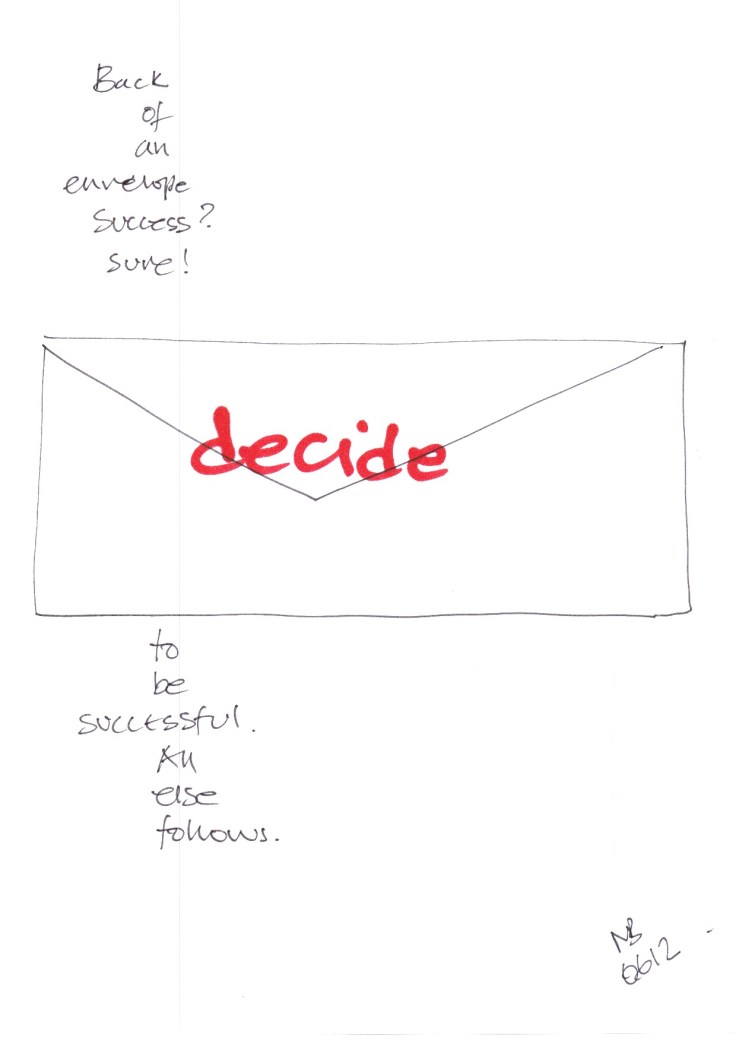
Success

via BackOfAnEnvelope: Success.

Are You a Saint or a Scorpion?

This is a long story, but one I thought worth sharing:

Once upon a time, on his way to the Himalayas, was a saint, a wandering ascetic. He came across a shallow river he had to cross. Just when he was about to wet his feet, he saw a scorpion helplessly treading the water, trying to come out of the river. It was almost touching the bank but not enough to gain hold of the ground. The sage saw scorpion’s struggle and decided to save it.

He picked up the scorpion in his right palm with the intention to place it on the dry surface. No sooner did he do that than the scorpion stung and rushed off the palm in frenzy, landing in the water again. It resumed its struggle to come out of water. The sage caressed his ailing right hand with his left. His body was in pain but his mind, calm.

Seeing that the scorpion could lose its life, the sage used left hand this time to lift the scorpion out of water. However, it panicked and stung again. Once again, it sped off the hand and fell in water resuming its struggle to come out. The saint was left with both hands singed with excruciating pain. He was not the one to give up either.

He tried again. This time, he cupped his hands together and lifted the scorpion in one swift movement. Before it could react, he safely dropped it on the land. The scorpion disappeared into the pebbles that lay near the bank. The sage felt elated, for, he succeeded in carrying out his resolve, for saving another life, in holding his forte. It was worth the pain he thought.

At a distance, oblivious to the saint, a man, surprised and shocked, had watched the whole episode. He promptly approached the sage and said, “Pray, can I ask you a question please?”

“Yes, you may.”

“First of all, there was no need to save a scorpion. It does no good to anybody. Secondly, if must you save him out of compassion, you could have simply tried once. I’m surprised that even after it stung you so ungratefully, you persisted with your efforts. Why? How come you did not just stomp on it after it stung you?”

“Oh! That’s pretty simple,” the sage replied softly rubbing his stung hands against each other. “This was a scorpion, someone really low on the food chain, a creature whose nature is to sting, to panic, to harm. It is known for not exhibiting any compassion. It is supposed to be weak. Whereas, I am supposed to be a saint, a person whose job is to love everybody, to only offer unconditional love and compassion. I am supposed to be the strong one, the one higher up on the food chain. With my principles and lifestyle, my philosophy and practice, my elevated emotional and mental state, I am supposed to cleanse and transform the other individual. Right?”

The man nodded.

“Well then, a creature as lowly and weak as a scorpion does not change its basic nature, its traits, reactions in the presence of a holy man. Should I, the one who’s supposed to be a saint, let go off my righteous conduct, my demeanor in the presence of a scorpion? Am I now so weak to allow a measly creature change me, throw me off my principles and virtues? It did what it is designed for and I did what I’m designed for. It retained its behavior, and I, mine.”

The man prostrated at the feet of the sage and expressed his gratitude for the profound wisdom.

Living in this world, disagreements are normal, in fact, natural. You will meet people ranging from scorpions to saints, thankful to thankless, from weak to wild, and so forth. If they are able to provoke you, put you off, throw you off balance, they are stronger than you. When in any conflict, if you retain your goodness, you will emerge a winner. If you stoop down to their level, treating them the way they treated you, that invariably means they have won, that means you have become like them. Rarely worth it, if you ask me.

It is often not possible for a person to be one or the other at all times. Sometimes circumstances force you to sting like a scorpion, perhaps you may even repent later on; forgive yourself. A lot more important is to make a serious attempt to act like a saint. Whether you are a sage or a scorpion, it is a matter of choice, an independent choice. You have the option to retain your individuality. Strength comes naturally from such stance.

So, if you are willing, write in the comments below, whether you are:

  • (a) a sage;
  • (b) a scorpion;
  • (c) or you can be either depending on the situation.

If you wish to be a sage under all circumstances, you can. It requires mindfulness and a conscious effort. Nothing will ever bother you thereafter.

Source: Being Yourself: Are You a Saint or a Scorpion?

Montaine wrote: “No man is more monster or miracle than myself” – unfortunately that’s true for me! I’d have answer with letter C right now, but as I’m thinking of the scorpions in my life, I don’t want to give up my power to be response-able and join them. “Am I now so weak to allow a measly creature change me, throw me off my principles and virtues?” If I am, my principles and virtues aren’t worth much, are they?

One more thought; imho the sage in this story isn’t quite so sagey as he comes out in the end. Think before you engage a scorpion! Perhaps his last action — quickly picking up the scorpion and setting it on the bank — should have been his first. Especially when “a creature as lowly and weak as a scorpion does not change its basic nature, its traits, reactions in the presence of a holy man”…

Questions? Feedback?

Making Life Easier

Melody Beattie writes:

Life doesn’t have to be hard.
Yes, there are times we need to endure, struggle through, and rely on our survival skills. But we don’t have to make life, growth, recovery, change, or our day-to-day affairs that hard all the time.
Having life be that hard is a remnant of our martyrdom, a leftover from old ways of thinking, feeling, and believing. We are worthy, even when life isn’t that hard. Our value and worth are not determined by how hard we struggle.
If we’re making it that hard, we may be making it harder than it needs to be, said one woman. Learn to let things happen easily and naturally. Learn to let events, and our participation in them, fall into place. It can be easy now. Easier than it has been. We can go with the flow, take the world off our shoulders, and let our Higher Power ease us into where we need to be.
Today, I will stop struggling so hard. I will let go of my belief that life and recovery have to be hard. I will replace it with a belief that I can walk this journey in ease and peace. And sometimes, it can actually be fun.

Source: Daily Meditation ~ Making Life Easier – Miracles In Progress Codependents Anonymous Group

Appreciate that our civilization has not as yet been evaporated by a supernova

Here are some excerpts from Sal Khan’s 2012 commencement address at MIT:

“Remember that real success is maximizing your internally derived happiness. It will not come from external status or money or praise. It will come from a feeling of contribution. A feeling that you are using your gifts in the best way possible.”

“…Start every morning with a smile — even a forced one — it will make you happier.  Replace the words “I have to” with “I get to” in your vocabulary. Smile with your mouth, your eyes, your ears, your face, your body at every living thing you see. Be a source of energy and optimism. Surround yourself with people that make you better. Realize or even rationalize that the grass is truly greener on your side of the fence. Just the belief that it is becomes a self-fulfilling prophecy…

…View stressful, political interactions as nothing more than a deeply immersive strategy game. One that can be won if you stay focused on what matters most and your emotions and ego are not tied to your argument…

…Make people feel that you care about them. And here’s, a well, a little secret, the best way to do this is to actually care about them.

…Make people feel that you are listening to them. Another little secret, the best way to do this is to actually listen…

…When you feel overwhelmed, walk alone through the woods and forget your name, your title, your education and view yourself for what you really are — another mammal wondering why it is here but appreciating the fact that your civilization has not as yet been evaporated by a supernova.” via Appreciate that our civilization has not as yet been evaporated by a supernova… – Lead.Learn.Live.. Thanks, David…

Recognizing Choices

English: Choices, choices A network of paths a...

Melody Beattie writes:

We have choices, more choices than we let ourselves see.

We may feel trapped in our relationships, our jobs, our life. We may feel locked into behaviors — such as caretaking or controlling.

Feeling trapped is a symptom of codependency. When we hear ourselves say, “I have to take care of this person… .”

“I have to say yes… ” “I have to try to control that person…

“I have to behave this way, think this way, feel this way….” we can know we are choosing not to see choices.

That sense of being trapped is an illusion. We are not con­trolled by circumstances, our past, the expectations of others, or our unhealthy expectations for ourselves. We can choose what feels right for us, without guilt. We have options.

Recovery is not about behaving perfectly or according to anyone else’s rules. More than anything else, recovery is about knowing we have choices and giving ourselves the freedom to choose.

Today, I will open my thinking and myself to the choices available to me. I will make choices that are good for me.” via June 18: Recognizing Choices.

Surrender


Melody Beattie writes:

Master the lessons of your present circumstances.
We do not move forward by resisting what is undesirable in our life today. We move forward, we grow, we change by acceptance.
Avoidance is not the key; surrender opens the door.
Listen to this truth: We are each in our present circumstances for a reason. There is a lesson, a valuable lesson that must be learned before we can move forward.
Something important is being worked out in us, and in those around us. We may not be able to identify it today; but we can know that it is important. We can know it is good.
Overcome not by force, overcome by surrender. The battle is fought, and won, inside ourselves. We must go through it until we learn, until we accept, until we become grateful, until we are set free.
Today, I will be open to the lessons of my present circumstances. I do not have to label, know, or understand what I’m learning; I will see clearly in time. For today, trust and gratitude are sufficient.

Source: Language of Letting Go – June 17 – Surrender – SoberRecovery : Alcoholism Drug Addiction Help and Information

Maybe I should change the name of this blog to The Daily Beattie?! :-D

Knowing How Far You’ve Come: 8 Tips to Celebrate Your Growth

“Always concentrate on how far you’ve come, rather than how far you have left to go.” ~Unknown

It is laughably easy to forget to stop and take stock of how far we have come in our lives. Our world focuses so much on what we lack—be it money, beauty, prestige, or romantic success—that it is far too common for us to get trapped in the loop of needing to have, be, or do “more” before thinking that we might be good enough. I, for one, do it all the time.

A year and a half ago I was unemployed with no idea what to do next. I’d spent my life until that point ignoring the conviction that there was something I was meant to do. Since I didn’t know what that calling might be, I played it safe by getting a library degree.

I was pretty good at library work, but I was never passionate about it, which made me an unremarkable candidate for the few remaining library positions after the economy crashed.

All of this left me sitting at home, miserable. Unemployment, combined with a particularly nasty winter, led to a terrible flare up of my lifelong nemesis, depression. To say that I was despondent that winter would be a gross understatement!

Of course, I can now see that this was a blessing. That terrible winter pushed me to realize that something had to change, and fast. I was finished playing it safe, and ready to figure out my dream!

Since then, I’ve identified my true calling (to become a life coach), sought training, and now I stand on the cusp of living my ideal life. But is that how I see the situation most days? Of course not.

More days than not, I find myself focusing on how far I still have to go. I see the programs I haven’t implemented yet and the website that isn’t quite perfect, rather than taking the time to marvel over the fact that I have so many ideas and a website at all.

And you know what? Failing to acknowledge how far I’ve come robs me of a lot of joy and a lot of pride. I may not have everything figured out in my new business, but I’ve come a long way from where I was a year ago.

I would be willing to bet that you’ve made huge progress in the last year, as well, but are too focused on what remains to be done to see it. I invite you to start giving yourself credit for a lot of hard work and achievement.” Get more here: Knowing How Far You’ve Come: 8 Tips to Celebrate Your Growth | Tiny Buddha: Wisdom Quotes, Letting Go, Letting Happiness In.

Choosing Me Before We

Some people think it means being selfish, which couldn’t be farther from the truth. It’s not choosing me instead of we. Choosing ME before WE is a message of self-empowerment, self-respect, and self-honor to say “I deserve to have only loving, respectful relationships in my life that support me in having the best, most happiest life I can.”

So often we choose relationships that don’t support our best selves or best lives, but stay because we “love” the person or because we aren’t complete and whole within ourselves. Choosing ME before WE says you have to choose love for yourself first, to look for love from yourself first, to take responsibility for having the life you came here to have—and that in that choice you will always make the best relationship choices for yourself and others, even when it’s hard.” Get more here: Giveaway and Author Interview: Choosing Me Before We | Tiny Buddha: Wisdom Quotes, Letting Go, Letting Happiness In.

Stop Waiting, Start Wanting 25

Stop. Wait.

Nicholas Bate shares this list:

  • It may not get better for a while.
  • Perhaps a very long while.
  • But you can get better.
  • People are spending;
  • businesses are spending;
  • people need things: plumbers, coffee grinders, beds, insurance…
  • businesses need stuff: training, consultancy, furniture, short-term lets..
  • It may not better for a very long time
  • But you can get better.
  • Any time.
  • But at what?
  • Inter-personal skills.
  • Professionalism.
  • Thinking differently.
  • Performing better.
  • It isn’t easy.
  • But Madrid was very, very busy last weekend with shops busy, restaurants full.
  • NYC firms will be teeming on Monday morning.
  • Stop waiting.
  • Get a plan.
  • Work the plan.
  • Use every ‘er’ you can get hold of:
  • better (at every transaction), faster (to market and fresh ideas), maker (of great customer service), thinker (of new ways to solve same old problems), lover (of life).
  • Stop waiting for success.
  • Start wanting success.

via Stop Waiting, Start Wanting 25.

Four Steps To Cleanse Toxic People And Thoughts

Donna Gates shares this…

Sometimes when we experience a massive shift in our mental, emotional or spiritual life, things can get worse before they get better.

One of the first things that we must confront with any addiction, whether it is to a toxic substance, an unhealthy distraction or an abusive relationship, is the level of honesty that we bring to the table.

This means that in addition to coping with the neurochemical balancing act that is taking place in the body, we also must look closely at what we desire, our resolve and long-term objectives.

These are big questions. And asking them can stir up quite a storm. Nonetheless, every day many of us are making a change for the better. We are making changes, weathering the storm and seeing the benefits.

How we nourish our physical body is very similar to how we nourish our mental and emotional body.

When I cleanse or detoxify my physical body, I always apply four straightforward steps to the process. Guess what? These four steps work with the fundamental process of detoxification. They can be applied to any area of life!

Source: Four Steps To Cleanse Toxic People And Thoughts!

Go to the source if you’d like to know the 4 steps – they are full of ‘practical, tactical’ information you can use to detoxify spiritually, physically and emotionally…

Start a Blog at WordPress.com.

Up ↑