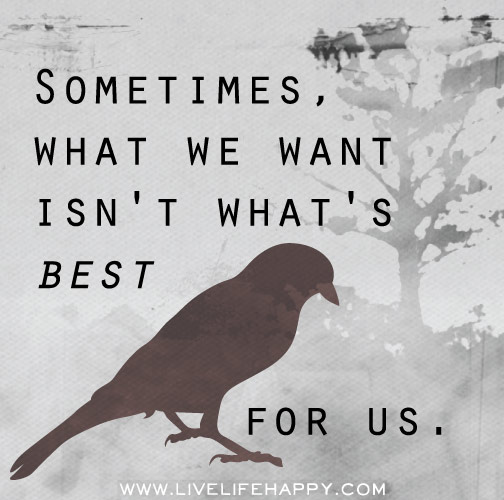
What We Want – Live Life Quotes, Beautiful Quotes, Love Life Quotes, Live Life Happy.
Here’s a little country wisdom from Garth Brooks…
Thinks I find along the way
What We Want – Live Life Quotes, Beautiful Quotes, Love Life Quotes, Live Life Happy.
Here’s a little country wisdom from Garth Brooks…

Robert Holden tells has a great perspective on love at The Daily Love that I wanted to share with you:
In my book Happiness NOW, I tell one of my favorite love stories. It’s an old Sufi tale of a conversation between Mulla Nasrudin and a good friend:
“I’m getting married on the morrow, Mulla,” announced his friend, smiling wide from ear to ear.
Mulla Nasrudin was quiet and thoughtful.
“Isn’t marriage wonderful, Mulla! It is quite the best! Have you ever considered getting married, Mulla?” Continue reading “Be The Love You Are Looking For!”
Mastin Kipp shares this quote:
“You are not your mind, your emotions or the circumstances of your life. You are the peaceful observer of your mind and emotions that allows life circumstances to pass through and around you for your evolution to finally come to a place of total acceptance of all that is. Only the peaceful observer remains after all else fades away. Only the peaceful observer in total acceptance of what is can take action towards effectively changing anything. You are only this peaceful observer – everything else is as fleeting as the blink of an eye, choose happiness and don’t buy into it.”
Jackson Kiddard, author & polymath.
via Today’s Quotes : “Only the peaceful observer remains after all else fades away.”.

Have you tried to pump up your self-esteem? Kristen Neff explains why it doesn’t work in the long run:
In this incredibly competitive society of ours, how many of us truly feel good about ourselves?
I remember once, as a freshman in college, after spending hours getting ready for a big party, I complained to my boyfriend that my hair, makeup, and outfit were woefully inadequate. He tried to reassure me by saying, “Don’t worry, you look fine.”
“Fine? Oh great, I always wanted to look fine . . .” Continue reading “Why Self-Compassion Trumps Self-Esteem”

Via http://tarabrach.com…

Tara Brach shared this story in a recent podcast:
“Imagine walking along a sidewalk with your arms full of groceries, and someone roughly bumps into you so that you fall and your groceries are strewn over the ground. As you rise up from the puddle of broken eggs and tomato juice, you are ready to shout out, ‘You idiot! What’s wrong with you? Are you blind?’ But just before you can catch your breath to speak, you see that the person who bumped into you is actually blind. He, too, is sprawled in the spilled groceries, and your anger vanishes in an instant, to be replaced by sympathetic concern: ‘Are you hurt? Can I help you up?’
“Our situation is like that. When we clearly realize that the source of disharmony and misery in the world is ignorance, we can open the door of wisdom and compassion.”
— B. Alan Wallace in Tibetan Buddhism from the Ground Up
via Spirituality & Practice: Book Review: The Buddha Is Still Teaching, by Jack Kornfield.
I heard this story in Tara Brach’s weekly meditation which you can hear here… :-D

 Kristin Neff writes:
In my work I have defined self-compassion as having three main interacting components: self-kindness, a sense of common humanity and mindfulness. Self-kindness refers to the tendency to be caring and understanding with oneself rather than being harshly critical or judgmental. Instead of taking a cold “stiff-upper-lip” approach in times of suffering, self-kindness offers soothing and comfort to the self. Common humanity involves recognizing that all humans are imperfect, fail and make mistakes. It connects one’s own flawed condition to the shared human condition so that one can take greater perspective towards one’s personal shortcomings and difficulties. Mindfulness involves being aware of one’s painful feelings in a clear and balanced manner so that one neither ignores nor obsesses about disliked aspects of oneself or one’s life.
For the past decade or so I’ve been conducting research on self-compassion and have found that people who are compassionate to themselves are much less likely to be depressed, anxious and stressed and are much more likely to be happy, resilient and optimistic about their future. In short, they have better mental health.
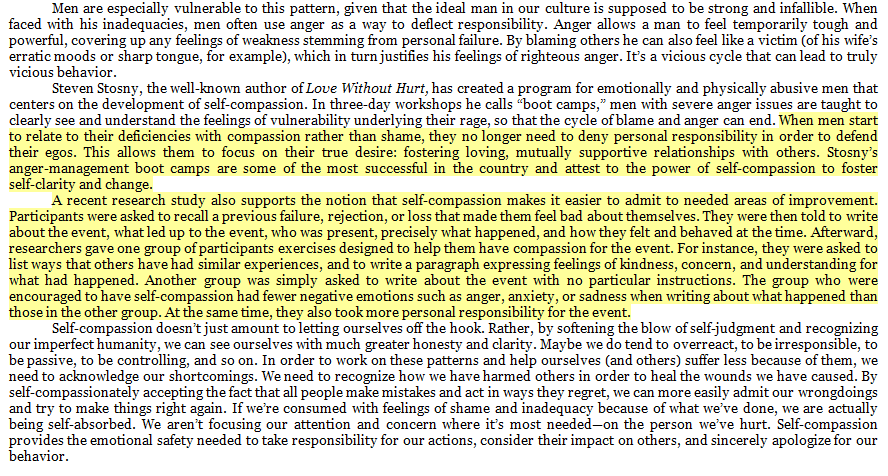
The power of self-compassion is not just an idea; it’s very real and actually manifests in our bodies. When we soothe our own pain, we are tapping into the mammalian care-giving system. And one important way the care-giving system works is by triggering the release of oxytocin. Research indicates that increased levels of oxytocin strongly increase feelings of trust, calm, safety, generosity and connectedness and facilitates the ability to feel warmth and compassion for ourselves. Oxytocin is released in a variety of social situations, including when a mother breastfeeds her child, when parents interact with their young children or when someone gives or receives a soft, tender caress. Because thoughts and emotions have the same effect on our bodies whether they’re directed to ourselves or to others, this research suggests that self-compassion may be a powerful trigger for the release of oxytocin.
Self-criticism appears to have a very different effect on our body. The amygdala is the oldest part of the brain and is designed to quickly detect threats in the environment. When we experience a threatening situation, the fight-or-flight response is triggered: the amygdala sends signals that increase blood pressure, adrenaline and the hormone cortisol, mobilizing the strength and energy needed to confront or avoid a threat. Although this system was designed by evolution to deal with physical attacks, it is activated just as readily by emotional attacks — by ourselves or others. Recent research indicates that generating feelings of self-compassion actually decreases our cortisol levels. In one study conducted by Helen Rockliff and her colleagues, researchers asked participants to imagine receiving compassion and feeling it in their bodies. Every minute they were told things like, “Allow yourself to feel that you are the recipient of great compassion; allow yourself to feel the loving-kindness that is there for you.” It was found that the participants given these instructions had lower cortisol levels after the imagery than those in the control group. Participants also demonstrated increased heart rate variability afterwards. The safer people feel, the more open and flexible they can be in response to their environment, and this is reflected in how much their heart rate varies in response to stimuli. So you could say that by giving themselves compassion, participants’ hearts actually opened and became less defensive.
When we soothe our painful feelings with the healing balm of self-compassion, not only are we changing our mental and emotional experience, we’re also changing our body chemistry. An effective aspect of self-compassion practice, therefore, is to tap into our body’s self-healing system through physical sensations.
This means that an easy way to calm and comfort yourself when you’re feeling bad is through soothing touch. It seems a bit silly at first, but your body doesn’t know that. It just responds to the physical gesture of warmth and care, just as a baby responds to being held in its mother’s arms. Remember, physical touch releases oxytocin, reduces cortisol and calms cardiovascular stress. So why not try it? If you notice that you’re feeling tense, upset or self-critical, try giving yourself a warm hug, or tenderly stroking your arm or face, or gently rocking your body. What’s important is that you make a clear gesture that conveys feelings of love, care and tenderness. If other people are around, you can often fold your arms in a non-obvious way, gently squeezing yourself in a comforting manner. Notice how your body feels after receiving the hug or caress. Does it feel warmer, softer, calmer? It’s amazing how easy it is to tap into mammalian care-giving system and change your biochemical experience.
via Kristin Neff: The Chemicals of Care: How Self-Compassion Manifests in Our Bodies.
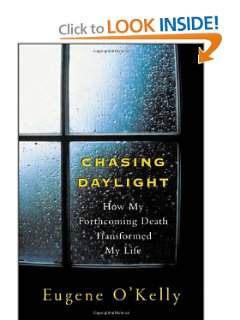
@TomRapsasTweets writes:
At 53, Eugene O’Kelly was on top of the world. He was Chairman and CEO at one of the Big Four accounting firms, a job he loved. He lived in a penthouse apartment in New York City, had a lakefront vacation home and a happy family life with a wife and two children.Then one day, he went to the doctor for what he thought was a small issue. Continue reading “You have three months to live. Now what?”
Thanks you for sharing this video, Steven — I’m doing my best to help amplify this excellent video…
Tara Brach talks:
A key to realizing our goodness is offering self-compassion in moments of difficulty. This short talk shares a quick yet powerful way to remember kindness. To watch the rest of this talk, go to http://www.tarabrach.com/video/2012-0…
If you’d like more, here is an audio version of a recent retreat talk on self-compassion [28Mb download]…

It is in our home!
Men, when was the last time you rolled up your sleeves and tackled the dishes?
Today’s modern family has women in the workplace and men much more involved in the home and parenting. This means men and women are figuring out how to divide the labor and conquer the household chores.
When it comes to marital satisfaction, at-home work seems to be a great equalizer. Husbands who pitch in and help around the house make their wives happy! That’s right, the quality of marriage is affected by men doing housework!
The division of labor matters. Husbands don’t have to work with their wives to get things done at home, just take on some of the tasks (April 2013, Journal of Family Issues). It’s not the togetherness of doing house work, but the fact that men are participating that makes a difference.
So men, pull out those culinary skills, clean a few toilets, and mop that floor…it just might improve your marriage! Your wives will be impressed and think you care.
And men, don’t worry, your leisure time is not at risk. According to Pew researchers, you might be spending more time at work than your female counterparts, doing more around the house, but you still have more leisure time than your wife. So no complaints. Doing housework can only help your marriage!
via Is Housework The Great Equalizer in Couples? – Doing Life Together.
Housework is so beneficial for both of us that I call it ‘choreplay’. Plus, it gives me an opportunity to practice mindfulness while I’m engaged in housework. Men, make it a priority to love your wife through acts of service by sharing the load. You and your wife will both benefit…
Kristin Neff writes:
We know how much it hurts. “I’m an idiot!” “I’m disgusting.” “No one will ever love me.” “What a lame-ass.”
So why do we do it? As soon as we ask ourselves this question, we often just pile on more self-criticism. “I’m such a bitch, even to myself.” “That’s why I’m such a loser, I’m always putting myself down.”
Don’t beat yourself up for beating yourself up in the vain hope that somehow it will help you stop beating yourself up. Instead, take a step back, and give your inner critic some slack. In its ineffective, counterproductive way, your inner critic is actually trying to keep you safe.
As humans we have two main evolved safety systems. The oldest and most quickly triggered is the threat defense system, which involves the amygdala. When we sense danger, our response is typically fight, flight, freeze, or submit: We turn and fight the threat, run like hell away from the threat, play dead in hopes the threat will pass, or show our bellies and hope the threat will be placated. These strategies are very successful for animals living in the wild, helping them to survive and pass on their genes. For humans, however, these responses often just make things worse. That’s because the threat we’re usually facing is a threat to our self-concept. We confuse our thoughts and representations of ourselves for our actual selves, meaning that when our self-image is under siege, we react as if our very existence is threatened. When this happens, our threat defense system uses the same strategies to stay safe:
Fight — we beat ourselves up emotionally, using cruel language to cut ourselves down.
Flight — we become anxious and restless, fleeing from ourselves by numbing out or using distractions like food or alcohol.
Freeze — we get stuck in rumination, thinking about our perceived inadequacies over and over again.
Submit — we admit that yes, we’re terrible, and accept all the harsh judgments we throw at ourselves.
More often than not we engage in some combination of all these strategies. Our stress levels go up as our amygdala activates our sympathetic nervous system (which arouses us so we can deal with threats) and floods our system with adrenaline and cortisol. And it’s a double whammy because when we criticize ourselves, we are both the attacker and the attacked. This type of chronic stress can eventually lead to anxiety and depression, undermining our physical and emotional wellbeing.
Still, it’s important to remember that when our inner critic attacks, at root it is trying to ward off danger. Marshal Rosenberg, author of the book Non-Violent Communication, says self-criticism is the “tragic expression of an unmet need.” It’s tragic because self-criticism makes us feel horrible and doesn’t effectively motivate productive change. (See my blog “The Motivational Power of Self-Compassion.”) But if we look closely — our inner critic cares. There is some safety need it is trying to meet. Our inner critic wants us to be happy, but doesn’t know a better way to go about it. Let’s say you criticize yourself for not going to the gym, calling yourself a “lazy slob.” At some level, your inner critic is reacting out of concern that if you don’t go to the gym you won’t be healthy, or that you’ll be rejected by others. We can be kind and compassionate to this part of ourselves, because at some level it has our best interests at heart. And believe it or not, by giving compassion to our inner critic, we are moving out of the threat defense system and into our other safety system.
As mammals, we also evolved the attachment/affiliation system as a survival strategy. Mammals have the innate capacity to be soothed by warmth and affection, meaning that our young are likely to stay near caregivers, be protected, and survive. The care-giving system deactivates the sympathetic nervous system (reducing cortisol) and activates the parasympathetic nervous system, which calms us down. This route to emotional safety is much more effective — reducing our stress and anxiety rather than exacerbating it. And it gives us the emotional balance needed to make wise decisions, including making behavioral changes if needed. (I write about self-compassion and the mammalian care-giving system in my blog “The Chemicals of Care.”)
So the next time you find yourself in the throws of harsh self-criticism, instead of beating yourself up for beating yourself up, thank your inner critic for its efforts, then try the strategy of giving yourself some compassion instead. It’s more effective, and a lot less painful!
Full story at: Kristin Neff: Why We Need to Have Compassion for Our Inner Critic.
Funny. A year ago this time I thought I was doing well to know that I could get off the Crazy Train. Now, thanks to the works of Brene Brown, Tara Brach and Kristin Neff I am realizing I don’t have to react to every opportunity to get on the train; I can respond to those opportunities by sitting at the station and watching the Crazy Train go by. It may seem silly to you, but it’s a big revelation for me…
:-D
I’m not much of an Ozzy Osbourne fan but I heard the words to this song for the first time today and I actually thought it was quite good…
Crazy,but that’s how it goes
Millions of people living as foes
Maybe it’s not too late
To learn how to love
And forget how to hate
Mental wounds not healing
Drivin’ me insane
I’m going off the rails on a crazy train
I’ve listened to preachers
I’ve listened to fools
I’ve watched all the dropouts
Who make their own rules
One person conditioned to rule and control
The media sells it and you live the role
Mental wounds still screaming
Driving me insane
I’m going off the rails on a crazy train
I know that things are going wrong for me
You gotta listen to my words
Yeah
Heirs of a cold war
That’s what we’ve become
Inheriting troubles I’m mentally…
View original post 70 more words
Ahhh. And remember my good Christian friends who freak out at the ‘B word’ that Jesus said ‘the Kingdom of God’ is within you. If you practice ‘deep ecumenism‘ you may find that there is one river and many wells…

In every one of us
there is a very safe island we can go to.
Every time you go home to that island
with mindful breathing, you create a space of
relaxation, concentration, and insight.
If you dwell on that island in yourself
with your mindful breathing, you are safe.
That is a place where you can take refuge
whenever you feel fearful, uncertain, or confused.
~~ Thich Nhat Hanh
What is it? According to Kristen Neff…

How has it helped me? By giving me the ability to respond rather than react… Continue reading “Mindfulness…”
Lately, I have been finding wisdom and refuge in Kristen Neff’s book Self-compassion [which I highly recommend!]. Here is a recent passage that resonated with me…
Tara Brach writes:
The Buddha taught that we spend most of our life like children in a burning house, so entranced by our games that we don’t notice the flames, the crumbling walls, the collapsing foundation, the smoke all around us.
Full story at: Defending Against Loss | elephant journal.
You can listen to Tara teach on this topic here…
Confidence is a tool you can use in your everyday life to do all kinds of cool stuff, not least to stop second-guessing yourself, manage your fears and become able to do more of the things that really matter to you.
But not many people realise that their self-confidence works just like a muscle – it grows in response to the level of performance required of it. Either you use it or you lose it. That’s why I’ve given you 63 ways to grow your confidence so that you can become a giant.
63 Ways to Build Self-Confidence
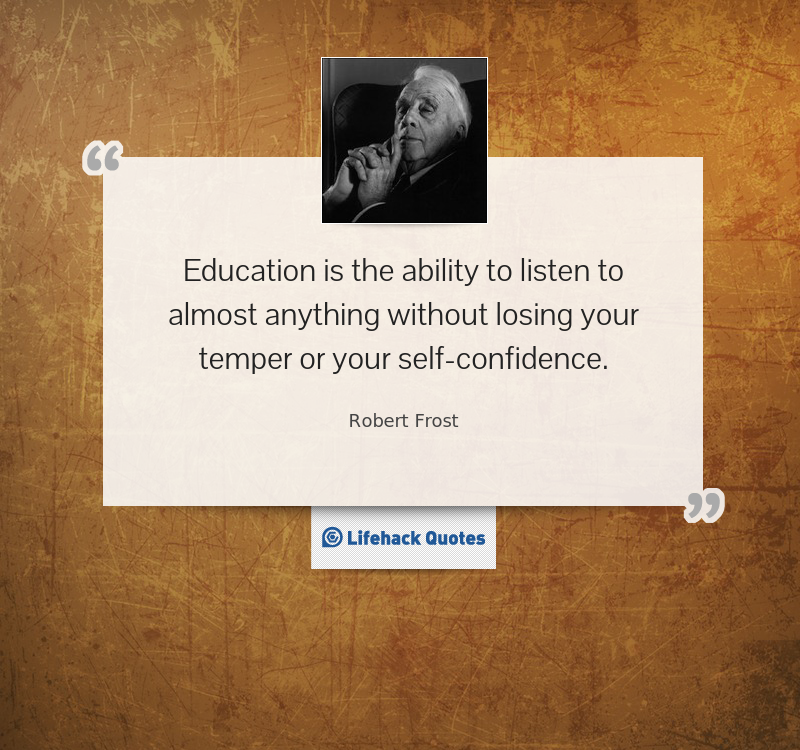
via Quote of the Day: What is the Ability of Education? – Lifehack.

“The secret of joy is the mastery of pain” ~Anais Nin
Full story at: Getting to the Root of Pain to Work Through It and Be Happy | Tiny Buddha.



 Bright, shiny objects!
You must be logged in to post a comment.