There Is Nothing Missing…

JenPastiloffSimpleReminders-850x567[1]

Beautiful soul Jennifer Pastiloff shares:

I feel like I’m about to write copy for an antidepressant commercial. Are you depressed? Trouble sleeping? Find you can’t focus? Find you’re feeling down when you have no real reason to, and, in fact, anyone would think you’re insane for admitting it?

I’ve been struggling lately. And it’s a little overwhelming.

That’s what I have done. Or what I want to do. Try to put down some of my load: in a parking lot, in a blog post. Anywhere, really.

I suffer from depression. Or I have suffered. Which is it? Past tense? Present?

Let me be frank: I’m slipping a little lately. So is it present tense? Do I acknowledge it, then shift my thoughts, creating new mantras, such as, “I am happy! I am free of depression!” or do I sit quietly on this airplane and contemplate it?

What does that even mean — depressed? Is it something I’ve been told (yes!) or something I know deep in the labyrinth of my body, in my DNA (also yes)?

For as long as I can remember, I’ve felt a certain sadness I could never explain to anyone: a dead part inside of me that made me pretend I was sick and stay home from school (even in kindergarten) so I could eat cream cheese and olive sandwiches and watch TV with my mom. During college, I would leave NYU during the weekends to go home to Cherry Hill, NJ, an hour and a half ride on the Peter Pan Bus, so I could be at home, safe from the slick world of New York City and from feeling anything except hunger. Perhaps that’s how I fell in love with anorexia; it allowed me to stop feeling such nothingness. I replaced nothingness with anxiety and hunger, but I no longer felt depressed.

The point is, my life is pretty great. I’m happily married. I’m successful. I’m healthy. So, what is it? What is this demon?

Go to the source of this quote: There Is Nothing Missing: The Epiphany That Helps Me Cope With Depression

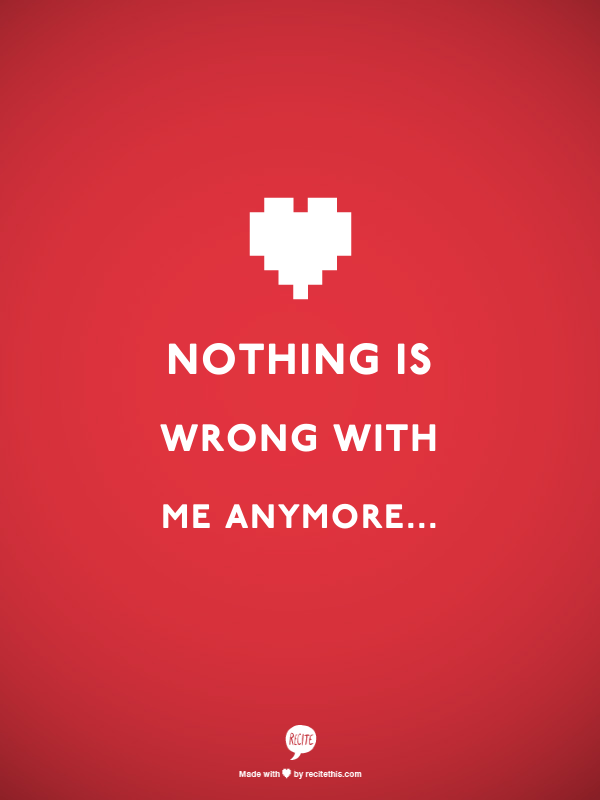
I’ve been learning a lot about ‘nothing’ along these lines lately as in ‘nothing is wrong with me anymore‘ and now ‘there is nothing missing’; both good mindful meditations…

You Are What You Focus On: The Strength of An Unstoppable Mindset

The FinerMinds teams shares this:

“It’s not what happens to you, it’s what you do about it.” – W Mitchell

Not many people have been as unfortunate as W Mitchell – or so it would seem.

He’s been involved in two separate serious accidents – one of which left him with burns covering most of his body, and the other that left him wheelchair-bound for life.

As a result of such disabilities, many would give up. But because of his firm belief that success is not dictated by what life deals to you, but by what you do with the challenges you’re dealt, W Mitchell re-trained himself to fly a plane, become a famous international speaker and an environmental lobbyist.

In this 4-minute video, he reinforces the fact that we become what we focus on, and how once he started focusing on how powerful and innovative he was, he not only changed his life – but the life of those around him.

Go to the source of this quote: You Are What You Focus On: The Strength of An Unstoppable Mindset

The Power of Awareness: The Quickest Technique to Get You Centered

Anil Gupta shares an easy technique that acts as a mini awareness alarm clock to help ensure that we regularly check in on our thoughts to keep us centered and aware…

Here is his previous thought on clarity…

Be Yourself: No More, No Less

Be Yourself: No More, No Less
Michael Woolson writes:

Be yourself. It’s a statement that people often dismiss as something doting mothers say, but it is actually a very poignant piece of advice.


For instance, have you ever seen a guy who’s trying to be more than what he is? He’s fifty-five, driving a sports car, wearing designer clothing that someone half his age would wear, trying to pick up twenty year olds, and showing off his face lift or hair plugs. It’s like he’s saying, “I’m not old, bald, or okay-looking. I’m a hot, rich, thick-haired, young stallion.” The truth is that he’s not fooling anyone. Wouldn’t your opinion of him be more favorable if he accepted his real age and appearance? This is an extreme example, but almost everyone does it on some level. If you’re an okay-looking person, be an okay-looking person. I know, how dare I say something like that. But the truth is that we are only beautiful when we stand firmly in what we truly are. Continue reading “Be Yourself: No More, No Less”

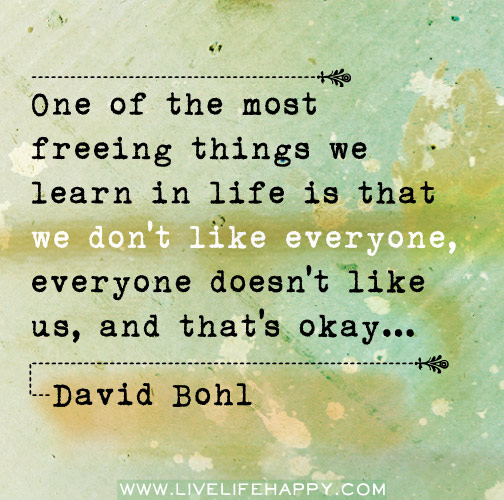
One Of The Most Freeing Things

…and it doesn’t say anything about you or the other person, either!

via One Of The Most Freeing Things.

Live a Big Life: Shift from “Why Me?” to “Why?”

Alexandra Hope Flood writes:

“The journey is the reward.” ~Chinese Proverb

We’ve probably all heard this famous piece of wisdom at one time or another.

I’ll be honest, there were a few years where I just plain blew it off.

Like, “Yeah, yeah, journey, reward, I got it. Cool. Now, when’s my ship coming in?”

Not that I was greedy. Just impatient to arrive at a place called Made It. It seemed that other people were already there and I was eager to join them.

I had seen the brochure for Made It and I knew then and there, it was my kind of place.

The trick about getting to Made It is that there wasn’t a singular map. You’re supposed to make your own.

Go to the source of this quote: Live a Big Life: Shift from “Why Me?” to “Why?” | Tiny Buddha

The Mirror of the Mind: How to Become the Creator of Your Reality

The FinerMinds team shares this:

The phenomenon of this reality “loop” means the more self-aware we become, the more we’re able to break free from baseline reality (which is governed by the ego) and enter a new reality that is exponentially fulfilling, and awakened.

via The Mirror of the Mind: How to Become the Creator of Your Reality.

Meditation for the Haters, Bullies, and Spirit Crushers in Your Life

Bex Borucki writes:

What if all the people who ever said anything mean or hateful or ugly about you could be completely silenced with just a thought? What if their words held no weight? No influence? What if no one could make you feel anything that you didn’t want to? Let’s imagine for a moment that everything I just asked could come true right now. RIGHT NOW. How would you act? How would you feel about yourself? What would be different in your life? What would be different about this day? This moment? Imagine with me for the next four minutes… Continue reading “Meditation for the Haters, Bullies, and Spirit Crushers in Your Life”

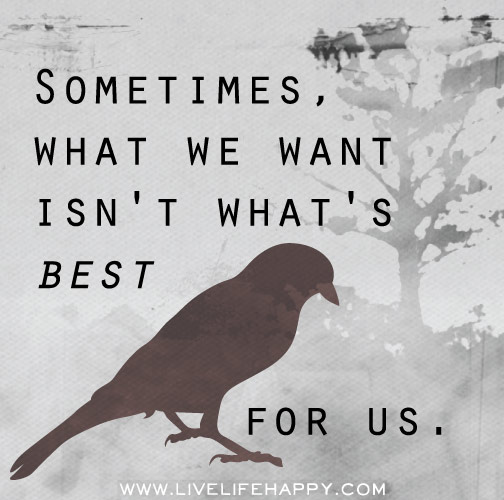
What We Want

What We Want – Live Life Quotes, Beautiful Quotes, Love Life Quotes, Live Life Happy.

Here’s a little country wisdom from Garth Brooks…

Be The Love You Are Looking For!

Robert Holden tells has a great perspective on love at The Daily Love that I wanted to share with you:

In my book Happiness NOW, I tell one of my favorite love stories. It’s an old Sufi tale of a conversation between Mulla Nasrudin and a good friend:

“I’m getting married on the morrow, Mulla,” announced his friend, smiling wide from ear to ear.

Mulla Nasrudin was quiet and thoughtful.

“Isn’t marriage wonderful, Mulla! It is quite the best! Have you ever considered getting married, Mulla?” Continue reading “Be The Love You Are Looking For!”

Only the peaceful observer remains after all else fades away

Mastin Kipp shares this quote:

“You are not your mind, your emotions or the circumstances of your life. You are the peaceful observer of your mind and emotions that allows life circumstances to pass through and around you for your evolution to finally come to a place of total acceptance of all that is. Only the peaceful observer remains after all else fades away. Only the peaceful observer in total acceptance of what is can take action towards effectively changing anything. You are only this peaceful observer – everything else is as fleeting as the blink of an eye, choose happiness and don’t buy into it.”

Jackson Kiddard, author & polymath.

via Today’s Quotes : “Only the peaceful observer remains after all else fades away.”.

Why Self-Compassion Trumps Self-Esteem

Have you tried to pump up your self-esteem? Kristen Neff explains why it doesn’t work in the long run:

In this incredibly competitive society of ours, how many of us truly feel good about ourselves?

I remember once, as a freshman in college, after spending hours getting ready for a big party, I complained to my boyfriend that my hair, makeup, and outfit were woefully inadequate. He tried to reassure me by saying, “Don’t worry, you look fine.”

“Fine? Oh great, I always wanted to look fine . . .” Continue reading “Why Self-Compassion Trumps Self-Esteem”

Nothing is wrong with me anymore…

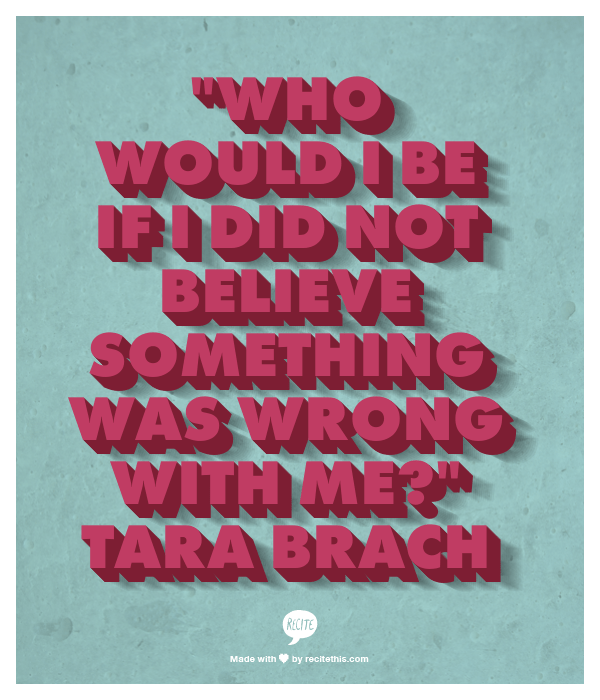
"Who would I be if I did not believe something was wrong with me?" Tara Brach

Via http://tarabrach.com

ARE YOU BLIND?

Tara Brach shared this story in a recent podcast:

“Imagine walking along a sidewalk with your arms full of groceries, and someone roughly bumps into you so that you fall and your groceries are strewn over the ground. As you rise up from the puddle of broken eggs and tomato juice, you are ready to shout out, ‘You idiot! What’s wrong with you? Are you blind?’ But just before you can catch your breath to speak, you see that the person who bumped into you is actually blind. He, too, is sprawled in the spilled groceries, and your anger vanishes in an instant, to be replaced by sympathetic concern: ‘Are you hurt? Can I help you up?’

“Our situation is like that. When we clearly realize that the source of disharmony and misery in the world is ignorance, we can open the door of wisdom and compassion.”

— B. Alan Wallace in Tibetan Buddhism from the Ground Up

via Spirituality & Practice: Book Review: The Buddha Is Still Teaching, by Jack Kornfield.

I heard this story in Tara Brach’s weekly meditation which you can hear here… :-D

The Chemicals of Care: How Self-Compassion Manifests in Our Bodies

Neff, Kristin_400Kristin Neff writes:

In my work I have defined self-compassion as having three main interacting components: self-kindness, a sense of common humanity and mindfulness. Self-kindness refers to the tendency to be caring and understanding with oneself rather than being harshly critical or judgmental. Instead of taking a cold “stiff-upper-lip” approach in times of suffering, self-kindness offers soothing and comfort to the self. Common humanity involves recognizing that all humans are imperfect, fail and make mistakes. It connects one’s own flawed condition to the shared human condition so that one can take greater perspective towards one’s personal shortcomings and difficulties. Mindfulness involves being aware of one’s painful feelings in a clear and balanced manner so that one neither ignores nor obsesses about disliked aspects of oneself or one’s life.

For the past decade or so I’ve been conducting research on self-compassion and have found that people who are compassionate to themselves are much less likely to be depressed, anxious and stressed and are much more likely to be happy, resilient and optimistic about their future. In short, they have better mental health.

The power of self-compassion is not just an idea; it’s very real and actually manifests in our bodies. When we soothe our own pain, we are tapping into the mammalian care-giving system. And one important way the care-giving system works is by triggering the release of oxytocin. Research indicates that increased levels of oxytocin strongly increase feelings of trust, calm, safety, generosity and connectedness and facilitates the ability to feel warmth and compassion for ourselves. Oxytocin is released in a variety of social situations, including when a mother breastfeeds her child, when parents interact with their young children or when someone gives or receives a soft, tender caress. Because thoughts and emotions have the same effect on our bodies whether they’re directed to ourselves or to others, this research suggests that self-compassion may be a powerful trigger for the release of oxytocin.

Self-criticism appears to have a very different effect on our body. The amygdala is the oldest part of the brain and is designed to quickly detect threats in the environment. When we experience a threatening situation, the fight-or-flight response is triggered: the amygdala sends signals that increase blood pressure, adrenaline and the hormone cortisol, mobilizing the strength and energy needed to confront or avoid a threat. Although this system was designed by evolution to deal with physical attacks, it is activated just as readily by emotional attacks — by ourselves or others. Recent research indicates that generating feelings of self-compassion actually decreases our cortisol levels. In one study conducted by Helen Rockliff and her colleagues, researchers asked participants to imagine receiving compassion and feeling it in their bodies. Every minute they were told things like, “Allow yourself to feel that you are the recipient of great compassion; allow yourself to feel the loving-kindness that is there for you.” It was found that the participants given these instructions had lower cortisol levels after the imagery than those in the control group. Participants also demonstrated increased heart rate variability afterwards. The safer people feel, the more open and flexible they can be in response to their environment, and this is reflected in how much their heart rate varies in response to stimuli. So you could say that by giving themselves compassion, participants’ hearts actually opened and became less defensive.

When we soothe our painful feelings with the healing balm of self-compassion, not only are we changing our mental and emotional experience, we’re also changing our body chemistry. An effective aspect of self-compassion practice, therefore, is to tap into our body’s self-healing system through physical sensations.

This means that an easy way to calm and comfort yourself when you’re feeling bad is through soothing touch. It seems a bit silly at first, but your body doesn’t know that. It just responds to the physical gesture of warmth and care, just as a baby responds to being held in its mother’s arms. Remember, physical touch releases oxytocin, reduces cortisol and calms cardiovascular stress. So why not try it? If you notice that you’re feeling tense, upset or self-critical, try giving yourself a warm hug, or tenderly stroking your arm or face, or gently rocking your body. What’s important is that you make a clear gesture that conveys feelings of love, care and tenderness. If other people are around, you can often fold your arms in a non-obvious way, gently squeezing yourself in a comforting manner. Notice how your body feels after receiving the hug or caress. Does it feel warmer, softer, calmer? It’s amazing how easy it is to tap into mammalian care-giving system and change your biochemical experience.

via Kristin Neff: The Chemicals of Care: How Self-Compassion Manifests in Our Bodies.

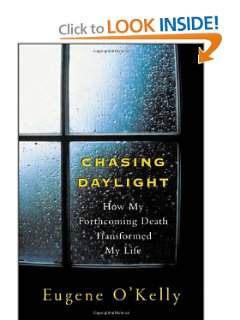
You have three months to live. Now what?

Click image to see contents...
Click image to see contents…

@TomRapsasTweets writes:

At 53, Eugene O’Kelly was on top of the world. He was Chairman and CEO at one of the Big Four accounting firms, a job he loved. He lived in a penthouse apartment in New York City, had a lakefront vacation home and a happy family life with a wife and two children.Then one day, he went to the doctor for what he thought was a small issue. Continue reading “You have three months to live. Now what?”

Thanks you for sharing this video, Steven — I’m doing my best to help amplify this excellent video…

Remembering Self Compassion

Tara Brach talks:

A key to realizing our goodness is offering self-compassion in moments of difficulty. This short talk shares a quick yet powerful way to remember kindness. To watch the rest of this talk, go to http://www.tarabrach.com/video/2012-0…

via Tara Talks: Remembering Self Compassion – YouTube.

If you’d like more, here is an audio version of a recent retreat talk on self-compassion [28Mb download]…

Is Housework The Great Equalizer in Couples?

It is in our home!

Men, when was the last time you rolled up your sleeves and tackled the dishes?

Today’s modern family has women in the workplace and men much more involved in the home and parenting. This means men and women are figuring out how to divide the labor and conquer the household chores.

When it comes to marital satisfaction, at-home work seems to be a great equalizer. Husbands who pitch in and help around the house make their wives happy! That’s right, the quality of marriage is affected by men doing housework!

The division of labor matters. Husbands don’t have to work with their wives to get things done at home, just take on some of the tasks (April 2013, Journal of Family Issues).  It’s not the togetherness of doing house work, but the fact that men are participating that makes a difference.

So men, pull out those culinary skills, clean a few toilets, and mop that floor…it just might improve your marriage! Your wives will be impressed and think you care.

And men, don’t worry, your leisure time is not at risk. According to Pew researchers, you might be spending more time at work than your female counterparts, doing more around the house, but you still have more leisure time than your wife. So no complaints. Doing housework can only help your marriage!

via Is Housework The Great Equalizer in Couples? – Doing Life Together.

Housework is so beneficial for both of us that I call it ‘choreplay’. Plus, it gives me an opportunity to practice mindfulness while I’m engaged in housework. Men, make it a priority to love your wife through acts of service by sharing the load. You and your wife will both benefit…

Why We Need to Have Compassion for Our Inner Critic

Kristin Neff writes:

We know how much it hurts. “I’m an idiot!” “I’m disgusting.” “No one will ever love me.” “What a lame-ass.”

So why do we do it? As soon as we ask ourselves this question, we often just pile on more self-criticism. “I’m such a bitch, even to myself.” “That’s why I’m such a loser, I’m always putting myself down.”

Don’t beat yourself up for beating yourself up in the vain hope that somehow it will help you stop beating yourself up. Instead, take a step back, and give your inner critic some slack. In its ineffective, counterproductive way, your inner critic is actually trying to keep you safe.

As humans we have two main evolved safety systems. The oldest and most quickly triggered is the threat defense system, which involves the amygdala. When we sense danger, our response is typically fight, flight, freeze, or submit: We turn and fight the threat, run like hell away from the threat, play dead in hopes the threat will pass, or show our bellies and hope the threat will be placated. These strategies are very successful for animals living in the wild, helping them to survive and pass on their genes. For humans, however, these responses often just make things worse. That’s because the threat we’re usually facing is a threat to our self-concept. We confuse our thoughts and representations of ourselves for our actual selves, meaning that when our self-image is under siege, we react as if our very existence is threatened. When this happens, our threat defense system uses the same strategies to stay safe:

Fight — we beat ourselves up emotionally, using cruel language to cut ourselves down.

Flight — we become anxious and restless, fleeing from ourselves by numbing out or using distractions like food or alcohol.

Freeze — we get stuck in rumination, thinking about our perceived inadequacies over and over again.

Submit — we admit that yes, we’re terrible, and accept all the harsh judgments we throw at ourselves.

More often than not we engage in some combination of all these strategies. Our stress levels go up as our amygdala activates our sympathetic nervous system (which arouses us so we can deal with threats) and floods our system with adrenaline and cortisol. And it’s a double whammy because when we criticize ourselves, we are both the attacker and the attacked. This type of chronic stress can eventually lead to anxiety and depression, undermining our physical and emotional wellbeing.

Still, it’s important to remember that when our inner critic attacks, at root it is trying to ward off danger. Marshal Rosenberg, author of the book Non-Violent Communication, says self-criticism is the “tragic expression of an unmet need.” It’s tragic because self-criticism makes us feel horrible and doesn’t effectively motivate productive change. (See my blog “The Motivational Power of Self-Compassion.”) But if we look closely — our inner critic cares. There is some safety need it is trying to meet. Our inner critic wants us to be happy, but doesn’t know a better way to go about it. Let’s say you criticize yourself for not going to the gym, calling yourself a “lazy slob.” At some level, your inner critic is reacting out of concern that if you don’t go to the gym you won’t be healthy, or that you’ll be rejected by others. We can be kind and compassionate to this part of ourselves, because at some level it has our best interests at heart. And believe it or not, by giving compassion to our inner critic, we are moving out of the threat defense system and into our other safety system.

As mammals, we also evolved the attachment/affiliation system as a survival strategy. Mammals have the innate capacity to be soothed by warmth and affection, meaning that our young are likely to stay near caregivers, be protected, and survive. The care-giving system deactivates the sympathetic nervous system (reducing cortisol) and activates the parasympathetic nervous system, which calms us down. This route to emotional safety is much more effective — reducing our stress and anxiety rather than exacerbating it. And it gives us the emotional balance needed to make wise decisions, including making behavioral changes if needed. (I write about self-compassion and the mammalian care-giving system in my blog “The Chemicals of Care.”)

So the next time you find yourself in the throws of harsh self-criticism, instead of beating yourself up for beating yourself up, thank your inner critic for its efforts, then try the strategy of giving yourself some compassion instead. It’s more effective, and a lot less painful!

Full story at: Kristin Neff: Why We Need to Have Compassion for Our Inner Critic.

Start a Blog at WordPress.com.

Up ↑