Dear Mom and Dad, Thank You for the Years of Trauma via @tinybuddha

“Dear Mom and Dad, thank you for the hard lessons. Thank you for creating me. Thank you for being who you were or weren’t to me.” Read on: Dear Mom and Dad, Thank You for the Years of Trauma – Tiny Buddha

Dear Mom and Dad, Thank You for the Years of Trauma via @TinyBuddha

I’m sharing this not as an indictment of my parent’s parenting but rather mine as something I would share with my sons. One of the most difficult things for children to understand is the complexity of being a parent today. Children don’t understand what their parent might be going through at work or in their marriage nor should they, but life is made up of ordinary days and sometimes parents have a hard time keeping their adult world from harming their children. Hopefully, as children grow older they have more grace to lend to their parents.

Allison Ayres writes “dear Mom and Dad, thank you for the hard lessons. Thank you for creating me. Thank you for being who you were or weren’t to me.” Source: Dear Mom and Dad, Thank You for the Years of Trauma – Tiny Buddha

10 Ways Childhood Trauma Manifests in Adult Relationships

Our formative years pave the way for interactions in our later relationships. Source: 10 Ways Childhood Trauma Manifests in Adult Relationships

Facing Fear in a Traumatized World with @tarabrach

Tara Brach says “Unprocessed fear cuts us off from our full aliveness and spirit, and it separates us from others. This talk looks at how we bring healing to the trauma and deep fears that cause us to dissociate from our body. We focus on ways we increase safety, diminish shame and then, with a courageous, embodied and compassionate presence, learn to contact and integrate fear into our larger awareness.” Listen for more…

What Happens When Americans Can Finally Exhale

“People have now lived through 14 months of pandemic life. Millions have endured a year of grief, anxiety, isolation, and rolling trauma. Some will recover uneventfully, but for others, the quiet moments after adrenaline fades and normalcy resumes may be unexpectedly punishing. When they finally get a chance to exhale, their breaths may emerge as sighs. “People put their heads down and do what they have to do, but suddenly, when there’s an opening, all these feelings come up,” Laura van Dernoot Lipsky, the founder and director of the Trauma Stewardship Institute, told me. Lipsky has spent decades helping people navigate the consequences of natural disasters, mass shootings, and other crises. “As hard as the initial trauma is,” she said, “it’s the aftermath that destroys people.”” Go to the Source: What Happens When Americans Can Finally Exhale

‘2020 Can Go to Hell’

Pandemic, unemployment, wildfire — Lake Berryessa, Calif., has seen it all this year. A photo from the town that evoked the trauma of 2020 sped across the internet. Here, though, it was real life.

When the News is a Trigger: 10 Ways to Lower Stress

With the latest news cycles churning out politically heated and disturbing information on a daily basis ad nauseum, many trauma survivors are finding they are particularly triggered. Specifically, with the recent two-week-long-Kavanaugh-confirmation-to-the-Supreme-Court-drama, sexual abuse survivors (both male and female), are reminded of feelings of hopelessness, powerlessness, and lack of safety. Regardless of what side of the political spectrum you fall on, if you have a trauma history, you are likely quite triggered when you see news which portrays themes of assault survivors being ridiculed and chastised, blamed and shamed and devalued and discounted. Many feel that politics has taken on an entirely new level of impacting mental health for many people who feel disenfranchised, stigmatized, and shunned. Go to the source for some suggestions for riding this wave of political trauma: When the News is a Trigger: 10 Ways to Lower Stress | The Savvy Shrink

The Science of Falling Out of Love

"Romantic breakups are an inevitable, if painful, part of living. Along with eliciting a wide range of emotions, including anger, sadness, and shame, a breakup can bring health problems as well. These could include insomnia, reduced immune functioning, depression, and even the temporary heart condition known as "broken heart syndrome." The severity of symptoms often depend on the strength of the relationship and how traumatic the breakup itself was. Source: https://www.psychologytoday.com/intl/blog/media-spotlight/201710/the-science-falling-out-love"

Best of the Psychology World Blogs: June 22, 2018

Your body isn’t working as it should. Your thoughts are triggering you. It can feel like you’re in a foreign place.

How do you make friends with your body? How do you find peace within yourself?

Acceptance can come from mindfulness. Paying attention can put you back in the hear and now. Viewing your circumstances and feelings without judgment can give you a sense of ease.

We cannot control everything in our lives. For those who suffered trauma, this can be retraumatizing. We can feel helpless, afraid and out of control.

But we can also remember that we always have a choice about our attitude and how we view the circumstances of our lives.

As you read our top posts on addictions and relationships, practice acceptance. Accept what comes up and be compassionate towards yourself.
https://psychcentral.com/blog/best-of-our-blogs-june-22-2018/

If Your Life Is a Movie and You’re the Director, Why Did You Add This Scene to It?

I don’t believe “everything happens for a reason” or that the world is fair. If we pause for even a moment to consider the victims of war and violence, as well as those who live in true poverty, I’d never want to suggest that somehow they imposed those tragedies on their lives. But if we leave trauma aside and focus instead on our lives of ordinary ups and downs, perhaps it’s helpful to consider the scenario of our life as a movie, with scenes added or deleted by the director. Source: If Your Life Is a Movie and You’re the Director, Why Did You Add This Scene to It? – Positively Positive!!

“Never Again!” The Psychological Fallout of Trauma

You’re born with various survival programs, or defenses. Later, when you actually experience a serious threat, you acquire more defenses, and these can end up really harming you.

via “Never Again!” The Psychological Fallout of Trauma — Bright, Shiny Objects via Todd Lohenry on Inoreader

Moving Beyond Electoral Trauma

After the 2008 election, I was so despondent over the results I that I caused an accident by turning left into an oncoming car ‘I didn’t see’ in my post-election-trauma fog. At the time, I was the 3rd Vice Chairman of the Republican Party of Wisconsin reporting to Trump’s chief of staff Reince Priebus [Wisconsin Party Chairman at the time] and I thought the election results were the end of my world.
pablo

In hindsight, I see that the growth and development that it caused in my life was some of the most important self work I’ve ever done. I feel the very real pain of my friends who have similar feelings over the election of Donald Trump but I’m telling you from my experience that the sun will still rise over Lake Michigan and you too will survive if you take the time to do some important self work. I offer these thoughts from Psychology Today author James Gordon M.D. as a starting point:

We’ve had a year of angry, clamorous, mean-spirited, often incoherent campaigning, increasing polarization, and now a rude electoral shock for Clinton’s supporters and a surprising vindication for Trump’s.

For the last few weeks, I’ve been listening to and working with large numbers of people of all potential persuasions—in Indiana, Louisiana, California, back here in DC, and with friends and patients on the phone. I’m frequently recognizing the symptoms of posttraumatic stress: anxiety and anger, difficulty focusing and sleeping, threatening dreams, and, often enough, emotional numbness and withdrawal from friends and families– uneasiness about the present and worries about the future.

When my Center for Mind-Body Medicine colleagues and I work with traumatized populations, or individuals, as we have for the last 20 years, we want to begin as early as possible: during rather than after wars, while the rubble is still being cleared after an earthquake or flood, just when the chemotherapy for cancer is beginning. That’s the time to most effectively address the biological, psychological, and social damage that trauma does: to reduce anxiety and agitation, relax bodies tensed against danger, help people gain perspective on what has happened and may happen, and move beyond feelings of powerlessness and despair. In published studies, our model of self-care and group support, whose basics I’m sharing here, has lowered symptoms of posttraumatic stress by 80%.

We also, and importantly, do our best to turn these crises into opportunities for self reflection. The losses and dangers traumatized people experience often make them more aware and appreciative of what really matters most to them.

An election is, of course, not a war, an earthquake, or a life threatening disease. Still, some of the approaches we’ve successfully used feel relevant now. They can help us regain the psychological and physical balance disturbed by this ugly political combat, and its unsettling aftermath, perhaps bring us together to forge a post-electoral future that will feel less contentious and more compassionate.

I’ll share three ways of being, acts of doing that can help us be more fully ourselves, and act more creatively and effectively in the days and months ahead– one in each of three blog posts.

Go to the source for more: Moving Beyond Electoral Trauma | Psychology Today

This is such an important topic, I’ve linked to each of the three blog posts for your convenience here:

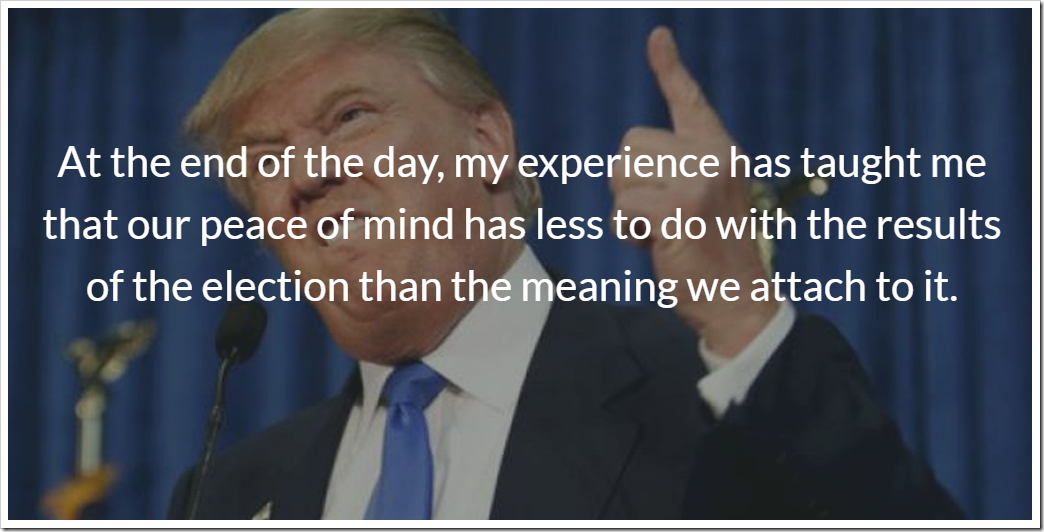
At the end of the day, my experience has taught me that our peace of mind has less to do with the results of the election than the meaning we attach to it and what we do with that meaning.

How Pain Can Cause Us to Act “Crazy” in Relationships

“Sometimes crazy behavior is a symptom of trauma and pain. A lot of times crazy behavior hides deeper issues. From the moment we are born we start to develop a sense of self and belonging. We start to develop an idea of whom we are, how others feel about us, and where we fit in the world. Our first feelings and ideas of self come from the relationship we have with our parents. Generally speaking, if children have healthy parents and feel loved and secure at home, they will grow up secure and will have secure adult relationships. But if children come from homes where there is any type of trauma, abuse, or abandonment, where they don’t learn to build a secure sense of self, then they will grow up anxious and insecure and will have difficulty trusting others and themselves. Most of the time, people who act “crazy” are subconsciously playing out their childhood wounds. These wounds need to be worked through; otherwise, they continue to manifest over and over again with every new relationship.” Source: http://tinybuddha.com/blog/how-pain-can-cause-us-to-act-crazy-in-relationships/?platform=hootsuite

Why Freud Wrote Stories

Author +Marilyn Wedge has a nice post in +Psychology Today about Why Freud Wrote Stories | Psychology Today. She says in part “In some ways, I think that most, if not all, the classifications in the DSM can be reduced to post traumatic stress disorder. That, too, was an insight that Freud got by listening to his patients’ stories. Behind the troubles for which his adult patients consulted him, he inevitably found repressed experiences of childhood trauma. He elicited the stories of the traumas by means of his talking cure and hypnosis. For Freud, stories were never just fiction. They were the best way of getting at the truth…”

from Blogger http://blogger.toddlohenry.com/2014/03/why-freud-wrote-stories.html
via IFTTT

Just Remember, Thoughts Aren’t Facts

-A wise man once said, 'Your worst enemy cannot harm you as much as your unguarded thoughts.'-
Elisha Goldstein writes:

“A wise man once said, ‘Your worst enemy cannot harm you as much as your unguarded thoughts.'” The Buddha

I want to share with you an important “Now Moment,” the short, action-oriented pieces that come at the end of most of the chapters in The Now Effect. This little instruction can be enormously helpful in bringing to light how to gain freedom from thinking; and since thinking can be our number one bad habit, often launching us into increased stress or downward spirals of automatic negative thinking, it’s a good thing to loosen our grip on.

Continue reading “Just Remember, Thoughts Aren’t Facts”

Which wolf will you feed?

For most of my life, I have been a bitter, resentful, angry person. The story that I tell myself is that I came by it honestly. I’m a classic case of a person who suffered early childhood trauma around abandonment and rejection issues and much of my life has been spent in trying to get the people in my life now to make up for the things done by the people in my past. When this plan didn’t work [for reasons that are obvious to me now] I reacted with resentment and anger; first toward myself and then toward others… Continue reading “Which wolf will you feed?”

The Top 10 Habits of Grateful People

“‘Gratitude is the fairest blossom which springs from the soul.” — Henry Ward Beecher.

It is no secret that gratefulness is correlated with life satisfaction and happiness. Countless research findings, particularly in the rapidly emerging field of Positive Psychology, have shown that gratefulness and life satisfaction go hand in hand.  Those who tend to be more grateful rather than bitter are generally more positive, more satisfied with their lives, and will be able to see the silver lining even on cloudy days.Despite this intuitive understanding of the importance of gratefulness, all too often when life throws us curve balls, this grateful mindset all but disappears. It certainly is easier to be grateful when you are on a winning team and things go in your favor. However, the true test of resiliency and gratefulness is when life does not go your way. If you find yourself losing more than you are winning, and can’t seem to get over past regrets, disappointments and life’s injustices, gratefulness is overturned by a sense of injustice. Experiencing loss, frustration and even trauma, especially if we feel blindsided, certainly can make it difficult not to indulge in negative feelings.  After all, we might wonder, when things go wrong what really do we have to be grateful about? No matter what happens to us, if we “dig deep” we often can find that there is really plenty to be thankful for in our lives. The following are the 10 top habits of people who remain steadfast in their ability to be grateful, and can temper the blows life gives them with an unwavering “attitude of gratitude” mindset: The Top 10 Habits of Grateful People…Even In Tough Times.

Disappointed Someone? It’s Okay. Get Over It.

“When we are the one responsible behind disappointment, we find ourselves poked by both ends of a double-edged sword – on the one side wounded by disappointment in ourselves, and the other traumatized with guilt towards the party affected.

But like toothaches and awkward puberty, we have to accept the fact that we are all bound to the possibility of disappointment, be it by ourselves, family, friends or co-workers; or by circumstances beyond our control, such as bad timing or a chain of events that eventually domino-crumble down our path.

Disappointment is an essential part of our growth and self-discovery, and despite being uncomfortable and hurtful, teaches us to trust ourselves, recognize our strengths and weaknesses, and let go of our hold on perfection.

By actively avoiding disappointment onto others, sometimes we set ourselves up for more failure and pain instead of less, or none at all.

We understand that like people, disappointment comes in many different shapes and sizes. While we don’t reproach the remorse that comes with our wrongdoing (hey, that’s a sign of empathy, right?), we’re definitely not down with the idea of indulging in continuous self-pity over a missed deadline or a forgotten detail.

So here are some tips you can apply in your personal or work life on how to overcome the emotional self-flagellation that comes with having disappointed someone.” Get more here: Disappointed Someone? It’s Okay. Get Over It..

Here’s How To End Suffering Once And For All

Love On The Rocks...lol

Mastin Kipp of The Daily Love shares this…

I am not saying that painful things in your past didn’t happen, but what I am saying is that they no longer have to be painful. And it’s not as easy as changing your mind once or twice. It takes work, and reps, like in the gym. But if you try and try enough over time, new life and new meaning can emerge.

One of the best ways I know how to do this is to take ourselves out of our own story and step into the thoughts, feelings and beliefs of the person who hurt us. Not so we can make right what they did, but so we can begin to understand the painful event from their point of view.

As I have guided clients through this process, the outcomes have been amazing. Forgiveness on a whole new level of themselves and others. And of VERY traumatic events.

The point of forgiveness is not to make right what happened, but to bring a new sense of empathy and compassion to all involved – this includes you.

The best way to get back at people who have hurt us is to forgive them, because that is how we break the bond over the painful event. And from there, when we step into their shoes of how they must have been thinking and feeling, we begin to understand that their actions were not truly against us, but a request for Love or Significance in a very messed up way; that was the best way that they knew how to at that time.

Source: Here’s How To End Suffering Once And For All!

Go to the source if you’d like the rest of his perspective on the issue…

Say good-bye to past trauma and hurt…


The time evolution of the probability density ...

Mastin Kipp shared something that I know someone needs to hear…

Let us review the definition of trauma from the good ole Merriam Webster’s:

Trauma (N):  A disordered psychic or behavioral state resulting from severe mental or emotional stress or physical injury.

A lot of people get so identified with what happened, that they stay there, always identified by what happened and, in many cases using that identification as an excuse not to grow.

Now, I am by NO MEANS diminishing that fact that crazy shit happens in life. Bad things happen to good people. There is all kinds of suffering in the world. But that doesn’t have to be where we LIVE!

You see, there are some key words in Webster’s definition. The first word is “state”. The state you are in changes during the day. Sometimes you are in a sleep state, sometimes you are in a groggy state, sometimes you are in an excited state, and if you are lucky enough to be with a partner you Love and end up getting busy with them, you can be in a pretty excited state, too.

We humans can be in all kinds of different states. The state that we go into when we experience a trauma is totally normal and natural. But afterwards, because we are co-creators of our life, the state we stay in is up to us. This is why I love it when Tony Robbins said that there are no such thing as victims, because once the event happens it’s up to us to choose to stay in a victim identity or choose an empowered story and become stronger.

I can hear some of you right now screaming, “YES MASTIN BUT I WAS ________” and then fill in the blank. I’m not saying that these things didn’t happen and that in that moment you aren’t a victim. Of course you are. But after that moment happens, how you live your life, where you choose to live emotionally is up to you and the meaning you give the events of your life! Moments of victimhood happen, a life of being a victim is chosen and we become a victim of our choice to identify with that moment, instead of growing past it.

The goal is not to avoid pain or to deny what happened to us; the goal is to learn that we have the power within us to change and that starts by not letting an event define us. Instead, we know that painful events happen and when they do, we give them an empowering meaning and choose not to relive and make our identity the trauma that we felt.

Source: Bye Bye Past Trauma & Hurt! Here Comes The Sun Baby!

Go to the source if you’d like to read the rest of his post. Choose life!

The ‘truth’ about failure…


Image via Wikipedia

Here’s a perspective from Chris Assaad I found interesting…

“Most people have a very negative association with the word “failure”. That one little word carries so much weight in our minds and it tends be loaded with so much meaning and negative energy. I call it the other F-word. Well, I’m going to come right out and say it: I’m a failure. There, I said it.

What many of us often forget or don’t realize is that the road to success is paved with many failures. What tends to happen to many of us is that somewhere along the way, we fail and we decide that we’re not going to get where we’re going so we give up. The irony of it is that what actually stops us from succeeding or reaching our goals is not failure itself, it’s how we respond to failure. It’s how we interpret our failures and what we make them mean. Things like: “I’m not good enough, I can’t do it, I’ll never be able to do X, Y or Z, I don’t deserve to have my dreams come true, to be in a loving relationship, to be successful…blah, blah, blah.” Sound familiar? Maybe not, because the voice that says these things is very sneaky. It shows up at our weakest moments and kicks us while we’re down or even worse still, it speaks up when we are so close to the finish line and tries to convince us to give up on a goal we’ve been working towards for so long.

Why is that? Well, it’s very simple. Many of us learned this distorted perception of failure at a young age and have carried it forward into our adult lives. We may have failed a test in school and were traumatized by the associated stigma. We may have liked someone in our adolescent years only to get our heart broken and decided never to express our feelings again. The examples are endless but the pattern is the same. We fail at something and we take that failure as conclusive evidence that we’re not worthy or capable of the thing we’re after, that it’s not going to happen and so we might as well give up. Right? Wrong! Continue reading “The ‘truth’ about failure…”

Start a Blog at WordPress.com.

Up ↑