Love Coldplay. Love this music. Seems to me, though, that so many love songs are codependent by their very nature. The sentiment is nice, but can you actually ‘fix’ another person? I’ll just shut up and enjoy the song… :-D
The acoustic kings

Thinks I find along the way
Love Coldplay. Love this music. Seems to me, though, that so many love songs are codependent by their very nature. The sentiment is nice, but can you actually ‘fix’ another person? I’ll just shut up and enjoy the song… :-D
Thanks for the inspiration! :-D


“Es war lange Zeit ein zähes Ringen zwischen der DFB-Elf und Portugal. Doch dann traf ausgerechnet der Mann, dessen Einsatz bis kurz vor Anpfiff noch nicht sicher war: Bayern-Stürmer Mario Gomez.” Video hier: EM 2012 in 3D: Gomez köpft Deutschland zum Sieg gegen Portugal – Nachrichten Sport – Fußball – EM 2012 – WELT ONLINE. [For those of you who didn’t study German, Germany won the European championship 1.0 yesterday…]

“Codependency (or codependence, interdependency ) is defined as a psychological condition or a relationship in which a person is controlled or manipulated by another who is affected with a pathological condition (as in an addiction to alcohol or heroin); and in broader terms, it refers to the dependence on the needs of or control of another.[1] It also often involves placing a lower priority on one’s own needs, while being excessively preoccupied with the needs of others.[2] Codependency can occur in any type of relationship, including family, work, friendship, and also romantic, peer or community relationships.[2] Codependency may also be characterized by denial, low self-esteem, excessive compliance, or control patterns.[2] Narcissists are considered to be natural magnets for the codependent.” Get more here: Codependency – Wikipedia, the free encyclopedia.
Wondering if this applies to you? Here are some questions that may help you decide…


“Whether Codependency is developed in childhood or in adulthood the Codependent demonstrates a lack of trust in themselves. Because they are unable to fix what they see as other peoples problems they feel deficient. Because they believe the lies that a Dependent tells them after being challenged by the Codependent (who often correctly asses the situation in the first place) they learn not to trust their own judgement or intuition. This lack of trust in themselves often leads to them clinging on to those who cannot or will not love them back – often settling for too little. Codependents are also controlled by others and find it hard to resist when someone they grow tired of caring for says or does something that indicates things may change, that they will make more effort and behave how the Codependent expects. So they stick by the Dependent hoping things will be different this time.
Codependents deny their true feelings (fear, neediness, anger, ambivalence towards a Dependent) because they are afraid that they may have to acknowledge that they have to take an action that they really don’t want to take e.g. leaving the Dependent or face a truth that they do not want to face e.g. they can’t fix this problem, the Dependent is abusive etc. Denial of feelings leads to physical problems as the body starts to struggle with the effects of stress and anxiety e.g. high blood pressure, fatigue etc. or as often can happen the effects of substance abuse/food abuse that the Codependent practices in order to numb their emotional pain.
Codependents undertake in manipulative behaviour in the name of love and trying to help but in the end “We aren’t the people who ‘make things happen’. Co-dependents are the people who consistently, and with a great deal of effort and energy, try to force things to happen” Beattie pg. 76. Codependents don’t understand that they don’t have to control others and that any element of control means that the other person would normally have no interest in achieving the outcome the Codependent wants to achieve. They ignore the reality because they are frightened of what it really means for them. “People ultimately do what they want to do. They feel how they want to feel (or how they are feeling); they think what they want to think; they do the things they believe they need to do; and they will change only when they are ready to change. It doesn’t matter if they’re wrong and we’re right. It doesn’t matter if they’re hurting themselves. It doesn’t matter that we could help them if they’d only listen to, and cooperate with, us. IT DOESN’T MATTER” Beattie pg. 80-81.” via Basics of Codependency.
 Tommy Rosen has been doing a great job covering the 12 step program over at The Daily Love. Today he writes:
In this Step, we will practice taking full ownership of the circumstances of our relationships in our lives to this point. We will own our side of the street completely and we will approach those that we have harmed with humility, honesty, compassion and a sincere desire to set things right. We will put out of our minds anything that they may have done wrong and approach them to apologize and also to make an amends. Many people confuse making amends with an apology. An apology is to say sorry for what you have done. To “make amends” is to express that you are changing yourself in such a way that you will not commit the same act again. To make amends also has a connotation of making reparations. We will need to make the situation right. If we have stolen, then we re-pay what we have stolen. If we have cheated, then we ask what we can do to make it up to them. Far beyond a simple apology, which by the way, we may have given before many times, when we give an amends, it is a more profound act that can bring true healing in its wake.
Go to your 8th Step list and note all the people who are in your general location. These are people who you can get to easily face to face. Begin to make appointments to see them. No need to let them know exactly what your intention is other than to get together to connect and that it is important to you. Sometimes they will not want to see you. We always try to make amends face to face unless it is not possible. If a person refuses to see you, or lives halfway across the world or if they have passed on, then writing a letter will be sufficient. Prepare yourself before you meet someone to make an amends. Make certain you are ready to own your side of the street and stay off of theirs. It is wise to discuss each amends first with your sponsor or teacher.” Get more here: Step Nine – The Path To Healing – Making Amends!.
Follow the link and read the whole series in you’re interested…


“We’ve been told yogurt is good for us. And in times past, most cultures have traditions of fermented food, such as sauerkraut, kimchi, kefir, and a tasty tea-based drink I’ve been fermenting at home, called kombucha. All these foods are jam-packed with living yeast and bacteria species that go down your gullet to comingle with the one hundred trillion (yes, trillion) bacteria already living there.
90% of the cells in your body are the bacteria who live on and within you. Most of them live in your colon. The species of bacteria in your colon could determine how thin or fat you are, or maybe how vulnerable you are to stress. The commensal beasties are difficult to study as they don’t live outside the human gut and can’t be cultured in a lab. There’s a lot to learn.
So fermented food had an obvious advantage in that it kept longer in the days before refrigerators, but did it have another advantage perpetuating it’s existence in so many cultures in human history? Are the probiotics helpful in keeping the beasties in our gut happy and healthy? I’ve discussed this issue a bit in a previous post, but last year a new paper came out that is also interesting:
Probiotics function mechanistically as delivery vehicles for neuroactive compounds: Microbial endocrinology in the design and use of probiotics.” Get more here: Groovy Probiotics | Psychology Today.
Good stuff! Lately, my wife has been introducing us to probiotics and it’s definitely worth looking into…
 Melody Beattie writes:
“Shame is the first feeling that strikes me whenever I, or someone I love, has a problem;’ said one recovering woman.
Many of us were raised with the belief that having a problem is something to be ashamed of.
This belief can do many damaging things to us. It can stop us from identifying our problems; it can make us feel alienated and inferior when we have, or someone we love has, a problem. Shame can block us from solving a problem and finding the gift from the problem.
Problems are a part of life. So are solutions. People have problems, but we, and our self-esteem, are separate from our problems.
I’ve yet to meet a person who didn’t have problems to solve, but I’ve met many who felt ashamed to talk about the problems they actually had solved!
We are more than our problems. Even if our problem is our own behavior, the problem is not who we are — it’s what we did.
It’s okay to have problems. It’s okay to talk about problems at appropriate times, and with safe people. It’s okay to solve problems.
And we’re okay, even when we have, or someone we love, has a problem. We don’t have to forfeit our personal power or our self-esteem. We have solved exactly the problems we’ve needed to solve to become who we are.
Today, I will let go of my shame about problems.” via June 10: Solving Problems.
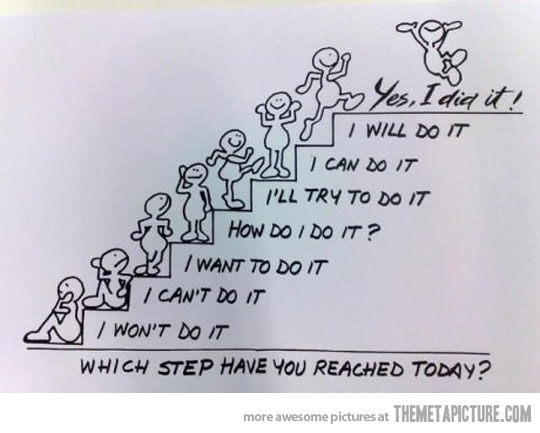 The Meta Picture via One step at a time….
 Nice try, but does that make either one ‘right’? The Meta Picture via Good going….


Retronaut. Get more here: Frank Sinatra, 1965. Love Frank! Here are some of my favorites…

Bach to basics…
Cute. I think I’ll swipe it! :-D

The Daily Love via Visual Inspiration: Celebrate The Journey!.

One of the most important things I’ve done in my fitness routine is to throw out my scale and to start using Endomondo on my Android [available for your iPhone, too]. Endomondo uses the GPS in my phone to track my exercise and keeps a running log with stats like this I can view on their website [click image to enlarge]…


My scale is a LIAR — it rarely says what I hope it will say. Endomondo reminds me that if I do the right thing, the right results will follow and it shows me how my efforts are adding up. THIS inspires me — you may benefit from it, too!

Melody Beattie writes:
Self care means taking responsibility for ourselves. Taking responsibility for ourselves includes assuming our true responsibilities to others. Sometimes, when we begin recovery, we’re worn down from feeling responsible for so many other people. Learning that we need only take responsibility for ourselves may be such a great relief that, for a time, we disown our responsibilities to others.
The goal in recovery is to find the balance: we take responsibility for ourselves, and we identify our true responsibilities to others.
This may take some sorting through, especially if we have functioned for years on distorted notions about our responsibilities to others. We may be responsible to one person as a friend or as an employee; to another person, we’re responsible as an employer or as a spouse. With each person, we have certain responsibilities. When we tend to those true responsibilities, we’ll find balance in our life.
We are also learning that while others aren’t responsible for us, they are accountable to us in certain ways.
We can learn to discern our true responsibilities for ourselves, and to others. We can allow others to be responsible for themselves and expect them to be appropriately responsible to us.
We’ll need to be gentle with ourselves while we learn.
Today, I will strive for clear thinking about my actual responsibilities to others. I will assume these responsibilities as part of taking care of myself.





 Bright, shiny objects!
You must be logged in to post a comment.