Steve Dotto has a great post over at Stepcase Lifehack:

Evernote has become, for many of us, the hub at the center of our digital lives. We store everything — from notes to images to web sites to expense reports — in Evernote.

While many productivity apps have built-in Evernote integration, many still don’t. Fortunately there is a terrific technique that allows you to integrate Evernote into almost every app or program.”via How to Use Evernote for Everything [Video].

If you’re an Evernote fan like I am, you’re going to love this…

Me? I’ve posted many times on how important Evernote is to me — especially as Getting Things Done [GTD] ‘container’. Here are some of my greatest hits…

I’ve also done 5 screencasts on various aspects of Evernote and I put them in a playlist for you here…

One last thought. If you’re a Getting Things Done [GTD] fan, you might also enjoy this powerful but inexpensive book…

Click to view and/or buy…
And this one’s only $.99; looks intersting although I haven’t read it…

Click to view and/or buy…

In his epic book “Here Comes Everybody”, Clay Shirky writes:

We are living in the middle of the largest increase in expressive capability in the history of the human race. More people can communicate more things to more people than has ever been possible in the past, and the size and speed of this increase, from under one million participants to over one billion in a generation, makes the change unprecedented, even considered against the background of previous revolutions in communications tools. The truly dramatic changes in such tools can be counted on the fingers of one hand: the printing press and movable type (considered as one long period of innovation); the telegraph and telephone; recorded content (music, then movies); and finally the harnessing of radio signals (for broadcasting radio and TV). None of these examples was a simple improvement, which is to say a better way of doing what a society already did. Instead, each was a real break with the continuity of the past, because any radical change in our ability to communicate with one another changes society.

Shirky, Clay (2009-02-24). Here Comes Everybody: The Power of Organizing Without Organizations (p. 106). Penguin Group. Kindle Edition.

What good, though, is that expressive capability if people can’t find you when they need what you do? You need to be known!

The question is, though, for what should I be known? Everyone’s an expert! How do we know this? Seth Godin told us so long ago in his ebook ‘Everyone’s an Expert’ [About Something]

So now you are an expert. I know it. You know it. It’s the rest of the world that may not know it. Yet. In my humble opinion however you did not get to this ripe old age of wherever you’re at without becoming an expert in something. The 10,000 hour rule is just that – Malcolm Gladwell hypothesized that it takes approximately 10,000 hours of practice to become an expert at something. Now think of all the things you are an expert at!

Here’s the problem, however: your area of expertise may be so narrow or specialized that no one in your town or county or even your state needs it. There are however almost 2,000,000,000 people on the Internet. Even if your expertise appeals to only one in 1 million people that still means there are 2,000 people who need you to guide them. The 10,000 hours you spent gaining your expertise probably means you’re pretty good thinker too. The challenge is you can be the sharpest knife in the drawer but if no one can find the drawer you’ll never get a chance to get out…

Chris Brogan says:

“As you now know, if you have no Google results, in a sense you don’t exist.

Brogan, Chris; Smith, Julien (2010-07-16). Trust Agents: Using the Web to Build Influence, Improve Reputation, and Earn Trust (p. 161). Wiley. Kindle Edition.”

My good friend Dana VanDen Heuvel, a thought leader in his own right, says “there are thinkers and there are thought leaders. They both have a point of view. The thinker has a point of view that is limited by word-of-mouth but the thought leader is only limited by world of mouth.” Using the good, fast and cheap tools available on the Internet a thinker can make his or her thought leadership position searchable, findable, knowable, usable, and shareable. Because of all those ‘ibles’, they may actually become credible. Publishing your thought leadership position will give you a share of voice which may lead to share of mind and ultimately to share of market…
The first step in ‘being known’ is actually accepting the face that you ARE an expert and discovering your ‘onlyness’ as author Nilofer Merchant puts it in her book “11 Rules for Creating Value in the #SocialEra“:

The foundational element starts with celebrating each human and, more specifically, something I’ve termed onlyness. Onlyness is that thing that only one particular person can bring to a situation. It includes the skills, passions, and purpose of each human. Onlyness is fundamentally about honoring each person, first as we view ourselves and second as we are valued. Each of us is standing in a spot that no one else occupies. That unique point of view is born of our accumulated experience, perspective, and vision. Some of those experiences are not as “perfect” as we might want, but even those experiences are a source of ideas and creativity. Without this tenet of celebrating onlyness, we allow ourselves to be simply cogs in a machine—dispensable and undervalued.

Merchant, Nilofer (2012-09-12). 11 Rules for Creating Value in the Social Era (Kindle Locations 107-113). Perseus Books Group. Kindle Edition.

So now we have established the foundation of being known; you have to define your area of expertise and embrace your ‘onlyness’; only then can you take the next step. More next Tuesday…

That time I interviewed David Allen, father of Getting Things Done (GTD)

On Friday, I launched a series on Getting Things Done [GTD] on the internet. I wanted to include this 2010 interview with David Allen but as humbling as it is to admit, I couldn’t track it down on my own site! :-D

Fortunately, I did locate it and I share it with you here as part of the series. The action starts at about 1:50 into the recording…


‘Personal news aggregation’? That’s using tools like Feedly and Google Reader to make the information you need to fuel your expertise come to you instead of rooting around the internet hoping to find good stuff…

Now I have spoken many times before about how I’d handle the flow of information in my world. I draw a sharp line between just-in-time information and just in case information. For me Gmail is the killer application for just-in-time information; information that affects relationships and revenue. You’ll never be a thought leader you can’t get out of your inbox…

But what about the just in case information? The just in case information belongs in Feedly/Google Reader and I believe the best way to consume that information is on a tablet or smart phone. The following playlist should give you a good idea of how Feedly on a tablet and Feedly on the Desktop can drive ‘personal news aggregation’. The first video is the product demo from the good folks at Feedly; they neglected, however, to show one of the best features of the new app, namely, that I can save articles to Google Reader simply by pressing down on an article for 1 second when I’m browsing. Take a look…

I think you’ll agree that Feedly, when combined with the 4 other tools in the video, is THE killer app for ‘personal news aggregation’. Try it today! You’ll thank me for it…

‘Non-modal’? You’ll have to watch the video! :-D

[listly id=”1ey” layout=”full”]

Here are the most popular posts from @e1evation this week…

Here are the most popular posts from @e1evation this week…

http://storify.com/e1evation/e1evation-the-weekly-reader-s-digest-for-8-18-2012

“Good, fast, and cheap”, this workflow is all three. Try it this weekend!

There are thousands and thousands of Twitter tools and choosing the ones that support your business objectives can be a challenge. Here are the best I have found for the ‘e1evation workflow’ creation and curation process along with my top 10 tactical Twitter videos…

There are thousands and thousands of Twitter tools and choosing the ones that support your business objectives can be a challenge. Here are the best I have found for the ‘e1evation workflow’ creation and curation process along with my top 10 tactical Twitter videos…

http://storify.com/e1evation/my-top-twitter-tools

Questions? Feedback? Comment, call or ‘connect’ so we can talk about how this applies to you and your organization…

The Grass Is Greener Somewhere Else . . . NOT!

Tony Meindl shares some great insight here:

The grass is greener syndrome.

If you suffer from it, it’s yet another way of postponing your life. Putting the things you desire on the back burner. When we covet another person’s journey, we think if only we had what they had, our life would be more fun. Or more exciting. Or more magical.

Your life already is magical.

We’re just not awake to it, so it feels as if we’re moving around in a monochromatic haze while everyone else seems to be living in Technicolor.

That’s the illusion.

The truth is that your grass is very green. It’s lush and tropical and exotic and fertile and full of possibilities. But it requires you to fully embrace it. All of it. Even the stuff you don’t like, because actually, that’s the stuff that becomes the catalyst for change.

That stuff is your grass’s fertilizer. It’s the essential stuff needed for your growth and expansion. And it holds the potential to unlock the doors you’ve shut to the things you’re seeking:  your joy, your passion, your peace of mind, your self-acceptance.

We can never get to where we’d like to be except by starting in the place we’re currently residing – emotionally, psychologically, spiritually. There’s no escaping you.

Wherever you are, there you are.

We can move to another city, or get another girlfriend or change jobs, but the common denominator in all these experiences is you.

So if you don’t like where you are, then change who you are. But don’t think that being somewhere else, or having a different lover or having a career like someone else is the answer.

The transformation occurs from the inside out. Not the outside in.

Start with your stuff. And watch how green your grass will grow.

Source: The Grass Is Greener Somewhere Else . . . NOT!

I’ve always heard that the grass is greener where you water it! Take care of your own lawn today…

Loving Ourselves Unconditionally

But most of all? You deserve it from YOURSELF! Melody Beattie writes:

Love yourself into health and a good life of your own.

Love yourself into relationships that work for you and the other person. Love yourself into peace, happiness, joy, success, and contentment.

Love yourself into all that you always wanted. We can stop treating ourselves the way others treated us, if they be­haved in a less than healthy, desirable way. If we have learned to see ourselves critically, conditionally, and in a diminishing and punishing way, it’s time to stop. Other people treated us that way, but it’s even worse to treat ourselves that way now.

Loving ourselves may seem foreign, even foolish at times. People may accuse us of being selfish. We don’t have to believe them.

People who love themselves are truly able to love others and let others love them. People who love themselves and hold themselves in high esteem are those who give the most, contribute the most, love the most.

How do we love ourselves? By forcing it at first. By faking it if necessary. By “acting as if.” By working as hard at lov­ing and liking ourselves as we have at not liking ourselves.

Explore what it means to love yourself.

Do things for yourself that reflect compassionate, nurtur­ing, self-love.

Embrace and love all of yourself — past, present, and fu­ture. Forgive yourself quickly and as often as necessary. Encourage yourself. Tell yourself good things about yourself.

If we think and believe negative ideas, get them out in the open quickly and honestly, so we can replace those beliefs with better ones.

Pat yourself on the back when necessary. Discipline your­self when necessary. Ask for help, for time; ask for what you need.

Sometimes, give yourself treats. Do not treat yourself like a pack mule, always pushing and driving harder. Learn to be good to yourself. Choose behaviors with preferable consequences — treating yourself well is one.

Learn to stop your pain, even when that means making difficult decisions. Do not unnecessarily deprive yourself. Sometimes, give yourself what you want, just because you want it.

Stop explaining and justifying yourself. When you make mistakes, let them go. We learn, we grow, and we learn some more. And through it all, we love ourselves.

We work at it, then work at it some more. One day we’ll wake up, look in the mirror, and find that loving ourselves has become habitual. We’re now living with a person who gives and receives love, because that person loves him- or herself. Self-love will take hold and become a guiding force in our life.

Today, I will work at loving myself. I will work as hard at loving myself as I have at not liking myself. Help me let go of self-hate and behaviors that reflect not liking myself. Help me replace those with behaviors that reflect self-love. Today, God, help me hold my­self in high self-esteem. Help me know I’m lovable and capable of giving and receiving love.” via June 16: Loving Ourselves Unconditionally.

Just in time for this ‘milestone’ post, Chris Brogan provided this handy list that I’ll use as a preamble to what it is that I already wanted to share with you…

If you would like to get further into blogging, here is a brief primer:

  1. Get a blog. (Easy: tumblr.com, wordpress.com, blogger.com. Better: host your own -affiliate link.)
  2. Pick an area of focus, but one that has broad sides. (Mine: helping people do digital business in a human way.)
  3. Start writing.
  4. Start by planning to publish 1 post a week.
  5. Get daring and try for 2 posts a week (eventually).
  6. Make the posts more than 100 words and less than 1000 words most days.
  7. Spell-check.
  8. Delete the sentences that don’t matter.
  9. Realize that posts that are helpful to others get shared more than posts that are merely interesting.
  10. Never write a “sorry I haven’t written” post. Ever.
  11. Posts that just comment on other people’s posts and sum things up aren’t all that interesting.
  12. Do NOT get hung up on the tech. Get hung up on passion.
  13. The best way to write better is to read more. Second best: write more (often).
  14. Don’t try to copy other people’s style. Try to copy their proliferation.
  15. My best (most popular) posts were the ones I spent the least time writing.
  16. My least popular posts were the ones that took me more than a half hour to write.
  17. Pictures are a great place to start a post idea.
  18. Inspiration is a verb and a muscle.
  19. Lazy is, too.
  20. You’re doing it wrong. So is everyone.
  21. There’s not a single rule on this list that isn’t breakable. Break all the rules you want and enjoy yourself.

There. Write. Stop what you’re doing. Don’t comment. Don’t even share this post. Go write. On whatever came to mind. Delete it, if you hate it. But write. Now.

Source: A Primer for Blogging

Far be it from me to take issue with the great Chris Brogan, but regarding #1 I’ll say choose WordPress.com if you’re just getting started. Tumblr and Blogger are nice, but if you’re looking for traffic, nothing is better for Search Engine Optimization [SEO] than WordPress.com. You can always graduate to the self-hosted version of WordPress later if you want…

Regarding #2, sooner or later, you’ll have to face up to the fact that if you want to get good at it, your blog will have a brand. What is a brand?

“A brand is a “Name, term, design, symbol, or any other feature that identifies one seller’s good or service as distinct from those of other sellers.” Branding began as a way to tell one person’s cattle from another by means of a hot iron stamp. A modern example of a brand is Coca Cola which belongs to the Coca-Cola Company.” Source: Brand – Wikipedia, the free encyclopedia.

Simply put, if you’re going to find faithful readers, you’ll have to curate or create information on a narrow scope of topics so that people will know what to expect from you – what they come to expect of you is your brand. A blog gives you a share of voice on the internet which gives you a share of mind which may ultimately give you a share of market if you pursue it. You might even become a thought leader like Chris Brogan if you work your blog well enough! Thought leader? To me that’s a recognized expert that can be found in Google search. To become one you only need to do two things well; deepen your expertise [continuously learn – stay on top of your craft] and document your expertise [blog and engage in social media].

Regarding #11, I think curation is an important part of thought leadership and I think Chris ‘sums up’ more than he realizes! In this age of information proliferation, you have the ability to become a source that people trust through your blog by consistently curating and creating information that is useful to them. Also, I’m following rule #21 by breaking rule #11 and quoting Chris himself twice in this post! Here’s another great post he did this weekend about having a plan and working it;

“It’s a gorgeous and sunny day as I write this. I would like to be outside, maybe grilling up some steaks and drinking a beer or 12. But I’m working because that’s the plan. I have a short window of time to get a bunch of things done before I hit the road again, and because part of my business is to create media, that means writing and creating information that might be useful to you. Work the plan. That’s the message of the day. Work the Plan My media plan says I should be writing one of six types of posts:

  • How to
  • Vision/Perspective
  • Promotion
  • Interview
  • Do it Better
  • Review

In this case, I’ll call this post a “how-to.” It’s not the best I’ve ever written, especially because it’s so self-referential, but it proves the point. If your goal is to reach into the heads of the people you hope to reach, you’d best have a plan. If your goal is to make money, and this digital strategy is part of the plan, then what are you doing to stick to it?” Source: Work the Plan.

Only you can decide if my summary of Chris’ posts is ‘not all that interesting’…

btw, yesterday, I passed the 3,000 post milestone on my personal blog and I’m fast approaching 5,000 on my business blog but these are just the posts that have been published! Counting other blogs that I’ve done since I started 7 years ago I conservatively estimate I’ve created over 20,000 posts. I’m no Chris Brogan, but I have developed an efficient ‘lather rinse repeat’ cycle of blogging using Google Reader and WordPress. This screencast above shares some of my best blogging secrets with you – I promise you’ll learn at least one time-saving tactic if you watch the whole think [‘typo’ intentional]…

…in which no one shows up for the first hangout, so this is just a brief overview…

Tim Allen is one of my favorite comedians and I love the show ‘Home Improvement’…

http://youtu.be/eZ9Xk0Lln5Y

For three years, I’ve been wanting to do a weekly live broadcast and now — thanks to Google+ Hangouts on Air — today’s the day! Watch this…

http://youtu.be/DHPOYf2dEhs

You can connect with me in Google+ at toddlohenry@gmail.com to participate live at 15:00 CDST [GMT-6] [only people in my circles can attend] or you can watch the stream here:

Are You Making Someone Else Your Higher Power?

Mastin Kipp writes:

A definition of interdependence is: “a reciprocal relation between interdependent entities.”

The key word here is: “reciprocal”. Interdependence can be thought of as a relationship where each party gives and receives from his or her own internal overflow. This is TOTALLY different than “codependence” which can be thought of as being “addicted to someone”.

Another way to look at it, spiritually, is this:

A codependent person makes someone else his or her Higher Power. An interdependent person knows that The Uni-verse is their Higher Power and keeps their focus on that, while choosing to be in a relationship with someone else who is also looking to The Uni-verse to fulfill them.” Get more here: Are You Making Someone Else Your Higher Power?.

If any of this gives you pause to think, you might want to take a look at Melody Beattie‘s book Codependent No More — it’s full of pratical thoughts, tools and tactics for taking codependency head on. You can download a free sample here. I first became aware of this issue in my life about a year ago but this book, the accompanying workbook and her meditation book “Language of Letting Go” have been helpful to me in overcoming codependency and having better relationships…

What do I do…

…when I’m not posting here? I run a firm called e1evation, llc in Algoma, WI. Here’s a ‘commercial’ that explains my approach in case you’re interested. Click to continue reading…

http://www.youtube.com/watch?feature=player_embedded&v=Pg7iQwcI8s8

Expectations and being ‘right’

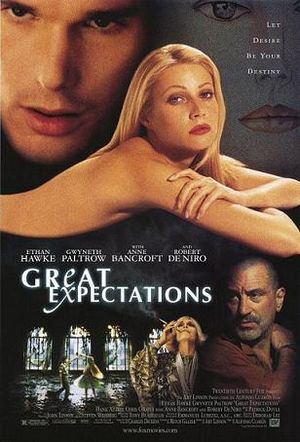
Great Expectations (1998 film)

Lately, I have been thinking a lot about the word ‘right’ in my life. In my professional life, I am a thought leader in the internet marketing space. I have strong opinions about ‘right’ and ‘wrong’ when it comes to strategy, tactics and tools. I am learning lately that being right or thinking I am right can lead to disastrous consequences…

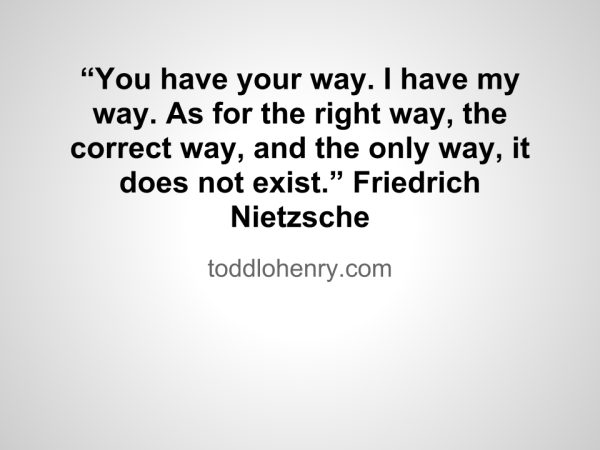
I have found fertile thinking in this quote from Nietzsche; “You have your way. I have my way. As for the right way, the correct way, and the only way, it does not exist.” When I think I am right, I think I HAVE rights and expectations. I think I know, however, that there is only one place disappointment comes from; false expectations…

Ponder this:

“There are/can be many disapointments in life and sometimes they can’t be avoided. Living up to what we expect is a big one. Whether it be in someone else or in ourselves. Our expectations can be “too high” unreasonable or unrealistic. No one is perfect nor can they be in this crazy world.

Sometimes we expect more from a person than they are able to give..at a particular time. Sometimes we expect a person to do more than they are capable of doing, or to be more than they are capable of being. Therefore we are the ones who wind up getting frustrated, angry, hurt, impatient and disapointed. We are the ones effected by our own actions. We are the ones who set ourselves up for disapointments.

Sometimes our approach can be critical, overbearing and destructive. Even when we simply suggest something or give an opinion it does’nt go over well. It can be viewed as an attack on ones charactor even tho that was not the intention. This should never be taken personally because we all have things we are trying to cope with from our past and present situations and we shut down.

Even when we simply try to point something out to someone they can go into the defend mode, protective mode because they are not ready to deal with “the problem” yet. They are still battling with it therefore they are consumed by it and it has power over their well being. Everyone needs to be comfortable in their own skin. Like no body states in one of my comments below..it must be the right message, from the right source, at the right time, by the right person (edified properly) or it will not be received in the way it was intended to be received. Otherwise it can be misinterpreted.

Our expectations, opinions and suggestions can sometimes be veiwed as attacks on self worth and competency. Therefore conflict, separation and alienation occures and the door is shut on communication. Then our relationships are compromised. I watched Charles Stanley‘s program last Sunday and he ministered on how “Words” can have a profound, everlasting effect on us and our well being, our growth and our lives. They can have a tremendous effect and sometimes we say things we later regret.

No one can live up to anyone’s” standards. It’s not that what everyone is doing is right or that we don’t have a big heart in wanting whats best for them, it’s just that our expectations may be overwelming.

A lot of people feel like failures because they can’t live up to the expectations they put on themselves or that others put on them. We can make others feel like failures because of our expections being “To high”> Expecting too much. Too much attention can be put on expectations and not on acheivements/accomplishments.” via Expectations.

Thinking I have rights as a husband leads me to expectations and the expectations lead to disappointment and frustration. Somehow, focusing on being friends with my wife is making a radical difference in my life and happiness has come from leaving ‘right’ behind…

I heard Dr. Phil say “would you rather be happy or right”. I choose happy and as for right? It really doesn’t exist according to Nietszche and only leads to sad for me. What do you think about this?

I just concluded my ‘lunch and learn’ series on information and content management at The Docking Station in Green Bay, WI today. The first two classes were shot via video camera and unfortunately you can’t see the screen but you can hear the narrative. The last class was captured using a Google+ hangout and I’ll be using that from now on. Questions? Feedback?

This is [almost] everything I think I know about the topic with a couple of bonus videos thrown in at the beginning…

…featuring a tool called Gist and you can see it here over the internet!

Here’s a brief outline of my intro:

This event is hosted by my friend Dana VanDen Heuvel at The Docking Station in Green Bay, however, thanks to the new functionality in Google+ of being able to broadcast a hangout over the air in YouTube, I’ll be broadcasting and recording the event in this post at Noon CDT. You can either watch it here or join more directly by connecting with toddlohenry@gmail.com in Google+…

Here is the Google+ Hangout video from the event:

The right way

"You have your way. I have my way. As for the right way, the correct way, and the only way, it does not exist." Friedrich Nietzsche

Fight Fair!

“A constructive complaint looks like this: You calmly ask him not to leave his things flung around the house, not because he’s a big slob (although that may be so) but because neatness is important to you. You “own” the problem (“I’m just not comfortable when you leave your briefcase and coat on the living room couch”) and appreciate that there are other women in the world who would be happy living with someone who didn’t pick up after himself. You mention the attacks you made earlier, at a time of frustration and you apologize for them.

At a relaxed time, you invite a conversation (“Can we make a rule about where briefcases and coats are kept?”) and figure out how to compromise on your different styles. You appreciate that change occurs slowly, in fits and starts, so you praise him for moves in the right direction. After all, you couldn’t transform yourself into a person comfortable with clutter overnight. You might even conclude that it would be simpler to sweep through the house twice a day and dump all his belongings on his big armchair until he decides what to do with them, if anything.

Constructive criticism asks for a specific behavioral adjustment that honors the other person’s capacity to change. It focuses on actions, not character judgments. The “lightly served” part is especially important if you’re talking to someone who responds poorly to anger or intensity in your voice.

People can say very difficult things if they calmly present the facts with no edge in their voice. And silliness helps enormously, as when my son’s wife threatened to charge him rent if he kept putting his clothes on her desk.” via Fight Fair! | Psychology Today.

Ever heard of ‘non violent communication‘? My wife and I have been using it as a tool for over a year. It’s simple, but it’s not easy — it is, however, effective. In NVC, there are 4 components. When I have an issue I talk about:

  • What I see
  • The story that I tell myself about what I see
  • How it makes me feel [mad, sad, glad, hurt]
  • What I would like to see instead

How your partner responds is their responsibility but if you use this tactic, you will have expressed yourself in a non-violent, non shaming, non blaming way and you might actually get heard. Oh and btw, I’ve found that it works even better if you keep the decibels down…

My beautiful wife in Italy…

Start a Blog at WordPress.com.

Up ↑