Emotional Intelligence – Why Your EQ Is More Important Than Your IQ

Good post on the topic!

IQ hasn’t been found to be a good predictor of success in life or in business. In fact higher IQ tends to be counter-intuitive to achieving such success. A better predictor of success is Emotional Intelligence or EQ (one’s emotional quotient). Although under-recognized, it plays a pervasive role in our everyday interactive life.

As social animals, humans’ emotions significantly impact our relationships, the very substance of our society. On an individual level, the ability to recognize our own emotions, to distinguish and control them, and to recognize and empathize with the emotions of others are the cornerstones of emotional intelligence. Individuals vary considerably in their abilities on these rather distinct measures, typically being stronger in one or two than in the others.

Identifying opportunities for improvement in emotional intelligence opens a pathway to improved relationships and greater success. Education to sharpen the skills involved in emotional intelligence via books, videos, and life coaching, as well as interpersonal practice offers promise for growth to every person who wants to increase their EQ and their success in business and personal relationships.

via Emotional Intelligence – Why Your EQ Is More Important Than Your IQ | Restore My Brain.

The best of @toddlohenry for 10/16/2012

  1. The way that I say it is that without self-acceptance your spiritual path is spiritual entertainment at best. I mean you might as well watch a movie and just observe someone else going through a transformation. It’s so true. I’ve spent a lot of my life trying to “change” or “fix” myself. And what I’ve concretely come to understand is that The Path is not so much about changing or fixing ourselves as it is accepting ourselves. Acceptance of who you REALLY are is the beginning of a brand new life. And not who you are on a personality level. Who you are on a SOUL level. That is to say – you are a Divine child of The Uni-verse, and when you accept that – you claim your Divine birthright, everything changes. This doesn’t mean your life will be showered in riches, but it does mean that you will begin to live a path that is in alignment with your highest creative potential.
  2. “Everything you want is out there waiting for you to ask. Everything you want also wants you. But you have to take action to get it.”  – Jack Canfield
  3. Todd’s tweets…

  4. e1evation
    The Todd Tracker is out! http://bit.ly/xwdjH1 ▸ Top stories today via @e1evation @toddlohenry
  5. toddlohenry
    Was out cycling 10.09 miles with #Endomondo. See it here: http://bit.ly/V57n9K
  6. toddlohenry
    Just saw this on Amazon: 11 Rules for Creating Value in the Social Era by Nilofer Merchant for $3.03 http://amzn.to/QNKelQ via @amazon
  7. HardenKurt
    RT @gurnick: The Best “I’m With Stupid” Sign Ever http://wp.me/p2aO5-8c6 via @wordpressdotcom
  8. toddlohenry
    The Greatist Table: 5 Healthy Avocado Recipes from Around the Web http://bit.ly/P5t6fo
  9. toddlohenry
    First-Person Footage From Felix Baumgartner’s Edge-Of-Space Skydive | TechCrunch http://twy.la/V2AjPH
  10. toddlohenry
    Felix Baumgartner Skydives From Inner Space Back to Earth (VIDEO) http://bit.ly/QJekXI
  11. toddlohenry
    What Truly Drives Us? « What I see, what I feel, what I’d like to see… http://twy.la/P53ajR
  12. Business tweets…

  13. e1evation
    .@YouTube, @GuyKawasaki, @nilofer, @jackiedumaine, and @danavan, you’re my top influencers on @klout! Who influences you? http://bit.…
  14. e1evation
    The Todd Tracker is out! http://bit.ly/xwdjH1 ▸ Top stories today via @e1evation @toddlohenry
  15. e1evation
    Just saw this on Amazon: 11 Rules for Creating Value in the Social Era by Nilofer Merchant for $3.03 http://amzn.to/QNKelQ via @amazon
  16. rontite
    @margaretatwood I worked w @e1evation who did a complete redesign (virtually), integrated some widgets, and provides on-going tutorials. Gr8
  17. e1evation
    Democrat says Congress will slap the FTC if it dares to sue Google http://bit.ly/V2dV9a
  18. e1evation
    How and When Should Your Nonprofit Organization Invest in Mobile http://bit.ly/QJm77S
  19. e1evation
    Career tip: Authentic self-promotion | SmartBlogs SmartBlogs http://twy.la/R1cYtT @nilofer rt?
  20. e1evation
    New Gmail Android update will at last provide pinch-to-zoom capabilities http://bit.ly/PuMG4G
  21. e1evation
    Making Facebook Marketing as Easy as One, Two, Free http://bit.ly/V1SaWY
  22. e1evation
    What Is on Your Business Website That Shouldn’t Be? http://bit.ly/QIKMJX
  23. e1evation
    How Self-Employed Bloggers and Online Marketers Should Schedule their Time | Social Media Today http://twy.la/RtOXJ1
  24. e1evation
    Windows 8 reportedly getting ‘overwhelmingly negative’ response from vendors http://bit.ly/P4VaPO
  25. e1evation
    Apple’s new iPod touch takes a step back: No light sensor http://bit.ly/RM6i0A

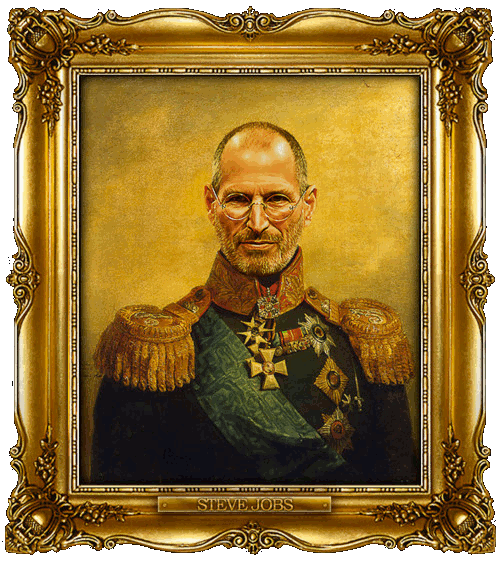
Steve Jobs: Guru and Goon

Relly Nadler, M.C.C., writes:

Steve Jobs has been a fascinating case study in this blog for leadership because he was a phenomenal innovator and marketer, while demonstrating a dark side that could demonize people. This is the last entry to explore his leadership conundrum.

Newsweek this week named Jobs a top Evangelists and stated “equal parts businessman and poet he envisioned what technology could be –and then delivered it with magnificent products.” He was also vicious, arrogant, stubborn, blind to others feelings and prone to temper tantrums.  He was a star in some Emotional Intelligence competencies, while devastated others on the way to success. How do we make sense of these opposite attributes?  As leaders what do we emulate and what do we eliminate from our leadership behaviors?

In the last blog we continued to look at the DSM IV criteria for Narcissistic Personality Disorder for Steve Jobs as it helps us understand the two sides of Steve Jobs, his motivations and personality. This is exploratory in nature only and educational and not deemed to give him a clinical diagnosis, as he would have to be a client and interviewed personally. Many of these back stories come from Walter Isaacson’s book Steve Jobs. This exploration can help you if you see yourself in any of these descriptions and determine which ones to tune down.

In the DSM IV, the manual that helps diagnose mental disorders, you need 5 of the 9 criteria to meet the diagnosis. It looks like Jobs clearly fits 6 of the 9. We looked at three in the last blog. Two in the second blog on Jobs and here we will explore the last four.” Get the answer here: Jobs: Guru and Goon | Psychology Today.”

Nadler concludes:

“Yes Jobs was one of the most influential people of this century and his Narcissism was driving force for his vision, perfection and success. He is a leadership conundrum for what to emulate and eliminate, which will be studied in MBA and leadership programs for years to come. These last blogs can help deconstruct his complicated nature as we move onto to new leading with Emotional Intelligence topics.

For a summary of What to Emulate and Eliminate from Jobs, go to the blog at www.truenorthleadership.com.”

Relly Nadler

Nadler’s article makes for interesting reading; I suggest you go to the source to get the context of his thoughts…

By the way,  I still think the best post-Jobs retrospective I’ve read was done by Harvard Business Review writer, author [and client] Nilofer Merchant who wrote:

“Certainly, we need inspiration to show us examples of clear purpose. But I wonder what happens in a world where we each figure out why we do what we do and we can live and work from that place. We might refocus on our own work and the community with which we get that work done. We might learn to define success in our own terms. We might even come up with our own mantra around this:

  • I shall not obsess over others’ success: not copying, idolizing, or mindlessly emulating.
  • I shall know my purpose and know why I’m doing something.
  • I shall ally myself to a tribe with a common purpose, though the tribe’s members may work in vastly different fields and forms.
  • I will make ideas stronger by uniting with others to do great work, not by holding my ideas all to myself but releasing them into the wild.
  • I recognize the truth in the credo that the future is not created, the future is co-created and will do my part as a part of the whole.

In doing so, we might go from a culture of find-a-fits-the-mold superhero to a system of heroes- and heroines-next-door. We might create, rather than copy. We might initiate, rather than wait for permission. We might see ourselves as powerful enough. We might not believe that solving the many problems around us is someone else’s responsibility. We might each be willing to disrupt ourselves as Whitney Johnson suggests we do. We might reimagine our careers, with clarity of purpose, and this might show up in our work with others. We might just transform the organizing principles of the places we work. We might even end up reinventing our economy. We might recognize just how connected we are.

For my own situation when I was a kid, once I realized there was no hero coming to save me, I found ways to manage the situation. I said “enough” to what was going on. I also started to claim the things that mattered, like an education.  As a result, I was ousted from my family — but I also started developing the sense of purpose that has led me to the work I do today and the people I do it with.

The cultural change when people know their own purpose and their own power in creating change is what could change everything: for ourselves, for our organizations, and our economy. So, go ahead and buy that Walter Isaacson book. But, let’s not obsess over being the next Steve Jobs or starting the next Facebook or [whatever]. Let us, instead, be inspired to find our own purpose in the world, and a tribe of people to do it with.” Be Your Own Hero | Yes & Know“.

What say you?

Executive Coaching for Leadership Bad Behaviors: Habits That Hold You Back | Working Resources Blog

“When there are conflicts in the workplace it is usually because of poor communication or interpersonal communication challenges. Leaders are challenged on a daily basis to interact effectively with others. The most successful leaders are emotionally intelligent agile. They know how to read people and are savvy in their communications.

In my executive coaching practice over the last twenty years, I have noticed a consistent pattern of bad behaviors displayed by less socially intelligent leaders. These ‘bad behaviors’ can be unlearned and a more effective communication style developed.

The good news is that better interpersonal skills can be learned and emotional intelligence improved.” Click the title to read more…

Start a Blog at WordPress.com.

Up ↑