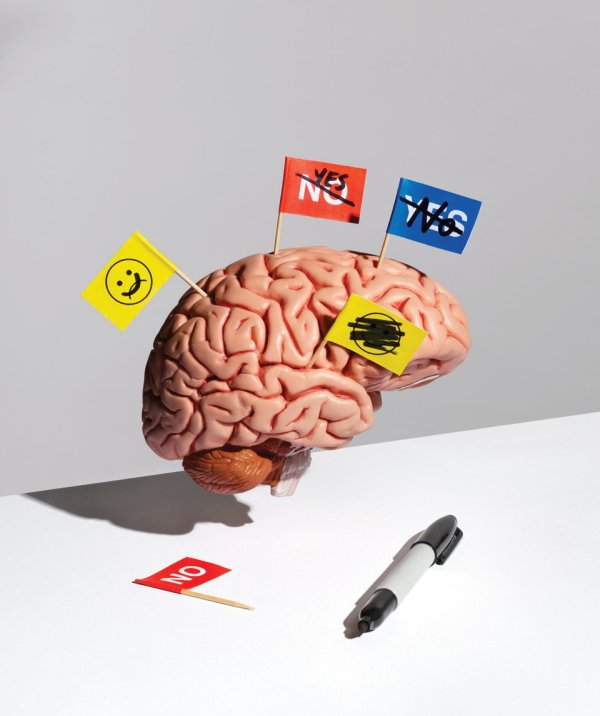
Brain Hacking


You aren’t at the mercy of your emotions – your brain creates them

Take a nap to sharpen your brain, suggests new science

New science supports your desire to take an afternoon nap!

A new study finds that naps bring cognitive benefits: Take a nap to sharpen your brain, suggests new science

Dr. Helen Fisher on How Brain Chemistry Determines Personality and Politics

I skim, you skim, we’re all skimmers in a digital world. But it’s altered our brains!

A neuroscientist conducted an experiment on herself to see whether technology was eroding her ability to read a book. It didn’t end well: Robert Fulford: I skim, you skim, we’re all skimmers in a digital world. But it’s altered our brains

Your Brain Is Constantly Searching for Problems to Fix

https://video-images.vice.com/articles/5b3e4f77d21612000670c1fd/lede/1530814309694-stocksy_txp607871d0zg0200_medium_1046450.jpeg?crop=1xw:0.8439935064935065xh%3bcenter%2ccenter&resize=1200:%2a

Your Brain Is Constantly Searching for Problems to Fix

When something becomes rare, we tend to see it in places more than ever. Source: https://tonic.vice.com/en_us/article/qvmdkw/your-brain-is-constantly-searching-for-problems-to-fix

https://platform.twitter.com/widgets.js

https://platform.twitter.com/widgets.js

How the mindful brain copes with rejection

Whether it’s being left out of happy hour plans or being broken up with by a significant other, we can all relate to the pain of social rejection. Such “social pain” is consequential, undermining our physical and mental health. But how can we effectively cope with the distressing experience of being left out or ignored? Mindfulness may be an answer: How the mindful brain copes with rejection | OUPblog

https://platform.twitter.com/widgets.js

https://platform.twitter.com/widgets.js

The brain in love

How Your Brain Falls In Love

For centuries poets and philosophers have speculated what causes two people to fall in love. Now, Biologist Dawn Maslar M.S. puts an innovative twist on this age-old question. Science can now take the mystery out of love. Thanks to latest neuroscience we can finally explain how your brain falls in love.

In this innovative twist on this age-old question, Maslar explores the latest neuroscience and explains how your brain falls in love.

The Break-Up: Human Brain Hardwired To Fall Out Of Love And Move On To New Relationships

Falling in love is the easy part, while getting over the breakup is the hard part. The emphasis on monogamy and finding “the one” makes the quest for love an emotional rollercoaster with ups and downs that we may actually be programmed for. According to a recent review published in the journal Review of General Psychology, just like the brain is hardwired to fall in love, it also has a mechanism that helps us fall out of love and move along: The Break-Up: Human Brain Hardwired To Fall Out Of Love And Move On To New Relationships

Cognitive Biases and the Human Brain

Ben Yagoda writes “I am staring at a photograph of myself that shows me 20 years older than I am now. I have not stepped into the twilight zone. Rather, I am trying to rid myself of some measure of my present bias, which is the tendency people have, when considering a trade-off between two future moments, to more heavily weight the one closer to the present. A great many academic studies have shown this bias—also known as hyperbolic discounting—to be robust and persistent.” Source: https://www.theatlantic.com/magazine/archive/2018/09/cognitive-bias/565775/?utm_source=pocket&utm_medium=email&utm_campaign=pockethits


giphy.gif?cid=f19dbcb55b6e2b317039722f515e2831
via GIPHY

It’s a familiar problem: "Sitting in front of a computer not long ago, a tenured history professor faced a challenge that billions of us do every day: deciding whether to believe something on the Internet.

On his screen was an article published by a group called the American College of Pediatricians that discussed how to handle bullying in schools. Among the advice it offered: schools shouldn’t highlight particular groups targeted by bullying because doing so might call attention to “temporarily confused adolescents.”

Scanning the site, the professor took note of the “.org” web address and a list of academic-looking citations. The site’s sober design, devoid of flashy, autoplaying videos, lent it credibility, he thought. After five minutes, he had found little reason to doubt the article. “I’m clearly looking at an official site,” he said." Go to the source for more: http://time.com/5362183/the-real-fake-news-crisis/

The Compassionate Brain

Dr. Rick Hanson presents a FREE eight-part video series—The Compassionate Brain—that explores effective ways to change your brain and heart and life.

In each interview, Dr. Hanson is joined by a world-class scholar/teacher, including Richie Davidson, Dan Siegel, Tara Brach, Dacher Keltner, Kelly McGonigal, Kristin Neff, and Jean Houston. They discuss different ways to use the power of neuroplasticity—how the mind can change the brain to transform the mind—to open the heart, build courage, find compassion, forgive oneself and others, and heal the world. Enroll here: The Compassionate Brain

Buddha’s Brain: The Practical Neuroscience of Happiness, Love and Wisdom

https://platform.twitter.com/widgets.js

https://platform.twitter.com/widgets.js

This Is Your Brain On Ads: How Media Companies Hijack Your Attention

How many ads have you encountered today? On this week’s radio show, we discuss the insidiousness of advertising in American media: This Is Your Brain On Ads: How Media Companies Hijack Your Attention

Start a Blog at WordPress.com.

Up ↑