I’m a big fan of James Altucher. I have not been a big fan of Louis CK. James Altucher, however, is. So because Altucher writes about Louis CK, I ‘evaluate’ Louis again. That’s what a trusted relationship does. Altucher writes:
“Laughter has been around since before language. Mammals would use laughter to convey that a situation that they first thought was dangerous, turned out not to be.
That rustle in the bushes? It was just a breeze. Not a lion.
He points it out. The contradictions in every day life. The contradictions I see in my life. The things that we’re uncomfortable about.
Guess what? We don’t have to be.
Here are some of his thoughts. And below are some of my interpretations.” Get the rest of the article here: The Tao of Louis CK.
Here’s a Louis CK bit on his daughter. Definitely NSFW! You were warned…
I have become lazy and sloppy on this blog — posting pithy memes instead of writing what they mean to me — so this post is really something outstanding if only because it’s the first post in ages where I’ve written more than 7 words. :-D
I believe that yesterday was a great day for all Americans, regardless of their sexual orientation. Years ago, however, I would have been apoplectic and spewing hatred and ranting about how yesterday’s Supreme Court decision signalled the death of America, blah, blah, blah. What changed? I did. Why? A simple thought rocked my world:
Who am I to judge? No one. I am not worthy!
Here’s a bit of a backstory: I have spent a big part of my life on ‘the right’; the political right [for two years, I was the 3rd Vice Chairman of the Republican Party and consulted with the RNC] and the religious right [I am a recovering Shiite evangelical fundamentalist].
Oh, yeah! I was in deep…
The irony of it all is that while I was obsessed with being RIGHT on the outside I was so wrong on the inside. My binary [true/false, black/white] orientation meant that I didn’t really need to THINK about a lot of things including the idea that all beings deserve happiness regardless of whether we agree on issues like with whom we want to cuddle up on a cold Wisconsin night.
Fundamental to my growth path or dharma over the past few years is a wonderful teacher named Tara Brach who introduced me to the idea of metta, or lovingkindness, practice. When you pray this:
May all beings have happiness and the causes of happiness;
May all be free from sorrow and the causes of sorrow;
May all never be separated from the sacred happiness which is sorrowless;
And may all live in equanimity, without too much attachment and too much aversion,
And live believing in the equality of all that lives.
…it is difficult to deny any being what they consider happiness regardless of what they believe or their ‘orientation’ on any one of a number of issues. May all beings have happiness and the causes of happiness…
It’s not that I don’t care anymore — it’s that I care more deeply than I ever did about all beings and not so much the issues themselves. The reason I celebrate the decision is because I am ok with it when only 5 years ago I would have been beside myself with anger and fear and I feel that I am a better person now than I was then. May all beings have happiness and the causes of happiness…
One of the many people I want to thank for the part they have played in my conversion is a beautiful man named Michael Rohrer who blogs in a raw, powerful, and transparent way about the struggles of being a gay man who comes from a religious background. I don’t know how I first came across his work but I’m grateful I did. Through his writing he has opened my eyes and heart to the idea we are all on the same journey even if we follow different paths and I cherish the friendship that has developed via Twitter and Facebook! I don’t agree with everything that Michael posts but I will defend to the death his right to post it and he opens my mind. May all beings have happiness and the causes of happiness…
Today I celebrate not only the Supreme Court decision but also the joy of having an open mind and how much nicer it is than needing to be RIGHT all the time! May all beings have happiness and the causes of happiness…
There’s so much good in this app that it’s hard to know where to start. Be My Eyes connects blind people who need assistance with sighted volunteers who want to help out via a direct video connection. Blind people get help navigating the world around them, sighted people get a helper’s high, and technology is used for a perfectly positive purpose.
Currently available for iPhone and coming soon for Android, the app can be used in a variety of situations – for example a blind person might need help checking the expiration date on a milk carton, or making their way around new surroundings. They enter a request for assistance and the volunteer gets a notification that the blind person could use some help. In an easy and informal interaction, the blind person films what they need assistance with, and the helper describes what they see – and together they work to solve the problem.
There are currently over 90,000 sighted volunteers active on Be My Eyes, and some 7,000 blind people using the app. On top of the joy of lending a hand to a stranger in need, the system is gamified, so volunteers earn points and advance levels – while making a real difference in people’s lives.
See the wonder of Be My Eyes in action in this short video:
I believe so. Psychologist Alice Boyes recently shared this thought on Psychology Today:
No one needs a research study to know that mainstream news generally consists of reporting negative events. For example, the nightly news or morning paper will tell you about a train that derailed but not the thousands of trains that didn’t.
Especially if you’re prone to anxiety, watching or reading mainstream news can be fear and anxiety inducing. Why does this matter? When the world seems dangerous, people are less likely to get out there and live their lives in interesting ways.
What’s an alternative? The alternative is to find media and other sources of information that are inspiring and give you a sense of general safety, optimism and abundant opportunity.
Here’s some ways to improve your information diet…
Not only can Feedly make you more smarter and more productive, if you use it to ‘accentuate the positive and eliminate the negative’ it can also help improve your state of mind!
The benefits are clear. Here are some thoughts on how to do it.
“Do not dwell in the past, do not dream of the future, concentrate the mind on the present moment.” Buddha
There is only one time and place where you can be and have any control over.
The present moment.
But most of us still spend a lot of our regular days lost in memories, reliving a sunny vacation or maybe more commonly repeating an old conflict or negative situation over and over in our thoughts.
Or we get lost in scenarios about what could happen in the future. Maybe through wishful daydreams. Or maybe by building monsters in our minds as thoughts go round and and round and create scary and dangerous mountains out of molehills or just air.
Or your thoughts may become split and unfocused between several different things and tasks.
If you spend a lot of your everyday moments and time in the future or the past or you have difficulty focusing and you feel this may have a negative effect on your life then maybe you want to learn to live more in the present moment.
Here’s what works for me to do that. Just a few simple things that I use in my normal day.
Like to read? You should. Here’s another reason why…
It’s no secret that reading is good for you. Just six minutes of reading is enough to reduce stress by 68%, and numerous studies have shown that reading keeps your brain functioning effectively as you age. One study even found that elderly individuals who read regularly are 2.5 times less likely to develop Alzheimer’s than their peers. But not all forms of reading are created equal.
The debate between paper books and e-readers has been vicious since the first Kindle came out in 2007. Most arguments have been about the sentimental versus the practical, between people who prefer how paper pages feel in their hands and people who argue for the practicality of e-readers. But now science has weighed in, and the studies are on the side of paper books.
Reading in print helps with comprehension.
A 2014 study found that readers of a short mystery story on a Kindle were significantly worse at remembering the order of events than those who read the same story in paperback. Lead researcher Anne Mangen of Norway’s Stavanger University concluded that “the haptic and tactile feedback of a Kindle does not provide the same support for mental reconstruction of a story as a print pocket book does.”
My friends, love is better than anger. Hope is better than fear. Optimism is better than despair. So let us be loving, hopeful and optimistic. And we’ll change the world.
In fact, those of us who routinely use anger as a “cover-up” to keep our more vulnerable feelings at bay, generally become so adept at doing so that we have little to no awareness of the dynamic driving our behavior. As I’ve discussed in earlier posts on the subject, anger is the emotion of invulnerability. Even though the self-empowerment (read, “adrenaline rush”) it immediately offers is bogus, it can yet be extremely tempting to get “attached”—or even “addicted”—to it if we frequently experience another as threatening the way we need to see ourselves (e.g., as important, trustworthy, lovable, etc.). After all, this is how all psychological defenses work. Simply put, they allow us to escape upsetting, shameful, or anxiety-laden feelings we may not have developed the emotional resources—or ego strength—to successfully cope with. So, for example, say your partner (whether intentionally or not) expresses something that leads you to feel demeaned. Rather than, assertively, sharing your hurt feelings, and risk making yourself more vulnerable to them, you may react instead by finding something to attack them for. It could be as petty as their forgetting to put something away, or not having gotten back to you on scheduling an event, or a past mistake that compromised the family budget—in short, anything! In such instances, what you’re basically doing (though it’s most likely unconscious) is endeavoring to make them feel demeaned, to hurt their feelings—or rather, hurt them back. It’s an undeclared, largely unrecognized, game of tit for tat. And while you’re engaged in such retaliatory pursuits, guess what? Presto! You’re no longer feeling demeaned—at least not in the moment. . . . Which, sadly, reinforces this essentially childish behavior (as in, “You’re the one who’s bad!”). Go to the source for more: Anger—How We Transfer Feelings of Guilt, Hurt, and Fear | Psychology Today
We have emotions for a reason. Anger in response to injustice can signal that the situation needs to change; sadness in response to loss can signal that we’d like to keep the people we love in our lives.
It’s when we ruminate, or get caught up in our emotions, that they might become maladaptive. That’s when emotion regulation can be helpful and healthy.
Previous research has shown that mindfulness can be an effective tool to help regulate our emotions. But why? A new model suggests that the ability to control one’s behavior—a concept that researchers call executive control—may play a role.
In a recent paper published in Current Directions in Psychological Science, researcher Rimma Teper and her colleagues at the University of Toronto write that, despite the common misconception that meditation “empties our head” of emotions, mindfulness actually helps us become more aware and accepting of emotional signals—which helps us to control our behavior.
I talked with Rimma Teper about how mindfulness relates to emotion regulation, and how executive control fits into the picture.
Such a great reminder for me! If you like the quote, go to the source and enjoy the whole article…
Most importantly, remember that expectations are in fact premeditated disappointments. In other words, no expectations, no anger — reduce your expectations, increase the peace between you. Managing your expectations together is rarely easy, but it’s that simple!
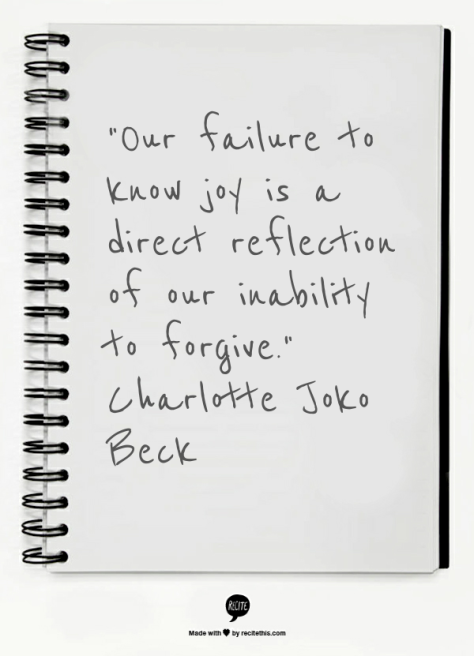
Anger is an intelligent emotion, a natural part of our evolutionary design that lets us know when we are endangered or impeded in our progress. But when it locks into ongoing resentment and blame, our heart becomes armored and we lose access to a wholeness of being. This talk explores forgiving as a process of relaxing our armoring and awakening a healing compassion for ourselves and others.











 Bright, shiny objects!
You must be logged in to post a comment.