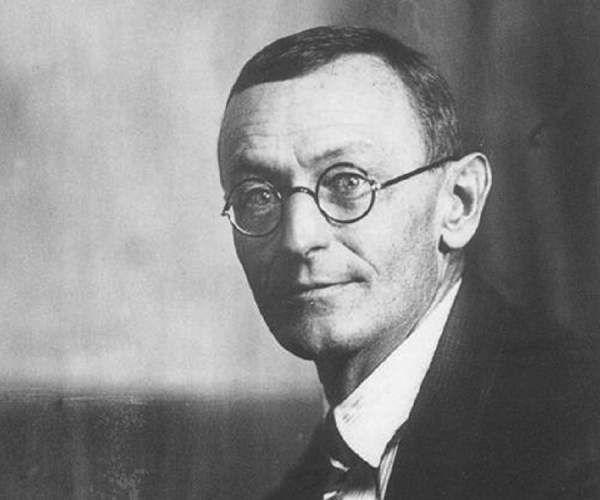
In Steppenwolf, Hermann Hesse wrote the following about Harry Haller’s experience in the Magic Theatre and it seems to me at once to be one of the most amazing fantasies in all of literature:
“ALL WOMEN ARE YOURS and it seemed to me, all in all, that there was really nothing else so desirable as this. I was greatly cheered at finding that I could escape from that cursed wolf world, and went in.
The fragrance of spring-time met me. The very atmosphere of boyhood and youth, so deeply familiar and yet so legendary, was around me and in my veins flowed the blood of those days. All that I had done and thought and been since, fell away from me and I was young again. An hour, a few minutes before, I had prided myself on knowing what love was and desire and longing, but it had been the love and the longing of an old man. Now I was young again and this glowing current of fire that I felt in me, this mighty impulse, this unloosening passion like that wind in March that brings the thaw, was young and new and genuine. How the flame that I had forgotten leaped up again, how darkly stole on my ears the tones of long ago! My blood was on fire, and blossomed forth as my soul cried aloud and sang. I was a boy of fifteen or sixteen with my head full of Latin and Greek and poetry. I was all ardor and ambition and my fancy was laden with the artist’s dreams. But far deeper and stronger and more awful than all there burned and leaped in me the flame of love, the hunger of sex, the fever and the foreboding of desire.
I was standing on a spur of the hills above the little town where I lived. The wind wafted the smell of spring and violets through my long hair. Below in the town I saw the gleam of the river and the windows of my home, and all that I saw and heard and smelled overwhelmed me, as fresh and reeling from creation, as radiant in depth of color, swayed by the wind of spring in as magical a transfiguration, as when once I looked on the world with the eyes of youth–first youth and poetry. With wandering hand I pulled a half-opened leaf bud from a bush that was newly green. I looked at it and smelled it (with the smell everything of those days came back in a glow) and then I put it between my lips, lips that no girl had ever kissed, and began playfully to bite it. At the sour and aromatically bitter taste I knew at once and exactly what it was that I was living over again. It all came back. I was living again an hour of the last years of my boyhood, a Sunday afternoon in early spring, the day that on a lonely walk I met Rosa Kreisler and greeted her so shyly and fell in love with her so madly.
Read more: All women are yours
She came, that day, alone and dreamingly up the hill towards me. She had not seen me and the sight of her approaching filled me with apprehension and suspense. I saw her hair, tied in two thick plaits, with loose strands on either side, her cheeks blown by the wind. I saw for the first time in my life how beautiful she was, and how beautiful and dreamlike the play of the wind in her delicate hair, how beautiful and provocative the fall of her thin blue dress over her young limbs; and just as the bitter spice of the chewed bud coursed through me with the whole dread pleasure and pain of spring, so the sight of the girl filled me with the whole deadly foreboding of love, the foreboding of woman. In that moment was contained the shock and the forewarning of enormous possibilities and promises, nameless delight, unthinkable bewilderments, anguish, suffering, release to the innermost and deepest guilt. Oh, how sharp was the bitter taste of spring on my tongue! And how the wind streamed playfully through the loose hair beside her rosy cheeks! She was close now. She looked up and recognized me. For a moment she blushed a little and looked aside; but when I took off my school cap, she was self-possessed at once and, raising her head, returned my greeting with a smile that was quite grown-up. Then, entirely mistress of the situation, she went slowly on, in a halo of the thousand wishes, hopes and adorations that I sent after her.
So it had once been on a Sunday thirty-five years before, and all that had been then came back to me in this moment. Hill and town, March wind and buddy taste, Rosa and her brown hair, the welling-up of desire and the sweet suffocation of anguish. All was as it was then, and it seemed to me that I had never in my life loved as I loved Rosa that day. But this time it was given me to greet her otherwise than on that occasion. I saw her blush when she recognized me, and the pains she took to conceal it, and I knew at once that she had a liking for me and that this encounter meant the same for her as for me. And this time instead of standing ceremoniously cap in hand till she had gone by, I did, in spite of anguish bordering on obsession, what my blood bade me do. I cried: “Rosa! Thank God, you’ve come, you beautiful, beautiful girl. I love you so dearly.” It was not perhaps the most brilliant of all the things that might have been said at this moment, but there was no need for brilliance, and it was enough and more. Rosa did not put on her grown-up air, and she did not go on. She stopped and looked at me and, growing even redder than before, she said: “Heaven be praised, Harry–do you really like me?” Her brown eyes lit up her strong face, and they showed me that my past life and loves had all been false and perplexed and full of stupid unhappiness from that very moment on a Sunday afternoon when I had let Rosa pass me by. Now, however, the blunder was put right. Everything went differently and everything was good.
We clasped hands, and hand in hand walked slowly on as happy as we were embarrassed. We did not know what to do or to say, so we began to walk faster from embarrassment and then broke into a run, and ran till we lost our breath and had to stand still. But we did not let go our hands. We were both still children and did not know quite what to do with each other. That Sunday we did not even kiss, but we were immeasurably happy. We stood to get our breath. We sat on the grass and I stroked her hand while she passed the other one shyly over my hair. And then we got up again and tried to measure which of us was the taller. In reality, I was the taller by a finger’s breath, but I would not have it so. I maintained that we were of exactly the same height and that God had designed us for each other and that later on we would marry. Then Rosa said that she smelled violets and we knelt in the short spring grass and looked for them and found a few with short stalks and I gave her mine and she gave me hers, and as it was getting chill and the sun slanted low over the cliffs, Rosa said she must go home. At this we both became very sad, for I dared not accompany her. But now we shared a secret and it was our dearest possession. I stayed behind on the cliffs and lying down with my face over the edge of the sheer descent, I looked down over the town and watched for her sweet little figure to appear far below and saw it pass the spring and over the bridge. And now I knew that she had reached her home and was going from room to room, and I lay up there far away from her; but there was a bond between her and me. The same current ran in both of us and a secret passed to and fro.
We saw each other again here and there all through this spring, sometimes on the cliffs, sometimes over the garden hedge; and when the elder began to bloom we gave each other the first shy kiss. It was little that children like us had to give each other and our kiss lacked warmth and fullness. I scarcely ventured to touch the strands of her hair about her ears. But all the love and all the joy that was in us were ours. It was a shy emotion and the troth we plighted was still unripe, but this timid waiting on each other taught us a new happiness. We climbed one little step up on the ladder of love. And thus, beginning from Rosa and the violets, I lived again through all the loves of my life–but under happier stars. Rosa I lost, and Irmgard appeared; and the sun was warmer and the stars less steady, but Irmgard no more than Rosa was mine. Step by step I had to climb. There was much to live through and much to learn; and I had to lose Irmgard and Anna too. Every girl that I had once loved in youth, I loved again, but now I was able to inspire each with love. There was something I could give to each, something each could give to me. Wishes, dreams and possibilities that had once had no other life than my own imagination were lived now in reality. They passed before me like beautiful flowers, Ida and Laura and all whom I had loved for a summer, a month, or a day.
I was now, as I perceived, that good-looking and ardent boy whom I had seen making so eagerly for love’s door. I was living a bit of myself only–a bit that in my actual life and being had not been expressed to a tenth or a thousandth part, and I was living it to the full. I was watching it grow unmolested by any other part of me. It was not perturbed by the thinker, nor tortured by the Steppenwolf, nor dwarfed by the poet, the visionary or the moralist. No–I was nothing now but the lover and I breathed no other happiness and no other suffering than love. Irmgard had already taught me to dance and Ida to kiss, and it was Emma first, the most beautiful of them all, who on an autumn evening beneath a swaying elm gave me her brown breasts to kiss and the cup of passion to drink.
I lived through much in Pablo’s little theater and not a thousandth part can be told in words. All the girls I had ever loved were mine. Each gave me what she alone had to give and to each I gave what she alone knew how to take. Much love, much happiness, much indulgence, and much bewilderment, too, and suffering fell to my share. All the love that I had missed in my life bloomed magically in my garden during this hour of dreams. There were chaste and tender blooms, garish ones that blazed, dark ones swiftly fading. There were flaring lust, inward reverie, glowing melancholy, anguished dying, radiant birth. I found women who were only to be taken by storm and those whom it was a joy to woo and win by degrees. Every twilit corner of my life where, if but for a moment, the voice of sex had called me, a woman’s glance kindled me or the gleam of a girl’s white skin allured me, emerged again and all that had been missed was made good. All were mine, each in her own way. The woman with the remarkable dark brown eyes beneath flaxen hair was there. I had stood beside her for a quarter of an hour in the corridor of an express and afterwards she often appeared in my dreams. She did not speak a word, but what she taught me of the art of love was unimaginable, frightful, deathly. And the sleek, still Chinese, from the harbor of Marseilles, with her glassy smile, her smooth dead-black hair and swimming eyes–she too knew undreamed-of things. Each had her secret and the bouquet of her soil. Each kissed and laughed in a fashion of her own, and in her own peculiar way was shameful and in her own peculiar way shameless. They came and went. The stream carried them towards me and washed me up to them and away. I was a child in the stream of sex, at play in the midst of all its charm, its danger and surprise. And it astonished me to find how rich my life–the seemingly so poor and loveless life of the Steppenwolf–had been in the opportunities and allurements of love. I had missed them. I had fled before them. I had stumbled on over them. I had made haste to forget them. But here they all were stored up in their hundreds, and not one missing. And now that I saw them I gave myself up to them without defence and sank down into the rosy twilight of their underworld. Even that seduction to which Pablo had once invited me came again, and other, earlier ones which I had not fully grasped at the time, fantastic games for three or four, caught me up in their dance with a smile. Many things happened and many games, best unmentioned, were played.
When I rose once more to the surface of the unending stream of allurement and vice and entanglement, I was calm and silent. I was equipped, far gone in knowledge, wise, expert–ripe for Hermine. She rose as the last figure in my populous mythology, the last name of an endless series; and at once I came to myself and made an end of this fairy tale of love; for I did not wish to meet her in this twilight of a magic mirror. I belonged to her not just as this one piece in my game of chess–I belonged to her wholly. Oh, I would now so lay out the pieces in my game that all was centered in her and led to fulfillment.
The stream had washed me ashore. Once again I stood in the silent theater passage. What now? I felt for the little figures in my pocket–but already this impulse died away. Around me was the inexhaustible world of doors, notices and magic mirrors. Listlessly I read the first words that caught my eye, and shuddered.”
Hermann Hesse. Steppenwolf (pp. 214-218). Kindle Edition.







 Bright, shiny objects!
You must be logged in to post a comment.