Do What You Cannot Do!

Zen Master Thich Nhat Hanh

“There is no one in the universe more dear to us than ourselves. The mind may travel in a thousand directions, but it will find no one else more beloved. The moment you see how important it is to love yourself, you will stop making others suffer.

Thich Nhat Hanh. via Today’s Quotes: Do What You Cannot Do!.

How To Help A Drunk Driver

Or at least stop it from happening.

via How To Help A Drunk Driver.

Happy 4th of July!

Holy Kaw! via Happy America Day (aka 4th of July)! [infographic].

How to Begin (Anything)

“I’m not ready.”

“I don’t know what I’m doing.”

“What if nobody likes it or I’m not a good writer?”

These questions haunted me for the past several months, as I got up the gumption to finally write my first post for Positively Positive.

Candor, self-disclosure, and transparency are my preferred teaching tools. No need to uphold an idealized version of myself—not helpful for you or me.

Yes, I was nervous to put myself “out there.” Every time I break open and expand, I’m met with self-doubt, fear, insecurity, and a comparing mind.

For my first post, I decided to tackle my self-doubting questions head-on and share some tools I find useful when battling the nasty voice of uncertainty: practical advice meets neuroscience meets spirituality.

Ask yourself: How do you handle the anxiety around a difficult transition and trust the unknown? Do you freeze (procrastination, excuses), run (avoid, deny, lie), or attack (irritable, critical, blame)?” via How to Begin (Anything) « Positively Positive.

Congress votes for independence; This Day in History — 7/2/1776

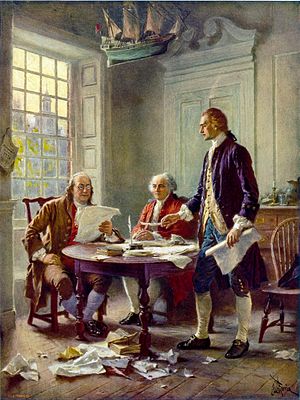
Benjamin Franklin, John Adams and Thomas Jeffe...
Benjamin Franklin, John Adams and Thomas Jefferson writing the Declaration of independence (1776) were all of British descent. (Photo credit: Wikipedia)

On this day in 1776, the Second Continental Congress, assembled in Philadelphia, formally adopts Richard Henry Lee’s resolution for independence from Great Britain. The vote is unanimous, with only New York abstaining.

The resolution had originally been presented to Congress on June 7, but it soon became clear that New York, New Jersey, Pennsylvania, Delaware, Maryland and South Carolina were as yet unwilling to declare independence, though they would likely be ready to vote in favor of a break with England in due course. Thus, Congress agreed to delay the vote on Lees Resolution until July 1. In the intervening period, Congress appointed a committee to draft a formal declaration of independence. Its members were John Adams of Massachusetts, Benjamin Franklin of Pennsylvania, Roger Sherman of Connecticut, Robert R. Livingston of New York and Thomas Jefferson of Virginia. Thomas Jefferson, well-known to be the best writer of the group, was selected to be the primary author of the document, which was presented to Congress for review on June 28, 1776.

On July 1, 1776, debate on the Lee Resolution resumed as planned, with a majority of the delegates favoring the resolution. Congress thought it of the utmost importance that independence be unanimously proclaimed. To ensure this, they delayed the final vote until July 2, when 12 colonial delegations voted in favor of it, with the New York delegates abstaining, unsure of how their constituents would wish them to vote. John Adams wrote that July 2 would be celebrated as the most memorable epoch in the history of America. Instead, the day has been largely forgotten in favor of July 4, when Jeffersons edited Declaration of Independence was adopted.” via Congress votes for independence — History.com This Day in History — 7/2/1776.

Einstein on the Beach, 1939

Words fail me right now. Retronaut. Get more here: Einstein on the Beach, 1939.

Dog Restrainer, 1940

Looks like a tool for rich people who want to own a dog but don’t actually want to touch it. What will they think of next? Source: LIFE Archive via Dog Restrainer, 1940.

Trusting God

T.G. Henderson House, in Lake City, Florida

Yes, even more Melody Beattie!

A married couple, friends of mine, decided to make some changes in their living situation. They had always lived in the city, and now they decided they wanted to live in the country, on a lake.

They found a small, lake home. It wasn’t the house of their dreams, but when they sold their city home, they would have money to remodel it. They had saved some money, so they moved into their lake home before selling their city home.

One year passed, and the city home didn’t sell. My friends went through many changes during this time. They had times of patience and impatience. Some days they trusted God; other days they couldn’t figure out why God was mak­ing them wait so long, why God wouldn’t let them move forward with their plan. The doors just wouldn’t swing wide open.

One day, a neighbor came to visit my friends. His home on the lake was my friends’ dream home — everything they wanted, plus more. The first time my friends saw this house, they admired it, wishing they could have a home just like it, but then they forgot about the idea. They didn’t believe it could ever be possible.

The reason the neighbor came to visit my friends was that he and his wife had decided to move. He offered my friends the first option on purchasing his home.

My friends accepted his offer, and signed a purchase agree­ment. Within two months, they sold their city home and their small but adequate lake home. A short time later, they moved into the home of their dreams.

Sometimes, we experience times of frustration in our life. We believe we’re on track, trusting God and ourselves, yet things don’t work out. We have false starts and stops. The door refuses to swing wide open.

We may wonder if God has abandoned us, or doesn’t care. We may not understand where we’re going, or what our direction is.

Then one day we see: the reason we didn’t get what we wanted was because God had something much better planned for us.

Today, I will practice patience. I will ask, and trust, my Higher Power to send me His best.” via June 26: Trusting God.

Where is God?

“God is near me (or rather in me), and yet I may be far from God because I may be far from my own true self.” C. E. Roll.

Our relationship with God and our relationship with ourselves are always interwoven. Sometimes we feel disconnected from ourselves or emotionally flat. We may block the flow of communication with our deeper selves by trying to evade a difficult or painful truth. At those times we grope for some kind of contact and may even ask, “Where is God?”

God is always with us, but sometimes we are the missing party. In the past, most of us were deeply alienated from ourselves and from our Higher Power. Our first moments of spiritual awakening may have been when we saw how far we were from our true selves. This honest message from ourselves to ourselves was painful but was also a re-contact with the truth that made it possible to find God.

I need not ask where God is because God is loving and always near. I only need to ask, “Where am I?” via Just For Today Meditations » Daily Recovery Readings – June 26, 2012.

Detachment

English: Black Cat Yawning
My cat has taught me a great deal about ‘healthy detachment’…

Melody Beattie writes:

Detachment doesn’t come naturally for many of us. But once we realize
the value of this recovery principle, we understand how vital detachment
is. The following story illustrates how a woman came to understand
detachment.

“The first time I practiced detachment was when I let go of my alcoholic
husband. He had been drinking for seven years, since I had married him.
For that long, I had been denying his alcoholism and trying to make him
stop drinking.

“I did outrageous things to make him stop drinking, to make him see the
light, to make him realize how much he was hurting me. I really thought
I was doing things right by trying to control him.

“One night, I saw things clearly. I realized that my attempts to control
him would never solve the problem. I also saw that my life was
unmanageable. I couldn’t make him do anything he didn’t want to do. His
alcoholism was controlling me, even though I wasn’t drinking.

“I set him free, to do as he chose. The truth is, he did as he pleased
anyway. Things changed the night I detached. He could feel it, and so
could I. When I set him free, I set myself free to live my own life.
“I’ve had to practice the principle of detachment many times since then.
I’ve had to detach from unhealthy people and healthy people. It’s never
failed. Detachment works.”

Detachment is a gift. It will be given to us when we’re ready for it.
When we set the other person free, we are set free….

Source: Detachment…Melody Beattie [Archive] – Cyber Recovery Social Network Forums – Alcohol and Drug Addiction Help/Support

Learning healthy detachment has been one of the most difficult things I’ve ever done. I knew how to be attached in an unhealthy way; it’s called codependency. I knew how to be detached in an unhealthy way; it’s called “Eff you — I’m leaving!”. Healthy detachment for me looks a lot like interdependence without giving over control or response-ability to my partner but I can’t say that I’ve mastered it yet or that I will in this lifetime. It may come naturally to some people but it does not come naturally to me — I have to work hard at it every day. I don’t claim perfection — only progress — but I know that learning healthy detachment is one of the best investments I can make in myself…

I’m a rock star at rocky times

If that’s not true for you fake it ’til you make it! notsalmon via I’m a rock star at rocky times.

Work and recovery

Melody Beattie writes this about work:

Just as we have relationship histories, most of us have work histories.

Just as we have a present circumstance to accept and deal with in our relationship life, we have a present circumstance to accept and deal with in our work life.

Just as we develop a healthy attitude toward our relationship history – one that will help us learn and move forward – we can develop a healthy attitude toward our work history.

I have worked many jobs in my life, since I was eleven years old. Just as I have learned many things about myself through my relationships, I have learned many lessons through my work. Often, these lessons run parallel to the lessons I’m learning in other areas of my life.

I have worked at jobs I hated but was temporarily dependent on. I have gotten stuck in jobs because I was afraid to strike out on my own and find my next set of circumstances.

I have been in some jobs to develop skills. Sometimes, I didn’t realize I was developing those skills until later on when they become an important part of the career of my choice.

I have worked at jobs where I felt victimized, where I gave and gave and received nothing in return. I have been in relationships where I manufactured similar feelings.

I have worked at some jobs that have taught me what I absolutely didn’t want; others sparked in me an idea of what I really did want and deserve in my career.

Some of my jobs have helped me develop character; others have helped me fine tune skills. They have all been a place to practice recovery behaviors.

Just as I have had to deal with my feelings and messages about myself in relationships, I have had to deal with my feelings and messages about myself, and what I believed I deserved at work.

I have been through two major career changes in my life. I learned that neither career was a mistake and no job was wasted time. I have learned something from each job, and my work history has helped create who I am.

I learned something else: there was a Plan, and I was being led. The more I trusted my instincts, what I wanted, and what felt right, the more I felt that I was being led.

The more I refused to lose my soul to a job and worked at it because I wanted to and not for the paycheck, the less victimized I felt by any career, even those jobs that paid a meager salary. The more I set goals and took responsibility for achieving the career I wanted, the more I could decide whether a particular job fit into that scheme of things. I could understand why I was working at a particular job and how that was going to benefit me.

There are times I have even panicked at work and about where I was in my employment history. Panic never helped. Trust and working my program did.

There were times I looked around and wondered why I was where I was. There were times people thought I should be someplace different. But when I looked into myself and at God, I knew I was in the right place, for the moment.

There were times I have had to quit a job and walk away in order to be true to myself. Sometimes, that was frightening. Sometimes, I felt like a failure. But I learned this: If I was working my program and true to myself, I never had to fear where I was being led.

There have been times I couldn’t survive on the small amount of money I was receiving. Instead of bringing that issue to a particular employer and making it his or her fault, I have had to learn to bring the issue to my Higher Power and myself. I’ve learned I’m responsible for setting my boundaries and establishing what I believe I deserve. I’ve also learned God, not a particular employer, is my source of guidance.

I’ve learned that I’m not stuck or trapped in a job no more than I am in a relationship. I have choices. I may not be able to see them clearly right now, but I do have choices. I’ve learned that if I really want to take care of myself in a particular way on a job, I will do that. And if I really want to be victimized by a job, I will allow that to happen too.

I am responsible for my choices, and I have choices.

Above all else, I’ve learned to accept and trust my present circumstances at work. That does not mean to submit; it does not mean to forego boundaries. It means to trust, accept, then take care of myself the best I’m able to on any given day.

God, help me bring my recovery behaviors to my career affairs.” via Thought for the Day — Hazelden.

How Do You Relate to a Gay Family Member?

This is a tough issue for me brought on by an upcoming event in our family. My gay brother-in-law is getting joined in a civil union — sorry, but I can’t quite bring myself to use the word ‘married’ yet — and we have been invited to the reception, not the ceremony. I have mixed feelings about this event;  I don’t know if I can really ‘celebrate’ it but I’m thinking about going to support my wife. In the past, I would have refused to attend on principle but as a recovering conservative Christianliving in the gray‘ I am considering input from all sides. Recently, John Piper posted this Christian conservative perspective on relating to gay family members…

Is there hope for a relationship with a family member who is not a believer and is in a same-sex relationship, and who knows your Christian position?

Yes. One story went like this. An adult sister-in-law was in a lesbian relationship and would bring her partner to all the wider family functions when she was invited. She knew her brother-in-law’s position. Not only was she sinning to be involved sexually this way, but her very soul was in danger of eternal judgment if she did not repent. She knew that’s what he thought.

At first she was very angry and, no matter how kind or gracious or caring the Christian couple tried to be, this sister-in-law saw them as homophobic and bigoted. She assumed she was not loved and let that define the relationship.

Then one day the brother-in-law asked her: Are you able to love me in spite of my views that you think are so wrong? Yes, she said. Then, why, he asked, will you not give us the same courtesy and assume that we might be able to love you in spite of your wrong views?

Remarkably, this actually made a difference. She apologized for pushing them away, and for assuming they could not love while disapproving of her ways.

Perhaps this might help others open the hearts of relatives to their genuine care.” via How Do You Relate to a Gay Family Member? – Desiring God.

‘Living in the gray’ is a new experience for me prompted by meditation on the word ‘right’. Nietszche said “You have your way. I have my way. As for the right way, the correct way, and the only way, it does not exist.I’ve had to let go of a lot of the need to be right in my life and I think have made great progress, but I have to admit there are some things about what Piper says that resonate with me and I’m wondering for myself what is ‘right’ in this situation as a Christian, an American and as a person ‘related’ to another person by marriage…

First of all, I have a problem with any person, community or group that demands tolerance but does not grant it in return and I believe respect for diversity should include respect for Christians, too. 16 years ago at my son’s baptism, my brother-in-law told my wife that he wanted to kill my infant son so that he wouldn’t grow up as a Christian Conservative like us. Something like that is hard to forget. Amends were not made, but forgiveness was given on our side. We have affirmed our love for him despite his cruel remark and his sexual orientation but I don’t feel we receive the same courtesy; or I don’t anyway — I shouldn’t speak for my wife…

On a broader level, I don’t know how I feel about civil unions as an American citizen or if I should just ‘get over it’. The human rights campaign says this about DOMA — the Defense of Marriage Act passed under the Clinton Administration:

The Defense of Marriage Act (DOMA) singles out lawfully married same-sex couples for unequal treatment under federal law.  This law discriminates in two important ways.  First, Section 2 of DOMA purports to allow states to refuse to recognize valid civil marriages of same-sex couples.  Second, Section 3 of the law carves all same-sex couples, regardless of their marital status, out of all federal statutes, regulations, and rulings applicable to all other married people—thereby denying them over 1,100 federal benefits and protections. ” via Respect for Marriage Act | Human Rights Campaign.

The Wikipedia says

The Defense of Marriage Act (DOMA) (Pub.L. 104-199, 110 Stat. 2419, enacted September 21, 1996, 1 U.S.C. § 7 and 28 U.S.C. § 1738C) is a United States federal law that defines marriage as the legal union of one man and one woman. The law passed both houses of Congress by large majorities and was signed into law by President Bill Clinton on September 21, 1996. Under the law, no U.S. state or political subdivision is required to recognize a same-sex marriage treated as a marriage in another state. Section 3 of DOMA codifies the non-recognition of same-sex marriage for all federal purposes, including insurance benefits for government employees, Social Security survivors’ benefits, and the filing of joint tax returns.

Clinton and key legislators have changed their views and advocated DOMA’s repeal. The Obama administration announced in 2011 that it had determined that Section 3 was unconstitutional and, though it would continue to enforce the law, it would no longer defend it in court. In response, the House of Representatives undertook the defense of the law on behalf of the federal government in place of the Department of Justice (DOJ).
Section 3 of the DOMA has been found unconstitutional in a California bankruptcy case, a California class action suit on the part of public employees, several federal district court judges in three circuit court jurisdictions, and by a unanimous United States Court of Appeals for the First Circuit three-judge panel.” via Defense of Marriage Act – Wikipedia, the free encyclopedia.

I wanted to get Focus on the Family’s perspective on DOMA, but the results have been skewed by anti-DOMA bloggers touting Senator Al Franken’s ‘demolition’ of their perspective. More of the anti-tolerance I referred to in ‘first of all’? The ultra-conservative Christian website Stand up for the Truth! frames the debate this way:

President Obama has opened up an issue that will divide the church in this nation—and for that I thank him.  For too long many Christian leaders and individuals have been able to tap dance around the issue of homosexuality and gay marriage.  We must use this opportunity to find out where our church leaders stand on this issue and then act accordingly.

God provides us choices.  He has given us free will to choose the paths for our lives.  I believe He is now allowing a choice that will define the future of American Christianity, giving it a choice to return to Him, or fall deep into apostasy.  The sheep are being separated from the goats.  Quite frankly I am excited that this issue is now front and center.  Hopefully, once and for all, Christian leaders will have to take a stand—a stand that will clearly define what they believe about the Word of God.  Insist that your pastor and church leadership make a clear, concise statement on this issue and how we as Christians should interact with the homosexual community.

If you think we can just stick our heads in the sand and sit this battle out, you are in for a rude awakening.  The battle is on us if we wish it or not—and how we react as Christians will say a lot.” via Gay Marriage: Seperating the Sheep From the Goats | Stand Up for the Truth.

My jury is still out and I’m looking for input. I’m going to forward this post to a couple of people whose opinions I respect and ask them to weigh in in the comments below. You, of course, are welcome to do the same…

Tolerance and Diversity…

I’m against all forms of intolerance. Even my own! Tolerance and Diversity… | Liberal Logic 101.

Profitability

Nicholas Bate via BackOfAnEnvelope: Profitability.

Eat More Dirt

A farmer in West Virginia blogs:

My morning routine gets me moving and my brain awakening. After I get my coffee and breakfast prepared, I carry it to my desk where the computer is first turned to email.  I was happy to see today that this blog has a new subscriber who lives in the Philappines. We can safely assume she will not be shopping our farmers markets but something I wrote struck a cord for her and she signed on. Welcome!  The local food movement is growing!

As I wandered down my email I came to my daily subscription for the New York Times. One of the op-ed pieces caught my eye and I want to share it with you: Dirtying Up Our Diets was written by Jeff D. Leach, a science and archaeology writer and founder of the Human Food Project. In the New York Times piece Leach poses one benefit to the increase in farmers market participation that I had not considered: we will be eating more dirt!

During the 20th century more Americans moved off the farm into the cities and no longer grew a good percentage of their own food. As food distribution industrialized, packaging of fresh produce became more prevalent and now we can get prewashed plastic bags of salads, vegetables all cut up ready for stir frying, and even prepared trays of fruit to bring to the next office party.

That popular time saving package saves you germs too. Sounds good, right?

Well, Leach says it is not all good. While he is not truly suggesting that we actually go eat some dirt and therefore ingest some harmful bacteria, he does say that all this washing has resulted in a reduction of the GOOD bacteria that our guts need.” Get more here: Eat More Dirt « wvfarm2u.

Get Your Exercise Without Going to the Gym

We have so many labor-saving devices these days, it’s no wonder we’re all getting pudgy. But, if we could look at everyday activities as exercises that can help us to reach our fitness goals and avoid paying gym fees, we might embrace them as something more positive than we have in the past.

The number of calories you burn during an activity depends on a number of factors, including your body size and composition, your gender and your age. It will also depend of the length of time you spend doing the activity but there’s no question that you can get your exercise without going to the gym.

via Get Your Exercise Without Going to the Gym.

I used to use living 18 miles from the Y as an excuse for being a fatass — another excuse was that the weather in Algoma sucks 7 months out of the year. I decided to stop making excuses and start power walking at 4.5mph, cycling at 15mph [weather permitting] and doing yoga — YES. Yoga! Deal with it…

Here are the most important tools in my smartphone arsenal:

Here’s What You Can Do!

Terri Cole has an amazing post over at The Daily Love today. She writes:

Are you wasting your energy, youth and beauty focusing on things you cannot change? Thinking too much about situations where you have no control or experiences that have already happened? Oftentimes we get so wrapped up in what’s happening in the world and political systems, in what the neighbors are doing and in the mistakes we’ve made, that we lose focus on what we CAN DO right here, right now to help make our lives and those around us better.

Focusing on that over which you have no control (the past, the state of the world and the drama of other people’s lives… to name a few) is a common cause of stress. This type of thinking makes us feel powerless, leading to feelings of hopelessness, anxiety, and depression, which are all key players in the game of stress. I could go on and on about the myriad of the side effects from stress, but you can check them out for yourself while we focus on what you CAN DO to switch your thinking from what you should have done to what you will do now.

This week, I want to challenge you to pay attention to what thoughts are taking up real estate in your mind. When you are ruminating about people and situations over which you have no control, jot down a quick line about the issue at hand. Over the course of the week, what patterns are you discovering? What is the content of your predominant thoughts? How do they make you feel?

Now make a plan to Do Something. If it’s politics that sets you into a tailspin, volunteer for a political campaign, get to know the issues, VOTE. If it’s an ethical or world issue (e.g. animal welfare, bullying, the environment, researching/living with/preventing/curing a particular disease), volunteer for an organization focusing on that particular agenda.

Now, to the biggie…. How often are you ruminating about the past? When you find yourself living anywhere but in the present moment, ask yourself why you are still holding onto the past incident or regret. Try to break down what really happened. Once you have established the facts around the scenario, dial into what you are meant to learn from the experience and use that information to inform your decisions now.

Remaining in a state of frustrated helplessness takes a toll – physically and emotionally. You can relieve stress and feel more empowered by getting into action. Being part of the solution, instead of stressing about the problem, will contribute to your ability to build a more peaceful and productive life. You have the power to change your life and your perspective. Do not give that power to politicians, lawmakers, your neighbors or anyone else. Most of these people you do not even know, so why be dominated by their choices? And the ones you do know most likely do not want to have power over your thoughts and feelings. Keep your side of the street clean and use your special talents to make life better. Interestingly enough, you will make others’ better in the process.

Share your thoughts and comments with us. Let’s start a rich dialogue with the focus on what is possible rather than what is wrong. I am curious to see what changes you notice physically and mentally when you become aware of your thoughts and flip the script.

I hope you have a meaningful week, filled with positive action, and, as always, take care of you.

Source: Here’s What You Can Do!

Continental Congress chooses national flag; This Day in History

On this day in 1777, during the American Revolution, the Continental Congress adopts a resolution stating that “the flag of the United States be thirteen alternate stripes red and white” and that “the Union be thirteen stars, white in a blue field, representing a new Constellation.”

The national flag, which became known as the “stars and stripes,” was based on the “Grand Union” flag, a banner carried by the Continental Army in 1776 that also consisted of 13 red and white stripes. According to legend, Philadelphia seamstress Betsy Ross designed the new canton for the flag, which consisted of a circle of 13 stars and a blue background, at the request of General George Washington. Historians have been unable to conclusively prove or disprove this legend.

With the entrance of new states into the United States after independence, new stripes and stars were added to represent new additions to the Union. In 1818, however, Congress enacted a law stipulating that the 13 original stripes be restored and that only stars be added to represent new states.

On June 14, 1877, the first Flag Day observance was held on the 100th anniversary of the adoption of the American flag. As instructed by Congress, the U.S. flag was flown from all public buildings across the country. In the years after the first Flag Day, several states continued to observe the anniversary, and in 1949 Congress officially designated June 14 as Flag Day, a national day of observance.” via Continental Congress chooses national flag — History.com This Day in History — 6/14/1777.

EAT THAI FOOD THEY SAID

Sadly, this reminds me of an experience I had at a Thai restaurant in Germany. My Thai friend asked if I liked spicy food and I said “Bring it! Don’t make it American hot — make it Thai hot.” I almost missed my plane the next morning… :-D

Very Demotivational – The Demotivational Posters Blog via EAT THAI FOOD THEY SAID.

Bigger Isn’t Better when it comes to Farming

The EPA was directed to set standards for radi...

I’ve shared information about CAFO’s here before. As a resident of rural Wisconsin in a county with 17 CAFO’s, I’m concerned about the impact of these mega-manure operations on my land and water…

The Environmental Protection Agency estimates that more than 1 billion tons of animal waste is produced annually by livestock operations, much of it from CAFOs. These facilities commonly rely on open lagoons or large piles to store the huge volumes of waste generated there, later to be crop-applied. This waste is essentially untreated and often used at levels that far exceed the fertilization needs of crops. This results in excess runoff and leaching into local rivers, streams and bays, damaging water quality and fish, birds, and other life.

“The waste generated by CAFOs contains a range of pollutants, including excess nutrients such as nitrogen and phosphorus. Even more alarming, this manure can carry pathogens like bacteria and viruses, antibiotics, copper, and arsenic.” Karen Steuer, Director, Reforming Industrial Animal Agriculture

And there have been plenty of reports of these issues affecting people, too. In 2004, 29 states identified livestock-feeding operations as a source of water pollution. According to the EPA, drinking water sources for an estimated 40 percent of Americans have suffered some level of pathogen contamination associated with CAFOs.

The waste generated by CAFOs contains a range of pollutants, including excess nutrients such as nitrogen and phosphorus. Even more alarming, this manure can carry pathogens like bacteria and viruses, antibiotics, copper, and arsenic.

All this can result in a multitude of problems for people, plants, and animals alike. For example:

A massive manure spill at a Lewis County, N.Y., dairy farm in 2005 contaminated 20 miles of the Black River and killed 375,000 fish.

At a national wildlife refuge near a large hog operation in Nebraska, wildlife experts concluded in 2004 that wastewater with high concentrations of phosphorous, ammonia, nitrogen, and harmful pathogens had created an environment conducive to algal blooms and possible outbreaks of avian botulism and avian cholera.

Over the last three years, toxic algal blooms have plagued Grand Lake St. Marys in western Ohio. These are caused by excess nutrients, and the Ohio Department of Natural Resources notes that the “manure generated by approximately 300 confined animal operations and applied to nearby crop fields is a major component of the nutrient load to the watershed.”

The Clean Water Act is the principal law for controlling pollution of rivers, lakes, and wetlands in the United States. The law has a mixed record overall, but an especially poor one when it comes to regulating pollution from animal agriculture, particularly concentrated animal feeding operations. While the EPA and state agencies have implemented various regulations to control nutrient pollution, significant gaps remain.

In my next blog, I will provide more detail on the specific links between CAFOs and water pollution across the country.” Get more here: Bigger Isn’t Better – Pew Environment Group.

You can track the issue here and via Google Alerts and Google Reader if you’re interested in knowing more…

Start a Blog at WordPress.com.

Up ↑