Put Your Excuses in a Pile of Sh*t

Jennifer Pastiloff writes:

One of the things I do in my Manifestation Workshops and Retreats is have people write down all their excuses on a piece of paper and then rip it up and put it in a pile at the front of the room. The little pieces of paper mix in with other little pieces of paper and look like a pile of trash. Which is, essentially, what they are.

So what do the papers say? What excuses am I talking about?

Any and all excuses.

Any excuses that we have collected over the years that stop us from going after what we want or saying Yes.

Mine have ranged from:

  • I don’t have enough money,
  • It will be hard,
  • I don’t have enough experience,
  • People won’t like me,
  • I am too old,
  • I am too fat
  • I am too tired
  • I am not good enough,

… and on and on depending on the year, the day, the mood.

So, I have them put the excuses into this pile at the front of the room, and then I ask them what the pile is. We all agree it is a pile of trash, of garbage, of sh*t. I then take a picture of it and tell anyone that if they ever forget that they have put their excuse into this pile, they can email me or call me and I will send them the photo as a sweet reminder.

Some people struggle when I ask them to rip up the excuses. You can see a slight subtle pull of resistance. Like they are afraid of who they might be, of what they might do, without their beloved excuse that they have clung to for so long.

At my last retreat in Italy, just a week ago, a girl from Philadelphia shared something really profound with me.

She had attended my workshop in Philadelphia at Dhyana Yoga in March. After the workshop, she emailed me to inquire about my Tuscany retreat. We exchanged a few emails, and then she decided she couldn’t make it happen.

A few days later she emailed me back and said she had changed her mind and was going to join me.

In Tuscany, she told me that she had been standing in her kitchen making tea after our initial emails where she told me she couldn’t make the retreat happen when it hit her like a pot of boiling water!

She had realized that all the excuses she had given me as to why she could not attend the retreat in Italy where no longer usable because she had ripped them up and put them into a pile of sh*t on the floor of Dhyana Yoga back in March. The excuses ran the gamut from she didn’t have enough money, she didn’t have anyone to go with, she wasn’t “good” at yoga, etc. She told me all of this with tears in her eyes in Italy, where she made lifelong friends and had a life-changing experience.

Yes, it was just words on a paper and a metaphor of throwing excuses into a pile of garbage. But, did it matter? She remembered that metaphor, and that action of ripping up her excuses, and chose to no longer use them.

We always have the choice.

Read the rest of the article here: Put Your Excuses in a Pile of Sh*t

Family Buttons

Melody Beattie writes:

“I was thirty five years old the first time I spoke up to my mother and refused to buy into her games and manipulation. I was terribly frightened and almost couldn’t believe I was doing this. I found I didn’t have to be meant. I didn’t have to start an argument. But I could say what I wanted and needed to say to take care of myself. I learned I could love and honor myself, and still care about my mother – the way I wanted to – not the way she wanted me to.” –Anonymous

Who knows better how to push our buttons than family members? Who, besides family members, do we give such power?

No matter how long we or our family members have been recovering, relationships with family members can be provocative.

One telephone conversation can put us in an emotional and psychological tailspin that lasts for hours or days.

Sometimes, it gets worse when we begin recovery because we become even more aware of our reactions and our discomfort. That’s uncomfortable, but good. It is by beginning this process of awareness and acceptance that we change, grow, and heal.

The process of detaching in love from family members can take years. So can the process of learning how to react in a more effective way. We cannot control what they do or try to do, but we can gain some sense of control over how we choose to react.

Stop trying to make them act or treat us any differently. Unhook from their system by refusing to try to change or influence them.

Their patterns, particularly their patterns with us, are their issues. How we react, or allow these patterns to influence us, is our issue. How we take care of ourselves is our issue.

We can love our family and still refuse to buy into their issues. We can love our family but refuse their efforts to manipulate, control, or produce guilt in us.

We can take care of ourselves with family members without feeling guilty. We can learn to be assertive with family members without being aggressive. We can set the boundaries we need and want to set with family members without being disloyal to the family.

We can learn to love our family without forfeiting love and respect for ourselves.

Today, help me start practicing self care with family members. Help me know that I do not have to allow their issues to control my life, my day, or my feelings. Help me know it’s okay to have all my feelings about family members, without guilt or shame.

Source: Detachment – Cyber Recovery Social Network Forums – Alcohol and Drug Addiction Help/Support

Go to the source for additional self-care thoughts on attachment and detachment.

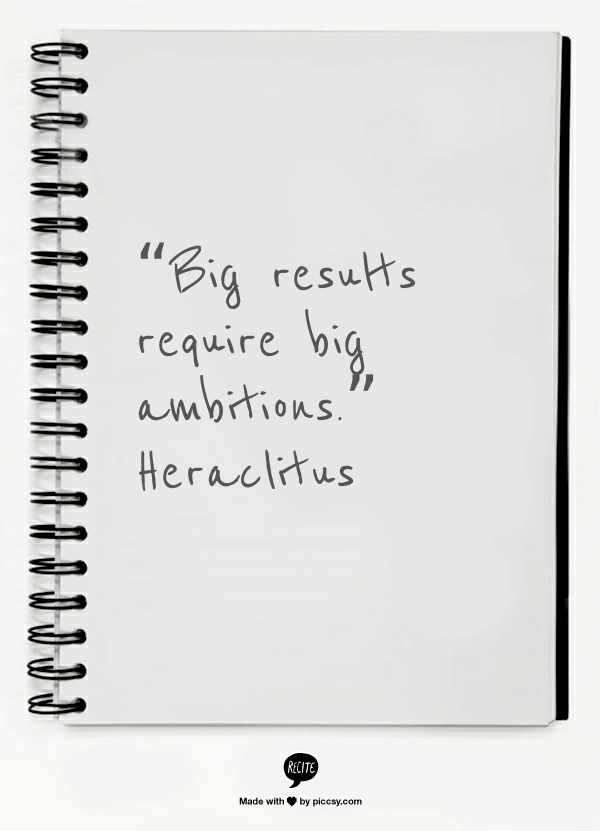
Big results require big ambitions

BrainyQuote via Big results require big ambitions.  – Heraclitus.

Bring back the 40 hour work week

40 hours? That would be like a vacation… :-D

Bring Back the 40 Hour Work Week Infographic
Source: OnlineMBA.com

Finally, An Athletic Shirt Model Even I Can Feel Superior To

Athletic Shirt Model Even You Can Feel Superior To | Jockular.

Welcome home: Wonderful military homecoming moments

US Navy 090511-N-8907D-358 Family and friends ...

Chances are, if you’ve been out and about today, you’ve noticed more than a few strangers shaking the hand of someone in uniform (or applauding the Army vet giving it his all trying to get the wave going at the Pirates game), but these gestures of thanks can’t compare to the rush of joy felt by the loved ones of military men and women when they come home unexpectedly.

Here’s to hoping for many more happy homecomings.

Full story at Welcome Home Blog via The Daily What. via Welcome home: Wonderful military homecoming moments .

One way to Stop Being Disappointed

English: Pigs in Mud A sow and piglet on the n...

Have you ever heard the expression ‘Doing _____ is like wrestling with a pig; you get dirty and the pig likes it’. Steve Pavlina writes:

If someone is late about 70% of the time, and you expect them to be on time, that’s a rather foolish prediction, isn’t it? They may be on time, but they probably won’t be.

What many people will do is get angry with the friend who’s frequently late. Does this usually change that person’s behavior? Perhaps sometimes, but it usually has little or no effect. The person will most likely continue being late at roughly the same frequency.

Wanting a person to change doesn’t change their behavior. It’s more likely to cement the behavior in place since people tend to resist others’ demands of them.

Instead of resisting your predictions, a more sensible approach is to accept them. Accept that your friend will probably continue to be late most of the time.

Note that this doesn’t mean predicting that your friend will always be late, so you can be pleasantly surprised when they’re on time. That would be inaccurate as well. It means accepting that you don’t really know when they’ll show up and that most likely they’ll be later than they say they will. Predict based on reality, not on overly positive or negative expectations. In many cases your prediction will be a spectrum of possible outcomes with some being more probable than others.

Now your friend may change their behavior over time, but when such changes are going to occur, you’ll typically see advance evidence of them. Is your friend committed to becoming more punctual? If so, is there any physical evidence other than empty promises? For instance, when you visit your friend’s home, do you see books like How to Be Punctual lying around? Does your friend share details of their efforts to change? In other words, do you have some solid evidence that this habit will in fact be corrected?

Let me put this another way. If someone said they’d bet you $100 that your friend would be late most of the time for all get-togethers for the next six months, would you take that bet (meaning that you’re betting that your friend will usually be on time)? If you wouldn’t take the bet, it’s fair to say you expect the old behavior to continue.

If there’s no evidence of change, then your best prediction of future behavior is past behavior. In this case, the past does equal the future.

If your current prediction is that the old behavior is likely to continue, then go ahead and project this expectation forward in time for at least a decade. In the absence of clear evidence to the contrary, it’s reasonable to expect that this pattern will continue year after year for at least the next 10 years.

Now do your best to accept this prediction without resistance. Don’t try to alter it for emotional reasons.

The best predictor of future behavior is past behavior, so if you’re clear about the past behavior, you can reasonably expect that it will continue as-is for the most part, absent any serious commitment to alter course. Change is always possible, but entertain the possibility that it may not happen.

Now with this newfound acceptance in mind, how does that affect your relationship with your friend? Does it mandate that you kick this person out of your life? Not necessarily. What it means is that you can now account for the likelihood that this person will be late most of the time. This means your decisions will be more intelligent since they’ll be based on more accurate predictions, not on false hopes.” via How to Stop Being Disappointed.

My old friend RJ always says that when it comes to people what you got is what you’ll get; we can hope that people change but to expect otherwise is an invitation to disappointment. Stop wrestling with pigs!!!

10 questions from the U.S. Naturalization Test

Could you pass the civics portion of the U.S. citizenship test? Applicants must answer 6 of 10 questions correctly (out of 100 different possible questions). Here are some sample questions taken from the U.S. Citizenship and Immigration Services official website:

1. How many amendments does the Constitution have?

2. What is the economic system in the United States?

3. Name your U.S. Representative.

4. What are two Cabinet-level positions?

5. Who is the Chief Justice of the United States now?

6. Who lived in America before the Europeans arrived?

7. The Federalist Papers supported the passage of the U.S. Constitution. Name ONE of the writers.

8. What is ONE thing Benjamin Franklin is famous for?

9. Before he was President, Eisenhower was a general. What war was he in?

10. What did Susan B. Anthony do?

ANSWERS: See the rest at mental_floss. via 10 questions from the U.S. Naturalization Test.

Mayoral Candidate Promises Kick Ass Fireworks

Finally, a politician with priorities. Everyone knows that on the 4th of July, fireworks are our top priority…

via Mayoral Candidate Promises Kick Ass Fireworks.

Success and achievement

English: Maslow's hierarchy of needs. Resized,...

“We fear our highest possibility (as well as our lowest one). We are generally afraid to become that which we can glimpse in our most perfect moments.” Abraham Maslow

In our daily lives, we may dream of success and achievement. We strive and compete in the workplace. We go to meetings and do our part on each Step in the program searching for better lives. When success comes, we are faced with a new problem we could not have expected. It comes as an outcome of some hard work, some good luck, and some help from our friends. It is frightening to have a good thing in our lives and not be in control of it.

We are just as powerless over our successes as we are over the worst of our behaviors. We can only be faithful to our duties and ourselves. The successes, which flow from our work, come and go. Since we can’t nail them down, they may make us feel insecure. Many a man has destroyed his moment of success because he couldn’t stand the powerless feeling. We must return to our program and allow success to rise and fall, as it will.

Today, I turn to my Higher Power for help in accepting success.” via Just For Today Meditations » Daily Recovery Readings – June 28, 2012.

Oopsie! San Diego set all its fireworks off at once

Ka-boom. That pretty much sums up San Diego’s July Fourth fireworks extravaganza. A technical malfunction condensed the entire 23 minute long fireworks show into one large explosion when all the devices went off at the same time. Instagram user Ben Baller captured a photo of the 15 second long blast that has racked up more than 10,000 likes.

Great fireworks show or greatest fireworks show?

Via The Atlantic Wire. via Oopsie! San Diego set all its fireworks off at once [photo].

Pastors, Politics, and the American Republic

John Piper writes:

For those reading from the States, today is Independence Day, the peak of America‘s summer. So in the midst of cookouts and fireworks, let’s do a quick dial back to the founders.

America and its founders. Now that’s a conversation folks can get passionate about, whether in political rhetoric or some Christian circles. However, beyond any dispute on the role Christianity played in those early days, we can say undoubtedly that public opinion in 1776 considered Christians beneficial to the American republic. In short, the consensus was that Christians bring a lot of societal good in a representative democracy.

The man who led the way in articulating this benefit was John Witherspoon, founding father, Presbyterian minister and president of Princeton University, among other things. Though he flies under the radar in many history classes, Witherspoon’s influence is significant. And while he embodied the major intellectual traditions of his day, he has a helpful word on the gospel’s influence in society.

Witherspoon contended that the contribution of “true religion” to the public order is the morality of its adherents. Or said another way, the gospel’s influence on society comes by the means of transformed lives.

And this influence is stewarded by the church’s pastors. Witherspoon writes,

The return which is expected from [pastors] to the community is, that by the influence of their religious government, their people may be the more regular citizens, and the more useful members of society. I hope none here will deny, that the manners of the people in general are of the utmost moment to the stability of any civil society. When the body of a people are altogether corrupt in their manners, the government is ripe for dissolution.

Good laws may hold the rotten bark some longer together, but in a little time all laws must give way to the tide of popular opinion, and be laid prostrate under universal practice. Hence it clearly follows, that the teachers and rulers of every religious denomination are bound mutually to each other, and to the whole society, to watch over the manner of their several members.1

How might pastors influence their people to be “the more useful members of society”? Or how might they “watch over the manner of their several members”? By “feed[ing] the saints with such meals that they go out strengthened and robust and able to do the study and do the courage and do the action needed as salt and light in this world.” via Pastors, Politics, and the American Republic – Desiring God.

Thomas Jefferson and John Adams die; This Day in History 7/4/1826

Benjamin Franklin, John Adams and Thomas Jeffe...
Benjamin Franklin, John Adams and Thomas Jefferson writing the Declaration of independence (1776) were all of British descent. (Photo credit: Wikipedia)

On this day in 1826, former Presidents Thomas Jefferson and John Adams, who were once fellow Patriots and then adversaries, die on the same day within five hours of each other.

Thomas Jefferson and John Adams were the last surviving members of the original American revolutionaries who had stood up to the British empire and forged a new political system in the former colonies. However, while they both believed in democracy and life, liberty and the pursuit of happiness, their opinions on how to achieve these ideals diverged over time.

Adams preceded Jefferson as president (1797-1800); it was during this time that their ideas about policy-making became as distinct as their personalities. The irascible and hot-tempered Adams was a firm believer in a strong centralized government, while the erudite and gentile Jefferson believed federal government should take a more hands-off approach and defer to individual states’ rights. As Adams’ vice president, Jefferson was so horrified by what he considered to be Adams’ abuse of the presidency–particularly his passage of the restrictive Alien and Sedition Acts of 1798–that he abandoned Adams and Washington for his estate at Monticello. There, he plotted how to bring his Republican faction back into power in the presidential election of 1800. After an exceptionally bitter campaign, in which both parties engaged in slanderous attacks on each other in print, Jefferson emerged victorious. It appeared the former friends would be eternal enemies.

After serving two presidential terms (1801-1809), Jefferson and Adams each expressed to third parties their respect the other and their desire to renew their friendship. Adams was the first to break the silence; he sent Jefferson a letter dated January 1, 1812, in which he wished Jefferson many happy new years to come. Jefferson responded with a note in which he fondly recalled when they were fellow laborers in the same cause. The former revolutionaries went on to resume their friendship over 14 years of correspondence during their golden years.

On July 4, 1826, at the age of 90, Adams lay on his deathbed while the country celebrated Independence Day. His last words were Thomas Jefferson still survives. He was mistaken: Jefferson had died five hours earlier at Monticello at the age of 82.” via Thomas Jefferson and John Adams die — History.com This Day in History — 7/4/1826.

History.com fails to mention that they both died 50 years to the day after signing the original Declaration of Independence

A Fourth of July channeling of Thomas Jefferson

English: Portrait of Thomas Jefferson, founder...

Paul Brandus writes:

“We hold these truths to be self-evident, that all men are created equal, that they are endowed by their Creator with certain unalienable Rights, that among these are Life, liberty and the pursuit of Happiness.”

Thomas Jefferson’s glorious sentence from his Declaration of Independence — arguably the most influential sentence in the history of the English language — holds true to this day, and remains a beacon to all who cherish or yearn for the human rights he espoused. Abraham Lincoln considered that specific passage one of the most important things he ever read, and regarded it as the bedrock of his political philosophy.

Jefferson believed that the Declaration was his greatest accomplishment — even more so than being president of the United States. In fact, gaze upon his gravestone at Monticello (appropriately adorned with nickels left by visitors), and you wouldn’t even know that he was president:

“Here was buried Thomas Jefferson, Author of the Declaration of American Independence, of the Statute of Virginia for religious freedom, Father of the University of Virginia.” via A Fourth of July channeling of Thomas Jefferson – The Week.

50 Patriotic Women In Stars And Stripes

BuzzFeed – Latest. Get more here: 50 Patriotic Women In Stars And Stripes.

July 4th is an exception to the rule: when we sing the national anthem

July 4th is an exception to the rule: when we sing the national anthem, we almost always do it before a sporting event. This is somewhat fitting because successfully performing the anthem is practically an athletic feat.

A look at some of the most famous performances of the National Anthem: http://nyr.kr/MR9urK via July 4th is an exception to the rule: when we sing the national….

The United Colors of America

Happy Fourth of July

via The United Colors of America.

Make today YOUR independence day

Mastin Kipp writes:

“Let today be the day that you declare to yourself that you have inalienable rights and have the courage to stand up to those in your life who convince you otherwise. If any of your relationships do not promote your right to “Life, liberty and the pursuit of Happiness”, do what we did in 1776 and draw a boundary. And like the Preamble says, if any relationship becomes destructive, it is your right to abolish it and create new relationships that promote Safety and Happiness.

A single act of defiance in the face of oppression created a whole new country full of new found possibility and freedom. And so it is with you, if you are feeling the need for your own Declaration of Independence, have the courage to stand up for what you need. Who knows what kind of new life and possibilities are out there just waiting for you to claim your right and acknowledge that you deserve a better life? What would of happened if our forefathers hadn’t taken a stand? Where would that of left us?

If you are not in the flow of your happiness, then abundance, freedom, creativity, joy and love cannot be yours. And if you are not in alignment with belief that what you desire for yourself you also desire for others, then these gifts will also evade you.

All beings are created equal and deserve happiness. Claim your right to happiness and let go of trying to control the will others. Give them the space to find what they need and give yourself the room to do the same.

The examples of how to do this are all around you. It’s up to you to claim your own happiness and release others to find this gift for themselves.” Source: Make Today YOUR Independence Day!

The Best Revenge

“The best revenge is to be unlike him who performed the injury.”

Teenage Bill Clinton meets JFK, 1963

via Retronaut. Get more here: Teenage Bill Clinton meets JFK, 1963.

Sonic boom shatters windows in Brazil

National pride so strong, it shatters glass. Before you break into chants of “U-S-A! U-S-A!,” note that this window-breaking display of national enthusiasm happened in Brazil.

Fighter jets conducting a flag exchange ceremony in the Brazilian capital of Brasíla created a sonic boom when the Mirage 2000 planes soared too close to the ground. The powerful shock wave shattered nearly all the windows of the nearby Supreme Court building.

via Sonic boom shatters windows in Brazil .

Start a Blog at WordPress.com.

Up ↑