In his epic book “Here Comes Everybody”, Clay Shirky writes:

We are living in the middle of the largest increase in expressive capability in the history of the human race. More people can communicate more things to more people than has ever been possible in the past, and the size and speed of this increase, from under one million participants to over one billion in a generation, makes the change unprecedented, even considered against the background of previous revolutions in communications tools. The truly dramatic changes in such tools can be counted on the fingers of one hand: the printing press and movable type (considered as one long period of innovation); the telegraph and telephone; recorded content (music, then movies); and finally the harnessing of radio signals (for broadcasting radio and TV). None of these examples was a simple improvement, which is to say a better way of doing what a society already did. Instead, each was a real break with the continuity of the past, because any radical change in our ability to communicate with one another changes society.

Shirky, Clay (2009-02-24). Here Comes Everybody: The Power of Organizing Without Organizations (p. 106). Penguin Group. Kindle Edition.

What good, though, is that expressive capability if people can’t find you when they need what you do? You need to be known!

The question is, though, for what should I be known? Everyone’s an expert! How do we know this? Seth Godin told us so long ago in his ebook ‘Everyone’s an Expert’ [About Something]

So now you are an expert. I know it. You know it. It’s the rest of the world that may not know it. Yet. In my humble opinion however you did not get to this ripe old age of wherever you’re at without becoming an expert in something. The 10,000 hour rule is just that – Malcolm Gladwell hypothesized that it takes approximately 10,000 hours of practice to become an expert at something. Now think of all the things you are an expert at!

Here’s the problem, however: your area of expertise may be so narrow or specialized that no one in your town or county or even your state needs it. There are however almost 2,000,000,000 people on the Internet. Even if your expertise appeals to only one in 1 million people that still means there are 2,000 people who need you to guide them. The 10,000 hours you spent gaining your expertise probably means you’re pretty good thinker too. The challenge is you can be the sharpest knife in the drawer but if no one can find the drawer you’ll never get a chance to get out…

Chris Brogan says:

“As you now know, if you have no Google results, in a sense you don’t exist.

Brogan, Chris; Smith, Julien (2010-07-16). Trust Agents: Using the Web to Build Influence, Improve Reputation, and Earn Trust (p. 161). Wiley. Kindle Edition.”

My good friend Dana VanDen Heuvel, a thought leader in his own right, says “there are thinkers and there are thought leaders. They both have a point of view. The thinker has a point of view that is limited by word-of-mouth but the thought leader is only limited by world of mouth.” Using the good, fast and cheap tools available on the Internet a thinker can make his or her thought leadership position searchable, findable, knowable, usable, and shareable. Because of all those ‘ibles’, they may actually become credible. Publishing your thought leadership position will give you a share of voice which may lead to share of mind and ultimately to share of market…
The first step in ‘being known’ is actually accepting the face that you ARE an expert and discovering your ‘onlyness’ as author Nilofer Merchant puts it in her book “11 Rules for Creating Value in the #SocialEra“:

The foundational element starts with celebrating each human and, more specifically, something I’ve termed onlyness. Onlyness is that thing that only one particular person can bring to a situation. It includes the skills, passions, and purpose of each human. Onlyness is fundamentally about honoring each person, first as we view ourselves and second as we are valued. Each of us is standing in a spot that no one else occupies. That unique point of view is born of our accumulated experience, perspective, and vision. Some of those experiences are not as “perfect” as we might want, but even those experiences are a source of ideas and creativity. Without this tenet of celebrating onlyness, we allow ourselves to be simply cogs in a machine—dispensable and undervalued.

Merchant, Nilofer (2012-09-12). 11 Rules for Creating Value in the Social Era (Kindle Locations 107-113). Perseus Books Group. Kindle Edition.

So now we have established the foundation of being known; you have to define your area of expertise and embrace your ‘onlyness’; only then can you take the next step. More next Tuesday…


The wishing/doing gap

Here’s something from Seth Godin to ponder this weekend:

It would be great to be picked, to win the random lottery, to have a dream come true.

But when we rely on a wish to get where we want to go, we often sacrifice the effort that might make it more likely that we get what we actually need. Waiting for the prince to show up is a waste of valuable time, and the waiting distracts us from and devalues the hard work we might be doing instead.

If you can influence the outcome, do the work.

If you can’t influence the outcome, ignore the possibility. It’s merely a distraction.

via Seth’s Blog: The wishing/doing gap.

Tolerance


Practice tolerance.

Tolerate our quirks, our feelings, our reactions, our peculiarities, and our humanness. Tolerate our ups and downs, our resistance to change, and our struggling and sometimes awkward nature.

Tolerate our fears, our mistakes, our natural tendency to duck from problems, and pain. Tolerate our hesitancy to get close, expose ourselves, and be vulnerable.

Tolerate our need to occasionally feel superior, to sometimes feel ashamed, and to occasionally share love as an equal. Tolerate the way we progress – a few steps forward, and a couple back.

Tolerate our instinctive desire to control and how we reluctantly learn to practice detachment. Tolerate the way we say we want love, and then sometimes push others away. Tolerate our tendency to get obsessive, forget to trust God, and occasionally get stuck.

Some things we do not tolerate. Do not tolerate abusive or destructive behaviors toward others or ourselves.

Practice healthy, loving tolerance of ourselves, said one man. When we do, we’ll learn tolerance for others. Then, take it one step further; learn that all the humanness we’re tolerating is what makes ourselves and others beautiful.

Today, I will be tolerant of myself. From that, I will learn appropriate tolerance of others.” via Just For Today Meditations » Blog.


I really need to do this more often… Updated!

…via Instagram!
I am blessed to live an work less than 1 mile from Lake Michigan on the ‘right side’ of Wisconsin. I love the many ‘moods’ of the lake as I travel back and forth between home and work or while doing errands. Yesterday, for the first time I went to the wayside less than a mile from my home, pulled out a folding chair, put my feet up on a fence, listened to good music over the bluetooth headphones and sat and looked at the lake for half an hour. Priceless! What opportunities to ‘stop and smell the roses’ are you overlooking in your life? Need justification? Try this article on 6 reasons to cherish your alone time from Positively Positive…

Pat Hopkins of Imaginasium in Green Bay [yes, we have very smart people here too!] wrote:

Steve Jobs had it. Bill Gates did, too. Their successors? Not so much.

Don’t get me wrong — Apple and Microsoft may still be successful. It’s just that they’ll never be the same companies that they set out to be.

These days, they’re operating based solely on sound business practices, rather than rallying around a unified, inspiring vision that made them the undisputed leaders in their field.

Same scenario in government: In 2008, Barack Obama had it in droves. This year? Both he and Mitt Romney have played it safe — relying on tried & true tactics rather than a bold vision to rally around. Thus, there’s been no clear leader in the race to date.

And remember good ol’ George H.W. Bush? After serving as Vice President to Reagan — an unequaled storyteller with a clear, compelling vision — he sought to continue the same successful policies for another eight years. Yet, he only served one term.

Bush 41 had an incredible resume — on paper, there was perhaps no one more qualified in recent history than he to serve as president. As he focused on the comfortable role of handling issues one-by-one and in the here-and-now, his advisors urged him to speak to broader themes. He referred to it as “that vision thing,” and didn’t see it as important as solving problems and letting his record speak for itself.

It cost him the election — voters instead rallied around a new candidate who urged them to “don’t stop thinking about tomorrow.” (And Clinton went on to serve two terms, with unparalleled popularity even today).

Vision is what every successful leader and company thrives on, yet one of the hardest things to truly communicate and achieve. In fact, it’s the most critical long-term success factor and challenge you’ll face.

You can get by for a while without it. But you won’t lead your industry. Or make as much profit as your competitor. Or retain the best talent.

And unless you also weave it into a compelling story and get good at telling it, you’re likely to face the same fate.” via About That Vision Thing….

Takeaway? Find yours — vision, that is — and pursue it while you still can…

Why Fast Food Is Addictive


Hailey Hobson writes:

Over the past 50-60 years, our American culture has slowly become out of balance with nature. With the speed of technology and the crazy, intense pace of our lives, our bodies can’t help but live in a chronic state of stress. The phrase is “fight or flight.” Either you’ve heard the terms, or you may — in fact — be living it yourself.

From the minute we wake up in the morning, our bodies are prepared for that state of emergency. It could be the almost car accident you got into on your way to work, the three jobs you’re trying to juggle, your kids screaming at you in the background, the marathon you’re training for or the relationship with your partner that has become less than ideal… Our bodies don’t know the difference. Stress is stress. And it’s chronic.

Our nervous systems are out of balance. So, Ronald McDonald went to India in 1954 to learn more about the six tastes in Ayurvedic nutrition. And, what did he find out?

According to Ayurvedic tradition, our bodies naturally crave tastes that balance our doshic make-up and shun tastes that are aggravating to our nature. The sweet taste of milkshakes are soothing and calming to our nervous systems. Salt (i.e. French fries) improves the taste of food, calms our nerves and prevents anxiety. And, the sour taste of pickles on burgers stimulates our appetites.

It’s called comfort food. Don’t you crave it when your life is going 90 miles an hour? Ah, that first bite! It’s like the needle to a heroine addict. It worked in America, and the rest of the world soon followed. Come 2012, and McDonald’s has more than 33,000 restaurants (do we actually call them that?), serving nearly 68 million people in 119 countries every day!

So, now we’re on track to have the entire world following in our American footsteps. Doesn’t that scare you?!

The problem is, there are actually six tastes that should be present in every meal and guide us toward proper nutritional health. Sweet, salty and sour are only three of them. The others are:

the bitter taste which is cleansing and detoxifying;

the pungent taste which strengthens our systems;

the astringent taste which cleanses our blood and helps us maintain healthy blood sugar levels.

Chances are, your tongue may also be missing a few of these tastes. Can you pass by the entrance to your favorite fast food restaurant, and add more peppers, chilies, radishes, ginger, lentils, broccoli, cabbage, cauliflower, green leafy vegetables, sprouts and beets to your diet instead?

via Why Fast Food Is Addictive: Ronald McDonald and The 6 Tastes of Ayurveda.


High-Fructose Corn Syrup Is a Total Catastrophe

Autumn Brooks writes:

High-Fructose Corn Syrup (HFCS) is a very low cost sweetener derived from milled corn, then processed again to form corn syrup, then again processed with fructose to form High-Fructose Corn Syrup. It’s very common in processed foods and beverages in the U.S., including breads, cereals, breakfast bars, lunch meats, yogurts, soups and condiments. Unfortunately, the overuse of such a toxic substance has led to an increase of metabolic syndrome in America that is supported study after study and proves that HFCS is not the same as sugar.

So, if HFCS is so damaging to the human body, why would a company prefer it over the other options? Not surprisingly, the main reason is it’s very inexpensive. But, it’s also easy to transport, keeps food moist and has a very long shelf life. It should also be divulged that the majority of HFCS is genetically modified and has a high potency of mercury. If you add up all of the information about HFCS, be prepared for a total catastrophe.

In 40 years since the introduction of HFCS, obesity rates have skyrocketed. In 1970, the obesity rate was 15 percent, and by 2010, the rate was around 33 percent – or one-third of the population. Princeton has been in the forefront of studies that are linking all of the information together. They have demonstrated that all sweeteners are not created equal when it comes to weight gain. HFCS isn’t recognized by the leptin receptors in your body, and leptin is the hormone assigned to tell you when you are full. Therefore, you aren’t told by your own body when to stop eating when it comes to foods that contain HFCS; that leads to overeating and weight gain.” Get the rest here: High-Fructose Corn Syrup Is a Total Catastrophe.

Self approval


Melody Beattie writes:

Most of us want to be liked. We want other people to think of us as nice, friendly, kind, and loving. Most of us want the approval of others.

Since childhood, some of us have been trying to get approval, trying to get people to like us and think highly of us. We may be afraid people will leave us if they disapprove of our actions. We may look for approval from people who have none to give. We may not know that we’re lovable now and can learn to approve of ourselves.

In order to live happily, to live consistently with the way our Higher Power wants us to live, and to tap into a way of life that is in harmony with the universe, we need to let go of our extreme need for approval. These unmet needs for approval and love from our past give others control over us today. These needs can prevent us from acting in our best interest and being true to ourselves.

We can approve of ourselves. In the end, that’s the only approval that counts.

Today, I will let go of my need for approval and my need to be liked. I will replace them with a need to like and approve of myself. I will enjoy the surprise I find when I do this. The people who count, including myself, will respect me when I am true to myself.” via Just For Today Meditations – Daily Recovery Reading – September 10, 2012.


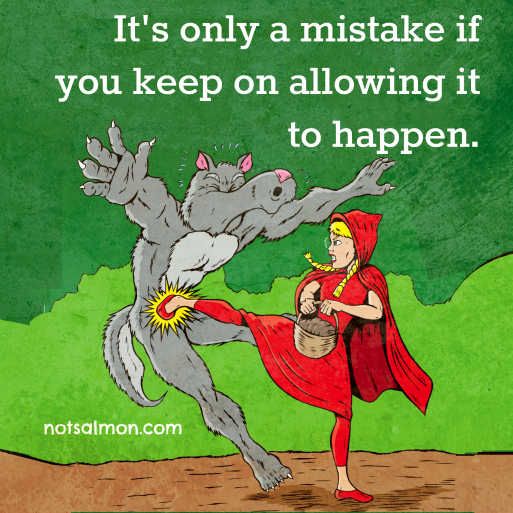
Zen Wisdom From Lil’ Red Riding Hood….


notsalmon

via Zen Wisdom From Lil’ Red Riding Hood…..


Lambeau’s new menu strives for quality over quantity?

Lambeau's new menu strives for quality over quantity | Green Bay Press Gazette | greenbaypressgazette.com

WTH?

The Lambeau Heap, a one-pound BBQ garlic-bacon-cheese curd burger with fried onion strings and coleslaw on an 8-inch pretzel roll. The burger is $15, or eager eaters can tackle the ‘Fan V. Food’ challenge with waffle fries and a milkshake for $20. / Evan Siegle/Press-Gazette” via Lambeau’s new menu strives for quality over quantity | Green Bay Press Gazette | greenbaypressgazette.com.

No wonder America is obese when THIS is considered quality over quantity.

The Mindset List: 2016

Beloit College in Wisconsin posted this on their blog; a ‘paradigm inventory’ of what the college class of 2016 really is about:

This year’s entering college class of 2016 was born into cyberspace and they have therefore measured their output in the fundamental particles of life: bits, bytes, and bauds. They have come to political consciousness during a time of increasing doubts about America’s future, and are entering college bombarded by questions about jobs and the value of a college degree. They have never needed an actual airline “ticket,” a set of bound encyclopedias, or Romper Room. Members of this year’s freshman class, most of them born in 1994, are probably the most tribal generation in history and they despise being separated from contact with friends. They prefer to watch television everywhere except on a television, have seen a woman lead the U.S. State Department for most of their lives, and can carry school books–those that are not on their e-Readers–in backpacks that roll.

The class of 2016 was born the year of the professional baseball strike and the last year for NFL football in Los Angeles. They have spent much of their lives helping their parents understand that you don’t take pictures on “film” and that CDs and DVDs are not “tapes.” Those parents have been able to review the crime statistics for the colleges their children have applied to and then pop an Aleve as needed. In these students’ lifetimes, with MP3 players and iPods, they seldom listen to the car radio. A quarter of the entering students already have suffered some hearing loss. Since they’ve been born, the United States has measured progress by a 2 percent jump in unemployment and a 16-cent rise in the price of a first class postage stamp.

Each August since 1998, Beloit College has released the Beloit College Mindset List, providing a look at the cultural touchstones that shape the lives of students entering college this fall. The creation of Beloit’s former Public Affairs Director Ron Nief and Keefer Professor of the Humanities Tom McBride, authors of The Mindset Lists of American History: From Typewriters to Text Messages, What Ten Generations of Americans Think Is Normal (John Wiley and Sons), it was originally created as a reminder to faculty to be aware of dated references. It quickly became an internationally monitored catalog of the changing worldview of each new college generation. Mindset List websites at themindsetlist.com and Beloit.edu, as well as the Mediasite webcast and their Facebook page receive more than a million visits annually.

For those who cannot comprehend that it has been 18 years since this year’s entering college students were born, they should recognize that the next four years will go even faster, confirming the authors’ belief that “generation gaps have always needed glue.” Get the list here: The Mindset List: 2016 List.

http://youtu.be/Hb3a44CaeBY

Being Both Strong and Hurt

“Pain is not a sign of weakness, but bearing it alone is a choice to grow weak.” ~from my book, Tiny Buddha via Tiny Wisdom: Being Both Strong and Hurt | Tiny Buddha.

Do the Work: An Important Message for Labor Day

Click image to go to amazon.com

Katharine Brooks writes:

As a career counselor/coach I listen to your ideas and dreams about the future. You have a project you long to do. It’s a screenplay, a book, or a song you want to write. You have an idea for a new invention or a new business you want to start. It’s that new job, diet or marathon training you keep thinking about. It’s that class you’d like to take or the commitment to something or someone important you’d like to make.Doing any of these activities will likely enrich and enhance your life. And that’s probably why you’re not doing them.

You’ll tell me about self-doubt, procrastination, fear, perfectionism, a lack of support from family or friends, and even how rational thinking stops you from going forward. But Steven Pressfield, in his marvelous book/manifesto Do The Work: Overcome Resistance and Get Out of Your Own Way, will drive a stake through all of that and tell you it’s simply Resistance. With a capital “R.” Get the rest here: Do the Work: An Important Message for Labor Day | Psychology Today.

Note: You can borrow this book free from your Kindle or purchase it for the low cost of $4.99 for Kindle software. Why not get it and read it today? It’s a quick but inspiring read…

College students spending less time studying [but it costs more!]

Parents [and students] ponder this:

Over the past half-century, the amount of time college students actually study – read, write, and otherwise prepare for class – has dwindled from 24 hours a week to about 15, survey data show.

And that invites a question: Has college become too easy?

Ashley Dixon, a sophomore at George Mason University, anticipated more work in college than in high school. Instead, she has less. In a typical week, Dixon spends 18 hours in classes and another 12 in study. All told, college course work occupies 30 hours of her week. Dixon is a full-time student, but college, for her, is a part-time job.

“I was expecting it to be a lot harder,’’ said Dixon, 20. “I thought I was going to be miserable, trying to get good grades. And I do get good grades, and I’m not working very hard.’’

Declining study time is a discomfiting truth about the vaunted US higher-education system. The trend is generating debate over how much students really learn, even as colleges raise tuition every year.

Some critics say colleges and their students have grown lazy. Today’s collegiate culture, they say, rewards students with high grades for minimal effort and distracts them with athletics, clubs, and climbing walls on campuses that increasingly resemble resorts.

Academic leaders counter that students are as busy as ever but that their attention is consumed in part by jobs they take to help make ends meet.” Get more here: College students spending less time studying – Nation – The Boston Globe.

Now, consider this:

Neil Armstrong’s 7 Most Inspirational Quotes


BuzzFeed – Latest

Get more here: Neil Armstrong’s 7 Most Inspirational Quotes.


Detaching in Relationships

Melody Beattie writes:

When we first become exposed to the concept of detachment, many of us find it objectionable and questionable. We may think that detaching means we don’t care. We may believe that by controlling, worrying, and trying to force things to happen, we’re showing how much we care.

We may believe that controlling, worrying, and forcing will somehow affect the outcome we desire. Controlling, worrying, and forcing don’t work. Even when we’re right, controlling doesn’t work. In some cases, controlling may prevent the outcome we want from happening.

As we practice the principle of detachment with the people in our life, we slowly begin to learn the truth. Detaching, preferably detaching with love, is a relationship behavior that works.

We learn something else too. Detachment – letting go of our need to control people – enhances all our relationships. It opens the door to the best possible outcome. It reduces our frustration level, and frees us and others to live in peace and harmony.

Detachment means we care, about others and ourselves. It frees us to make the best possible decisions. It enables us to set the boundaries we need to set with people. It allows us to have our feelings, to stop reacting and initiate a positive course of action. It encourages others to do the same.

It allows our Higher Power to step in and work.” via Detaching in Relationships – Saturday, August 21 – Adult Children Anonymous.

The best of @toddlohenry for 8/5/2012

Lots of goodness all in one post! The best of @toddlohenry for 8/5/2012 (with images, tweets) · toddlohenry · Storify.

Do you relate?

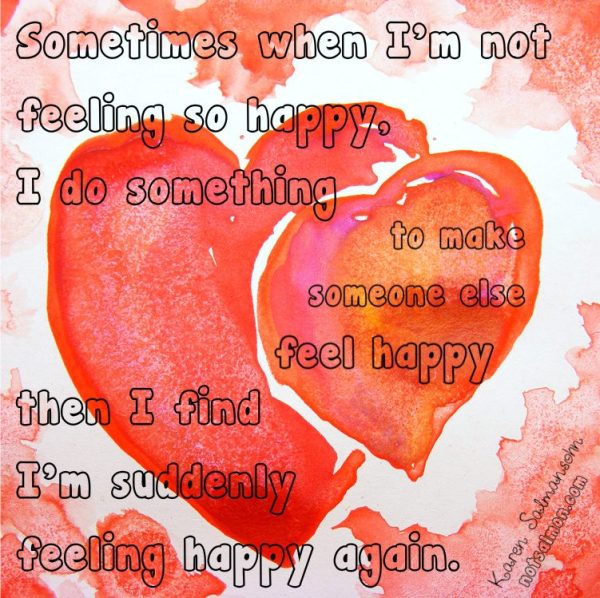
Sometimes when I’m not feeling so happy

I do something to make someone else feel happy

then I find I’m suddenly feeling happy again. – Karen Salmansohn

The post Do you relate…? appeared first on Notsalmon.

via Do you relate…?.

Lasting Change Starts from Within: Transform Your Life

“All meaningful and lasting change starts on the inside and works its way out.”  ~Anon

Get the rest here: Lasting Change Starts from Within: Transform Your Life | Tiny Buddha.

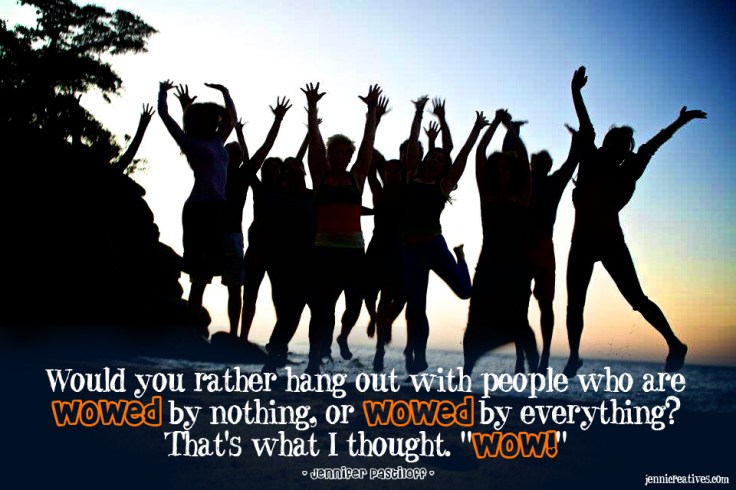
Wow! What’s Your Mantra?

Jennifer Pastiloff writes:

According to Wikipedia, a mantra is a sound, syllable, word or group of words that is considered capable of “creating transformation.” I use mantras when I teach my yoga classes. When the yogis bring their hands to prayer I ask them to pause and recite the silent mantra of the day. Whatever it is.

Sometimes I give it to them. For example, if the theme of the class is “inspiration,” I will maybe suggest to them: “I am inspired.” Or if the theme is “joy,” it will be: “I am joy.”

We literally pause for a few seconds with the hands there, right over the heart and rewire our thoughts. It’s like sending small rocket ships into our consciousness.

I joke with them saying that if they don’t like the “I am inspired” mantra, they can change it to “I am dead inside” or something else that suits them.

We always have the choice.” via Wow! What’s Your Mantra?.

Armstrong walks on moon; This Day in History — 7/20/1969

I saw it as it happened!

At 10:56 p.m. EDT, American astronaut Neil Armstrong, 240,000 miles from Earth, speaks these words to more than a billion people listening at home: “That’s one small step for man, one giant leap for mankind.” Stepping off the lunar landing module Eagle, Armstrong became the first human to walk on the surface of the moon.

The American effort to send astronauts to the moon has its origins in a famous appeal President John F. Kennedy made to a special joint session of Congress on May 25, 1961: “I believe this nation should commit itself to achieving the goal, before this decade is out, of landing a man on the moon and returning him safely to Earth.” At the time, the United States was still trailing the Soviet Union in space developments, and Cold War-era America welcomed Kennedy’s bold proposal.

In 1966, after five years of work by an international team of scientists and engineers, the National Aeronautics and Space Administration (NASA) conducted the first unmanned Apollo mission, testing the structural integrity of the proposed launch vehicle and spacecraft combination. Then, on January 27, 1967, tragedy struck at Kennedy Space Center in Cape Canaveral, Florida, when a fire broke out during a manned launch-pad test of the Apollo spacecraft and Saturn rocket. Three astronauts were killed in the fire.

Despite the setback, NASA and its thousands of employees forged ahead, and in October 1968, Apollo 7, the first manned Apollo mission, orbited Earth and successfully tested many of the sophisticated systems needed to conduct a moon journey and landing. In December of the same year, Apollo 8 took three astronauts to the dark side of the moon and back, and in March 1969 Apollo 9 tested the lunar module for the first time while in Earth orbit. Then in May, the three astronauts of Apollo 10 took the first complete Apollo spacecraft around the moon in a dry run for the scheduled July landing mission.

At 9:32 a.m. on July 16, with the world watching, Apollo 11 took off from Kennedy Space Center with astronauts Neil Armstrong, Edwin Aldrin Jr., and Michael Collins aboard. Armstrong, a 38-year-old civilian research pilot, was the commander of the mission. After traveling 240,000 miles in 76 hours, Apollo 11 entered into a lunar orbit on July 19. The next day, at 1:46 p.m., the lunar module Eagle, manned by Armstrong and Aldrin, separated from the command module, where Collins remained. Two hours later, the Eagle began its descent to the lunar surface, and at 4:18 p.m. the craft touched down on the southwestern edge of the Sea of Tranquility. Armstrong immediately radioed to Mission Control in Houston, Texas, a famous message: “The Eagle has landed.”

At 10:39 p.m., five hours ahead of the original schedule, Armstrong opened the hatch of the lunar module. As he made his way down the lunar module’s ladder, a television camera attached to the craft recorded his progress and beamed the signal back to Earth, where hundreds of millions watched in great anticipation. At 10:56 p.m., Armstrong spoke his famous quote, which he later contended was slightly garbled by his microphone and meant to be “that’s one small step for a man, one giant leap for mankind.” He then planted his left foot on the gray, powdery surface, took a cautious step forward, and humanity had walked on the moon.

“Buzz” Aldrin joined him on the moon’s surface at 11:11 p.m., and together they took photographs of the terrain, planted a U.S. flag, ran a few simple scientific tests, and spoke with President Richard M. Nixon via Houston. By 1:11 a.m. on July 21, both astronauts were back in the lunar module and the hatch was closed. The two men slept that night on the surface of the moon, and at 1:54 p.m. the Eagle began its ascent back to the command module. Among the items left on the surface of the moon was a plaque that read: “Here men from the planet Earth first set foot on the moon–July 1969 A.D–We came in peace for all mankind.”

At 5:35 p.m., Armstrong and Aldrin successfully docked and rejoined Collins, and at 12:56 a.m. on July 22 Apollo 11 began its journey home, safely splashing down in the Pacific Ocean at 12:51 p.m. on July 24.

There would be five more successful lunar landing missions, and one unplanned lunar swing-by, Apollo 13. The last men to walk on the moon, astronauts Eugene Cernan and Harrison Schmitt of the Apollo 17 mission, left the lunar surface on December 14, 1972. The Apollo program was a costly and labor intensive endeavor, involving an estimated 400,000 engineers, technicians, and scientists, and costing $24 billion (close to $100 billion in today’s dollars). The expense was justified by Kennedy’s 1961 mandate to beat the Soviets to the moon, and after the feat was accomplished ongoing missions lost their viability.

via Armstrong walks on moon — History.com This Day in History — 7/20/1969.

As long as you’ve read this far, here’s a bonus funny story that unfortunately never happened…

Start a Blog at WordPress.com.

Up ↑