John Adams on celebrating the 2nd of July

-500px
-500px (Photo credit: Wikipedia)

“The Second Day of July 1776 will be the most memorable Epocha, in the History of America. It ought to be solemnized with Pomp and Parade, with Shews, Games, Sports, Guns, Bells, Bonfires, and Illuminations from one End of this Continent to the other from this Time forward forever more.” – John Adams to Abigail Adams, July 3, 1776. 1776 filled the calendar with dates deserving of remembrance and even celebration. John Adams, delegate from Massachusetts to the Second Continental Congress, wrote home to his wife Abigail that future generations would celebrate July 2, the date the Congress voted to approve Richard Henry Lee’s resolution declaring independence from Britain for 13 of the British colonies in America. Two days later, that same Congress approved the wording of the document Thomas Jefferson had drafted to announce Lee’s resolution to the world. Today, we celebrate the date of the document Jefferson wrote, and Richard Henry Lee is often a reduced to a footnote, if not erased from history altogether. Who can predict the future? (You know, of course, that Adams and Jefferson both died 50 years to the day after the Declaration of Independence, on July 4, 1826. In the 50 intervening years, Adams and Jefferson were comrades in arms and diplomacy in Europe, officers of the new government in America, opposing candidates for the presidency, President and Vice President, ex-President and President, bitter enemies, then long-distance friends writing almost daily about how to make a great new nation. Read David McCullough’s version of the story, if you can find it.)”

Thomas Jefferson and John Adams die; This Day in History 7/4/1826

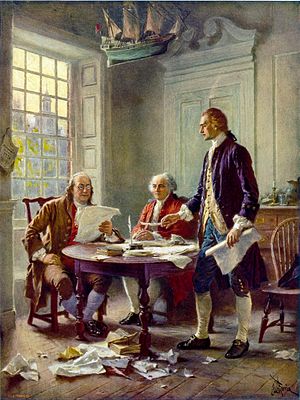
Benjamin Franklin, John Adams and Thomas Jeffe...
Benjamin Franklin, John Adams and Thomas Jefferson writing the Declaration of independence (1776) were all of British descent. (Photo credit: Wikipedia)

On this day in 1826, former Presidents Thomas Jefferson and John Adams, who were once fellow Patriots and then adversaries, die on the same day within five hours of each other.

Thomas Jefferson and John Adams were the last surviving members of the original American revolutionaries who had stood up to the British empire and forged a new political system in the former colonies. However, while they both believed in democracy and life, liberty and the pursuit of happiness, their opinions on how to achieve these ideals diverged over time.

Adams preceded Jefferson as president (1797-1800); it was during this time that their ideas about policy-making became as distinct as their personalities. The irascible and hot-tempered Adams was a firm believer in a strong centralized government, while the erudite and gentile Jefferson believed federal government should take a more hands-off approach and defer to individual states’ rights. As Adams’ vice president, Jefferson was so horrified by what he considered to be Adams’ abuse of the presidency–particularly his passage of the restrictive Alien and Sedition Acts of 1798–that he abandoned Adams and Washington for his estate at Monticello. There, he plotted how to bring his Republican faction back into power in the presidential election of 1800. After an exceptionally bitter campaign, in which both parties engaged in slanderous attacks on each other in print, Jefferson emerged victorious. It appeared the former friends would be eternal enemies.

After serving two presidential terms (1801-1809), Jefferson and Adams each expressed to third parties their respect the other and their desire to renew their friendship. Adams was the first to break the silence; he sent Jefferson a letter dated January 1, 1812, in which he wished Jefferson many happy new years to come. Jefferson responded with a note in which he fondly recalled when they were fellow laborers in the same cause. The former revolutionaries went on to resume their friendship over 14 years of correspondence during their golden years.

On July 4, 1826, at the age of 90, Adams lay on his deathbed while the country celebrated Independence Day. His last words were Thomas Jefferson still survives. He was mistaken: Jefferson had died five hours earlier at Monticello at the age of 82.” via Thomas Jefferson and John Adams die — History.com This Day in History — 7/4/1826.

History.com fails to mention that they both died 50 years to the day after signing the original Declaration of Independence

A Fourth of July channeling of Thomas Jefferson

English: Portrait of Thomas Jefferson, founder...

Paul Brandus writes:

“We hold these truths to be self-evident, that all men are created equal, that they are endowed by their Creator with certain unalienable Rights, that among these are Life, liberty and the pursuit of Happiness.”

Thomas Jefferson’s glorious sentence from his Declaration of Independence — arguably the most influential sentence in the history of the English language — holds true to this day, and remains a beacon to all who cherish or yearn for the human rights he espoused. Abraham Lincoln considered that specific passage one of the most important things he ever read, and regarded it as the bedrock of his political philosophy.

Jefferson believed that the Declaration was his greatest accomplishment — even more so than being president of the United States. In fact, gaze upon his gravestone at Monticello (appropriately adorned with nickels left by visitors), and you wouldn’t even know that he was president:

“Here was buried Thomas Jefferson, Author of the Declaration of American Independence, of the Statute of Virginia for religious freedom, Father of the University of Virginia.” via A Fourth of July channeling of Thomas Jefferson – The Week.

Make today YOUR independence day

Mastin Kipp writes:

“Let today be the day that you declare to yourself that you have inalienable rights and have the courage to stand up to those in your life who convince you otherwise. If any of your relationships do not promote your right to “Life, liberty and the pursuit of Happiness”, do what we did in 1776 and draw a boundary. And like the Preamble says, if any relationship becomes destructive, it is your right to abolish it and create new relationships that promote Safety and Happiness.

A single act of defiance in the face of oppression created a whole new country full of new found possibility and freedom. And so it is with you, if you are feeling the need for your own Declaration of Independence, have the courage to stand up for what you need. Who knows what kind of new life and possibilities are out there just waiting for you to claim your right and acknowledge that you deserve a better life? What would of happened if our forefathers hadn’t taken a stand? Where would that of left us?

If you are not in the flow of your happiness, then abundance, freedom, creativity, joy and love cannot be yours. And if you are not in alignment with belief that what you desire for yourself you also desire for others, then these gifts will also evade you.

All beings are created equal and deserve happiness. Claim your right to happiness and let go of trying to control the will others. Give them the space to find what they need and give yourself the room to do the same.

The examples of how to do this are all around you. It’s up to you to claim your own happiness and release others to find this gift for themselves.” Source: Make Today YOUR Independence Day!

Happy 4th of July!

Holy Kaw! via Happy America Day (aka 4th of July)! [infographic].

Congress votes for independence; This Day in History — 7/2/1776

Benjamin Franklin, John Adams and Thomas Jeffe...
Benjamin Franklin, John Adams and Thomas Jefferson writing the Declaration of independence (1776) were all of British descent. (Photo credit: Wikipedia)

On this day in 1776, the Second Continental Congress, assembled in Philadelphia, formally adopts Richard Henry Lee’s resolution for independence from Great Britain. The vote is unanimous, with only New York abstaining.

The resolution had originally been presented to Congress on June 7, but it soon became clear that New York, New Jersey, Pennsylvania, Delaware, Maryland and South Carolina were as yet unwilling to declare independence, though they would likely be ready to vote in favor of a break with England in due course. Thus, Congress agreed to delay the vote on Lees Resolution until July 1. In the intervening period, Congress appointed a committee to draft a formal declaration of independence. Its members were John Adams of Massachusetts, Benjamin Franklin of Pennsylvania, Roger Sherman of Connecticut, Robert R. Livingston of New York and Thomas Jefferson of Virginia. Thomas Jefferson, well-known to be the best writer of the group, was selected to be the primary author of the document, which was presented to Congress for review on June 28, 1776.

On July 1, 1776, debate on the Lee Resolution resumed as planned, with a majority of the delegates favoring the resolution. Congress thought it of the utmost importance that independence be unanimously proclaimed. To ensure this, they delayed the final vote until July 2, when 12 colonial delegations voted in favor of it, with the New York delegates abstaining, unsure of how their constituents would wish them to vote. John Adams wrote that July 2 would be celebrated as the most memorable epoch in the history of America. Instead, the day has been largely forgotten in favor of July 4, when Jeffersons edited Declaration of Independence was adopted.” via Congress votes for independence — History.com This Day in History — 7/2/1776.

My declaration of independence

Icon from Nuvola icon theme for KDE 3.x.

Click the icon below for the audio version…

God, grant me the serenity to accept the things I cannot change,

Courage to change the things I can,

And wisdom to know the difference.” via en.wikipedia.org

This independence day, I declare independence from…

  • Trying to manage the unmanageable…
  • Anger and resentment related to the first item…
  • Substances that stimulate or depress…
  • Anything that’s keeping me from being a more authentic me…

I’ll give myself 30 days and I’ve entered these issues into Habitforge to help keep me on track. July is going to be a hell of a month — you may want to wait until August to talk to me…

Why July 4th is NOT exactly the day of US Independence

The belltower atop Independence Hall in Philad...
Image via Wikipedia

Historically, the legal liberation of 13 original colonies took place on July 2, 1776, in a closed session of Congress. However, the Second Continental Congress took two more days to modify the famous of American documents, delaying the final approval of Declaration of Independence by two more days.

Although the Declaration of Independence managed to get the Congressional approval on July 4, 1776, it was not made public until July 8. Thus the first Independence Day was celebrated on July 8, 1776.

The Declaration of Independence was read on July 8th, 1776 by Col. John Nixon. He, less than a year later, would be made a brigadier general of the Continental Army.

The day saw summoning of citizens to Independence Hall for the very first public reading of the US Independence Declaration, by ringing the bells of Philadelphia, including the Liberty Bell. This breaks yet another American myth regarding the ringing of Liberty Bell.

Contrary to the popular misconception, Liberty Bell did not ring on July 4th, 1776 to mark the US Independence day. Americans had to wait four more days, till July 8th, to listen to the Liberty Bell as well as the public reading of Declaration of Independence.

My birthday falls on July 8th which would appear is the best of all American holidays according to historical fact…

Start a Blog at WordPress.com.

Up ↑