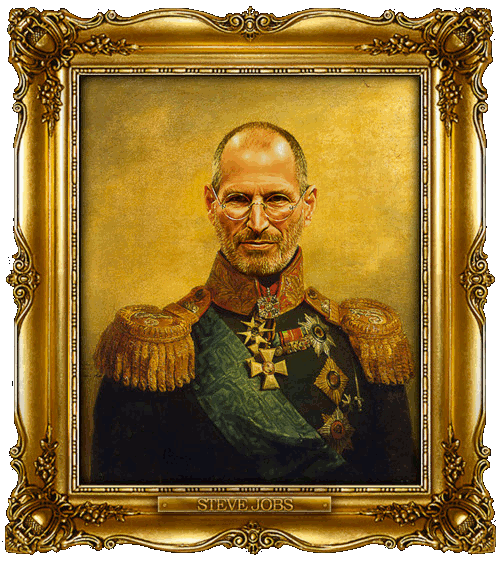
Never let your job prevent your passions

6910976_460s_v19GAG.com Site Feed

via Never let your job prevent your passions.

Pat Hopkins of Imaginasium in Green Bay [yes, we have very smart people here too!] wrote:

Steve Jobs had it. Bill Gates did, too. Their successors? Not so much.

Don’t get me wrong — Apple and Microsoft may still be successful. It’s just that they’ll never be the same companies that they set out to be.

These days, they’re operating based solely on sound business practices, rather than rallying around a unified, inspiring vision that made them the undisputed leaders in their field.

Same scenario in government: In 2008, Barack Obama had it in droves. This year? Both he and Mitt Romney have played it safe — relying on tried & true tactics rather than a bold vision to rally around. Thus, there’s been no clear leader in the race to date.

And remember good ol’ George H.W. Bush? After serving as Vice President to Reagan — an unequaled storyteller with a clear, compelling vision — he sought to continue the same successful policies for another eight years. Yet, he only served one term.

Bush 41 had an incredible resume — on paper, there was perhaps no one more qualified in recent history than he to serve as president. As he focused on the comfortable role of handling issues one-by-one and in the here-and-now, his advisors urged him to speak to broader themes. He referred to it as “that vision thing,” and didn’t see it as important as solving problems and letting his record speak for itself.

It cost him the election — voters instead rallied around a new candidate who urged them to “don’t stop thinking about tomorrow.” (And Clinton went on to serve two terms, with unparalleled popularity even today).

Vision is what every successful leader and company thrives on, yet one of the hardest things to truly communicate and achieve. In fact, it’s the most critical long-term success factor and challenge you’ll face.

You can get by for a while without it. But you won’t lead your industry. Or make as much profit as your competitor. Or retain the best talent.

And unless you also weave it into a compelling story and get good at telling it, you’re likely to face the same fate.” via About That Vision Thing….

Takeaway? Find yours — vision, that is — and pursue it while you still can…

Steve Jobs: Guru and Goon

Relly Nadler, M.C.C., writes:

Steve Jobs has been a fascinating case study in this blog for leadership because he was a phenomenal innovator and marketer, while demonstrating a dark side that could demonize people. This is the last entry to explore his leadership conundrum.

Newsweek this week named Jobs a top Evangelists and stated “equal parts businessman and poet he envisioned what technology could be –and then delivered it with magnificent products.” He was also vicious, arrogant, stubborn, blind to others feelings and prone to temper tantrums.  He was a star in some Emotional Intelligence competencies, while devastated others on the way to success. How do we make sense of these opposite attributes?  As leaders what do we emulate and what do we eliminate from our leadership behaviors?

In the last blog we continued to look at the DSM IV criteria for Narcissistic Personality Disorder for Steve Jobs as it helps us understand the two sides of Steve Jobs, his motivations and personality. This is exploratory in nature only and educational and not deemed to give him a clinical diagnosis, as he would have to be a client and interviewed personally. Many of these back stories come from Walter Isaacson’s book Steve Jobs. This exploration can help you if you see yourself in any of these descriptions and determine which ones to tune down.

In the DSM IV, the manual that helps diagnose mental disorders, you need 5 of the 9 criteria to meet the diagnosis. It looks like Jobs clearly fits 6 of the 9. We looked at three in the last blog. Two in the second blog on Jobs and here we will explore the last four.” Get the answer here: Jobs: Guru and Goon | Psychology Today.”

Nadler concludes:

“Yes Jobs was one of the most influential people of this century and his Narcissism was driving force for his vision, perfection and success. He is a leadership conundrum for what to emulate and eliminate, which will be studied in MBA and leadership programs for years to come. These last blogs can help deconstruct his complicated nature as we move onto to new leading with Emotional Intelligence topics.

For a summary of What to Emulate and Eliminate from Jobs, go to the blog at www.truenorthleadership.com.”

Relly Nadler

Nadler’s article makes for interesting reading; I suggest you go to the source to get the context of his thoughts…

By the way,  I still think the best post-Jobs retrospective I’ve read was done by Harvard Business Review writer, author [and client] Nilofer Merchant who wrote:

“Certainly, we need inspiration to show us examples of clear purpose. But I wonder what happens in a world where we each figure out why we do what we do and we can live and work from that place. We might refocus on our own work and the community with which we get that work done. We might learn to define success in our own terms. We might even come up with our own mantra around this:

  • I shall not obsess over others’ success: not copying, idolizing, or mindlessly emulating.
  • I shall know my purpose and know why I’m doing something.
  • I shall ally myself to a tribe with a common purpose, though the tribe’s members may work in vastly different fields and forms.
  • I will make ideas stronger by uniting with others to do great work, not by holding my ideas all to myself but releasing them into the wild.
  • I recognize the truth in the credo that the future is not created, the future is co-created and will do my part as a part of the whole.

In doing so, we might go from a culture of find-a-fits-the-mold superhero to a system of heroes- and heroines-next-door. We might create, rather than copy. We might initiate, rather than wait for permission. We might see ourselves as powerful enough. We might not believe that solving the many problems around us is someone else’s responsibility. We might each be willing to disrupt ourselves as Whitney Johnson suggests we do. We might reimagine our careers, with clarity of purpose, and this might show up in our work with others. We might just transform the organizing principles of the places we work. We might even end up reinventing our economy. We might recognize just how connected we are.

For my own situation when I was a kid, once I realized there was no hero coming to save me, I found ways to manage the situation. I said “enough” to what was going on. I also started to claim the things that mattered, like an education.  As a result, I was ousted from my family — but I also started developing the sense of purpose that has led me to the work I do today and the people I do it with.

The cultural change when people know their own purpose and their own power in creating change is what could change everything: for ourselves, for our organizations, and our economy. So, go ahead and buy that Walter Isaacson book. But, let’s not obsess over being the next Steve Jobs or starting the next Facebook or [whatever]. Let us, instead, be inspired to find our own purpose in the world, and a tribe of people to do it with.” Be Your Own Hero | Yes & Know“.

What say you?

More on being your own hero…

Kute Blackson’s post made me think of another epic post on ‘being your own hero’ written by friend, client and Harvard Business Review author Nilofer Merchant on the deification of Steve Jobs and the lessons it holds for us…

So, it’s with that life context that I am watching the beatification of Steve Jobs. Google the term, “Steve Jobs tribute” and you get back 5 million plus results. And I’m fairly sure that’s an undercount. There’s a good reason for this; the Hero Narrative has deep roots in our culture. We find it in history books and religions, in our sports teams and, yes, even in our corporate cultures. We obsess. We deify, as if there is a single defining idea of how innovation works, what makes a leader great, or how success happens.

This is not new. It is the idea of The One and it shows up in many ways: Who will be the next leader of the free world? What nation will be the next superpower? Which visionary company is the single conqueror of industry? (It’s Amazon, it’s Google, it’s Facebook, it’s Apple!). And we have it in management disciplines with debates like: isn’t it better to have one smart person than lots of ordinary people working for our organizations?

But I wonder if this framework is wrong.

Continue reading “More on being your own hero…”

Your starting place does not define you

Personal Best

“Your story is where you take it to, not where you start.”―Tony Robbins

Let’s be honest and get a few things out on the table:

Your starting point does not define you.

Your starting point is a neutral data point.

What matters is where you want to go rather than where you are right now.

Your starting place is just that—where you start. Nothing more and nothing less. It’s neutral.

Jeff Bezos started Amazon in a garage. Steve Jobs started Apple in a garage. Many people think a garage is a pretty terrible place to start a business. However, both visionaries built incredibly successful companies that have since changed the world and our view of what’s possible.

Iyanla Vanzant, an author and self-help guru, went through a divorce, lost her daughter to cancer, and lost her home. She is now a NY Times bestselling author and will soon have a self-empowerment show on Oprah’s network (OWN). Although, we tend to classify our starting place in an extreme way, it’s just a starting place. No need to be dramatic.

“We can think, speak, and bring the best possible outcome into existence by focusing on where we are going, not on where we think we are.”—Iyanla Vanzant

Do yourself and everyone around you a favor, please stop being so tough on yourself because your starting place is difficult…

Source: Your Starting Place Does Not Define You [BLOG] « Positively Positive

Go to the source if you want more…

Bio as Bible: managers imitate Steve Jobs

In the latest ‘drive-by’ management trend, the deification of Steve Jobs continues…

Mimicking Mr. Jobs’s keynote style and adopting catch phrases like “one more thing”—the words Mr. Jobs often used to introduce products—may make bosses think they’re operating more like the genius himself. But it has provoked plenty of eye-rolling among staffers. “Some employees are teasing me about when I’ll start wearing black turtlenecks,” says Mr. Thammineni, referring to Mr. Jobs’s signature item of clothing.

“It’s not to that point of being annoying yet, but it might get there,” says Dominique Levin, vice president of marketing at Totango Inc., a software company based in Mountain View, Calif., and Tel Aviv. Her boss, CEO Guy Nirpaz, devoured all 656 pages of the book in three days, then bought copies for his employees—including Hebrew translations for employees in Israel—so they could discuss the book at company meetings.

Source: Bio as Bible: Managers Imitate Steve Jobs – WSJ.com

Jobs was a brilliant but an assaholic! Managers should be careful about who and what they choose to emulate…

Is happiness the secret of success?

An emoticon with a smile. For more emoticons i...

Some people think if you are happy, you are blind to reality. But when we research it, happiness actually raises every single business and educational outcome for the brain. How did we miss this? Why do we have these societal misconceptions about happiness? Because we assumed you were average.

When we study people, scientists are often interested in what the average is. If we study what is merely average, we will remain merely average.

Many people think happiness is genetic. That’s only half the story, because the average person does not fight their genes. When we stop studying the average and begin researching positive outliers — people who are above average for a positive dimension like optimism or intelligence — a wildly different picture emerges. Our daily decisions and habits have a huge impact upon both our levels of happiness and success.

via Is happiness the secret of success? – CNN.com.

Are YOU the one that everyone finds difficult?

porcupine_CCDrew_AveryGretchen Rubin again. This time on the topic of being an a$$…

We all see the world through our own eyes, and it can be hard to recognize how our words and actions appear to other people. One of the challenges of being a difficult person is realizing that you’re a difficult person. I’ve known many difficult people who, I suspect, have no idea that others find them difficult!

In his excellent book The No A****** Rule (I’m omitting the title not from prudery but from fear of spam-blockers), and also on his blog, Work Matters, Bob Sutton has a quiz to help people recognize if they are a*******.

I was inspired to adapt that material for this quiz. As you answer these questions, be brutally honest with yourself. Don’t make excuses for yourself or other people; just try to answer accurately. These questions apply to family members gathering for a holiday, or to co-workers, or to any group of people who are trying to get along with each other.

Source: The Happiness Project: Quiz: Are YOU the One That Everyone Finds Difficult?

Go to the source if you want to read Gretchen’s quiz. Personally I was disappointed that she offers questions but no recommendations. Fortunately, one of her readers suggested this series of posts from writer Annie Zirkel. Annie says…

We come into contact with prickly people all the time. It might be a scowl, a frosty attitude or a touchy disposition. It might be the choice of words as in ‘What do you want?!’

Sometimes they serve us coffee. Sometimes they sit across from us at work or in committee meetings. Sometimes they live in our neighborhood or even worse! in our own homes.

And sometimes – more often then we’d like to admit – they are staring back at us in the mirror.

Source: How Prickly Are You? Part 1

Me? I often ponder why society secretly venerates a**holes like Steve Jobs, Gregory House of House, MD, and Cal Lightman from ‘Lie to me‘ and why they are a source of entertainment for us. Personally I’m a recovering assaholic [got that word from Steve Jobs’ biography] – deep inside I know I am warm, loving and caring but for reasons I often don’t understand even my best intentions are frequently taken the wrong way. And the results are far from entertaining. Because Gretchen’s quiz got me thinking I’ll be digging into Annie’s series for insight. Join me if you’d like. I’ll report back on what I find…

The growth of information

Image representing Eric Schmidt as depicted in...
Image via CrunchBase

“Every two days now we create as much information as we did from the dawn of civilization up until 2003.” – Eric Schmidt, former CEO of Google

Image representing Google as depicted in Crunc...
Image via CrunchBase

Things we’ve been tracking in the past 24 hours…


Image representing Google as depicted in Crunc...
Image via CrunchBase

Things we’ve been tracking in the past 24 hours…


West facade of Buckingham Palace, seen from th...
Image via Wikipedia

Things we’ve been tracking in the past 24 hours…


Steve Jobs: Master of Irony

I’m not sure if it still is, but at one point in time this commercial was the most popular of all time…

Now, ironically, Robert Wright of the New York Times says Steve Jobs has become the ‘Big Brother’ that Apple warned us about in 1984

“Jobs stands accused of what in Silicon Valley is a capital crime: authoritarian tendencies. He’s long played hardball with journalists who reveal details about forthcoming products, and now he’s deciding what content people can view on the iPhone and iPad. Apps featuring even soft-core porn are verboten, and some kinds of political commentary don’t make the cut. Apple recently rejected an app from a political cartoonist — and then, embarrassingly, had to reconsider after he won the Pulitzer Prize.

Put these two Jobs profiles together — emerging infotech hegemon and congenital control freak — and you get a scary scenario: growing dominance of our information pipelines by a guy who likes to filter information. No wonder Jobs’s detractors have been making ironic reference to Apple’s famous 1984 Super Bowl ad, the one that implicitly cast the IBM-Microsoft alliance as Big Brother.” Source: Is Steve Jobs Big Brother? – Opinionator Blog – NYTimes.com

Follow the source — it’s an interesting read…

Au revoir iPhone!

Yesterday I said goodbye to the iPhone and along with it, Apple as well. While I was working on the AGCO social media project, my good friend and partner on the project David Sauter of Envano had been kind enough to let me use an iPhone [I think he was secretly trying to bring me back into the Apple fold] until he hired a new account manager and yesterday my love/hate relationship with the iPhone — and Apple — came to an end when I returned the phone to Envano. It takes a lot of Apple to lose the love of a fanboi like me, but at the end of the day, to paraphrase the great Ronald Reagan “I didn’t leave Apple, Apple left me…

It wasn’t so much dissatisfaction with the iPhone that brought me to this point — it actually had much more to do with the iPad announcement. As Alex Payne lamented…

“”The iPad leaves me with the feeling that Apple’s interests and values going forward are deeply divergent from my own. The future of personal computing that the iPad shows us is both seductive and dystopian. It’s not a future I want to bring into my home.”” Source: Alex Payne on the iPad | Smarterware

Continue reading “Au revoir iPhone!”

How to fail in 2010

I had the privilege earlier in my career to work closely with the great Jeff Martin [the guy Steve Jobs credits with the ‘Think Different’ campaign and you know Steve Jobs doesn’t often give credit!]. Jeff’s response to stupid ideas was to say ‘Well, that’s a great going out of business strategy’. My friend Dana VanDen Heuvel outlines some great ‘going out of business strategies’ in this guest column in the Green Bay PressGazette…

Congratulations! Your business made it through 2009, one of the toughest years since the Depression, and now you’re ready to accelerate into the rebound. After all, optimism is one of the hallmark traits of most successful business people. We know that we can’t sell in the past and believe that the best lies ahead of us.

There are a few things that can, if you do them, hinder your progress immeasurably, virtually sealing your demise in the New Year. If you do these things, failure is all but assured. However, if you heed this advice and act positively in the other direction, your success is all but guaranteed. Source: Guest column: How to fail in business in 2010 | greenbaypressgazette.com | Green Bay Press-Gazette

Go to the source to get 6 pointers on creating your own personal ‘going out of business strategy’…

;-)

Reblog this post [with Zemanta]

Start a Blog at WordPress.com.

Up ↑