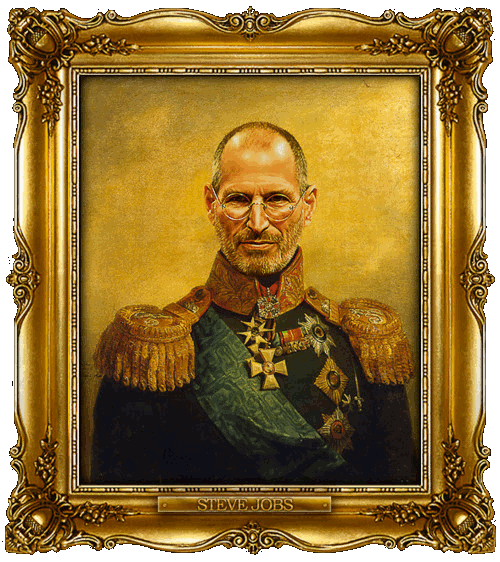
Relly Nadler, M.C.C., writes:
“Steve Jobs has been a fascinating case study in this blog for leadership because he was a phenomenal innovator and marketer, while demonstrating a dark side that could demonize people. This is the last entry to explore his leadership conundrum.
Newsweek this week named Jobs a top Evangelists and stated “equal parts businessman and poet he envisioned what technology could be –and then delivered it with magnificent products.” He was also vicious, arrogant, stubborn, blind to others feelings and prone to temper tantrums. He was a star in some Emotional Intelligence competencies, while devastated others on the way to success. How do we make sense of these opposite attributes? As leaders what do we emulate and what do we eliminate from our leadership behaviors?
In the last blog we continued to look at the DSM IV criteria for Narcissistic Personality Disorder for Steve Jobs as it helps us understand the two sides of Steve Jobs, his motivations and personality. This is exploratory in nature only and educational and not deemed to give him a clinical diagnosis, as he would have to be a client and interviewed personally. Many of these back stories come from Walter Isaacson’s book Steve Jobs. This exploration can help you if you see yourself in any of these descriptions and determine which ones to tune down.
In the DSM IV, the manual that helps diagnose mental disorders, you need 5 of the 9 criteria to meet the diagnosis. It looks like Jobs clearly fits 6 of the 9. We looked at three in the last blog. Two in the second blog on Jobs and here we will explore the last four.” Get the answer here: Jobs: Guru and Goon | Psychology Today.”
Nadler concludes:
“Yes Jobs was one of the most influential people of this century and his Narcissism was driving force for his vision, perfection and success. He is a leadership conundrum for what to emulate and eliminate, which will be studied in MBA and leadership programs for years to come. These last blogs can help deconstruct his complicated nature as we move onto to new leading with Emotional Intelligence topics.
For a summary of What to Emulate and Eliminate from Jobs, go to the blog at www.truenorthleadership.com.”
Relly Nadler
Nadler’s article makes for interesting reading; I suggest you go to the source to get the context of his thoughts…
By the way, I still think the best post-Jobs retrospective I’ve read was done by Harvard Business Review writer, author [and client] Nilofer Merchant who wrote:
“Certainly, we need inspiration to show us examples of clear purpose. But I wonder what happens in a world where we each figure out why we do what we do and we can live and work from that place. We might refocus on our own work and the community with which we get that work done. We might learn to define success in our own terms. We might even come up with our own mantra around this:
- I shall not obsess over others’ success: not copying, idolizing, or mindlessly emulating.
- I shall know my purpose and know why I’m doing something.
- I shall ally myself to a tribe with a common purpose, though the tribe’s members may work in vastly different fields and forms.
- I will make ideas stronger by uniting with others to do great work, not by holding my ideas all to myself but releasing them into the wild.
- I recognize the truth in the credo that the future is not created, the future is co-created and will do my part as a part of the whole.
In doing so, we might go from a culture of find-a-fits-the-mold superhero to a system of heroes- and heroines-next-door. We might create, rather than copy. We might initiate, rather than wait for permission. We might see ourselves as powerful enough. We might not believe that solving the many problems around us is someone else’s responsibility. We might each be willing to disrupt ourselves as Whitney Johnson suggests we do. We might reimagine our careers, with clarity of purpose, and this might show up in our work with others. We might just transform the organizing principles of the places we work. We might even end up reinventing our economy. We might recognize just how connected we are.
For my own situation when I was a kid, once I realized there was no hero coming to save me, I found ways to manage the situation. I said “enough” to what was going on. I also started to claim the things that mattered, like an education. As a result, I was ousted from my family — but I also started developing the sense of purpose that has led me to the work I do today and the people I do it with.
The cultural change when people know their own purpose and their own power in creating change is what could change everything: for ourselves, for our organizations, and our economy. So, go ahead and buy that Walter Isaacson book. But, let’s not obsess over being the next Steve Jobs or starting the next Facebook or [whatever]. Let us, instead, be inspired to find our own purpose in the world, and a tribe of people to do it with.” Be Your Own Hero | Yes & Know“.
What say you?

 Bright, shiny objects!