How Do You Find Self-Worth When You Don’t Like Yourself?

My friendĀ Michael Rohrer writes:

Being desired is such a basic craving. We all want to be desired: by our family, by our friends, by a lover, by our coworkers. What happens when we don’t desire ourselves?

I’m beginning to realize that I don’t like myself very much. All these years of feeling like I couldn’t raise the eyebrow or pique the interest of an attractive man might actually stem from the fact that I’m exuding the pheromones of one who feels unworthy of being loved and therefore thinks he’s undesirable to all. Could it be that simple? I’m sure I’m not the only gay man — or person — who feels or has felt this way. Do you have to love yourself before you can love someone else or be loved by someone else? Is that a myth?

I keep wondering if I’ll ever love myself enough to be loved by another person. I hate being vulnerable, but vulnerability is key to opening one’s heart to another person. For years I’ve told myself, “When the right person shows up, I’ll know, and my heart will automatically open.” Is that utter bullshit?

Continue reading: How Do You Find Self-Worth When You Don’t Like Yourself? | Michael Rohrer.

A few years ago, I would not have touched the HuffingtonPost with a 10 foot mouse [now I have 100 fans there!] and I certainly would not have curated an article by a gay man. In the time between, however, many thinks [intentional] have changed. “We all want to be desired: by our family, by our friends, by a lover, by our coworkers.” This desire makes us all human and should unite, rather than divide…

Over 10 years ago, The Telegraph reported:

Whether you hail from Surbiton, Ulan Bator or Nairobi, your genetic make-up is strikingly similar to that of every other person on Earth, an analysis concludes today.

Although scientists have long recognised that, despite physical differences, all human populations are genetically similar, the new work concludes that populations from different parts of the world share even more genetic similarities than previously assumed.

All humans are 99.9 per cent identical and, of that tiny 0.1 per cent difference, 94 per cent of the variation is among individuals from the same populations and only six per cent between individuals from different populations.

Nonetheless, the team found that tiny differences in DNA can provide enough information to identify the geographic ancestry of individual men and women.

The results of the study, published today in the journal Science, have implications for understanding ancient human migrations and for resolving an ongoing debate about the use of family histories in medical research, said Prof Marcus Feldman of Stanford University who led the team.

via DNA survey finds all humans are 99.9pc the same – Telegraph.

Are we not, then, all interconnected persons? All sparks of the divine? All stardust?

Tara Brach writes:

Because so many of us grew up without a cohesive and nourishing sense of family, neighborhood, community or ā€œtribe,ā€ it is not surprising that we feel like outsiders, on our own and disconnected. We learn early in life that any affiliation—with family and friends, at school or in the workplace—requires proving that we are worthy. We are under pressure to compete with each other, to get ahead, to stand out as intelligent, attractive, capable, powerful, wealthy. Someone is always keeping score.

After a lifetime of working with the poor and the sick, Mother Teresa’s surprising insight was: ā€œThe biggest disease today is not leprosy or tuberculosis but rather the feeling of not belonging.” In our own society, this disease has reached epidemic proportions. We long to belong and feel as if we don’t deserve to.

D.H. Lawrence described our Western culture as being like a great uprooted tree with its roots in the air. ā€œWe are perishing for lack of fulfillment of our greater needs,ā€ he wrote, ā€œwe are cut off from the great sources of our inward nourishment and renewal.ā€

via Tara Brach: Everybody Has Buddha Nature.

Lo, these many years I turned to ‘tribes’ — Christian Fundamentalists, The Republican Party, The Green Bay Packers — to make me feel right inside when in truth everything inside me was screaming at me from the mirror that everything inside me was wrong, and to compensate for the lack of a cohesive, nourishing sense of belonging. By learning about and practicing self-compassion, however, I am making progress in making peace with myself, my past, my present and my future…

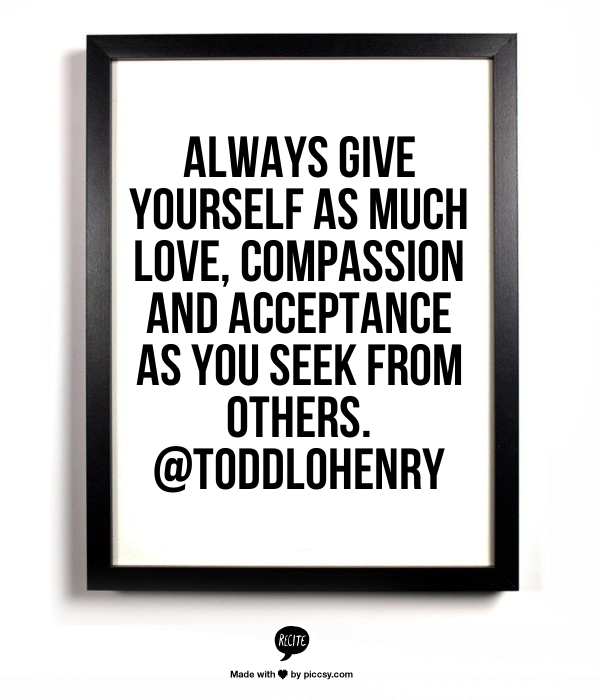
Thank you for your post, Michael, and for giving me pause to think about this topic. I agree that thinking our hearts will ‘automatically open’ is utter bullshit but, that if we practice self-compassion our hearts may slowly and gently open to the possibility of healthy interdependence and my hope is that when we are able to give ourselves at least the same amount of love, compassion and acceptance we seek from others, the craving to be desired may pass away. NamastĆ©!

recite 6222 448393507 u009ao1

Life as we find it…

Sigmund Freud, founder of psychoanalysis, smok...


ā€œLife as we find it, is too hard for us it brings us too many pains, disappointments and impossible tasks. In order to bear it, we cannot dispense with palliative measures. There are three such measures; powerful deflections, which cause us to make light of our misery, substitute satisfactions, which diminish it and intoxicating substances which make us insensitive to it.ā€ Sigmund Freud

Go to the source of this quote: Sigmund Freud Quotes | Famous Sigmund Freud Quotations – Page 3


5 Principles to Live by When Life Doesn’t Go Your Way

ā€œYou may not control all the events that happen to you, but you can decide not to be reduced by them.ā€ ~ Maya Angelou

Full story at:Ā 5 Principles to Live by When Life Doesn’t Go Your Way | Tiny Buddha.

Wise investigation

Click to see...
Click to see more…

Tara Brach may be glad to know that I have ‘discovered’ her work [I find the ‘discovery’ process, how things come to us and the language around it amusing at times]. In any case, thanks to Kristin Barton Cuthriell I became aware of the term ‘radical acceptance‘ a few week ago and devoured Tara Brach’s book by the same name shortly thereafter. I look forward to reading her book True Refuge when I can get a copy but until then I have been listening to her teaching via her podcast. Today on her blog, I found this video recording of one of these podcast meditations that I want to share with you here…

btw, Kristin — I’m very jealous you get to attend one of these meditations soon… :-D

2 Words That Make You Powerless

Doubt

FinerMinds

Full story at: Ā 2 Words That Make You Powerless.

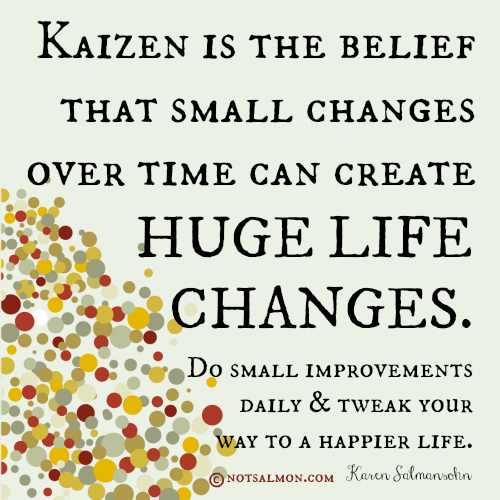
Want to see HUGE CHANGE in your life?

I frequently curate ā€˜pattern interrupts’ like the one above from Karen Salmansohn at notsalmon.com and I love her mind and her images. Did you know she is also a beautiful thinker? Here’s proof…

You can get there by making small changes daily. After all, it’s easier to beĀ a saint for 15 minutes, than to be a saint for 2 hours. Right? Of course!Ā  I’m personally a big fan of small daily changes – which means I’m a big fan of ā€œKaizenā€ – which is a Japanese word which pithily summed up means: ā€œdoing small changes over time which create huge life changes.ā€

With all this in mind, I want you to do a Kaizen Experiment. For the next month commit to devoting a tiny 15 minutes a day to a new improved habit- and tweak your way to a happier life. The good news: You can always find an extra 15 minutes in your day!

More good news: Brain researchers Sandra Aamodt and Sam Wang believe if you can train yourself to stay disciplined for a mere 15 minutes a day doing a specific task – eventually – over time – you will become a more disciplined person in general – and be able to do a habit for far longer than 15 minutes!

The Brain Research Cliff Notes: AamodtĀ and Wang have discovered that a human brainā€˜s overall willpower capacity increases like a muscle every time a human practices even a little bit of willpower — for even 15 minutes — because the human is literally strengthening their brainā€˜s neural pathways.

Meaning? If you want a tooshĀ of steel, exercise your toosh muscles a little daily! If you want a discipline of steel, exercise your discipline muscles a little daily. Ā On an amusing note:Ā Aamodt and Wang mention in their report how increasing ā€œa human’s overall willpower muscleā€ can begin with something as simple as disciplining yourself to brush your teeth for two weeks with your non-dominant hand.

Well, instead of having you brush your teeth differently, I want you to brush up on doing ā€œthat thingā€ you know you need to brush up on! For example:Ā Yoga stretches. Jumping rope. Organizing closets. Meditating. Gratitude journaling. Staying in closer loving touch with friends/family. Reading that NYTimesĀ Best Selling book. Reading that cute picture book to your child at bedtime. Writing that book you want to write. Writing that business plan. Looking into a family vacation. Creating a vision board (then happily staring at your vision board) etc…
Basically, sometimes the idea of doing something new to change your life can feel so overwhelming – that you wind up choosing not to do anything at all. However, if you commit to doing a tiny 15 minute habit a day – moving one tiny 15 minute step forward a day – you will happily discover changing your life is not as overwhelming as youā€˜d thought.

Start today. Right now. Start to do ā€œthat thingā€ you know you gotta do – for just a mere 15 minutes of doing. No excuses. You can find 15 minutes. I promise you that if you can do this 15 minute habit tweak daily for the month, over time you’ll want to do this habit more and more – and over time you’ll find yourself smiling more and more – because both your discipline and your happiness will increase substantially.

By the way, I believe thereʼs a secondary reason why discipline for changing your life increases when doing small 15 minute habit changes over time. Youʼre creating what I call ā€œidentity shifting.ā€ Basically, when you start doing a new disciplined live-improving 15 minute action, your identity begins to shift to see yourself as a disciplined life-improving person.

Your subconscious starts to say: ā€œThe old me did not used to have discipline. But lo and behold, now this new me does! I be da boss of my cerebrum, baby!ā€ Thereʼs even a famed psychological theory called ā€œCognitive Dissonanceā€ which explains this identity shift. The Cliff Notes On ā€œCognitive Dissonanceā€: We humans donʼt like to have a disparity between our thoughts and our actions — so when we change our actions, we change our thoughts to match them.

For example: If Human A starts to do a loving action for Human B — through Cognitive Dissonance — Human Aʼs brain will start to tell them ā€œGeez, I must surely like Human B if Iʼm now doing a loving action for them!ā€ As a result, according to studies on cognitive dissonance, Human A will wind up liking Human B a wee bit more.

Likewise: If you force yourself to do positive, disciplined actions, then your brain — via the perks of Cognitive Dissonance — will start to tell you, ā€œGeez, I must be a positive, disciplined person if I am doing positive, disciplined actions.ā€ Eventually you will wind up being a wee bit more positive and disciplined!

Source: Want to see HUGE CHANGE in your life? – Karen Salmansohn

I hope Karen doesn’t mind that I shared her post in its entirety on my blog. You can find her site by following the link and she has books full of pattern interrupts and other great thinking available on Amazon.com:

Click to buy…

If you like By the way,Ā  for those of you keeping score at home this is post number 5,000 on this blog…

The wishing/doing gap

Here’s something from Seth Godin to ponder this weekend:

It would be great to be picked, to win the random lottery, to have a dream come true.

But when we rely on a wish to get where we want to go, we often sacrifice the effort that might make it more likely that we get what we actually need. Waiting for the prince to show up is a waste of valuable time, and the waiting distracts us from and devalues the hard work we might be doing instead.

If you can influence the outcome, do the work.

If you can’t influence the outcome, ignore the possibility. It’s merely a distraction.

via Seth’s Blog: The wishing/doing gap.

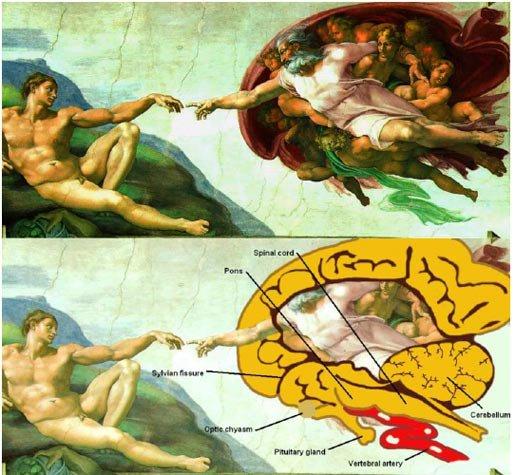
Michaelangelo and The Creation of God

Here’s something to ponder over the weekend. Was Michelangelo sending a ‘secret message’?

Get the scoop here and tell me what you think about this below:Ā The Creation of God | Psychology Today.

Sixteen Strategies for Combating Rumination

Did you know that goats and cows and other animals that chew their cud are called ‘ruminants’? You learn all kinds of thinks living on a farm! Think about that image as you ruminate about rumination!

Conquering ruminative tendencies can make a big difference in your wellbeing.

Shakespeare said, ā€œNothing is good or bad but thinking makes it so.ā€  Many great thinkers and philosophers have articulated, in one form or another that altering your thoughts is the key to wellbeing.  Mind Shift, a technique in The Creativity Cure involves transforming self-defeating thoughts into life affirming ones.  It is possible.

When something terrible has happened it is tempting to ruminate. Over-thinking is a way of trying to attain a sense of mastery or a feeling of control when you feel trammeled, helpless or victimized.  There is a tiny hope that you can get somewhere if you just get to the bottom of it.  Accept that trying to understand what happened is often not a good investment of your time. Some people’s actions will never make sense so you will not uncover a satisfying answer. Pondering other subjects rather than ruminating allows your mood can change. Your creative thoughts can emerge.” Get more here: Sixteen Strategies for Combating Rumination | Psychology Today.

Don’t chew the cud of your past! Stop ruminating and move on…

Is He Worth It? Six Questions to Ask When Sacrificing in Relationships

What about ‘is she worth it?’ Despite the slant, I think this is worth a read if you’re asking yourself this question:

We must all face situations in our close relationships that require us to make a sacrifice. Perhaps, your spouse receives a big promotion, and it requires that you quit your job and move across the country. Or your boyfriend wants you to miss an important work event to attend his family reunion. Maybe you and your wife get jobs in different cities and must decide who has to make the long commute. For me, it was deciding whether to apply to graduate programs in areas that weren’t near where my husband (then boyfriend) was working. When faced with these situations, what information do we use to decide whether or not to make the sacrifice? In addition to consulting theĀ pros and cons list, there are also important questions we should be asking ourselves. Below, I suggest six questions that might help when deciding whether or not making a sacrifice is right for you.” Get the answer here:Ā Is He Worth It? Six Questions to Ask When Sacrificing in Relationships | Psychology Today.

See Your Imperfect Self As Precious

Leslie Becker-PhelpsLeslie Becker-Phelps writes:

As a therapist, I am often faced with people who struggle with feeling essentially flawed in some way. They are quick to take responsibility for their errors or to blame themselves for problems with friends. And, they experience their struggles, mistakes, and imperfections as proof that they are lesser as a person.

As I listen to them, I know that when they look in the mirror, they do not see the value in them that I see. It is this negative self-perception that is the real source of their torture, not the daily issues that loom so large for them. Being overweight, shy, depressed, or socially awkward may cause them great pain; but I see this pain as a distress that requires caring – not condemnation. Making mistakes at work or becoming upset with your children is just part of life. After all, there’s a reason that ā€œIt’s only humanā€ has come to be an expression. No one – and I mean no one – handles everything well all the time. And everyone – and, again, I mean everyone – has things they really struggle with.” Get more here:Ā See Your Imperfect Self As Precious | Psychology Today.

Elevator Groupthink

I am wondering how I would react. Interesting post over on Brain Pickings: Elevator Groupthink: A Psychology Experiment in Conformity, 1962.Ā via Elevator Groupthink.

One way to Stop Being Disappointed

English: Pigs in Mud A sow and piglet on the n...

Have you ever heard the expression ‘Doing _____ is like wrestling with a pig; you get dirty and the pig likes it’. Steve Pavlina writes:

If someone is late about 70% of the time, and you expect them to be on time, that’s a rather foolish prediction, isn’t it?Ā They may be on time, but they probably won’t be.

What many people will do is get angry with the friend who’s frequently late. Does this usually change that person’s behavior? Perhaps sometimes, but it usually has little or no effect. The person will most likely continue being late at roughly the same frequency.

Wanting a person to change doesn’t change their behavior. It’s more likely to cement the behavior in place since people tend to resist others’ demands of them.

Instead of resisting your predictions, a more sensible approach is to accept them. Accept that your friend will probably continue to be late most of the time.

Note that this doesn’t mean predicting that your friend will always be late, so you can be pleasantly surprised when they’re on time. That would be inaccurate as well. It means accepting that you don’t really know when they’ll show up and that most likely they’ll be later than they say they will. Predict based on reality, not on overly positive or negative expectations. In many cases your prediction will be a spectrum of possible outcomes with some being more probable than others.

Now your friend may change their behavior over time, but when such changes are going to occur, you’ll typically see advance evidence of them. Is your friend committed to becoming more punctual? If so, is there any physical evidence other than empty promises? For instance, when you visit your friend’s home, do you see books like How to Be Punctual lying around? Does your friend share details of their efforts to change? In other words, do you have some solid evidence that this habit will in fact be corrected?

Let me put this another way. If someone said they’d bet you $100 that your friend would be late most of the time for all get-togethers for the next six months, would you take that bet (meaning that you’re betting that your friend will usually be on time)? If you wouldn’t take the bet, it’s fair to say you expect the old behavior to continue.

If there’s no evidence of change, then your best prediction of future behavior is past behavior. In this case, the past does equal the future.

If your current prediction is that the old behavior is likely to continue, then go ahead and project this expectation forward in time for at least a decade. In the absence of clear evidence to the contrary, it’s reasonable to expect that this pattern will continue year after year for at least the next 10 years.

Now do your best to accept this prediction without resistance. Don’t try to alter it for emotional reasons.

The best predictor of future behavior is past behavior, so if you’re clear about the past behavior, you can reasonably expect that it will continue as-is for the most part, absent any serious commitment to alter course. Change is always possible, but entertain the possibility that it may not happen.

Now with this newfound acceptance in mind, how does that affect your relationship with your friend? Does it mandate that you kick this person out of your life? Not necessarily. What it means is that you can now account for the likelihood that this person will be late most of the time. This means your decisions will be more intelligent since they’ll be based on more accurate predictions, not on false hopes.”Ā via How to Stop Being Disappointed.

My old friend RJ always says that when it comes to people what you got is what you’ll get; we can hope that people change but to expect otherwise is an invitation to disappointment. Stop wrestling with pigs!!!

Is Your Life “Bucket” Leaking?

A plastic yellow bucket.

“Each of has a psychological ā€œbucket.ā€

It’s our inner reservoir of positive energy that enables us to engage other people with good will, kindness, consideration, generosity, care and concern, acceptance, and respect.

And all of our buckets are leaky, to some extent or other.

At those times when our buckets are pretty well topped up, and not leaking very much, we feel good about ourselves and we’re likely to act in ways other people experience as ā€œnourishingā€ – we help them feel good about themselves.

And when our internal buckets get leaky, we’re more inclined to treat others in ways they experience as ā€œtoxicā€ – we say and do things that cause them to feel offended, insulted, ignored, devalued, disrespected, unappreciated, or unloved.

Most of us manage to keep our buckets fairly well topped up, most of the time. Some days we’re more ā€œupā€ than others, but over the long run most of us realize the value of expressing this positive energy to those around us.” Get the rest here:Ā Is Your “Bucket” Leaking? | Psychology Today.

Are You Resilient Enough?

Psychology Today Features. Get more here:Ā Are You Resilient Enough?.

Is Your Spouse Really Your Best Friend?

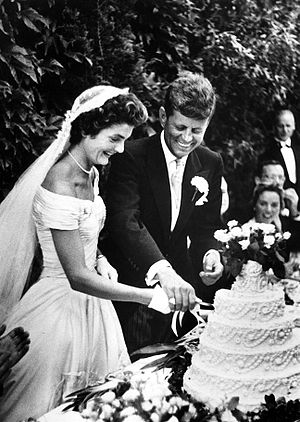
Kennedy marriage

A few weeks ago I curated an article from Michael Hyatt on ā€˜How to be your spouse’s best friend’. A few days ago, I found this article in Psychology Today by author Isadora Alman who has an interesting perspective and some good advice:

With any client’s first visit, usually presenting with some aspect of a relationship concern, I always review other aspects of their life – general health, the work he or she does and feelings about it, other people in their life (family, friends), what recreational activities are pursued, and if the person has enough time for him or herself.Ā  Almost always the answer to this last question is ā€œnoā€.Ā  While all the other aspects of a life I ask about may have some bearing on a relationship issue, this last one always does.

Most of us these days lead frantic lives with demands for time coming at us from all directions.Ā  Priorities have to be assigned and almost always personal needs beyond the most basic of food and sleep are often swept aside.Ā  Even then, many people are not eating well or getting enough sleep so a half hour a day to simply take a deep breath of fresh air is just not there. Time to connect with a partner about how your day went or what’s on your mind in general is left, if it happens at all, to a few groggy moments before sleep takes over.

Let’s say, however, that one does manage to schedule a movie or a meal out.Ā  What if your partner prefers a different movie than the one you want to see, or a different type of restaurant food?Ā  What if he or she would prefer not to go to a movie at all but to a sports event or an art museum?Ā  Do you forego what you want for the sake of couple harmony?Ā  If so, no wonder you might be feeling lonely although coupled.Ā  You’re living your life via someone else’s choices rather than your own.

An oversimplification perhaps, but I strongly feel that you need to be your own best friend.Ā  Your own needs must be given some priority so that, as a fulfilled person, you can then be in a position to be more generous with your partner and others around you.Ā  If you’re feeling lonely and not getting the support, sympathy or help from your spouse that is the very definition of friendship, look elsewhere – for a friend, usually same sex, and not place that burden of such expectations entirely on your spouse.Ā  If you are feeling too much closeness within the coupled bonds, take what space you need for maximum enjoyment of life….and for maximum enjoyment of your partnership as well.Ā  Two people who each have their needs met, who take responsibility of fulfilling their own needs, will make much better and more interesting partners to each other.

Source: Is Your Spouse Really Your Best Friend? | Psychology Today

Disappointed Someone? It’s Okay. Get Over It.

“When we are the one responsible behind disappointment, we find ourselves poked by both ends of a double-edged sword – on the one side wounded by disappointment in ourselves, and the other traumatized with guilt towards the party affected.

But like toothaches and awkward puberty, we have to accept the fact that we are all bound to the possibility of disappointment, be it by ourselves, family, friends or co-workers; or by circumstances beyond our control, such as bad timing or a chain of events that eventually domino-crumble down our path.

Disappointment is an essential part of our growth and self-discovery, and despite being uncomfortable and hurtful, teaches us to trust ourselves, recognize our strengths and weaknesses, and let go of our hold on perfection.

By actively avoiding disappointment onto others, sometimes we set ourselves up for more failure and pain instead of less, or none at all.

We understand that like people, disappointment comes in many different shapes and sizes. While we don’t reproach the remorse that comes with our wrongdoing (hey, that’s a sign of empathy, right?), we’re definitely not down with the idea of indulging in continuous self-pity over a missed deadline or a forgotten detail.

So here are some tips you can apply in your personal or work life on how to overcome the emotional self-flagellation that comes with having disappointed someone.”Ā Get more here: Disappointed Someone? It’s Okay. Get Over It..

Affirm Yourself…

Cover of "The Language of Letting Go (Haz...

Melody Beattie writes:

Who or what do you want to become? A good parent? A sober, recovering person? A good girlfriend, boyfriend, or spouse? Do you want to become happy, peaceful, tolerant? Don’t wait until you’re successful to tell yourself you’re that. Start now by saying you are what you want to become instead of reinforcing the words I’m not. Yes, you have much to learn. Yes, there’s a ways to go on that path. And you may not be proficient at it, or an expert, yet. But you don’t have to be to say those two little words I am.

Help create the new part of your personality by using and affirming those powerful words I am. Then watch as a new part of yourself emerges.

God, help me use my creative powers to create a better, more fulfillĀ­ing life. Help me use the words I am to create who you and I want me to be…

via April 23: Affirm Yourself | Language of Letting Go.

Is Nonviolent Communication Practical?

Yellow daffodils

Have you ever heard of Nonviolent Communication? My wife and I have been using it our relationship for almost a year with a great degree of success…

“One of the most common critiques I hear of Nonviolent Communication is that it’s simply not practical. ā€œIt would be great if this can work,ā€ the line often goes. ā€œToo bad that in my (school, family, organization) we don’t have the luxury of taking all this time to do all this endless dialogue that it takes to get anywhere. No one would have the patience, anyway.ā€Ā via Is Nonviolent Communication Practical? | Psychology Today.

Yes, Nonviolent Communication does take time but so does having arguments and recovering from them. Follow the ‘via’ link if you want to know more about Nonviolent Communication…

Start a Blog at WordPress.com.

Up ↑