Powerlessness

Melody Beattie writes:

Willpower is not the key to the way of life we are seeking. Surrender is.

“I have spent much of my life trying to make people be, do, or feel something they aren’t, don’t want to do, and choose not to feel. I have made them, and myself, crazy in that process,” said one recovering woman.

“I spent my childhood trying to make an alcoholic father who didn’t love himself be a normal person who loved me. I then married an alcoholic and spent a decade trying to make him stop drinking.

“I have spent years trying to make emotionally unavail­able people be emotionally present for me.

“I have spent even more years trying to make family mem­bers, who are content feeling miserable, happy. What I’m saying is this: I’ve spent much of my life desperately and vainly trying to do the impossible and feeling like a failure when I couldn’t. It’s been like planting corn and trying to make the seeds grow peas. It won’t work!

“By surrendering to powerlessness, I gain the presence of mind to stop wasting my time and energy trying to change and control that which I cannot change and control. It gives me permission to stop trying to do the impossible and focus on what is possible: being who I am, loving myself, feeling what I feel, and doing what I want to do with my life.”

In recovery, we learn to stop fighting lions, simply because we cannot win. We also learn that the more we are focused on controlling and changing others, the more unmanage­able our life becomes. The more we focus on living our own life, the more we have a life to live, and the more manage­able our life will become.

Today, I will accept powerlessness where I have no power to change things, and allow my life to become manageable.” via June 20: Powerlessness.

Are You Addicted To Suffering? (And Ready To Quit?)

I teach my students and clients that one should look for the best three paragraphs when curating; occasionally I say it’s OK to double dip and grab two quotes. When it comes to Kute Blackson, I usually break all my rules – his stuff is sooo good that I usually end up curating his entire post to that it’s easier for you to read the whole think. Today is no exception to the Kute Blackson rule:

Most guru’s or teachers will teach how to avoid suffering. I am going to share with you the seven steps of how to successfully create suffering in your life, so that you can be aware of them and make different choices.

Suffering can become a very dangerous addiction. An unhealthy way to feel. An ultimately unfulfilling way to feel alive. You can get so used to suffering that it becomes comfortable and familiar. Suffering is the ego’s way of feeling important.

Whether you are a businessman or a buddha, pain is inevitable. There is no way to avoid it. Just by virtue of being in a human body there will be some pain. Trying to avoid pain will only create more suffering. Embrace pain to release yourself from suffering.

Suffering is optional. Suffering is a choice.

Suffering comes from your story about what is happening in your life and less about what is actually happening. What is happening is simply what is happening. The suffering part comes from all your interpretations and meanings about the experience. Change your story and the way you are interpreting reality and you begin to change your reality. When you change your reality within yourself, you shift your experience of your reality outside. Once you understand this, you only suffer if you chose to.

What stories are you making up about yourself, your life, your partner, your current experience that is causing you suffering?

The Seven Keys to creating suffering:

1- Resist everything: Resist what is. Resist reality. Fight against what is happening in your life with all your might. This is a guaranteed method to suffer.

Key Solution: Accept what is, so that you can then decide how to shift it.

2- Holding the belief: “The experience that is happening to me should not be happening to me. I should be having some other experience than the one I am having. This shouldn’t be happening to me”. You have probably heard yourself doing some version of this. It just keeps you stuck.

Key Solution: Embrace your current experience. Your current experience is the experience that you are meant to be having because you are having it right now. Trust, and focus on what you can learn and how you can grow. The experience is here to help you evolve.

3- Focusing on all the things that you cannot control. This will only cause you to feel completely helpless and disempowered. It will leave you in a state of worry and anxiety. Some of us are professional “worriers”. No matter how much you worry, it doesn’t actually change the situation. Once you are done worrying, the situation will be the same. Worrying is a waste of time.

Key Solution: Focus on what you can control. Take actions that are in your power, step by step.

4- Refusing to change. Keep doing the same over and over and hoping for a different result. Well, as Einstein said, this is the definition of insanity. Are you so set in your ways that you are afraid of giving up the known suffering for the unknown possibility of happiness?

Key Solution: Embrace change. Be willing to do something different. Let go. Go into the unknown. Take different actions.

5- Give up your responsibility: Be a victim. Play the blame game, making everyone else at fault or responsible for your life and how you feel. Unless you take responsibility for your current experience, then you are powerless to change it.

Key Solution: Take full responsibility for your current reality and decide what changes you are committed to making. Give up blame.

6- Focus on everything that is wrong in your life. Whether a relationship or person. When you focus on what is wrong, you will surely find what is wrong. You will end up creating more of what is wrong to feel wrong about. Then the negative cycle continues.

Key Solution: Start focusing on what you are grateful for. Remember all your blessings, and appreciate that daily. What you appreciates, expands. What you thank about comes about.

7- Denial: Lie to yourself and others. Pretend that everything is fine when you know that it isn’t. When you avoid facing what is, you end up staying stuck and repeating the same patterns of pain and relationship. This only ends up prolonging your suffering.

Key Solution: Tell the truth to yourself first. Tell the truth to those in your life. Be honest. Face reality.

Life is too short to waste spent suffering. Most of what you worry about today, you won’t even remember a few months from now. Most of what you are trying to change in people today, you won’t care about on your deathbed.

You hold the padlock and you hold the key to your freedom.

Source: Are You Addicted To Suffering? (And Ready To Quit?)

3 Ways To Find the Truth—About Yourself

Michael Hyatt writes:

Many of us have a love/hate relationship with truth. We tell ourselves we want to know the truth, but we’re very selective about the kind of truth we seek. About others, yes—and usually about world events and situations that impact us directly, but we are less receptive to revelations about ourselves.

In fact, self-knowledge is a two-edged sword because we might find out something about ourselves that we would rather not know. We’ve carefully packaged ourselves to look and act in a manner that ensures success in the world. Our ego has dressed us up for so long that many of us don’t even know how to begin to peel back the layers of illusion to expose cold, hard facts about ourselves.” Get more here: 3 Ways To Find the Truth—About Yourself | Michael Hyatt.

Living Our Lives

Melody Beattie writes:

“Don’t stop living your life!

So often, when a problem occurs, inside or around us, we revert to thinking that if we put our life on hold we can posi­tively contribute to the solution. If a relationship isn’t work­ing, if we face a difficult decision, if we’re feeling depressed, we may put our life on hold and torment ourselves with obsessive thoughts.

Abandoning our life or routines contributes to the problem and delays us from finding the solution.

Frequently, the solution comes when we let go enough to live our life, return to our routine, and stop obsessing about the problem.

Sometimes, even if we don’t feel like we have let go or can let go, we can “act as if” we have, and that will help bring about the letting go we desire.

You don’t have to give up your power to problems. You can take your focus off your problem and direct it to your life, trusting that doing so will bring you closer to a solution.

Today, I will go on living my life and tending to my routine. I will decide, as often as I need to to stop obsessing about whatever is bothering me. If I don’t feel like letting go of a particular thing, I will “act as if” I have let go of it until my feelings match my behavior.” via June 9: Living Our Lives.

Who And What Are You Attracting?

I love Kute Blackson’s energy and insights. Today’s is no exception:

You attract to you in life who you are.

The experiences and people of your life are an incredible mirror showing you where you are today in your consciousness.

So you are constantly in relationship with yourself. The real relationship is with aspects of yourself that you attract to you in the physical, in the form of the partner and experiences that are in front of you at any given moment.

Take a moment to look at who and what you are attracting.

Do you like what you see? Are there any repetitive patterns?

To the degree you are willing to be responsible for your current reality and the people you attract is the degree to which you will be free and have the power to change your reality.

You are not a victim…

Regardless of what might have happened in your past or what someone might have done to you.

You have a choice in this moment to choose what your experience of yourself and life will be today. You have a choice as to how you will respond and live your present and future.

Playing victim doesn’t serve you in any way. It just keeps you small and powerless. Who you are is so much more.

Sometimes we hold onto being a victim out of feeling right that we were wronged. Staying stuck in victimhood is simply giving away your power to the person that you have perceived hurt you.

Is it really worth it?

Nothing is worth your freedom.

Nothing.

Life is too short and precious. Every second wasted is a moment you will never get back.

Trust that if any wrong is done to you, it is not your job to “right” it. The Uni-verse will rebalance all actions. You cannot cheat the Uni-verse. When you retaliate with anger, resentment or vindictiveness, you simply end up hurting yourself. And it certainly won’t bring you real joy.

It takes real courage to forgive and let go. It takes real courage to take responsibility for your inner experience, especially when someone has wronged or hurt you.

So how much freedom do you want to experience?

You choose.

Relationship is a great mirror in life.

Many of us want a relationship out there, with a special person, but we’re not even in relationship with ourselves. We want someone out there to give us something, to love us in a certain way, to accept us unconditionally, but we’re not giving that to ourselves.

It has to start with YOU. This is the foundation. This is the key.

In order to attract the right person and relationship into your life you must be the right person with yourself. That’s what you can control. You can’t control others behaviors out there, but you can control taking an honest look at yourself and seeing what the blocks, wounds, insecurities, resentments and fears are inside of you, and releasing them. The more you release, the more in alignment you become with your authentic self, and as a result the more life will reflect this back to you.

As you heal and transform what no longer serves you, you access your innate wholeness. From there, not only will you be able to feel differently within yourself, you will be attracted and attracting differently based on who you have become. No longer seeking to get love from the outside, but living in touch with the love that you are inside.

This is the power you have.

So remember this:

1- Take responsibility for your inner and outer experiences.
2- Learn your lessons from life.
3- Forgive yourself and the others involved.
4- Let go and trust the Uni-verse.
5- Envision your inspired future letting that pull you forward.

You are born to be the best you can be and evolve into the highest expression that your soul is seeking to become in this lifetime.

Focus on what is real, important and brings you more joy.

You are Infinite.

Love. Now.” Source: Who And What Are You Attracting?

Don’t Stop Living Your Life

“So often, when a problem occurs, inside or around us, we revert to thinking that if we put our life on hold we can positively contribute to the solution. If a relationship isn’t working, if we face a difficult decision, if we’re feeling depressed, we may put our life on hold and torment ourselves with obsessive thoughts.

Abandoning our life or routines contributes to the problem and delays us from finding the solution.

Frequently, the solution comes when we let go enough to live our life, return to our routine, and stop obsessing about the problem.

Sometimes, even if we don’t feel like we have let go or can let go, we can act as if we have, and that will help bring about the letting go we desire.

You don’t have to give up your power to problems. You can take your focus off your problem and direct it to your life, trusting that doing so will bring you closer to a solution.

Today, I will go on living my life and tending to my routine. I will decide, as often as I need to, to stop obsessing about whatever is bothering me. If I don’t feel like letting go of a particular thing, I will act as if I have let go of it until my feelings match my behavior.” via Language of Letting Go – May 18 – Don’t Stop Living Your Life – SoberRecovery : Alcoholism Drug Addiction Help and Information.

…on improving yourself

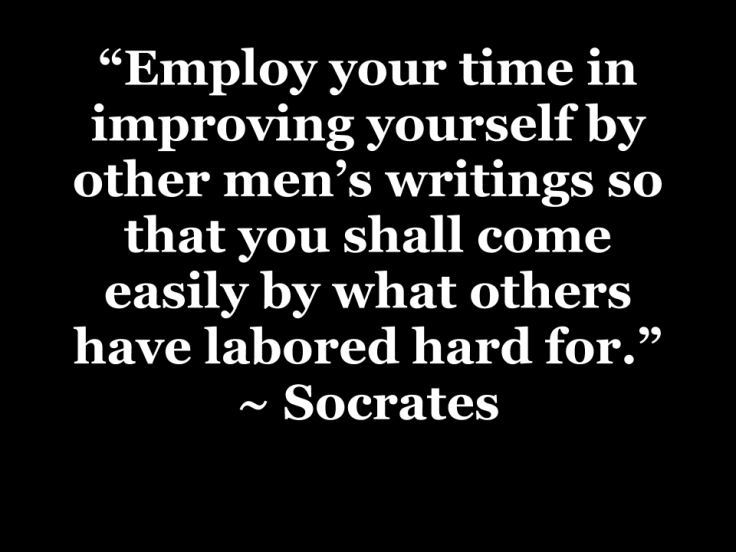
"Employ your time in improving yourself by other men's writings so that you shall come easily by what others have labored hard for." ~ Socrates

Go to the source: Holy Kaw! via Heady philosophical concepts illustrated with simple shapes.

Create your day!

Mastin Kipp shares this today…

“The quality of your life is DIRECTLY related to the amount of uncomfortable conversations you are willing to have.

Authentic expression means telling the truth. Your truth. What you think. How you feel. What you make up about what something means. What you see. What you don’t see. What you want to understand. This is authentic expression.

Sometimes it means admitting when you are wrong. Sometimes it means saying no. Sometimes it means opening your heart; sometimes it means setting a boundary and walking away.

We know inside. We always know.

When we make the outside world, other people’s opinions or forms more important than trusting our intuition and expressing ourselves authentically, we start to get off track. If we do it long enough, we begin to believe that things will never change because we don’t trust ourselves enough to make the change.

Most people live unrealized lives because they are too afraid to express themselves authentically. It takes courage. Not everyone is going to like it. You may make some people mad, piss some people off and make others happy beyond measure.” via The Daily Love — Create your day!.

Here’s Why It’s VITAL To Be 100% Self-Approved!

Mastin Kipp at The Daily Love has some good thoughts I’d like to amplify today…

With the uneducated approach to life, we tend to seek outward for things that are within us. Goals, intentions, desires, etc. are all well and good, but if the motive for why we want them goes unexamined, we can keep ourselves in a form of bondage.

One of the great mistakes in life is living life as an “If, then” statement. “If I get X, then I’ll be happy.” The goal is to be happy now.

So are you happy now? And if not, why not? Continue reading “Here’s Why It’s VITAL To Be 100% Self-Approved!”

10 Simple Ways to Find Happiness

An emoticon with a smile. For more emoticons i...

Mmmmm. Good thoughts from Barton Goldsmith at Psychology Today…

“We all want to feel happy, and each one of us has different ways of getting there. Here are 10 steps you can take to increase your joie de vivre and bring more happiness into your life: Continue reading “10 Simple Ways to Find Happiness”

…on Being Awesome and Negative

Can’t do it! Impossible…

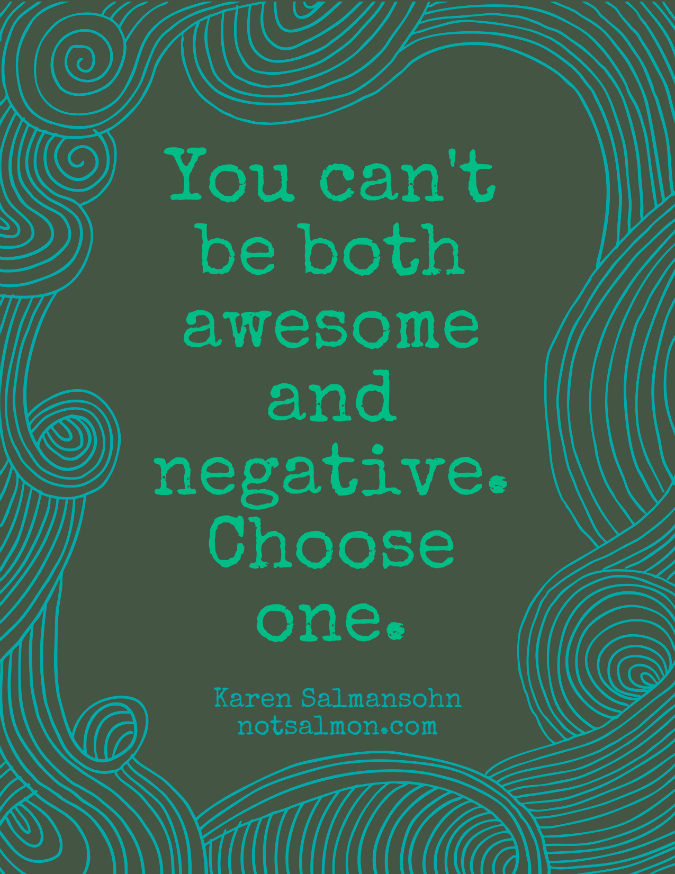
You can’t be both awesome and negative. Choose one. doodle awesome negative poster – notsalmon.

On possessions…

Road from Possessions Corner

How important is the stuff in your life?

Your material possessions—those things you’ve worked so hard for, slaving 40, 50, 60 hours a week to acquire—how much value do they actually add to your life?

We bet it’s less than you realize.

Here’s an exercise for you. Take a moment, write down your 10 most expensive material possessions from the last decade. Things like your car, your house, your jewelry, your furniture, and any other material possessions you own or have owned in the last ten years. The big ticket items.

Next to that list, make another top 10 list: 10 things that add the most value to your life. This list might include experiences like catching a sunset with a loved one, watching your kid play baseball, eating dinner with your parents, etc.

Be honest with yourself when you’re making these lists. It’s likely that both lists share zero things in common.

via The Minimalists | 10/10 Material Possessions Theory.

Every behavior and every thought has a consequence

PhotoReading David Kanigan’s blog led me to this gem by Kristin Cuthriell

“When you choose the behavior, you choose the consequences.  When you choose the thoughts, you choose the consequences.” –Dr. Phil McGraw

First, look at the consequences and decide.  Is this what I really want?

My dad once told me, “Remember what you know.” Through the years, I have found this to be great advice.  So many times we forget simple truths in life, things that we already know.  Often, I write about these simple truths to not only remind my readers, but to also remind myself of things that we already know and may have forgotten to practice in our lives.

Today I write about choices.

Every choice that we make is followed by a consequence.  Too often, we act impulsively, not taking the time to think through the possible repercussions of our actions.  We do not play the tape through, which means that we do not visualize the backlash of our thoughts and behaviors.  We simply act without thinking it through in its totality.

Whether our choices are impulsive or well thought out, the consequences will be the same. Take the time to play the tape through. The choices we make when emotions are high, we usually come to regret.  Take a moment to think it all the way through.

Source: Every Behavior and Every Thought Has a Consequence | Let Life in Practices

Go to the source if you’d like her list of ‘obvious things we forget’. Click the ‘follow’ button while you’re there!

Don’t let your fire go out!

Ayn Rand

“When one door of happiness closes, another opens; but often we look so long at the closed door that we do not see the one which has been opened for us.”

Helen Keller, was an American author, activist and lecturer.

“Do not let your fire go out, spark by irreplaceable spark…. Do not let the hero in your soul perish, in lonely frustration for the life you deserved, but have never been able to reach. Check your road and the nature of your battle. The world you desired can be won. It exists, it is real, it is possible, it is yours.”

– Ayn Rand, was the best selling author of The Fountainhead and Atlas Shrugged.

“Giving energy to the fantasy of your shame takes you places you don’t want to go. Anger, shame, remorse and sadness are all feelings that are related to the past. Worry & anxiety are more related to the future. This should illuminate the importance of becoming truly present through forgiveness & acceptance of oneself and others.”

– Tommy Rosen

via Today’s Quotes: Don’t Let Your Fire Go Out!.

Solitude: the benefits it brings

Solitude

Are you lonely or alone? Consider this…

“In a study of fifth through ninth graders, Reed Larson found that over time, the older children choose to spend more time alone. What’s more, their emotional experience was improved after they had spent some time on their own. Those adolescents who spent an intermediate amount of time alone – not too much, not too little – seemed to be doing the best psychologically.

The psychologists who really do get it about the sweetness of solitude are the ones I mentioned in my last post – Christopher Long and James Averill. The title of their key theoretical article is “Solitude: An exploration of the benefits of being alone.” No apology. No befuddlement that humans might actually benefit from their time alone.

Here’s how they characterize solitude:

“The paradigm experience of solitude is a state characterized by disengagement from the immediate demands of other people – a state of reduced social inhibition and increased freedom to select one’s mental and physical activities.”

Many readers made similar observations in the comments they posted to Part 1. Although there can be benefits to spending time with others, there can also be rewards to “disengagement from the immediate demands of other people.””

Source: The Benefits It Brings | Psychology Today.

Go to the source if you’d like to read the rest of the article. Me? This reminds me of the old adage about snow. If it comes to me, it’s work. If I go to it, it’s play. Same with being by yourself. If I choose it, it’s solitude. If I feel I have no choice, I’m lonely. What do you think?

Here’s How To End Suffering Once And For All

Love On The Rocks...lol

Mastin Kipp of The Daily Love shares this…

I am not saying that painful things in your past didn’t happen, but what I am saying is that they no longer have to be painful. And it’s not as easy as changing your mind once or twice. It takes work, and reps, like in the gym. But if you try and try enough over time, new life and new meaning can emerge.

One of the best ways I know how to do this is to take ourselves out of our own story and step into the thoughts, feelings and beliefs of the person who hurt us. Not so we can make right what they did, but so we can begin to understand the painful event from their point of view.

As I have guided clients through this process, the outcomes have been amazing. Forgiveness on a whole new level of themselves and others. And of VERY traumatic events.

The point of forgiveness is not to make right what happened, but to bring a new sense of empathy and compassion to all involved – this includes you.

The best way to get back at people who have hurt us is to forgive them, because that is how we break the bond over the painful event. And from there, when we step into their shoes of how they must have been thinking and feeling, we begin to understand that their actions were not truly against us, but a request for Love or Significance in a very messed up way; that was the best way that they knew how to at that time.

Source: Here’s How To End Suffering Once And For All!

Go to the source if you’d like the rest of his perspective on the issue…

It’s Not Your Thoughts That Matter, But How You Feel About Them!

Kute Blackson shares these thoughts today…

There is so much talk these last few years about how important your thoughts are.

It’s like the latest trend to believe…

That your thoughts literally create your reality.

That you must only think positive thoughts.

Sometimes we get so scared about the slightest negative thought, that it freaks us out. We become negative about our negative thoughts.

We have over 65,000 thoughts each day, most of which are happening too fast to even keep a track of.

I have a secret for you!

It’s the SECRET secret: It’s not just what you think about that matters, but how you FEEL about what you think about that makes the real difference. Continue reading “It’s Not Your Thoughts That Matter, But How You Feel About Them!”

Don’t Dwell on It, Revision It!

Rarely is dwelling on the past seen in a positive light. Nor should it be. Thinking too much about times gone by typically keeps your mind–and life–stuck in neutral (and maybe even shifts it into reverse). If you habitually ruminate over your earlier life, you may regularly be revisited by feelings of anger, guilt, resentment, sorrow, or shame. And such emotions are hardly productive. In many ways, they’re downright toxic. Fretfully obsessing about the people and events precipitating such negative feelings can lead to endless recycling. Becoming increasingly stagnant, or fixated, your thinking really can’t progress toward any adaptive resolution.

Moreover, returning to the past to rehearse old dissatisfactions and grievances–even to replay images of earlier triumphs–and idly preoccupying yourself with irreconcilable thoughts about them, can result in self-reproach, lamentation, remorse, and even bitterness. Using your mental energy for such a doubtful purpose can catapult you into the inextricable pit of woulda, coulda, shoulda. With the result that you can end up consumed with regret–what French existentialist, Albert Camus, has referred to as the most futile of emotions.

Yet, to be fair, dwelling on the past does have certain short-term advantages. For instance, you might become preoccupied with earlier events of success by way of rationalizing present-day frustrations and failures. If you haven’t been able to live up to the hopes of others–or to your own expectations–you might find temporary comfort in reliving past accomplishments. But while focusing on past positives may afford you some relief from current disappointments, by itself it does nothing to direct (or re-direct) your efforts to further your objectives in the here-and-now. And if you’re to realize your full potential in life, you need to squarely focus on what you can do right now to fulfill your promise–not on what you achieved in bygone times.

Source: The Past: Don’t Dwell on It, Revision It! Part 1 | Psychology Today

Go to the source if you’d like to read the rest of Leon Seltzer’s article…

Finding Our Own Truth

English: Woodland Light A shaft of sunlight fi...

Here is something I needed to hear from Melody Beattie today…

We must each discover our own truth.

It does not help us if those we love find their truth. They cannot give it to us. It does not help if someone we love knows a particular truth in our life. We must discover our truth for ourselves.

We must each discover and stand in our own light.

We often need to struggle, fail, and be confused and frus­trated. That’s how we break through our struggle; that’s how we learn what is true and right for ourselves.

We can share information with others. Others can tell us what may predictably happen if we pursue a particular course. But it will not mean anything until we integrate the message and it becomes our truth, our discovery, our knowledge.

There is no easy way to break through and find our truth. But we can and will, if we want to.

We may want to make it easier. We may nervously run to friends, asking them to give us their truth or make our dis­covery easier. They cannot. Light will shed itself in its own time.

Each of us has our own share of truth, waiting to reveal itself to us. Each of us has our own share of the light, wait­ing for us to stand in it, to claim it as ours.

Encouragement helps. Support helps. A firm belief that each person has truth available — appropriate to each situa­tion — is what will help.

Each experience, each frustration, each situation, has its own truth waiting to be revealed. Don’t give up until you find it — for yourself.

We shall be guided into truth, if we are seeking it. We are not alone.

Today, I will search for my own truth, and I will allow others to do the same. I will place value on my vision and the vision of others. We are each on the journey, making our own discoveries — the ones that are right for us today.

Source: March 16: Finding Our Own Ruth | Language of Letting Go

The Million Dollar Question

Million Dollar Question

Expectancy theory states, that which we focus on expands. If we continue to allow ourselves to focus on problems, we will actually have more problems. Conversely, asking and answering the question—what is one thing I can do differently that could make this better?—within sixty seconds of a problem arising, literally causes our level of optimism and success to grow.

Any time you catch yourself thinking about what is going wrong in your life, be relentless about asking this question (what is one thing I can do differently that could make this better?). Keep asking until you identify a potential solution to your problem.

The mere identification of a potential plan for a solution is helpful, as it breaks the negative cycle of thought. You will obviously need to put energy into the execution of the solution, but the essential first step in getting started is realizing that something can be done to improve any situation.

Source: The Million Dollar Question [BLOG] « Positively Positive

Go to the source if you’d like the rest of author Jason Selk’s perspective. I’m trying to apply this to a situation that happened yesterday; I received a horrible, hurtful, hateful email full of shame and blame from a friend. The worst part is that I actually have to consider whether or not some of it is true, and if so, what should I do about it. I’ll have to think about what Jason says…

Start a Blog at WordPress.com.

Up ↑