In an increasingly complex world, communication is key. Yet, many find themselves overwhelmed by the noise created by constant messaging. This is where exception-based communication shines, offering a streamlined approach that focuses on clarity, relevance, and efficiency.
“Each New Year brings awesome opportunities for personal growth. Now is the perfect time to make powerful change—your willingness is at an all-time high. To help you get a jump-start on your resoluting, I’m sharing thirteen happiness tips from my new book, May Cause Miracles: A 40-Day Guidebook of Subtle Shifts for Radical Change and Unlimited Happiness. Apply these principles, and you’ll kick off the New Year with power, commitment, and confidence. Each tip will greatly help you redirect your energy and learn to heighten an inner sense of power to let your outer life grow, expand, and flow.”New Year’s Tips That May Cause Miracles « Positively Positive
Relationships take work. Hard work. But the rewards to having a fulfilling relationship are MANY. Are you doing the things necessary to keep your relationship strong? Could it be stronger? Look for ways to improve your relationship today and everyday.
Focus on what you can change about yourself rather than concentrating on what your partner needs to change. Instead of approaching your partner with a “This is what you need to work on” approach- approach them with a “this iswhat we need to work on approach.” Then work on yourself regardless of the actions of your partner. You may be surprised to see what teaching by example can do for you and your relationship.
The more of these things you are doing- the healthier the relationship. Use this list to guide your growth rather than to judge your relationship. Just as no person is perfect, no relationship is perfect. Rather than demanding that you or your partner be perfect, look for areas of needed growth. See what you can do to improve the relationship with the one that you love.
Christine Hassler has a real beauty of a post today that I grabbed in its entirety for you…
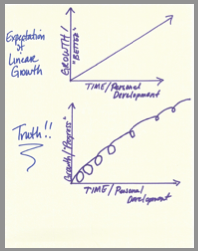
One of my pet peeves about the personal growth industry is that there is a lot of expectation placed on consistently making positive changes. The promise is that over time as we do our work, we gradually and continuously “get better” (whatever “better” means). What often isn’t addressed is that our learning and growth isn’t linear. It’s not a straight shot from an “aha” moment to being totally transformed.
Please don’t torture yourself by buying into the misunderstanding that your growth needs to be straight up. That’s a lot of pressure – and also not possible. Growth is more fluid. And over time the lows (or perceived backtracking) we experience become shorter in duration and the length of time in between them becomes longer. I drew this picture for you to illustrate what I am talking about:
The original image was kinda small; I think this is still legible…
The human experience is about contrast and sometimes the best way we learn is when we take a few steps that feel backwards. Often when we have a big “aha” so much to the extent that we feel transformed, the Universe will bring us a situation that feels very similar to past experiences. Often people get frustrated and think, “This again? I thought I learned this already!” That may be accurate; you may have learned the lesson and now the Universe is bringing you an amazing opportunity to practice the learning so that you can fully integrate it. I give some examples of this in today’s video.
If you feel like you are backtracking in your own behavior, choices, or feelings rest assured you are not flunking life. You learned from my UPdate last week that only about 95% of our processing power is conscious so there is a lot of subconscious programming that you are working through. Your so-called issues and programmed responses got implemented decades ago so it may take some time before you totally shift something. So if you find yourself slipping into old habits, reactions, behaviors or choices that you thought were behind you, cut yourself some slack.
Growth is a process not an event. You can’t upgrade yourself like you do your iPhone.
When you perceive yourself taking steps backwards, that does not mean change is not occurring. You may take ten steps forward and then eight steps back. But the next time you will take eleven steps forward and only seven steps back. You are making progress!! Whatever you do, just keep going. And forgive yourself! This is super duper important. Nothing will hold you back more than judging yourself and allowing your inner critic to have its way with you. Immediately say to yourself, “I forgive myself for judging myself for back-tracking. I’m doing the best I can.” Then re-commit to your vision and intentions and keep going.
Here are some of the points she makes I think are worthy of review…
“It’s not a straight shot from an “aha” moment to being totally transformed.”
“Only about 95% of our processing power is conscious so there is a lot of subconscious programming that you are working through”; this is why we say in Celebrate Recovery that we don’t claim perfection, only progress…
“Growth is a process not an event. You can’t upgrade yourself like you do your iPhone.” As a tech guy, there have been many times I have wished I could upgrade myself like hardware. If only I could reformat my brain and delete all the old Beatles‘ lyrics! I’d have so much more room! I do think, however, you CAN upgrade your thinking. There is an old computer programming acronym GIGO; Garbage In, Garbage Out. It applies to thinking and food as well…
And finally, this bears repeating…
“Nothing will hold you back more than judging yourself and allowing your inner critic to have its way with you. Immediately say to yourself, “I forgive myself for judging myself for back-tracking. I’m doing the best I can.” Then re-commit to your vision and intentions and keep going.”
And perhaps the most important lesson of all? Go easy on yourself and practice ‘self-forgiveness’…
“I’ve discovered that you can’t change people. They can change themselves.” Jim Rohn
We all want to be loved and accepted, just as we are. We want people to honor our interests, value our needs, and respect our choices in life.
So why, then, do we expect other people to sacrifice theirs for us?
Why do we hope people will change their goals, habits, and values to better align with ours when they haven’t given us any indication they’d be happier for doing it?
Why do we hope for it, bank on it, and then assume it will eventually happen just because of how badly we want it?
Sometimes we think we know what’s best for others, but if we’re honest with ourselves, we’ll likely realize we want people to change when it somehow benefits us.
I’m not talking about people who are violent, dangerous to themselves and others, or in any way abusive.
I’m talking about the boyfriend who isn’t as open-minded as you. Or the girlfriend who doesn’t value fitness like you. Or the husband who isn’t as social as you. Or the wife who doesn’t take risks like you.
I spent most of my twenties dating people who were completely incompatible with me.
I got involved with stoic men hoping they’d become more sentimental. I pursued self-professed bachelors hoping I’d be the one to make them want to commit. I even dated men who said they never wanted kids, hoping they’d change their minds because I did.
And why? Because those were the men who were there, and it felt safer to be with the wrong men than leave and risk not finding the right one.
Relationships are all about compromise, and there’s no such thing as a perfect match.
But we owe it to ourselves to recognize what’s non-negotiable in relationships so we don’t end up resentfully sacrificing our needs while secretly hoping the people we’re with will make it worth our while.
Do you enjoy learning new things? I certainly do.In particular, I enjoy about learning new ways to better myself and my relationships with others. When I first started on this quest I couldn’t get enough. I read about it all the time on blogs, online magazines and in books. There came a point where everything I read was just a slightly different version of the same thing. I was stuck.
I felt as though I had run out of things to read and ideas to try, yet I didn’t feel any better. I didn’t feel as though I was a better person or that my relationships with others had improved at all. There was something missing. It was the doing.
It wasn’t until I actually started applying what I had learned in the personal development realm to my own life that it started to make a difference. All the lessons, all the truths were suddenly having an impact. There was a huge difference in simply knowing it vs. actually doing it.
If you read all the books, blogs and articles on ice skating you would likely think it’s pretty easy, and it is … in theory. But strap on some skates and step on the ice for the very first time and my bets are that you’d be sitting on the ice a whole lot more than you’d be gracefully gliding around on it. It boils down to the old saying that practice makes perfect.
Here’s another reason I’ve found for ‘learning new things by doing’ — it makes me more sensitive to the learners in my life by reminding me how hard it can be to try anything new. What about you?







 Bright, shiny objects!
You must be logged in to post a comment.