Christmas Anxiety? 4 Ways Not To Sweat The Small Stuff

FinerMinds

Full story at: Christmas Anxiety? 4 Ways Not To Sweat The Small Stuff.

The Frustration Situation

Craig Harper shares these thoughts:

Frustration: it affects all of us at some stage. It’s a part of the human experience and it’s an emotion that doesn’t discriminate. We often find ourselves frustrated when things don’t turn out the way we expected or hoped they would or should. More often than not, our frustration is triggered by something (a situation, a conversation, a circumstance, a person, an event) which is beyond our immediate control.

Like that idiot who lives across the road.

Having said that, what is in our control, is our reaction. Like all emotions, frustration is a personal response to something that’s happening (or not happening, as the case may be) in our world. And while most people believe it’s the external stimulus that produces our internal response, in reality, our frustration is self-created. The challenge is not to overcome frustration (as such) but rather, to learn to manage it as opposed to being managed by it.

So, having worked with the frustrated multitudes for years, I thought I’d share a few suggestions that you might find helpful.

1. Don’t Try to Change People. Trying to change others (we’ve all done it) is an exercise in frustration and, at times, disconnection and aggravation. Giving people unwanted advice, direction or feedback (no matter how well-intended) will invariably end in tears. Either literally or metaphorically. Keep in mind that unwanted input or commentary is typically interpreted as criticism.

2. Stop Wasting Your Emotional Energy. Control what you can and let go of what you can’t. All too often, we invest our emotional energy into things (situations, circumstances, issues) over which we have little or no control. Not surprisingly, sending our blood pressure through the roof while screaming at a sporting event on television (for example) won’t change the outcome. Or the umpire’s stupid decisions. In fact, the only thing it might do is send us to an early grave. Oh, and possibly, annoy the crap out of everyone else within earshot.

3. Stop Juggling. Stop doing fifty things poorly and focus your time and energy on doing the important things well. That is, prioritise. I had to learn this lesson as I once had a propensity to bite off more than I could chew. Many of us simply take on more things than we can do well. Sometimes the answer is to put certain things on hold in order to be able to make progress in other areas. As a rule, over-commitment leads to exhaustion, anxiety and frustration. And eventually, physical illness. So, what’s the best use of your time, skill and energy right now? The answer to that question is your starting point.

4. Stop Aiming for Perfection. Aim for better. Aim for improvement. Aim for growth. Our society’s obsession with perfection has led to unrealistic expectations, unhealthy thinking, mass frustration and disappointment. Of course frustration will be the result when our goal is unattainable. When perfection is the goal, no result will ever be good enough.

5. Be Patient. Stop trying to reinvent yourself by next Tuesday. It took you a long time to get where you are now (practically, financially, emotionally, physically, psychologically, sociologically), so be realistic with your expectations as you work towards creating the new and improved version of you. I’m always amazed by people who have punished their body for decades (with atrocious eating, zero exercise and poor lifestyle habits) who then find a way to be disappointed and frustrated when they don’t look like a supermodel or elite athlete two weeks into their ‘weight-loss kick’. Good grief.

6. Stop Relying on Others to Get You There (wherever there is). It’s great to have support, encouragement and help along the way, but it’s not great to be totally dependant on others to make our dreams a reality. While it’s healthy to be part of a team of people who are all on the same page and all moving in the same direction, it’s still important for us to be functional, productive and effective on our own. Independent and strong. Being totally reliant on someone else (to reach our goals) is an exercise in both frustration and disempowerment.

7. Compare Yourself to Others – with Caution. Comparing ourselves to others rarely results in something positive. It can, but typically, it won’t. Invariably, it will focus our attention on what we don’t have or what we haven’t done and lead to self-pity and/or frustration. Having said that, it can work in our favour when we make it. Comparisons can be a positive when we use the achievements of others with similar attributes, potential and opportunities (to us) as a source of motivation, inspiration, learning and perspective for our own journey.

Now… deep breaths. :)

If you liked this article, subscribe to my blog and get a my FREE eBook, click here: I want a FREE eBook. You can also check out My Best Selling Book, and My Best Selling Video (Trailer).

Source: The Frustration Situation

The Secrets That Keep Happy Couples Together

Cynthia Belmer shares this:

What makes a relationship work? What can couples do to stay happy in their relationship, especially in this modern age with stress all around us?

Everyone wants to make their relationship last and everyone wants to feel loved, happy, and in harmony with their partner, but few experience it.

Harmony is about a mutual agreement of giving and receiving in the most balanced, loving and humble way, while maintaining the space needed for self-nurturing and self-love. You can realize it and live it in your relationship when you:

1. Become best friends. Understand the likes, dislikes, the fears, the pain and the gain of your partner and ask open-ended questions.

2. Explore your common vision for the future. Discuss your goals and your visions for the future. How does a great and lasting relationship look like to you? Follow through with this view and commit to realizing and nurturing it.

3. Be humble. Take responsibility of our own actions and say that you’re sorry when you mess up.

4. Be generous. Allow yourself to give with humbleness, to appreciate with love, to forgive with softness, to listen with care and to compromise while receiving your needs in return.

5. Invest in your own and constant self-growth. Follow through with your interests, your goals, your emotional needs and wants and share them with your partner.

6. Trust. Speak your truth, always and allow both of your fears to surface and share them gently together.

7. Listen and never forget. Listen very carefully to your partner and remember what interests them, what they enjoy, they dislike and most importantly, remember their stories.

8. Allow spaciousness. Give some alone time to yourself and your partner and do unique things that you enjoy and that make you feel good.

9. Get intimate. Express your love through hugging, kissing, caressing, cuddling, holding, and other forms of physical affection.

10. Have faith. Never give up on realizing the picture of a great relationship, especially when going through a big storm.

So my question to you is: If you were to make a change so you could live happily and in harmony in your relationship, what would you be doing?

via The Secrets That Keep Happy Couples Together.

Letting go of difficult people…

8017656512_520c03ee99_z
Every morning, I wake up. I make a strong pot of coffee. I drink it while reading 100 or so posts from some of my favorite bloggers. It’s always interesting to me when the messages from different bloggers seem to be in sync and it appears the universe is trying to teach me a lesson. Today is one of those days. First up is Kristin Barton Cuthriell who writes:

A client came to me the other day. She is chronically anger with her mother and has been for years. The anger is poisoning her. It is tearing her apart. She describes herself as nothing but a bitter shell of who she use to be. She is so consumed by her anger that she is shutting out all of the joy in her life (and there is a lot). I shared with her my lesson.

My lesson about life being precious and short- way too short to spend it full of contempt and resentment. The lesson that we learn when we have a near death experience, survive a life threatening illness, or lose a loved one.

Her mother is getting up there in years and is struck with an illness that is taking over her body. “Let go,” I stressed to my client. I moved my chair a little closer, but not too close. I looked my client in the eye, and with extreme passion, but a tone close to a whisper, I said, “It is time to let go. Enjoy the time that you have left with your mother.” My client’s eyes welled with tears, and she nodded yes. She knew, the time had come. The time to let go. The time to rid herself of the poison. The time to stop ruminating about the past. The time to reclaim her life. The time to let life in.

Are you poisoning yourself with resentment? Has the time come to let it go? Only you can really make that decision. Make it well. You deserve the best in life, but it is up to you.” via Letting Go – Kristin Barton Cuthriell.

Full disclosure? Kristin is a client, but I hunted her down because I like her content so much!

Next up is Melody Beattie. I have been starting my days with her book “The Language of Letting Go” for over a year now and I frequently curate her content. Today’s reading was more poignant for me than most:

Few things can make us feel crazier than expecting something from someone who has nothing to give. Few things can frustrate us more than trying to make a person someone he or she isn’t; we feel crazy when we try to pretend that person is someone he or she is not. We may have spent years negotiating with reality concerning particular people from our past and our present. We may have spent years trying to get someone to love us in a certain way, when that person cannot or will not.

It is time to let it go. It is time to let him or her go. That doesn’t mean we can’t love that person anymore. It means that we will feel the immense relief that comes when we stop denying reality and begin accepting. We release that person to be who he or she actually is. We stop trying to make that person be someone he or she is not. We deal with our feelings and walk away from the destructive system.

We learn to love and care differently in a way that takes reality into account.

We enter into a relationship with that person on new terms – taking our needs and ourselves into account. If a person is addicted to alcohol, other drugs, misery, or other people, we let go of his or her addiction; we take our hands off it. We give his or her life back. And we, in the process, are given our life and freedom in return.

We stop letting what we are not getting from that person control us. We take responsibility for our life. We go ahead with the process of loving and taking care of ourselves.

We decide how we want to interact with that person, taking reality and our own best interests into account. We get angry, we feel hurt, but we land in a place of forgiveness. We set him or her free, and we become set free from bondage.

This is the heart of detaching in love.

Today, I will work at detaching in love from troublesome people in my life. I will strive to accept reality in my relationships. I will give myself permission to take care of myself in my relationships, with emotional, physical, mental, and spiritual freedom for both people as my goal.” via Just For Today Meditations » Daily Recovery Readings – December 5, 2012.

Additions? Subtractions? This content is easy for me to share, but hard to implement…

Rule 12: Live in Alignment

feat-craigharper.pngCraig Harper writes:

“Living in alignment.” Have you heard this expression before? It gets thrown around quite a lot these days and to be honest, it can be one of those cheesey, over-used clichés that gets way too much mileage in an already-cheesey personal development landscape but at the risk of immersing both of us in mozzarella, I thought I’d share what it means to me and how creating and living a life of alignment can transform our day-to-day, multi-dimensional emotional, physical, psychological and practical existence for the better.

So, what does ‘living in alignment’ mean?

“Living in alignment means living a life which is reflective of, and in alignment with, our core values, beliefs and principles.”

Q. What’s the point of living in alignment?
A. Authenticity and happiness.

When our typical choices, behaviours, habits and outcomes are reflective of our core values, then we’re in balance. We’re being true to ourselves. Consciously living a life of alignment produces less stress, less frustration, less misery and even less physical illness. And, therefore, more peace, satisfaction, happiness and health.

Who’s out of alignment?

  • The girl who says she wants to be healthy but continues to smoke.
  • The guy who says he values fidelity but cheats on his partner.
  • The girl who expects loyalty from others but betrays her friends.
  • The guy who criticises others while ignoring his own faults.
  • The minister who doesn’t walk the talk.
  • The speaker who advocates work-life balance while working a million hours each week.
  • The personal trainer who preaches health and self-control during the week while abusing alcohol every weekend.
  • The person who loves nature but never leaves suburbia.
  • The highly-principled employee who turns a blind eye to unethical behaviour in the workplace.
  • Anyone who doesn’t listen to their body.
  • Anyone who ignores their inner wisdom.
  • Anyone who consciously compromises their values.

Sounds good in theory but…

While it all makes sense in theory, sometimes the practical reality of our life situation means that ‘living our values’ twenty-four-seven can be a major challenge. I agree. And that’s okay. Nobody said it would be easy or painless. Everything worthwhile comes at a cost. The question is whether or not we’re prepared to make the necessary investment. Sometimes, the price of alignment is high in the short term but totally worth it over the long haul.

Sometimes, choosing to live our values means taking a backward step in certain areas. It means getting uncomfortable and doing what scares us. It might mean changing, or even ending, certain relationships. It could mean ruffling a few feathers, getting noses out of joint and standing up for what we know is right (for us). Sometimes the right thing is not the easy thing and, sometimes, the only approval we need is our own.

By the way, people-pleasers rarely live in alignment because they are always compromising.

How did I end up here?

Sometimes, we allow certain situations, circumstances, expectations (of others) and relationships to gradually come between us and the life we want to build and inhabit. We don’t do it intentionally or consciously but we do it. Most of us have woken up at some stage of our journey only to say something like “how on earth did I end up in this place (literally or metaphorically)? This wasn’t my plan. This wasn’t my intention. This isn’t who I want to be.”

So, how can you live a life of alignment?

Step 1: Get clear about your core values, beliefs and principles (not anyone else’s, yours).
Step 2: Build a life around those things. No matter what.

Is it easy? Not always.
Possible? Yes.
Worth it? Definitely.

If you liked this article, subscribe to my blog and get a my FREE eBook, click here: I want a FREE eBook. You can also check out My Best Selling Book, and My Best Selling Video (Trailer).

Source: Rule 12: Live in Alignment

By the way, if you want some help on discovering your core values, I strongly recommend this 5 minute video I curated earlier this week…

How to Spot A Narcissist and Walk Away

medicating-menKelly O’Brien writes this:

Most of us have been in a relationship with a narcissist. Perhaps you’ve been sucked in by a self-absorbed family member, a spouse, a boyfriend, a co-worker, or a friend.

Perhaps you thought it was your fault when the narcissist left you feeling diminished and full of despair.

The truth is, your only “fault” was getting involved with the narcissist in the first place!

Learning to spot this toxic behavior before it hurts you is crucial to your health. A huge part of wellness is surrounding ourselves with healthy people and healthy relationships. If we have unhealthy relationships, we need to assess whether or not they can transform, or we must find the strength to walk away.

So, let’s talk about how to spot a narcissist and how to walk away from one.

Here Are 6 Qualities of a Narcissist:

  1. He or she rarely takes responsibility for problems and instead blames them on everyone else.
  2. The narcissist expresses little emotion, particularly during conflict with you. When you do express emotion, he or she blames you for doing so. It’s a subtle form of abuse.
  3. He or she drains you, but thrives on your energy. Consider how much energy you are expending on this relationship… my guess is that it’s your effort keeping the relationship alive. You’re most likely exhausted emotionally and physically because you do all of the planning, all of the apologizing, and all of the work to ‘fix’ what is wrong.
  4. This person is charming, often a flirt, and thinks very highly of himself.
  5. This person is irresponsible with his finances, career, drinking, and/or keeping his home in order.
  6. Jekyll & Hyde: This person is so incredibly endearing, but when you say one thing wrong, she snaps at you. You walk on eggshells wanting to do everything right.

Once you have determined that you are with a narcissist, the wisest thing to do is to walk away.

Why?

There is no reasoning with this individual. You will inevitably lose every single argument and end most conflicts thinking everything was your fault. You will end up apologizing. You will end up in counseling and you will be the one to end up losing your self-esteem.

You can avoid all of this!

Go here to learn how: How to Spot A Narcissist and Walk Away

Express your power gently

Cover of "The Tao of Pooh"

Melody Beattie writes:

Express your power naturally and as gently as you can.

When I started learning what it meant to take care of myself and to own my power, I talked loudly, spoke up, and yelled in order to set boundaries, limits, and to express myself. That was the way to get my point across. That’s how I’d showed people I meant what I said.

I had to say it loudly.

About five years after I started this process of learning what it meant to own my power, I met a bear called Winnie the Pooh. The book that introduced me was The Tao of Pooh. Lights started coming on. The seeds of new lessons began to sprout.

To own my power, I could quietly say what I meant. The clearer I was about what I had to say and who I was, the less I had to shout. Owning my power wasn’t something I had to plan out, premeditate, and obsess about.

The more I took care of myself and connected to myself, and the clearer I became, the more natural and easier it became to own my power. My power–including setting limits, saying no, refusing to be manipulated, and saying I’d changed my mind– often became a natural, graceful, timely expression of me.

There are still times in our lives when we have to be firm, sometimes forceful, and repeat what we’ve said, sometimes loudly. The quieter and more relaxed we can be when we say what we mean is usually in direct proportion to how much we believe in ourselves.

Let your power, boundaries, and expressions of who you are arise naturally.

Learn and respect the value of responding as gently, but as firmly, as you can.

God, help your power flow through me. Teach me to take care of myself gently, in a way that reflects harmony with myself and as much as possible, the people in my life.” via Just For Today Meditations – Maintaining A Life.

45 Characteristics of Healthy Relationships + The Secret to Applying Them

Sometimes, when I start curating content, I don’t know when to stop. In those times, only copying and pasting will suffice! Kristen Barton Cuthriell writes:

Is your relationship healthy?

Relationships take work.  Hard work.  But the rewards to having a fulfilling relationship are MANY.  Are you doing the things necessary to keep your relationship strong?  Could it be stronger?  Look for ways to improve your relationship today and everyday.

Characteristics of Healthy Relationships

  1. You can be your true self with the other.
  2. Communication is spontaneous and open.
  3. There is a balance of closeness and separateness.
  4. You are able to take responsibility for your own behaviors without blaming your partner for your actions. (Get rid of “He/she made me do it.”)
  5. You discuss and negotiate rather than fight.
  6. You feel comfortable sharing your fears and insecurities.
  7. Rules and boundaries are clear, yet flexibility exists.
  8. You don’t lie, but you also refrain from using hurtful language in the name of being brutally honest.  (Don’t say something just to be mean.)
  9. You enjoy doing things for yourself, as well as for the other.
  10. Personal growth is encouraged.
  11. You make it through rough times without splitting up or threatening divorce.
  12. You treat each other the way you would like to be treated.
  13. You have a strong sense of interdependence rather than dependency or co-dependency. (Equality within the relationship)
  14. There is play and humor in the relationship.  You have fun together.
  15. You enjoy being together, but are able to spend time alone.
  16. You do not attempt to control each other.
  17. Each is trustful of the other.
  18. Privacy is respected.
  19. You both refrain from passive-aggressive behavior. (Silent treatment, hanging up phone, being late when the other is waiting)
  20. You forgive each other for mistakes.
  21. You actively listen to the other. (Really hear what the other is saying)
  22. You both are able to apologize. (Even when you do not think you are at fault, you can be sorry that your partner is feeling hurt.)
  23. You avoid mind reading and making assumptions.  When upset you both seek clarity.
  24. You are able to validate each other- even when you disagree. (You recognize that the opinions and feelings of the other are important.)
  25. There is a balance in giving and receiving.
  26. Conflict is faced and resolved.  Avoid allowing resentment to take hold.
  27. Negotiations are fair and compromise is present.  Create win-win resolutions.
  28. Mistakes are accepted and lessons are learned.
  29. You NEVER bring up the intimate disclosures of the other when angry or arguing.  Intimate disclosures are off-limits.
  30. Humility is present.  You are able to give up always being “right.”  Don’t let your ego get in the way.
  31. You are willing to make sacrifices for the other.
  32. You speak each other’s love language even when it differs from your own.
  33. You share mutual activities and interests.
  34. You NEVER call each other names or physically assault one another.
  35. You have strong friendship.
  36. You encourage and support each other. (“I have got your back.”)
  37. In conflict, you respect your partner’s need for a time out.  (Time to calm down and think rationally before resolving an issue.)
  38. You do not expect your partner to complete you.  You are secure in your own worth and want to share your life with them.
  39. Physical contact is mutually enjoyed.
  40. Appreciate each other’s strengths and overlook each other’s idiosyncrasies.
  41. Both are open to constructive feedback.
  42. Other meaningful relationships and interests are present.
  43. You have similar values, but do not demand that the other have the same values as you. (Mutual respect exists)
  44. You are willing to take risks and be vulnerable.
  45. You avoid intentionally hurting the other because you have been hurt.  No tit for tat.  No keeping score of grievances.

The Secret to Applying Them

Focus on what you can change about yourself rather than concentrating on what your partner needs to change.  Instead of approaching your partner with a “This is what you need to work on” approach- approach them with a “this is what we need to work on approach.” Then work on yourself regardless of the actions of your partner.  You may be surprised to see what teaching by example can do for you and your relationship.

The more of these things you are doing- the healthier the relationship.  Use this list to guide your growth rather than to judge your relationship.  Just as no person is perfect, no relationship is perfect.  Rather than demanding that you or your partner be perfect, look for areas of needed growth.   See what you can do to improve the relationship with the one that you love.

Source: 45 Characteristics of Healthy Relationships + The Secret to Applying Them – Let Life in Practices

(When) Are You Neurotic?

I find it interesting that Dr. Gregg Henriques’ title implies many of us are a bit neurotic from time to time; reading his article may help some ‘get a grip’:

Although the term “neurotic” has more recently fallen out of favor, it was used by psychiatrists for most of the 20th Century to describe a broad category of conditions that were associated with poor functioning, anxiety and depression, but were clearly differentiated from “psychotic” in that in contrast to individuals in the latter category, neurotics maintained contact with reality and were rarely engaged in highly deviant, socially unacceptable behavior. (A factoid worth noting is that the term “borderline”, of borderline personality disorder fame, originated from the conceptual space between neurotic and psychotic. Originally, borderline individuals were those who generally maintained contact with reality, but under duress exhibited extreme volatility and primitive defenses and were not good candidates for psychoanalysis).

Get more here: (When) Are You Neurotic? | Psychology Today

I agree with Dr. Henriques when he says later in the article “The importance of understanding the meaning of “neurotic” in terms of character adaptations is that we are all neurotic some of the time, even if we might be low on trait Neuroticism.” Reading the rest of his thoughts gave me some valuable insights…

Create Healthy Habits!

Take 21 days to create a new healthy habit and the habits you create will take care of you! With what healthy habits would you like to start the new year? A year from now, you’ll wish you had started today…

Oh, and by the way if you’re a geeky type you might want to look into tools like Habitforge to get you started!

image via Visual Inspiration: Create Healthy Habits!.

8 Tips for Dealing with Difficult Relatives During the Holiday Season

Gretchen Rubin has some valuable insight for those who struggle with the holidays for one reason or another:

Holidays can be tough. Some people love them; some people dread them.

I thought a lot about the holidays as I was writing Happier at Home, because the holiday season tends to be a time when we focus on home. Maybe you’re going “home” the way I go home to Kansas City for Christmas–which may be fun for you, or not. Maybe you’re deciding how to decorate your home. Maybe you’re making an effort to arrange the holidays the way you experienced them as a child–or the opposite. Maybe you’re feeling sad, or happy, about whom you will or won’t be seeing.

From talking to people, it seems that one of the biggest happiness challenges of the holidays is dealing with difficult relatives. You want to have a nice dinner, but Uncle Bobby makes you crazy. What to do?” Get the answer here: 8 Tips for Dealing with Difficult Relatives During the Holiday Season. « The Happiness Project.

The Freedom (and Challenge) of Detachment

Detach660

Danielle Robinson has some valuable insights on the topic of detachment I’d like to share with you:

Most spiritual teachers worth their salt, including all the popular ones (Deepak, Eckhart, Osho), speak in depth about attachment.

Being aware of our impending deaths practically since birth, we humans cling to life and our possessions as though we can bring them with us into the next phase. We cannot. And thank the universe, because that would all be quite burdensome.

There’s a fine line between defining and adhering ourselves to our accomplishments, beliefs and opinions, jobs, loved ones, homes and other assets; and severing all ties between us and those outside “things.”

I’d never want to live life aloof, indifferent or apathetic, but that’s not what detachment implies.

Detachment implies acceptance, specifically of life’s transience. We cannot predict or control another and therefore, we’re bound to be surprised and disappointed by many in our lifetime. How we process this delight or disturbance indicates our level of attachment to outside influences.

I’ve had my heart broken and it sucked, royally. If the me now could talk to the me then, I’d say, “He wasn’t what you’d hope he’d be, someone else is. Move the f*ck on, idiot. “

I am mean to myself sometimes. I’m very, very blunt. I spent three years attached to my heartache and disconnected with thousands of potentially great human beings because of it. My attachment to what was left me incapable of embracing what is or open to what could be. I glued myself to the past. If this happened to me today, I’d allow time to mourn and be sad, but you bet your ass I’d be keeping myself in line toward a better future, and more importantly, a happier present.

No one owes us anything. That’s the hard part to accept.

Get the rest of Danielle’s thoughts here: The Freedom (and Challenge) of Detachment

imho, detachment is one of the most important skills a healthy person can master and I have so far to go. This book has been a great help in showing me what healthy dependency actually looks like…

No more drama

I’m not a big Mary J. Blige fan, but this song is a good reminder that you don’t have to play a role in other people’s dramas if you don’t want to…

As a bonus, here’s the other music video of hers [along with U2] that I really like…

Owning Our Power

Melody Beattie writes:

Don’t you see? We do not have to be so victimized by life, by people, by situations, by work, by our friends, by our love relationships, by our family, by ourselves, our feelings, our thoughts, our circumstances.

We are not victims. We do not have to be victims. That is the whole point!

Yes, admitting and accepting powerlessness is important. But that is a first step, an introduction to this business of recovery. Later, comes owning our power. Changing what we can. This is as important as admitting and accepting powerlessness. And there is so much we can change.

We can own our power, wherever we are, wherever we go, whoever we are with. We do not have to stand there with our hands tied, groveling helplessly, submitting to whatever comes along. There are things we can do. We can speak up. Solve the problem. Use the problem to motivate ourselves to do something good for ourselves.

We can make ourselves feel good. We can walk away. We can come back on our terms. We can stand up for ourselves. We can refuse to let others control and manipulate us.

We can do what we need to do to take care of ourselves. That is the beauty, the reward, the crown of victory we are given in this process called recovery. It is what it is all about!

If we can’t do anything about the circumstance, we can change our attitude. We can do the work within: courage­ously face our issues so we are not victimized. We have been given a miraculous key to life.

We are victims no more unless we want to be.

Freedom and joy are ours for the taking, for the feeling, for the hard work we have done.

Today, I will remind myself as often as necessary that I am not a victim, and I do not need to be victimized by whatever comes my way. I will work hard to remove myself as a victim, whether that means setting and enforcing a boundary, walking away, dealing with my feelings, or giving myself what I need. God, help me let go of my need to feel victimized.

Source: November 18: Owning Our Power | Language of Letting Go

I’ve seen a lot of good TEDTalks…

…but right now, this one strikes me as one of the best I’ve ever seen! Dr. Brene Brown on vulnerability…

Thanks, Tim Kastelle!!!

Timing…

Melody Beattie writes:

Wait until the time is right. It is self-defeating to postpone or procrastinate; it is also self-defeating to act too soon, before the time is right.

Sometimes, we panic and take action out of fear. Sometimes, we take untimely action for revenge or because we want to punish someone. We act or speak too soon as a way to control or force someone to action. Sometimes, we take action too soon to relieve feelings of discomfort or anxiety about how a situation will turn out.

An action taken too soon can be as ineffective as one taken too late. It can backfire and cause more problems than it solves. Usually, when we wait until the time is right – sometimes only a matter of minutes or hours – the discomfort dissolves, and we’re empowered to accomplish what we need to do.

In recovery, we are learning to be effective.

Our answers will come. Our guidance will come. Pray. Trust. Wait. Let go. We are being led. We are being guided.

Today, I will let go of my need to control by waiting until the time is right. When the time is right, I will take action.

Source: Just For Today Meditations » Daily Recovery Readings – November 12, 2012

Two Techniques To Hack And Control Your Emotional “Database”

The folks at Finerminds share this:

“There are two things that people want to be able to do to improve their emotional life. You want to be able to choose what you become emotional about and when you become emotional. That’s number one. And the second is, you want to be able to choose how you act when you are emotional.”

Here’s the truth: nature didn’t give us any tools to control our emotions. But psychologist Paul Ekman is telling us that there are, in fact, two researched techniques you can use to access your “your emotional alert database.” One of these can even let you hold back your inner “attack dogs” and delay rash actions to provocative situations.

They’re not exactly ninja techniques, but they will get you very close to monk-like control over your impulses. And let’s face it – if you do eventually gain control over what you react emotionally to, how you react and when not to react – you’re pretty much a ninja over the one area most humans have little control over: their emotions.

Watch this 9-minute video of Paul Ekman that we found on the Big Think channel on YouTube to find out what these two techniques are. And let Paul’s steady delivery convince you to take up the challenge.

Two Techniques To Hack And Control Your Emotional “Database” | FinerMinds.

Expect Nothing; Get Everything

Life is rarely what we expect it to be. Sometimes, it’s better than we expect. Other times, it just is as it is.

Set your expectations to zero, show up at 110% every day, and your positive attitude will drive your 110% experience of life.

Moreover, you won’t be depleting precious mental energy by beating yourself and others up because you’re disappointed and angry at not having your expectations met.

Having low expectations does not mean that you don’t “go for it,” establish goals, or have visionary dreams. Setting your expectations to zero means that you are able to minimize your emotional setbacks that deplete and drain your vision of valuable energy. When you’re able to accept the outcome as it is, then you can rise from any fall, thus increasing your personal power of resiliency to move forward more quickly. When you give it your best shot and you miss, it’s not seen as a failure. Instead, it’s just another opportunity to step up to the plate and do it better next time.

When your child tries out for an activity and doesn’t make the “A” list, then you encourage him or her by saying: “It’s ok. Practice some more; enjoy what you are doing, and try, try, try again.” Life as an adult is no different. The game of life is like a sport; it takes practice. And the practice here is giving it your very best shot and accepting the end result without engaging in negative thoughts that lead you to feeling low. On playing fields, this is called good sportsmanship. In life, it’s called having a winning attitude.

Expect nothing and you’ll have everything. Strive every moment you’re alive to bring an attitude of excellence and integrity to your actions and words, and the end result will reflect the brilliance you bring.

You will find that if you can go with the flow then it’s far easier to be in the flow.

Get the rest here: Expect Nothing to Have Everything « Positively Positive

10 Things to Stop Caring About Today

Royale Scuderi has a post that I thought was so good I curated the whole thing for you:

stop caring

Some things you can feel free to stop caring about

Other people’s expectations for your life

This is your life. You are the one who has to live it. You have to live with the consequences of the decisions you make and the actions you take, so you should make them according to what you want for and from your life, not what someone else thinks you “should” do with your life. We care way too much about what other people think about us and far too little about what we think about ourselves.

How much you weigh

It’s just a number people! We live in such a weight-obsessed culture that our weight is often a measure by which we are judged and worse by which we judge ourselves. I’m not saying to stop caring about being healthy, that’s a completely different thing, and one definitely worth worrying about. Just don’t fixate on the number on the scale. Care about healthier food choices, care about how strong you are, how much exercise you’re getting, just stop attaching your value, your success, your confidence, your attractiveness and your health to this one single number.

How other people live

Let other people live their own lives, just as you’d like to be able to live yours. Stop judging what other people do and how they live. That’s their business. If it doesn’t affect you, stop caring about it. Stop comparing what you have, how you look, the money, the status, the possessions, the beauty to what you “think” others have. Don’t measure yourself against other people, measure yourself against your own yardstick.

How many Facebook friends you have

Same goes for Twitter followers. The number of social connections you have is not a good indicator of either the strength of your network or your true popularity. True connections are measured by the quality of interactions and the people you who actually care about you and what you have to say. How people respond to you and share with you is a far better indicator or your social status.

Perfection

We suffer so much anguish caring about being perfect. Perfection is nearly unattainable and our striving for it, costs us so much. Perfect is a waste of time, perfect is unreasonable, perfect is a recipe for stress. Pretty darn good is a better goal. It’s usually more than good enough and far less stressful. (Note: If you’re a brain surgeon or a pilot, please try for close to perfect, but as long as you leave my gray matter in place and get me on the ground safely, I’m good.)

Aging

You can’t stop the clock. It’s a fact, no matter how much you worry about it or how much money you spend trying to hide it, time is going to keep right on ticking and taking you along with it. Stop caring about how old you are. It’s not a good measure of the quality of life anyway. Or maybe it is…Studies have shown that people are actually happier as they age. So stop caring about your biological age and wrinkles (whether you have them or worry about getting them,) and start caring about what how you want to live the years you have left.

Fitting in

We place too much value on conformity. If you like to listen to jazz and wear purple shoes, go for it. If you are the sculptor in a family of accountants, good for you. No make-up, big jewelry, cowboy boots, bow tie, thrift store clothes, dinner on cushions, no TV…it’s all fine. You’re not hurting anyone, and though they may judge you, that’s their problem, not yours.

Star Watching

Why are we so obsessed with celebrities? From reality shows to magazines, entertainment news shows to paparazzi photos, clothing lines to hairstyles, we are so infatuated with the lives of the rich and famous. Why? Are we so unhappy in our own lives that we have to get our excitement and pleasure by watching public figures live theirs? Stop wasting your time caring about what famous people do, good, bad, crazy, sad or fabulous. It has nothing to do with you. It’s only a distraction from your own life.

Being right

We all want to be right. It must be intrinsically bred into our DNA, but more times than not, it’s very destructive. When we’re striving to be right, we’re focused on proving other people wrong. We’re grasping for power by trying to prove our infallibility. Care about finding solutions, collaborating with others to find the best answers, and cultivating relationships. Care about the result, not who is right or wrong.

Anything you can’t control

Stop caring about things you can’t control. If there’s nothing you can do to impact the person or the situation, then don’t waste your energy. There are so many important things in your life, in this world that you can affect. Focus on what you can change, where you can have the most impact, make a difference, and let the rest go.

Source: 10 Things to Stop Caring About Today

Thanks for your excellent thoughts, Royale – hope you don’t mind that I promoted your content here…

Accepting love…

Melody Beattie write:

Many of us have worked too hard to make relationships work; sometimes those relationships didn’t have a chance because the other person was unavailable or refused to participate.

To compensate for the other person’s unavailability, we worked too hard. We may have done all or most of the work. This may mask the situation for a while, but we usually get tired. Then, when we stop doing all the work, we notice there is no relationship, or we’re so tired we don’t care.

Doing all the work in a relationship is not loving, giving, or caring. It is self-defeating and relationship defeating. It creates the illusion of a relationship when in fact there may be no relationship. It enables the other person to be irresponsible for his or her share. Because that does not meet our needs, we ultimately feel victimized.

In our best relationships, we all have temporary periods where one person participates more than the other. This is normal. But as a permanent way of participating in relationships, it leaves us feeling tired, worn out, needy, and angry.’

We can learn to participate a reasonable amount, and then let the relationship find it’s own life. Are we doing all the calling? Are we doing all the initiating? Are we doing all the giving? Are we the one talking about feelings and striving for intimacy?

Are we doing all the waiting, the hoping, and the work?

We can let go. If the relationship is meant to be, it will be, and it will become what it is meant to be. We do not help that process by trying to control it. We do not help the other person, the relationship, or ourselves by trying to force it or by doing all the work.

Let it be. Wait and see. Stop worrying about making it happen. See what happens and strive to understand if that is what you want.

Today, I will stop doing all the work in my relationships. I will give myself and the other person the gift of requiring both people to participate. I will accept the natural level my relationships reach when I do my share and allow the other person to choose what his or her share will be. I can trust my relationships to reach their own level. I do not have to do all the work; I need only do my share.” Source: Just For Today Meditations – Maintaining A Life

Questions? Feedback?

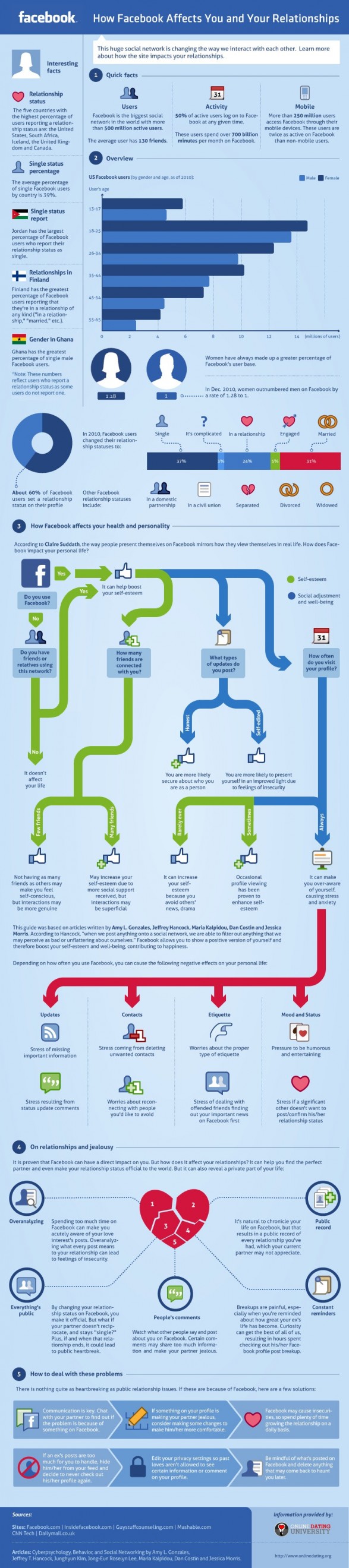
How Is Facebook Affecting Your Relationships?

FinerMinds

via How Is Facebook Affecting Your Relationships? (Infographic).


Start a Blog at WordPress.com.

Up ↑