“So often, when a problem occurs, inside or around us, we revert to thinking that if we put our life on hold we can positively contribute to the solution. If a relationship isn’t working, if we face a difficult decision, if we’re feeling depressed, we may put our life on hold and torment ourselves with obsessive thoughts.
Abandoning our life or routines contributes to the problem and delays us from finding the solution.
Frequently, the solution comes when we let go enough to live our life, return to our routine, and stop obsessing about the problem.
Sometimes, even if we don’t feel like we have let go or can let go, we can act as if we have, and that will help bring about the letting go we desire.
You don’t have to give up your power to problems. You can take your focus off your problem and direct it to your life, trusting that doing so will bring you closer to a solution.
Today, I will go on living my life and tending to my routine. I will decide, as often as I need to, to stop obsessing about whatever is bothering me. If I don’t feel like letting go of a particular thing, I will act as if I have let go of it until my feelings match my behavior.” via Language of Letting Go – May 18 – Don’t Stop Living Your Life – SoberRecovery : Alcoholism Drug Addiction Help and Information.
Don’t overdo it
“So, you surrendered. You let go. Now you’re ready to face a particular challenge. So you hunker down and garner all your forces. And you hit the wall again.
“What’s wrong?” you may ask. “I’m doing all the spiritual things I’m supposed to do. And things still aren’t working. I can’t get anywhere.”
Did you ever try to get a key to unlock a door, and you tried and tried, and the key just wouldn’t open it? The harder you tried, the more frustrated you became. So you stopped trying for a while, relaxed, and tried again. Voila. The key fit perfectly and the slightest turn unlocked the door.
Many of us live our lives that way While some people may not try at all, we may be trying too hard. There’s a gentler way of being in the world, of trying things, doing things, going about our business.
Whether I’m tackling a specific project, enjoying a new relationship, or grinding through some miserable situation, my first inclination is to force myself and try too hard. If one cup of tea tastes good, I’ll drink five. If I want to express love or concern for someone, I’ll overdo it.
“If it’s worth doing, it’s worth doing well,” doesn’t mean if it’s worth doing, try harder and harder. Doing it well means relaxing and letting the actions unfold—gently, naturally without force. We don’t have to make things happen. We can learn to take our part in letting them happen. It is really okay to ease up a little. We don’t have to think that hard, try that hard, feel that hard, do quite so much. Pull back a little. Relax.
When force and trying harder doesn’t do it, try something else.
Value: “Easy does it” is the value this week.” via May 16.
Climb the highest mountain
“We can climb the highest mountains and navigate the darkest valleys. We can do anything. Just not all at once.” Melody Beattie via May 15 | Language of Letting Go.
Eating life one bite at a time
“Thank God for the ability to break life down into days.
Gratitude Focus: We can start and end each day by being grateful for everything that happened in it and the help we encountered along the way.” via May 14.
Codepedence is not just an issue for partners of addicts
 I don’t normally curate this much content in one ‘swell foop’ as I like to say but Melody Beattie’s perspective on owning your own stuff and Mark Brower’s comments on same were so good I couldn’t find anything to exclude. Mark starts out and then quotes my ‘Language of Letting Go’ reading for today…
Many of us struggle with codependency. When addiction is present in a relationship, the old model was that the addict was “dependent” and his or her spouse was “codependent.” But today we know that usually both the addict and spouse struggle with codependency in its various forms.
Codependency happens when we lose touch with our sense of self, and become over-dependent on how other people are doing, and/or how they perceive us. Since we are not “okay” with ourselves, we have to work overtime to ensure that other people around us are doing okay, and/or that they feel good about us.
So we wind up tolerating things we shouldn’t tolerate, feeling responsible for things we shouldn’t feel responsible for, and compromising what we want simply in order to please someone else. This inevitably leads to distress and frustration, which causes the addict to move deeper into their addiction, and for the addict’s spouse to cope in other ways.
The issue of codependence is complicated for Christians, because it gets mixed up with our desire to love and serve other people. The Bible tells us to “consider others better than ourselves.” But the same Bible also tells us to love our neighbor as ourselves, which presupposes some sort of healthy self-regard. The Bible also portrays Jesus himself taking time away from the crowds – not being “nice” and doing what they want him to do – in order to rest and reconnect with God the Father.
The trick to living a recovery life in relationships with others is to know how to separate healthy love with unhealthy codependence.
Melody Beattie has been a great help for me over the years with her many books on this topic. One of her best books on this topic is a daily meditation book called “The Language of Letting Go.”
In another article on this blog, I wrote about codependence, and quoted at length from her book. But it’s so good and helpful that I want to quote some more! What follows are some excerpts about the issue of “Property Lines”:
A helpful tool in our recovery, especially in the behavior we call detachment, is learning to identify who owns what. Then we let each person own and possess his or her rightful property.
If another person has an addiction, a problem, a feeling, or a self-defeating behavior, that is their property, not ours. If someone is a martyr, immersed in negativity, controlling, or manipulative, that is their issue, not ours.
If someone has acted and experienced a particular consequence, both the behavior and the consequence belong to that person.
People’s lies, deceptions, tricks, manipulations, abusive behaviors, inappropriate behaviors, cheating behaviors, and tacky behaviors belong to them, too. Not us.
People’s hopes and dreams are their property. Their guilt belongs to them too. Their happiness or misery is also theirs. So are their beliefs and messages.
If some people don’t like themselves, that is their choice. Their choices are their property, not ours. What people choose to say and do is their business.
What is our property? Our property includes our behaviors, problems, feelings, happiness, misery, choices, and messages; our ability to love, care, and nurture; our thoughts, our denial, our hopes and dreams for ourselves. Whether we allow ourselves to be controlled, manipulated, deceived, or mistreated is our business.
In recovery, we learn an appropriate sense of ownership. If something isn’t ours, we don’t take it. If we take it, we learn to give it back. Let other people have their property, and learn to own and take good care of what’s ours.
Today, I will work at developing a clear sense of what belongs to me, and what doesn’t. If it’s not mine, I won’t keep it. I will deal with myself, my issues, and my responsibilities.
If you want to learn more about codependence, consider signing up for the Recovery Journey, an e-course for people in recovery from sexual struggles. If you are the partner of someone who struggles, note that we have a special module with materials just for the partners. You can learn more about this program at the website: http://recoveryjourney.com
Source: Codepedence is not just an issue for partners of addicts | sexualsanity.com
Codependence is a constant battle for me and it has made made my wife’s vacation in Italy even more difficult than the simple logistics of trying to run a business and hold down the fort with 4 boys while she’s gone but by the grace of God, with the help of Celebrate Recovery, my good friends Sandy and Steve and Melody Beattie’s good thoughts. we are winning on this trip! If these issues resonate with you, drop me a note below. I’ll be happy to share with you what I have…
Related articles
- Fear & Codependency (toddlohenry.com)
- …on Control (toddlohenry.com)
- …on feeling good (toddlohenry.com)
- The Reality of Recovery, Part 2 (carolynswords.wordpress.com)
- When to stop enabling and start disabling (spreadinformation.wordpress.com)
One day at a time…
“It’s easy to look at all the tasks and unsolved problems and feel so pressured that we get paralyzed and don’t get anything done. It takes discipline to gather in our scattered forces and focus on one thing, one day, one step, and sometimes one hour—even when taking only that one step can seem so trivial in the face of all that looms.
Would you rather try to do everything at once and get nothing done, or take one small step and do that well? Remember, one plus one equals two.
Inventory Focus: Are you creating unnecessary fear and drama by taking on more than you can handle? Are you willing to trade in the I’m-out-of-control-and-overwhelmed feeling for a sense of manageability? Do you have any history with deliberately living life one day or one step at a time? How did that work? Plans, goals, and dreams are good, but the only way to get there is one day at a time.” via May 12.
Perfection?
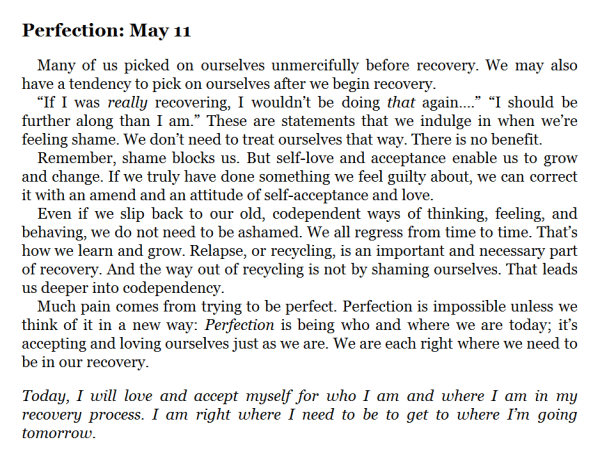
Another great perspective from Melody Beattie…
Easy does it…
“I watched a friend set up beach chairs and an umbrella. He was grunting, groaning, trying with all his might to accomplish a simple task. After he finished, he looked around and clapped the sand off his hands.
“I’m pretty dumb,” he said. “It didn’t have to be that hard or that much work.”
Yes, life really can be easier. Relaxing and letting it unfold can seem too simple and easy at times. What if we really knew that it was okay to gently go about our lives, living and working and handling things at a relaxed pace? What if we knew it was okay to gently take care of ourselves, and that a force would be present to guide us and help us accomplish each task, each problem, in fact, all the parts of our lives?
Life experience truly has taught me that when I relax, I am so much more capable of experiencing great happiness as well as simple joys. Things get done, problems get solved, and my needs get met.
Gratitude Focus: We can be grateful for all the situations that teach and remind us that “easy does it” works.” via May 11.
…on One Day at a Time
“Arc you always this happy?” I asked my favorite clerk at the grocery store.
“I am today,” he said.
Doing anything forever – even being happy – can seem like too much. The good news is that we don’t have to do anything forever. Just today.
Challenge: The hardest part about taking life one day at a time is remembering that the present moment is all we have.” via May 10.
…on One Day at a Time
“One day at a time” isn’t a value I acquired because I wanted to. I had to. Now I apply it because I want to.
Application: Sailing through life? Falling in love? Plenty of money? Or maybe things aren’t going that well. Lonely? Dealing with relationship issues? Not sure how the relationship will work out?Your boss is driving you nuts, but you don’t want to quit? Concerned about your child? Whatever circumstances we find ourselves in, taking each day as it comes is a good idea.” via May 9.
…on Taking One Day at a Time
More Melody Beattie…
“My best friend was going through some tough situations in her life. I was in the midst of a hard stretch too. We didn’t particularly like the things we had to do in our lives. We talked about our feelings and decided that what we were going through was necessary and important, even though we didn’t like it.We expressed gratitude for our lives.
“It’s still a dreadful time,” I said.
“Brutal,” she said. “I guess we’re back to the old one day-at-a-time approach. We’re so lucky. What do people do that haven’t learned that gem?”
There are times when we can look at the stretch ahead and like what we see. Taking life one day at a time is still a good idea, even when things are going well.
Taking life one day at a time can be particularly useful when the road ahead looks dreadful. We may not even know where to start with some challenges. That’s when taking life one day at a time is essential.
“I’ve been using alcohol and other drugs every day since I’ve been twelve years old,” I said to my counselor years ago in treatment. “Now you’re telling me I need to stay sober the rest of my life. Plus get a job. And a life. How am I going to do that?”
“One day at a time,” she said. She was right. Sometimes I had to take life one minute at a time or one hour at a time. And all these years later, it still works.
Value: Taking life one day at a time is the gem we’ll focus on this week.” via May 8.
Fear & Codependency
“Fear is at the core of codependency. It can motivate us to control situations or neglect ourselves. Many of us have been afraid for so long that we don’t label our feelings fear. We’re used to feeling upset and anxious. It feels normal. Peace and serenity may be uncomfortable. At one time, fear may have been appropriate and useful. We may have relied on fear to protect ourselves, much the way soldiers in a war rely on fear to help them survive. But now, in recovery, we’re living life differently. It’s time to thank our old fears for helping us survive, then wave good-bye to them. Welcome peace, trust, acceptance, and safety. We don’t need that much fear anymore. We can listen to our healthy fears, and let go of the rest. We can create a feeling of safety for ourselves, now. We are safe, now. We’ve made a commitment to take care of ourselves. We can trust and love ourselves.
God, help me let go of my need to be afraid. Replace it with a need to be at peace. Help me listen to my healthy fears and relinquish the rest.” Beattie, Melody (2009-12-15). The Language of Letting Go (Hazelden Meditation Series) (p. 127). Hazelden. Kindle Edition.
…on feeling good
Today I’ll be working hard on making myself feel good even though my wife is far away and I miss her terribly. What ‘feel good challenge will you over come today?
Related articles
- Owning our Power (toddlohenry.com)
- Go easy (toddlohenry.com)
- Feeling Good (toddlohenry.com)
- On Making Yourself Do Uncomfortable Things! (toddlohenry.com)
- Rise to the Occasion (toddlohenry.com)
…on Control
Melody Beattie has a good reminder I needed to hear this morning…
“Control is an illusion, especially the kind of control we’ve been trying to exert. In fact, controlling gives other people, events, and diseases, such as alcoholism, control over us. Whatever we try to control does have control over us and our life. I have given this control to many things and people in my life. I have never gotten the results I wanted from controlling or trying to control people. What I received for my efforts is an unmanageable life, whether that unmanageability was inside me or in external events. In recovery, we make a trade-off. We trade a life that we have tried to control, and we receive in return something better—a life that is manageable. Today, I will exchange a controlled life for one that is manageable.
Beattie, Melody (2009-12-15). The Language of Letting Go (Hazelden Meditation Series) (pp. 125-126). Hazelden. Kindle Edition.”
…on Blessing
Melody Beattie posts…
“I was out with a married couple for dinner, when the husband sneezed.
“God bless you,” I said.
He sneezed again. “Bless you,” I said.
Then he sneezed again and again.
“He sneezes all the time,” his wife said. “I think he does it on purpose. He just wants people to bless him.” “Who doesn’t want that?” I said.
My first experience with the value of blessing people happened in the early years of my sobriety. I wanted a job that someone else was given. I felt envious and resentful. Twelve Step programs and religions teach us a basic formula to cure ill will: pray for those you resent. Pray for God to shower blessings and happiness on those people. Pray for these blessings each time the resentment—or any hint of ill will enters your mind.
So I did. I prayed twenty or more times a day because that is how often I resented this person. I didn’t feel like praying for blessings. I decided to pray because the envy and bitter feelings were consuming me.
Over a period of months, I watched the situation transform. This person became my friend and mentor.
I eventually got a new position that I really wanted. I learned two things. Other people don’t have anything that belongs to me. And praying for blessings on people is a double whammy. They get blessed, and so do we.
Blessings are not just a tool to cure ill will and resentment—although that would be plenty. Blessings, like gentle rain or sunshine, are in this world for all. Don’t wait for people to sneeze to bless them. Be an active participant in spreading goodwill.
Value: Blessing our enemies, our loved ones, and ourselves is the value for this week.” via May 1.
…on Making Yourself Do Uncomfortable Things!
“Many of us do not understand what we are responsible for and what we are not responsible for. We may believe we have to get into a tizzy when someone has a problem because it is our responsibility to do that. However, at the heart of most rescues is a demon: low self-worth. We rescue because we don’t feel good about ourselves.. caretaking provides us with a temporary hit of good feelings, self-worth, and power. Just as a drink helps an alcoholic momentarily feel better, a rescue move momentarily distracts us from the pain of being who we are. We don’t feel loveable, so we settle for being needed. We don’t feel good about ourselves, so we feel compelled to do a particular thing to prove how good we are.” ~ Melody Beattie via Today’s Quotes: What Joy!? Make Yourself Do Uncomfortable Things!.

You Are a Work of Art
Melody Beattie shares this today….
All the arts we practice are apprenticeship. The big art is our life. ~ M. C. Richards
What you do is not who you are.
You are more, much more, than that.
It’s easy to get so caught up in what we do that we’re only identifying ourselves through our daily tasks. I am a mechanic. I am a parking lot attendant. I am a doctor. I am a dishwasher. When we link ourselves too closely to our jobs, we deny ourselves the chance to ever be anything else. We limit ourselves by believing that’s all we are and all we’ll ever be.
Our concept of who we are is one of the hardest, but most rewarding, ideas we can change. If you have been brought up believing that you are clumsy, you will probably demonstrate this belief in your actions—until you identify that idea, let go of it, and let yourself be something else.
Don’t limit yourself by saying you are just what you do. Stop seeing yourself as a static being. If I am “just” a parking lot attendant, then how can I hope to ever influence someone through my words, my art, my music, my life? But if I am a vital, living, growing soul who happens to be parking people’s cars, then everything I do can become a symphony. I can have an influence for good in the lives of everyone I touch. I can learn from them, and they from me. I can learn the lessons that I am supposed to learn at this place in my life, and I can move on to other lessons.
God gave us the power to change. You’re more than what you do. You’re a vital vibrant soul that came here to experience, grow, and change. Make a masterpiece out of your life.
God, help me realize the glory of my soul. Thank you for my mortality and for the ability to learn and grow.
Source: April 24: You are a Work of Art | Language of Letting Go
Remember to Take Care of Yourself

Here’s a moral with a story from Melody Beattie…
Jenna started dating a new man. Like many women, she was a little frustrated with all the losers that had come along before. She thought she’d put this one to the test. She wanted to see how good he’d be to her.
So when he called her up and asked her what she wanted to do, she told him she thought he should take her on a little trip.
“Hawaii would be nice,” she said. “You get us the tickets. And find someplace nice for us to stay when we get there. I don’t want to be in a cheesy hotel.”
He had enough money in the bank. The trip, she thought, would be exquisite and luxurious. She envisioned the first-class air travel, the limos, and the home he’d rent complete with maid service and a cook.
When the day of the trip arrived, they took a taxi, not a limo, to the airport. And when she boarded the airplane, he led her back to coach. When the flight attendant came around asking if people wanted to rent movies, her boyfriend shook his head and went back to reading his book. She had to dig out the four dollars to pay for the movie.
She sat scrunched up in her seat, all the way to Hawaii. When they got there, he took her to a time-share condo. Then he drove her in the rental car to the grocery store and said, “Pick out what you want to cook.”
Throughout the vacation she spent a lot of time stewing in her head, but when they got home, she decided to give him one more chance.
So when he called her up and asked her what she wanted to do Friday night, she said she thought a movie would be nice. She hung up the phone, then dressed up and did her hair. She thought maybe he’d take her to a nice theater.
He picked her up, then drove to the nearest Blockbuster. “Go in and pick out whatever video you’d like to rent,” he said. “Do you want to watch it at your place or mine?
The moral of this story is twofold and simple. The first lesson is if you know exactly what you want, you need to spell it out clearly. The second is that it’s better not to expect people to take care of us. Even if they agree to do it, we might not like how they do the job.
While it’s nice to have people love us and do things for us, it’s better to plan on taking care of ourselves.
God, help me remember that it’s my job to take care of myself.
Source: April 18: Remember to Take Care of Yourself | Language of Letting Go
Hmmmm…
Lately I’ve been learning a lot about expectations. I think the simplest way to avoid disappointment is not to have them. Or, as Melody points out if you DO have expectations “you need to spell it [them] out clearly” or be prepared to meet them yourself…
Related articles
- On taking care of your self… (toddlohenry.com)
- You are Responsible for You (toddlohenry.com)
- Owning our Power (toddlohenry.com)
- You have the power (toddlohenry.com)
- Go easy (toddlohenry.com)
Taking Care of Ourselves
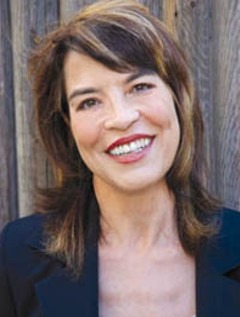
In The Language of Letting Go Melody Beattie says…
“We often refer to recovery from codependency and adult child issues as “self-care.” Self-care is not, as some may think, a spin-off of the “me generation.” It isn’t self-indulgence. It isn’t selfishness—in the negative interpretation of that word. We’re learning to take care of ourselves, instead of obsessively focusing on another person. We’re learning self-responsibility, instead of feeling excessively responsible for others. Self-care also means tending to our true responsibilities to others; we do this better when we’re not feeling overly responsible. Self-care sometimes means, “me first,” but usually, “me too.” It means we are responsible for ourselves and can choose to no longer be victims. Self-care means learning to love the person we’re responsible for taking care of—ourselves. We do not do this to hibernate in a cocoon of isolation and self-indulgence; we do it so we can better love others, and learn to let them love us. Self-care isn’t selfish; it’s self-esteem. Today, God, help me love myself. Help me let go of feeling excessively responsible for those around me. Show me what what I need to do to take care of myself and be appropriately responsible to others.”
Beattie, Melody (2009-12-15). The Language of Letting Go (Hazelden Meditation Series) (pp. 105-106). Hazelden. Kindle Edition.
Feel free today to take care of yourself…
Related articles
- You are Responsible for You (toddlohenry.com)
- Go easy (toddlohenry.com)
- On taking care of your self… (toddlohenry.com)
- Owning our Power (toddlohenry.com)
- Thursday Quote – Melody Beattie (elizaggie.wordpress.com)
You are Responsible for You
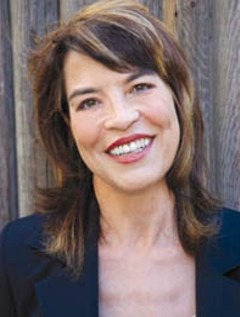
More from Melody Beattie:
We can delegate tasks, but we can’t delegate responsibility, if the responsibility is really ours.
Sometimes, it’s normal to delegate tasks to other people. We may hire people to do certain things for us. We may engage in contracts with a therapist or a healer to help us work through a certain issue. But the responsibility for which pieces of advice we follow, and the decisions we make in our lives, ultimately belongs to us.
It’s easy to get lazy. We can let a friend, an employee, or even a skilled therapist begin making our decisions for us. We can listen to what they say and blindly take their advice. Then we don’t have to take responsibility for our lives. If the decision doesn’t work out, we can say, “You were wrong. Look at the mess you’ve gotten me into. I’m a victim, again.”
Yes you are. But you’re a victim of yourself.
We can listen to advice and let other people help us, but if they’re helping us do something that is our responsibility, the ultimate responsibility for the decision still belongs to us.
Get help when you need it. Delegate tasks. But don’t give away your power. Remember you can think, you can feel, you can take care of yourself, you can figure out your problems.
Don’t get lazy. Don’t give away responsibility for your life.
God, help me remember that I am responsible for me.
Source: April 17: You are Responsible for You | Language of Letting Go
Related articles
- Owning our Power (toddlohenry.com)
- Go easy (toddlohenry.com)
- On taking care of your self… (toddlohenry.com)
- Feeling Good (toddlohenry.com)
- You’re Being Protected (toddlohenry.com)
Own Your Life

A valuable message from Melody Beattie…
Are you willing to take responsibility for this mat, to own it? That doesn’t mean it isn’t everybody else’s mat, too. If you’re big enough to own the mat as yours, you’re big enough to let it be theirs, too.
— George Leonard
In his book The Way of Aikido, George Leonard wrote about the concept of owning the mat. He was talking about aikido. He was referring to an air of ownership, a certain presence he learned to demonstrate both on the mats while practicing martial arts and in his life.
Many subtle attitudes and past conditioning can affect our sense of ownership of our lives and of the world we live in—guilt, a haunting sense of victimization, laziness, living with repressive, angry, or abusive people may have tamed our sense of ownership of our lives. Continue reading “Own Your Life”
 Bright, shiny objects!
You must be logged in to post a comment.