Insisting on the Best

Melody Beattie writes:

We deserve the best life and love has to offer, but we are each faced with the challenge of learning to identify what that means in our life. We must each come to grips with our own understanding of what we believe we deserve, what we want, and whether we are receiving it.

There is only one place to start, and that is right where we are, in our current circumstances. The place we begin is with us.

What hurts? What makes us angry? What are we whining and complaining about? Are we discounting how much a particular behavior is hurting us? Are we making excuses for the other person, telling ourselves we’re “too demanding”?

Are we reluctant, for a variety of reasons, especially fear, to tackle the issues in our relationships that may be hurting us? Do we know what’s hurting us and do we know that we have a right to stop our pain, if we want to do that?

We can begin the journey from deprived to deserving. We can start it today. We can also be patient and gentle with ourselves as we travel in important increments from believing we deserve second best, to knowing in our hearts that we deserve the best, and taking responsibility for that.

Today, I will pay attention to how I allow people to treat me, and how I feel about that. I will also watch how I treat others. I will not overreact by taking their issues too personally and too seriously; I will not under react by denying that certain behaviors are inappropriate and not acceptable to me.” Source: Language of Letting Go – July 16 – SoberRecovery : Alcoholism Drug Addiction Help and Information

Family Buttons

Melody Beattie writes:

“I was thirty five years old the first time I spoke up to my mother and refused to buy into her games and manipulation. I was terribly frightened and almost couldn’t believe I was doing this. I found I didn’t have to be meant. I didn’t have to start an argument. But I could say what I wanted and needed to say to take care of myself. I learned I could love and honor myself, and still care about my mother – the way I wanted to – not the way she wanted me to.” –Anonymous

Who knows better how to push our buttons than family members? Who, besides family members, do we give such power?

No matter how long we or our family members have been recovering, relationships with family members can be provocative.

One telephone conversation can put us in an emotional and psychological tailspin that lasts for hours or days.

Sometimes, it gets worse when we begin recovery because we become even more aware of our reactions and our discomfort. That’s uncomfortable, but good. It is by beginning this process of awareness and acceptance that we change, grow, and heal.

The process of detaching in love from family members can take years. So can the process of learning how to react in a more effective way. We cannot control what they do or try to do, but we can gain some sense of control over how we choose to react.

Stop trying to make them act or treat us any differently. Unhook from their system by refusing to try to change or influence them.

Their patterns, particularly their patterns with us, are their issues. How we react, or allow these patterns to influence us, is our issue. How we take care of ourselves is our issue.

We can love our family and still refuse to buy into their issues. We can love our family but refuse their efforts to manipulate, control, or produce guilt in us.

We can take care of ourselves with family members without feeling guilty. We can learn to be assertive with family members without being aggressive. We can set the boundaries we need and want to set with family members without being disloyal to the family.

We can learn to love our family without forfeiting love and respect for ourselves.

Today, help me start practicing self care with family members. Help me know that I do not have to allow their issues to control my life, my day, or my feelings. Help me know it’s okay to have all my feelings about family members, without guilt or shame.

Source: Detachment – Cyber Recovery Social Network Forums – Alcohol and Drug Addiction Help/Support

Go to the source for additional self-care thoughts on attachment and detachment.

Detachment breaks the bond

Santa Maria degli Angeli (Assisi)

“Joy fixes us to eternity and pain fixes us to time. But desire and fear hold us in bondage to time, and detachment breaks the bond.” Simone Weil.

We live both in the material realm and the spiritual. In our material dimension we seek material pleasures, inherent in which is pain. Our human emotions are tied to our material attachments, and joy, at its fullest, is never found here. Real joy lies outside of the material dimension while living fully within us too, in the secret, small place inside where we always know that all is well.

We are on a trip in this life. And our journey is bringing us closer to full understanding of joy with every sorrowful circumstance. When you or I are one with God, have aligned our will with the will of God, we know joy. We know this, fully, that all is well. No harm can befall us.

Each circumstance in the material realm is an opportunity for us to rely on the spiritual realm for direction, security, and understanding. As we turn within, to our spiritual nature, we will know joy.

Every day in every situation I have an opportunity to discover real joy. It’s so close and so ready for my invitation.” via Just For Today Meditations » Daily Recovery Readings – June 28, 2012.

When Things Don’t Work

Melody Beattie writes:

Frequently, when faced with a problem, we may attempt to solve it in a particular way. When that way doesn’t work, we may continue trying to solve the problem in that same way.

We may get frustrated, try harder, get more frustrated, and then exert more energy and influence into forcing the same solution that we have already tried and that didn’t work.

That approach makes us crazy. It tends to get us stuck and trapped. It is the stuff that unmanageability is made of.

We can get caught in this same difficult pattern in relationships, in tasks, in any area of our life. We initiate something, it doesn’t work, doesn’t flow, we feel badly, then try the same approach harder, even though it’s not working and flowing.

Sometimes, it’s appropriate not to give up and to try harder. Sometimes, it’s more appropriate to let go, detach, and stop trying so hard.

If it doesn’t work, if it doesn’t flow, maybe life is trying to tell us something. Life is a gentle teacher. She doesn’t always send neon road signs to guide us. Sometimes, the signs are more subtle. Something not working may be a sign!

Let go. If we have become frustrated by repeated efforts that aren’t producing desired results, we may be trying to force ourselves down the wrong path. Sometimes, a different solution is appropriate. Sometimes, a different path opens up. Often, the answer will emerge more clearly in the quietness of letting go than it will in the urgency, frustration, and desperation of pushing harder.

Learn to recognize when something isn’t working or isn’t flowing. Step back and wait for clear guidance.

Today, I will not make myself crazy by repeatedly trying solutions that have proven themselves unsuccessful. If something isn’t working, I will step back and wait for guidance.” via Just For Today Meditations » Daily Recovery Readings – June 28, 2012.

Starting over again…

Melody Beattie writes:

Divorce. Breaking up. Moving. A new job. Getting sober. Stopping using or abusing drugs. Discovering we’re codependent, and redefining ourselves, our relationships (including our relationship with ourselves) and our behaviors. Finding out we have a chronic illness, and we need to center our lives around it. Empty nest syndrome (yes, it’s real).

We wake up in the morning and before we go to bed that night, our lives have been irrevocably changed. They’ll never be the same again.

Sometimes we lose it all (or almost all of it) all at once. A friend from many years back woke up one morning. That day, he discovered that his wife of 15 years had been cheating on him from day
one; that neither the son nor his daughter he thought belonged to him were his; and that day, his business went belly-up.

Some people may call it “reorganization.” Others name it a “new beginning.” Most of the time I hear it described like this: “Sigh. I’m starting all over. Again.”

I hate it, at least in the beginning. We’re walking in the dark and living in the mystery. We don’t have a clue about what’s next. Sometimes we may wonder if we’re dying – the transformation feels that profound. Usually the person isn’t dying – not in the physical sense. But the changes taking place can be so profound that the experience feels similar to a death.

Times it feels like our heart has been broken. If we tell people that, they may look at us like we’re overplaying the drama queen role, but recently Mayo Clinic identified “Broken Heart Syndrome” as a legitimate physical illness. A broken heart, which can be caused by the loss of a loved one or an overload of stress, shows itself with symptoms similar to those of a real heart attack. These symptoms may include heart pain that worsens with each heartbeat; difficulty breathing or shortness of breath; and nausea or vomiting.

I went out to do errands. Around lunch-time, I decided to find someplace to eat. I had driven out of my usual neighborhoods and didn’t recognize the mall I pulled into, at least not at first. Then I saw it – the restaurant where we celebrated my son, Shane’s last birthday – the one two days before the date of his death.

The pain hit hard and fast – right in my chest. I felt paralyzed. My hands gripped the steering wheel. I couldn’t move them to rummage around in my purse and find my cell phone. Movement of any kind hurt too much. I couldn’t even roll down my window and yell, “Help.” I’d rate the pain as a ten on the pain scale from one to ten.

For just over one hour I sat in the same position, leaning forward, clutching the steering wheel, stopped in my tracks by this pain in my heart. Then slowly the debilitating pain began to subside. I
didn’t get out of the car; I went home instead. A week later I went to my doctor. (This was before the identification of Broken Heart Syndrome as an actual physical illness.) The doctors made me stay overnight.

The diagnosis? “It’s the strangest thing,” the doctors said. “For all purposes, it looks like you had a myocardial infarction (heart attack). But then, it also doesn’t appear as though you actually suffered from a heart attack. It left the doctors scratching their heads but I’d known from the minute – the second – the nurse at the Emergency Room asked me if I had someone I could call after Shane’s
accident that his death had broken my heart.

Don’t rely on self-diagnosis. If your heart hurts, get a checkup.

Then, when your body stabilizes – which it will – you can get on with the business of Starting Over Again (SOA). One idea that may be helpful: although it feels like you’re starting over again, is remembering you’re not really starting over. Life is a continuum. You’re either jolted or sliding into the next experience. You’re moving on.

Here are a few tips for those of you in that uncomfortable place of SOA when you thought the last time you started over would be the last, only to find yourself SOA.

  1. Let yourself grieve your loss or losses. You don’t need to be so stoic. Give yourself room to be human. What you’re going through may be extremely difficult and it may hurt. But you will get through it.
  2. Remind yourself that what you’re going through won’t last forever. If you have to leave post-it notes around the house, then do it. Remember other times you’ve started over, and how you got through those experiences? Draw on what you learned, including that you did survive that devastating time.
  3. Give yourself time to cocoon. No, you’re not isolating. You’re resting, giving your body a chance to adapt to this sudden change.
  4. Tell your story as often as you need to, and tell it to people who will listen and care. While some people may accuse us of obsessiveness, telling our story over and over is an important way we integrate the unthinkable into our life story.
  5. Set goals. In the beginning, start by writing a list of what you want or need to accomplish just that day. Take life in small chunks. After some time passes, begin writing goal lists that go further into the future. For now, while you’re in shock, a list for today is enough.
  6. Be kind to yourself. There may be days when all you accomplish is getting out of bed and taking a shower. Instead of focusing on how little you did, tell yourself you did great – because you did.
  7. Slowly, as new people and interests come into your life, be willing to say “yes” to opportunities. I never fail to be amazed at how either a person or an interest that I think is just a “time killer” slowly becomes a major part of my new life.
  8. If you need help, ask.
  9. If you need to cry or get angry, cry or get angry. You may even be furious with your Higher Power. That’s okay. You’ll work it out further down the road.
  10. Know there is no one right way to start over. We have tools, not rules. Now is the time to dig into your toolbox and use what you’ve been given: living in the present moment; prayer; meditation; exercise (when your body can handle it); detachment (which involves feeling all your emotions); and sometimes Acting As If. Know that if the emotions become too intense, you can shut them down for a while without going into denial. Something as simple as taking a shower, going into another room, or going to the grocery store can help you stop falling deeper into what may feel like a bottomless pit of pain.

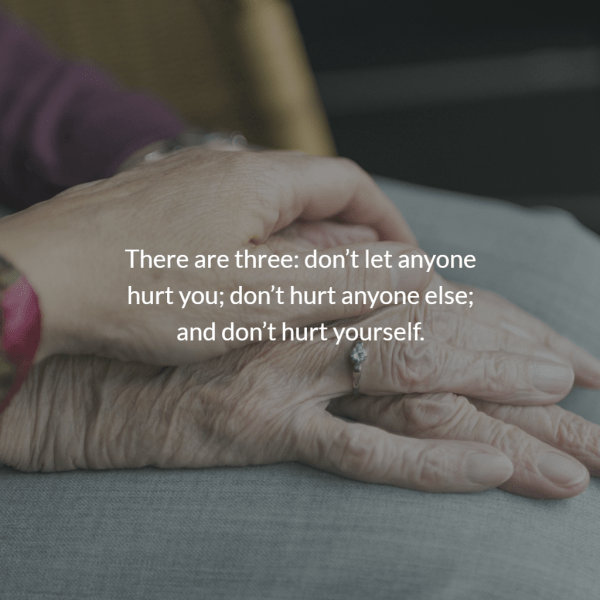
Although I said there aren’t any rules, I lied. There are three: don’t let anyone hurt you; don’t hurt anyone else; and don’t hurt yourself.

You will get through this – I promise. It might not happen as quickly as you want it to or it may happen so quickly it surprises you. But one morning you’ll wake up and find yourself living in a new normal instead of waking up to a blast of pain from what you’ve lost. Instead, your new life will be there, fully formed. You’ll be living it.

You’ve done it. You started over again, whether you wanted to or not. Now the next time you need to start over, you’ll be more prepared.

From the Desk of Melody Beattie

Related articles

Denouncing

“There is nothing as easy as denouncing. It don’t take much to see that something is wrong, but it takes some eyesight to see what will put it right again.” Will Rogers.

We come to this day with a choice of whether to be for something or against it. Shall we put energy into what we seek and admire or shall we give our energy to opposition and resistance of what we dislike? If someone asks a favor, we have a choice to resent and resist the intrusion or to engage with the person and see where it might lead. If a project we are working on is frustrating, we can wallow in criticizing it or try to get a clearer picture of what will work and what we want.

Criticizing may be a helpful first stage in learning, but it is seductive because it holds little risk and we feel safe doing it. In that comfort we forget to go forward to create what we really want. Our negative energy, when we are seduced by it, creates negative results. When we look back upon today, we will admire those choices that risked creating something positive.

Today, I will not give my energy to denouncing but to creating what I believe is worthwhile.” via Just For Today Meditations » Daily Recovery Readings – June 30, 2012.

Into Orbit

Melody Beattie writes:

“It doesn’t matter if they’re hurting themselves. It doesn’t matter that we could help them if they’d only listen to, and cooperate with, us. IT DOESN’T MATTER, DOESN’T MATTER, DOESN’T MATTER, DOESN’T MATTER.” Codependent No More

I think I can change him. Nobody’s ever really loved him and appreciated him before. I’ll be the one to do that, and then he’ll change.. .. She’s never been with anybody trust­worthy before. I’ll prove how trustworthy I am, and then she’ll be able to love. . . . Nobody’s been able to get to her, to conquer her, before. I’ll be the one to do that … Nobody’s ever really given him a chance. . . . Nobody’s ever really believed in him before….

These are warning signs. Red lights. Red flags. In fact, if we’re thinking these thoughts, they need to be stop signs.

If we have gotten hooked into believing that somehow we will be the one who will make the difference in someone’s life, if we are trying to prove how good we can be for some­one, we may be in trouble.

This is a game. A deception. It won’t work. It’ll make us crazy. We can trust that. We’re not seeing things clearly. Something’s going on with us.

It will be self-defeating.

We may be “the one” all right — the one to wind up victimized.

The whole thought pattern reeks of codependency, of not being responsible for oneself, and of victimization. Each per­son needs to do his or her own work.

Nobody in the past has really understood him…. Nobody has seen what I see in her…. It’s a set-up. It sets us up to stop paying attention to ourselves while we focus too much on the other person. It takes us away from our path and often puts us in orbit.

Nobody has appreciated him enough…. Nobody has been good enough to her, or done for her what I can do…. It’s a rescue. It’s a game move, a game we don’t have to play. We don’t have to prove were the one. If we’re out to show people we’re the best thing that ever happened to them, it may be time to see if they’re the best thing that ever happened to us.

We have not been appointed as guardian angel, god­mother, godfather, or “the one who will.”

The help, support, and encouragement that truly benefits others and ourselves emerges naturally. Let it.

God, help me let go of my need to meet dysfunctional challenges in my relationships.” via June 29: Into Orbit.

The Gift of Readiness

Melody Beattie is one of America's most beloved self-help authors and a household name in addiction and recovery circles. Her international bestselling book, Codependent No More, introduced the world to the term "codependency" in 1986. Millions of readers have trusted Melody's words of wisdom and guidance because she knows firsthand what they're going through. In her lifetime, she has survived abandonment, kidnapping, sexual abuse, drug and alcohol addiction, divorce, and the death of a child. "Beattie understands being overboard, which helps her throw bestselling lifelines to those still adrift," said Time Magazine.Melody Beattie writes:

“Were entirely ready to have God remove all these defects of character.” Step Six of Al-Anon.

We progress to the Sixth Step by working diligently, to the best of our ability, on the first five Steps. This work readies us for a change of heart, an openness to becoming changed by a Power greater than ourselves — God.

The path to this willingness can be long and hard. Many of us have to struggle with a behavior or feeling before we become ready to let it go. We need to see, over and over again, that the coping device that once protected us is no longer useful.

The defects of character referred to in Step Six are old sur­vival behaviors that once helped us cope with people, life, and ourselves. But now they are getting in our way, and it is time to be willing to have them removed.

Trust in this time. Trust that you are being readied to let go of that which is no longer useful. Trust that a change of heart is being worked out in you.

God, help me become ready to let go of my defects of character. Help me know, in my mind and soul, that I am ready to let go of my self-defeating behaviors, the blocks and barriers to my life.” via June 28: The Gift of Readiness.

Combating Shame

Melody Beattie writes:

“Shame can hold us back, hold us down, and keep us staring at our feet.” Beyond Codependency.

Watch out for shame.

Many systems and people reek of shame. They are con­trolled by shame and may want us to play their game with them. They may be hoping to hook us and control us through shame.

We don’t have to fall into their shame. Instead, well take the good feelings — self-acceptance, love, and nurturing.

Compulsive behaviors, sexually addictive behaviors, over­eating, chemical abuse, and addictive gambling are shame-

based behaviors. If we participate in them, we will feel ashamed. It’s inevitable. We need to watch out for addictive and other compulsive behaviors because those will immerse us in shame.

Our past, and the brainwashing we may have had that im­posed “original shame” upon us, may try to put shame on

us. This can happen when we’re all alone, walking through the grocery store or just quietly going about living our life. Don’t think . . Don’t feel…. Don’t grow or change… . Don’t be alive. . . . Don’t live life. . .. Be ashamed!

Be done with shame. Attack shame. Go to war with it. Learn to recognize it and avoid it like the plague.

Today, I will deliberately refuse to get caught up in the shame float­ing around in the world. If I cannot resist it, I will feel it, accept it, then be done with it as quickly as possible. God, help me know that it’s okay to love myself and help me to refuse to submit to shame. If I get off course, help me learn to change shame into guilt, correct the behavior, and move forward with my life in immediate self-love. via June 27: Combating Shame.

Trusting God

T.G. Henderson House, in Lake City, Florida

Yes, even more Melody Beattie!

A married couple, friends of mine, decided to make some changes in their living situation. They had always lived in the city, and now they decided they wanted to live in the country, on a lake.

They found a small, lake home. It wasn’t the house of their dreams, but when they sold their city home, they would have money to remodel it. They had saved some money, so they moved into their lake home before selling their city home.

One year passed, and the city home didn’t sell. My friends went through many changes during this time. They had times of patience and impatience. Some days they trusted God; other days they couldn’t figure out why God was mak­ing them wait so long, why God wouldn’t let them move forward with their plan. The doors just wouldn’t swing wide open.

One day, a neighbor came to visit my friends. His home on the lake was my friends’ dream home — everything they wanted, plus more. The first time my friends saw this house, they admired it, wishing they could have a home just like it, but then they forgot about the idea. They didn’t believe it could ever be possible.

The reason the neighbor came to visit my friends was that he and his wife had decided to move. He offered my friends the first option on purchasing his home.

My friends accepted his offer, and signed a purchase agree­ment. Within two months, they sold their city home and their small but adequate lake home. A short time later, they moved into the home of their dreams.

Sometimes, we experience times of frustration in our life. We believe we’re on track, trusting God and ourselves, yet things don’t work out. We have false starts and stops. The door refuses to swing wide open.

We may wonder if God has abandoned us, or doesn’t care. We may not understand where we’re going, or what our direction is.

Then one day we see: the reason we didn’t get what we wanted was because God had something much better planned for us.

Today, I will practice patience. I will ask, and trust, my Higher Power to send me His best.” via June 26: Trusting God.

Surviving Slumps

Melody Beattie writes:

A slump can go on for days. We feel sluggish, unfocused, and sometimes overwhelmed with feelings we can’t sort out. We may not understand what is going on with us. Even our attempts to practice recovery behaviors may not appear to work. We still don’t feel emotionally, mentally, and spiritually as good as we would like.

In a slump, we may find ourselves reverting instinctively to old patterns of thinking, feeling, and behaving, even when we know better. We may find ourselves obsessing, even when we know that what we’re doing is obsessing and that it doesn’t work.

We may find ourselves looking frantically for other people to make us feel better, the whole time knowing our happiness and well being does not lay with others.

We may begin taking things personally that are not our issues, and reacting in ways we’ve learned all to well do not work.

We’re in a slump. It won’t last forever. These periods are normal, even necessary. These are the days to get through. These are the days to focus on recovery behaviors, whether or not the rewards occur immediately. These are sometimes the days to let ourselves be and love ourselves as much as we can.

We don’t have to be ashamed, no matter how long we’ve been recovering. We don’t have to unreasonably expect “more” from ourselves. We don’t ever have to expect ourselves to live life perfectly.

Get through the slump. It will end. Sometimes, a slump can go on for days and then, in the course of an hour, we see ourselves pull out of it and feel better. Sometimes it can last a little longer.

Practice one recovery behavior in one small area, and begin to climb uphill. Soon, the slump will disappear. We can never judge where we will be tomorrow by where we are today.

Today, I will focus on practicing one recovery behavior on one of my issues, trusting that this practice will move me forward. I will remember that acceptance, gratitude, and detachment are a good place to begin.” via Just For Today Meditations » Daily Recovery Readings – June 26, 2012.

Figuring out God’s will

Melody Beattie writes:

It was a stressful time in my life. I didn’t know what to do. I had pressing business decisions to make, and painful relationship issues to face. Everything felt like a mess.

I gathered up a few favorite books, the Bible, a journal, and some clothes. Then I headed for the mountains, a resort that was a favorite place of mine to hide out in and gather my thoughts.

I told myself, “I’m going to stay in there. Write in my journal. Pray. And meditate. I’m not coming out until I know what to do.”

After forty-eight hours of writing about my problems, praying about my problems, and meditating about my problems, I remembered something a friend had said to me.

“What are you doing?” he had asked.

“I’m trying to surrender to God’s will.”

“No you’re not, you’re trying to figure it out.”

Within six months, each of the problems I was wrestling with worked themselves out. I was either guided into an action that naturally felt right at the time, or a solution came to me. The immediate solution to each problem was the same: let go. Just surrender to the situation taking place. Sometimes, what we need to do next is surrender.

If you don’t like the word surrender, try calling it making peace.

God, help me surrender to your will, especially when I don’t know what to do next.” via Just For Today Meditations » Daily Recovery Readings – June 25, 2012.

Owning Our Power

More goodness for my spirit from Melody Beattie:

We don’t have to give others so much power and ourselves so little. We don’t have to give others so much credit and ourselves so little. In recovery from codependency, we learn there’s a big difference between humility and discounting ourselves.

When others act irresponsibly and attempt to blame their problems on us, we no longer feel guilty. We let them face their own consequences.

When others talk nonsense, we don’t question our own thinking.

When others try to manipulate or exploit us, we know it’s okay to feel anger and distrust and to say no to the plan.

When others tell us that we want something that we really don’t want, or someone tells us that we don’t want some­thing that we really do want, we trust ourselves. When others tell us things we don’t believe, we know it’s okay to trust our instincts.

We can even change our mind later.

We don’t have to give up our personal power to anyone: strangers, friends, spouses, children, authority figures, or those over whom we’re in authority. People may have things to teach us. They may have more information than we have, and may appear more confident or forceful than we feel. But we are equals. Our magic is not in them. Our magic, our light, is in us. And it is as bright a light as theirs.

We are not second-class citizens. By owning our power, we don’t have to become aggressive or controlling. We don’t have to discount others. But we don’t discount our­selves either.

Today, I will own my power with people. I will let myself know what I know, feel what I feel, believe what 1 believe, and see what I see. I will be open to changing and learning from others and experience, but I will trust and validate myself too. I will stand in my own truth.” via June 24: Owning Our Power.

Detachment

English: Black Cat Yawning
My cat has taught me a great deal about ‘healthy detachment’…

Melody Beattie writes:

Detachment doesn’t come naturally for many of us. But once we realize
the value of this recovery principle, we understand how vital detachment
is. The following story illustrates how a woman came to understand
detachment.

“The first time I practiced detachment was when I let go of my alcoholic
husband. He had been drinking for seven years, since I had married him.
For that long, I had been denying his alcoholism and trying to make him
stop drinking.

“I did outrageous things to make him stop drinking, to make him see the
light, to make him realize how much he was hurting me. I really thought
I was doing things right by trying to control him.

“One night, I saw things clearly. I realized that my attempts to control
him would never solve the problem. I also saw that my life was
unmanageable. I couldn’t make him do anything he didn’t want to do. His
alcoholism was controlling me, even though I wasn’t drinking.

“I set him free, to do as he chose. The truth is, he did as he pleased
anyway. Things changed the night I detached. He could feel it, and so
could I. When I set him free, I set myself free to live my own life.
“I’ve had to practice the principle of detachment many times since then.
I’ve had to detach from unhealthy people and healthy people. It’s never
failed. Detachment works.”

Detachment is a gift. It will be given to us when we’re ready for it.
When we set the other person free, we are set free….

Source: Detachment…Melody Beattie [Archive] – Cyber Recovery Social Network Forums – Alcohol and Drug Addiction Help/Support

Learning healthy detachment has been one of the most difficult things I’ve ever done. I knew how to be attached in an unhealthy way; it’s called codependency. I knew how to be detached in an unhealthy way; it’s called “Eff you — I’m leaving!”. Healthy detachment for me looks a lot like interdependence without giving over control or response-ability to my partner but I can’t say that I’ve mastered it yet or that I will in this lifetime. It may come naturally to some people but it does not come naturally to me — I have to work hard at it every day. I don’t claim perfection — only progress — but I know that learning healthy detachment is one of the best investments I can make in myself…

Work and recovery

Melody Beattie writes this about work:

Just as we have relationship histories, most of us have work histories.

Just as we have a present circumstance to accept and deal with in our relationship life, we have a present circumstance to accept and deal with in our work life.

Just as we develop a healthy attitude toward our relationship history – one that will help us learn and move forward – we can develop a healthy attitude toward our work history.

I have worked many jobs in my life, since I was eleven years old. Just as I have learned many things about myself through my relationships, I have learned many lessons through my work. Often, these lessons run parallel to the lessons I’m learning in other areas of my life.

I have worked at jobs I hated but was temporarily dependent on. I have gotten stuck in jobs because I was afraid to strike out on my own and find my next set of circumstances.

I have been in some jobs to develop skills. Sometimes, I didn’t realize I was developing those skills until later on when they become an important part of the career of my choice.

I have worked at jobs where I felt victimized, where I gave and gave and received nothing in return. I have been in relationships where I manufactured similar feelings.

I have worked at some jobs that have taught me what I absolutely didn’t want; others sparked in me an idea of what I really did want and deserve in my career.

Some of my jobs have helped me develop character; others have helped me fine tune skills. They have all been a place to practice recovery behaviors.

Just as I have had to deal with my feelings and messages about myself in relationships, I have had to deal with my feelings and messages about myself, and what I believed I deserved at work.

I have been through two major career changes in my life. I learned that neither career was a mistake and no job was wasted time. I have learned something from each job, and my work history has helped create who I am.

I learned something else: there was a Plan, and I was being led. The more I trusted my instincts, what I wanted, and what felt right, the more I felt that I was being led.

The more I refused to lose my soul to a job and worked at it because I wanted to and not for the paycheck, the less victimized I felt by any career, even those jobs that paid a meager salary. The more I set goals and took responsibility for achieving the career I wanted, the more I could decide whether a particular job fit into that scheme of things. I could understand why I was working at a particular job and how that was going to benefit me.

There are times I have even panicked at work and about where I was in my employment history. Panic never helped. Trust and working my program did.

There were times I looked around and wondered why I was where I was. There were times people thought I should be someplace different. But when I looked into myself and at God, I knew I was in the right place, for the moment.

There were times I have had to quit a job and walk away in order to be true to myself. Sometimes, that was frightening. Sometimes, I felt like a failure. But I learned this: If I was working my program and true to myself, I never had to fear where I was being led.

There have been times I couldn’t survive on the small amount of money I was receiving. Instead of bringing that issue to a particular employer and making it his or her fault, I have had to learn to bring the issue to my Higher Power and myself. I’ve learned I’m responsible for setting my boundaries and establishing what I believe I deserve. I’ve also learned God, not a particular employer, is my source of guidance.

I’ve learned that I’m not stuck or trapped in a job no more than I am in a relationship. I have choices. I may not be able to see them clearly right now, but I do have choices. I’ve learned that if I really want to take care of myself in a particular way on a job, I will do that. And if I really want to be victimized by a job, I will allow that to happen too.

I am responsible for my choices, and I have choices.

Above all else, I’ve learned to accept and trust my present circumstances at work. That does not mean to submit; it does not mean to forego boundaries. It means to trust, accept, then take care of myself the best I’m able to on any given day.

God, help me bring my recovery behaviors to my career affairs.” via Thought for the Day — Hazelden.

Directness

Melody Beattie shares this:

We feel safe around direct, honest people. They speak their minds, and we know where we stand with them.

Indirect people, people who are afraid to say who they are, what they want, and what they’re feeling, cannot be trusted. They will somehow act out their truth even though they do not speak it. And it may catch everyone by surprise.

Directness saves time and energy. It removes us as victims. It dispenses with martyrdom and games. It helps us own our power. It creates respectful relationships.

It feels safe to be around direct, honest people. Be one.

Today, I will own my power to be direct. I do not have to be pas­sive, nor do I need to be aggressive. I will become comfortable with my own truth, so those around me can become comfortable with me.” via June 23: Directness.

Perfection

Melody Beattie writes:

Try harder. Do better. Be perfect. These messages are tricks that people have played on us. No matter how hard we try, we think we have to do better. Perfection always eludes us and keeps us unhappy with the good we’ve done.
Messages of perfectionism are tricks because we can never achieve their goal. We cannot feel good about ourselves or what we have done while these messages are driving us. We will never be good enough until we change the
messages and tell ourselves we are good enough now.
We can start approving of and accepting ourselves. Who we are is good
enough. Our best yesterday was good enough; our best today is plenty good
too.
We can be who we are, and do it the way we do it – today. That is the
essence of avoiding perfection.
Help me let go of the messages that drive me into the crazies. I will
give myself permission to be who I am and let that be good enough.” Source: Daily SNIPS Discussion: 062706 0507-1111 – DailyStrength

Powerlessness & Unmanageability

Melody Beattie writes:

Willpower is not the key to the way of life we are seeking. Surrender is.

“I have spent much of my life trying to make people be, do, or feel something they aren’t, don’t want to do, and choose not to feel. I have made them, and myself, crazy in that process,” said one recovering woman.

I spent my childhood trying to make an alcoholic father who didn’t love himself be a normal person who loved me. I then married an alcoholic and spent a decade trying to make him stop drinking.

I have spent years trying to make emotionally unavailable people be emotionally present for me. I have spent even more years trying to make family members, who are content feeling miserable, happy.

What I’m saying is this: I’ve spent much of my life desperately and vainly trying to do the impossible and feeling like a failure when I couldn’t. It’s been like planting corn and trying to make the seeds grow peas. Won’t work!

By surrendering to powerlessness, I gain the presence of mind to stop wasting my time and energy trying to change and control that which I cannot change and control. It gives me permission to stop trying to do the impossible and focus on what is possible: being who I am, loving myself, feeling what I feel, and doing what I want to do with my life.

In recovery, we learn to stop fighting lions, simply because we cannot win. We also learn that the more we are focused on controlling and changing others, the more unmanageable our life becomes. The more we focus on living our own life, the more we have a life to live, and the more manageable our life will become.

Today, I will accept powerlessness where I have no power to change things, and I’ll allow my life to become manageable.” via Daily Meditation ~ Powerlessness & Unmanageability – Miracles In Progress Codependents Anonymous Group.

Today, I am thinking about how to apply this to my in-laws…

My mother in law will never love me like a son and my sibling in laws will never treat me like a brother. Three years ago during the ‘summer of forgiveness’, I made amends and was forgiven and yet I remain in their ‘penalty box‘. I refuse to let myself in an close the lid on top of me. I refuse to play a role in their drama. If I’m not going to get what I need it’s not worth the work…

Boundaries

Fence
Good fences make good neighbors…

Melody Beattie writes:

“Having boundaries doesn’t complicate life; boundaries simplify life.” Beyond Codependency.

There is a positive aspect to boundary setting. We learn to listen to ourselves and identify what hurt us and what we don’t like. But we also learn to identify what feels good.

When we are willing to take some risks and begin actively doing so, we will enhance the quality of our life.

What do we like? What feels good? What brings us pleasure? Whose company do we enjoy? What helps us to feel good in the morning? What’s a real treat in our life? What are the small, daily activities that make us feel nurtured and cared for?

What appeals to our emotional, spiritual, mental, and physical self? What actually feels good to us?

We have deprived ourselves too long. There is no need to do that anymore, no need. If it feels good, and the consequences are self-loving and not self-defeating, do it!

Today, I will do for myself those little things that make life more pleasurable. I will not deny myself healthy treats.” via Thought for the Day.

Commitment

Couple in love

Melody Beattie writes:

As we walk through life, there are many things and people we may lose, or lose out on, if we are unwilling to commit. We need to make a commitment for relationships to grow beyond the dating stage, to have the home or apartment we want, the job we want, or the car we desire.

We must commit, on deep levels, to careers — to goals ­to family, friends, recovery. Trying something will not ena­ble us to succeed. Committing ourselves will.

Yet, we need never commit before we are ready.

Sometimes, our fear of commitment is telling us some­thing. We may not want to commit to a particular relation­ship, purchase, or career. Other times, it is a matter of our fears working their way out. Wait, then. Wait until the issue becomes clear.

Trust yourself. Ask your Higher Power to remove your fear of commitment. Ask God to remove your blocks to commit­ment. Ask God for guidance.

Ask yourself if you are willing to lose what you will not commit to. Then listen, quietly. And wait until a decision seems consistently right and comfortable.

We need to be able to commit, but we need never commit until we are ready.

Trust that you will commit when you want to.

God, guide me in making my commitments. Give me the courage to make those that are right for me, the wisdom to not commit to that which does not feel right, and the patience to wait until I know.” via June 21: Commitment.

The Good Feelings

Sunrise 3

Melody Beattie writes:

Let yourself feel the good feelings too.
Yes, sometimes, good feelings can be as distracting as the painful, more difficult ones. Yes, good feelings can be anxiety producing to those of us unaccustomed to them. But go ahead and feel the good feelings anyway.
Feel and accept the joy. The love. The warmth. The excitement. The pleasure. The satisfaction. The elation. The tenderness. The comfort.
Let yourself feel the victory, the delight.
Let yourself feel cared for.
Let yourself feel respected, important, and special.
These are only feelings, but they feel good. They are full of positive, upbeat energy – and we deserve to feel that when it comes our way.
We don’t have to repress. We don’t have to talk ourselves out of feeling good – not for a moment.
If we feel it, it’s ours for the moment. Own it. If it’s good, enjoy it.

Today, God, help me be open to the joy and good feelings available to me.

Source: Daily Meditation ~ The Good Feelings – Miracles In Progress Codependents Anonymous Group

Start a Blog at WordPress.com.

Up ↑